For those with naturally thin or sparse eyebrows, achieving fullness and definition can feel like a daily struggle. While makeup offers temporary fixes, semi-permanent treatments like microblading and brow lamination have surged in popularity for their long-lasting results. But when your goal is enhancing thin hair, choosing between these two techniques requires understanding how each works, who benefits most, and what outcomes are realistic.
Both treatments promise transformation—but they take fundamentally different approaches. Microblading mimics individual hairs through precise pigment implantation, while brow lamination reshapes existing hairs into a fuller, brushed-up style. The right choice depends on your natural brow condition, desired look, skin type, and maintenance tolerance. This guide breaks down every factor to help you decide which treatment aligns with your needs—especially if you're working with minimal brow hair.
Understanding Thin Brows: A Starting Point
Thin brows come in many forms: some people lack hair entirely in certain areas, others have fine, light-colored hairs that don’t show well, and some experience patchiness due to over-plucking, genetics, or medical conditions like hypothyroidism. Before considering any enhancement, it’s essential to assess your current brow structure.
- Hair presence: Do you have visible hairs, even if sparse?
- Hair texture: Are your brows soft and straight, coarse, or wiry?
- Skin condition: Is your forehead oily, acne-prone, or sensitive?
- Desired shape: Do you want more volume, arch definition, or symmetry?
These factors directly influence whether microblading or brow lamination will deliver the best outcome. For example, microblading relies on having enough skin stability and minimal oil production to hold pigment, while lamination thrives when there are enough natural hairs to style—even if they’re faint.
Tip: Use a magnifying mirror and good lighting to evaluate your brow density. Gently brush your brows upward to see how much natural hair you actually have before booking a consultation.What Is Microblading? Precision Pigmentation for Sparse Areas
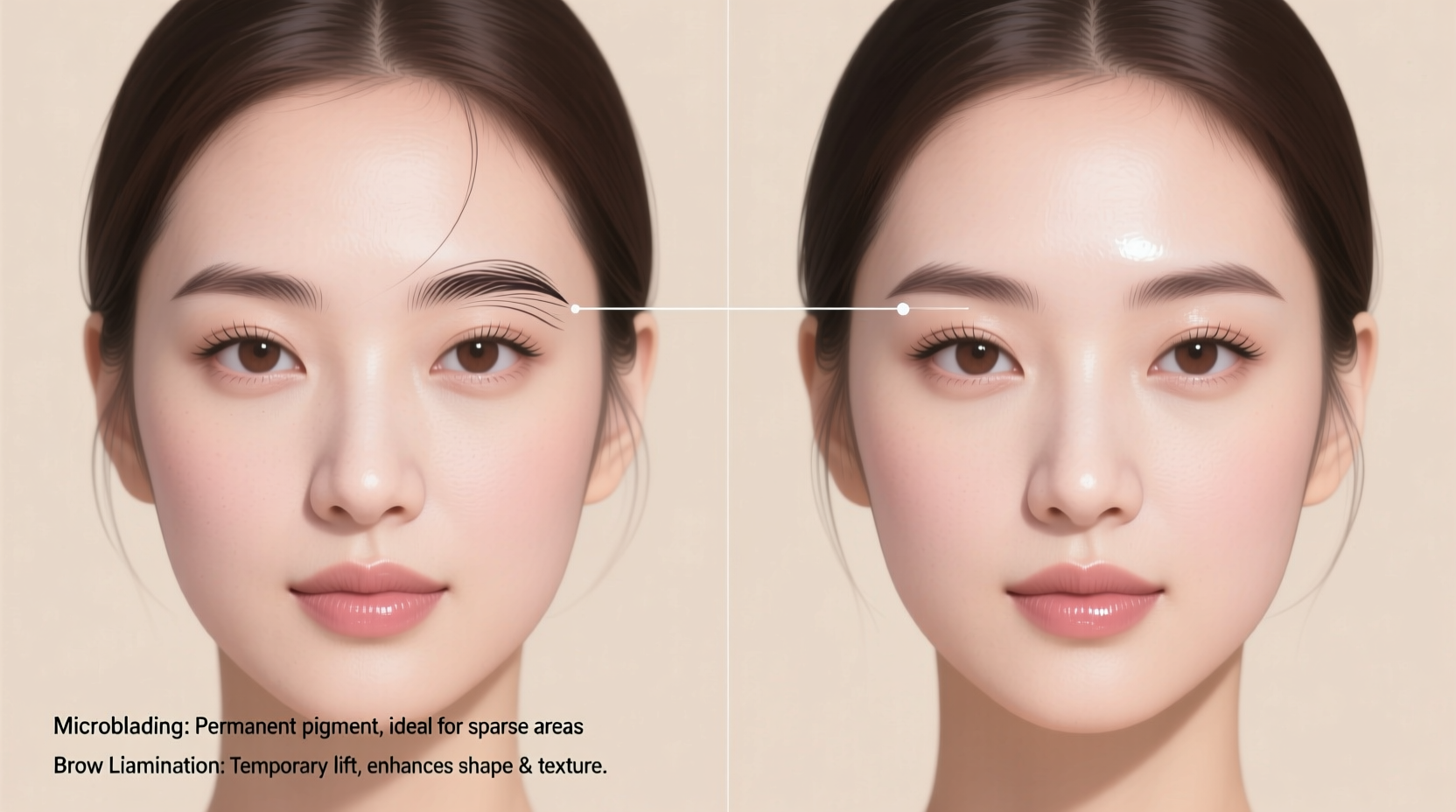
Microblading is a form of cosmetic tattooing where a licensed technician uses a handheld tool with fine needles to deposit pigment into the upper layers of the skin. The strokes are drawn one by one to replicate the appearance of real eyebrow hairs, creating a hyper-realistic, feathered effect.
This technique excels in filling gaps where no hair exists. It's particularly effective for clients with very thin or absent brows because it builds structure from scratch. A skilled artist can design a completely new brow shape based on facial symmetry, bone structure, and personal preference.
The procedure typically takes 1.5 to 2 hours, including numbing cream application. Healing lasts 7–10 days, during which the area may scab slightly and appear darker before fading to a softer tone. Touch-ups are usually required after 6–8 weeks to refine the shape and ensure even pigment retention.
Results last 12–18 months on average, though longevity varies depending on skin type, sun exposure, skincare routine, and aftercare. Oily skin tends to break down pigment faster, leading to blurred lines or patchiness over time.
“Microblading gives us the ability to reconstruct brows almost like drawing with real ink—but only if the canvas (the skin) is suitable.” — Lila Chen, Certified Permanent Makeup Artist with 12 years of experience
Pros and Cons of Microblading for Thin Brows
| Advantages | Drawbacks |
|---|---|
| Creates realistic hair-like strokes where none exist | Not ideal for oily or acne-prone skin |
| Fills large gaps and rebuilds entire brow shapes | Pigment can blur or fade unevenly over time |
| Long-lasting results (up to 1.5 years) | Requires touch-ups and proper aftercare |
| Immediate fullness without daily makeup | More invasive; involves breaking the skin |
Brow Lamination: Reshaping What You Already Have
Brow lamination is a non-invasive chemical treatment that temporarily straightens, lifts, and sets brow hairs in place using a perming solution. Think of it as a “keratin treatment” for your eyebrows. Hairs are brushed upward into a fluffy, laminated look that creates the illusion of thickness and volume.
The process involves three main steps: neutralizing, lifting, and setting. First, a softening cream relaxes the hair cuticle. Then, brows are shaped into the desired direction using a gel or wax. Finally, a fixing lotion locks them in place. Tinting is often added to darken fine, light-colored hairs for greater visibility.
Treatment time averages 45–60 minutes. There’s no downtime, and results last 6–8 weeks. Unlike microblading, lamination doesn’t add new pigment or create artificial strokes—it enhances what’s already present.
This makes it ideal for people with thin but existing hair who want a groomed, bold look without tattoos. However, if you have almost no hair, lamination won’t magically produce volume. At best, it can lift and tint faint hairs; at worst, it leaves empty spaces untouched.
Tip: Combine brow lamination with a nourishing serum containing peptides or castor oil to gradually improve hair health and density between sessions.Who Benefits Most from Brow Lamination?
- People with fine, wispy brows that disappear into the skin
- Those whose brows grow downward or scatter unpredictably
- Individuals seeking a low-maintenance, makeup-free routine
- Clients with oily skin (unlike microblading, oil doesn’t affect lamination)
Lamination works especially well for younger clients who want trendy, fluffy brows without committing to permanent changes. It’s also safer for sensitive skin types since it doesn’t penetrate the dermis.
Key Differences: Microblading vs Brow Lamination
To make an informed decision, compare both treatments across critical categories:
| Feature | Microblading | Brow Lamination |
|---|---|---|
| Invasiveness | Semi-permanent; breaks skin surface | Non-invasive; topical only |
| Best For | No or very little natural hair | Thin but present hair needing styling |
| Duration | 12–18 months | 6–8 weeks |
| Results | Realistic hair strokes, defined shape | Voluminous, brushed-up appearance |
| Skin Suitability | Dry to normal skin; not recommended for oily/acneic | All skin types, including oily |
| Maintenance | Annual touch-ups needed | Repeat every 6–8 weeks |
| Cost (Average) | $400–$800 initial, $150–$300 touch-up | $100–$200 per session |
The table highlights a crucial distinction: microblading adds what’s missing, while lamination organizes what’s already there. If you have fewer than five visible hairs per brow, lamination may disappoint. Conversely, if you have decent hair growth but poor shape, microblading might be overkill.
Realistic Expectations: A Mini Case Study
Sophie, 29, had severely over-plucked her brows in her teens. By her late twenties, she had a faint tail and almost no head or arch. She wanted a natural yet defined look without relying on pencils every morning.
She consulted two specialists—one recommended microblading, citing her lack of base hair; the other suggested lamination with tinting. Sophie tried lamination first. While the lifted shape looked clean, the front third of her brows remained invisible. The result was unbalanced and didn’t meet her expectations.
She then opted for microblading. Over two sessions, her artist rebuilt the entire brow using taupe-toned pigment and fine strokes. After healing, Sophie achieved a soft, powdered-pencil look that lasted over a year. She reported feeling confident without makeup for the first time in years.
Her case illustrates a key principle: treatment success depends on matching the method to the anatomy. Lamination enhanced what existed—but couldn’t compensate for absence. Microblading filled the void.
Step-by-Step: How to Decide Which Treatment Fits You
Follow this logical sequence to determine the best option for thin brows:
- Assess Your Natural Hair: Brush brows up with a spoolie. Can you see individual strands across the entire arch? If yes, lamination could work. If large sections are bare, consider microblading.
- Evaluate Skin Type: Do you have active acne, rosacea, or excessive oiliness on your forehead? These conditions increase risks with microblading. Lamination is safer.
- Define Your Desired Look: Want soft, natural-looking hairs? Microblading. Prefer bold, fluffy, Instagram-style brows? Lamination.
- Consider Maintenance Tolerance: Are you willing to schedule annual touch-ups and avoid sun exposure? Choose microblading. Prefer flexible, reversible treatments? Go for lamination. <5> Consult a Professional: Book a patch test or consultation with a licensed specialist. Bring reference photos and ask to see before-and-after cases of clients with similar brow types.
“Clients often fall in love with a trend without realizing it may not suit their biology. My job is to match the treatment to the face—not the Instagram feed.” — Jordan Lee, Licensed Esthetician and Brow Specialist
Frequently Asked Questions
Can I combine microblading and brow lamination?
Yes—but not simultaneously. Wait at least 3 months after microblading has fully healed before attempting lamination. Applying chemicals too soon can disrupt pigment. Once healed, lamination can be used on surrounding natural hairs to enhance fullness around the tattooed area.
Does brow lamination work on blonde or gray hairs?
It works physically (reshaping), but light hairs may remain hard to see. That’s why tinting is usually included. A dark tint dramatically improves visibility, making fine blonde hairs appear thicker and more defined.
Is microblading painful for sensitive skin?
Most people describe it as a scratching or scraping sensation. Topical numbing cream minimizes discomfort significantly. However, if you have extremely sensitive skin or a history of keloids, discuss alternatives with your provider.
Final Recommendation: Matching Treatment to Brow Reality
If your primary concern is thinning hair with visible gaps, **microblading** is likely the better investment. It creates structure where none exists and delivers long-term confidence. However, it demands commitment to aftercare and periodic refreshes.
If you have scattered but usable hair that just won’t stay in place, **brow lamination** offers a quick, painless upgrade. It’s perfect for maintaining a polished look with minimal effort, especially if you dislike makeup or have oily skin.
Neither treatment is universally superior. The best choice honors your unique brow biology. When in doubt, start with a less invasive option like lamination. If results fall short, you can always explore microblading later—once you understand exactly what you’re trying to achieve.
💬 Have questions about your brow journey? Share your experience or ask for advice in the comments—your story might help someone else find their perfect solution.








