
For cat owners, providing a clean and accessible litter box is only half the battle. The other half—often overlooked—is where that litter box is placed. A poorly located litter box can lead to inappropriate elimination, stress, and strained relationships between cats and their humans. Just like humans, cats have preferences when it comes to privacy, safety, and convenience. Understanding these needs transforms litter box management from a chore into a thoughtful part of feline care.
The right placement supports natural behaviors, reduces anxiety, and encourages consistent use. It’s not just about hiding the box in a closet or tucking it behind the washing machine. Strategic positioning considers traffic patterns, noise levels, accessibility, and even household dynamics. When done correctly, proper litter box placement fosters a healthier, happier environment for both cats and their caregivers.
Understanding Feline Behavior and Elimination Habits
Cats are instinctively fastidious animals. In the wild, they bury their waste to avoid attracting predators and signaling territory. This behavior persists in domesticated cats, who rely on scent control and environmental predictability to feel secure. Disruptions to this routine—especially related to their bathroom space—can trigger avoidance or marking behaviors.
A key factor in litter box success is recognizing that cats do not view elimination as a trivial act. It's a vulnerable moment. They need a space where they feel safe from surprise encounters with people, other pets, or loud noises. A cat startled during use may associate the box itself with fear, leading to future avoidance—even if the disturbance was a one-time event.
Additionally, cats are creatures of habit. Once they establish a preferred elimination spot, changing it without careful transition can cause confusion and resistance. That’s why initial placement is so critical: it sets the behavioral foundation for years to come.
Tip: Observe your cat’s movement patterns in the home to identify naturally quiet zones they already frequent.Key Factors in Choosing the Right Location
Selecting the ideal spot requires balancing several environmental and behavioral considerations. The following elements should guide your decision-making process:
- Privacy: Cats prefer secluded areas where they won’t be watched or interrupted.
- Accessibility: The box must be easy to reach, especially for kittens, seniors, or mobility-impaired cats.
- Low Traffic: High-activity zones (hallways, kitchens, entryways) increase stress and deter use.
- Quietness: Avoid locations near appliances that make sudden noises (e.g., washers, dryers, furnaces).
- Odor Control: While ventilation helps, strong cleaning smells or air fresheners nearby can repel cats.
- Separation from Food and Water: Cats instinctively avoid eliminating near eating areas due to hygiene instincts.
One common mistake is placing the litter box in a basement laundry room simply because it’s “out of sight.” But if the dryer starts unexpectedly or the space feels confined, the cat may begin seeking alternatives elsewhere in the house.
“Cats are highly sensitive to their surroundings. A litter box in a noisy or unpredictable area can become emotionally charged, leading to avoidance.” — Dr. Sarah Thompson, DVM, Feline Behavioral Consultant
Do’s and Don’ts of Litter Box Placement
| Do’s | Don’ts |
|---|---|
| Place boxes in quiet, low-traffic rooms like spare bedrooms or bathrooms (if frequently used by humans) | Put the box directly next to food and water bowls |
| Ensure multiple access points in multi-cat homes—one box per cat plus one extra | Hide the box so well that the cat struggles to find it |
| Use corner placements with partial enclosures for added privacy | Locate near loud appliances or HVAC vents that cycle on suddenly |
| Elevate boxes slightly for arthritic cats (with ramps if needed) | Place in dark, enclosed closets without natural light or airflow |
| Provide options across different floors in multi-level homes | Move the box frequently; consistency builds confidence |
Step-by-Step Guide to Optimal Litter Box Setup
Finding the perfect location isn’t guesswork—it’s a structured process rooted in observation and adjustment. Follow these steps to ensure long-term success:
- Assess Your Home Layout: Walk through each room and note noise levels, foot traffic, and lighting. Identify spaces that are consistently calm and easily reachable.
- Match Location to Cat Personality: Shy cats benefit from more secluded spots, while confident ones may tolerate semi-open areas. Watch where your cat naps or retreats when stressed.
- Choose Initial Placement: Start with a neutral, ground-floor room like a guest bathroom, hallway nook, or quiet bedroom corner. Avoid basements or attics unless climate-controlled and frequently visited by the cat.
- Introduce Gradually: Place the clean box in the chosen spot with familiar litter. Allow your cat to investigate at their own pace. Do not force interaction.
- Monitor Usage Patterns: For one week, observe frequency, posture during use, and any hesitation. Note if they sniff but walk away, which may indicate discomfort with location or litter type.
- Adjust Based on Feedback: If avoidance occurs, consider relocating incrementally—no more than a few feet per day—toward a better zone. Sudden moves disrupt routine.
- Maintain Consistency: Once established, keep the box in place unless major changes (renovations, new pets) require reassessment.
Real-World Example: Resolving Inappropriate Elimination
Sarah adopted two cats—Milo, an outgoing tabby, and Luna, a reserved black cat. Initially, both used the single litter box placed in the laundry room. After three weeks, Sarah noticed urine spots near the bedroom doorway. She assumed it was a territorial issue and considered separating them.
Instead, she consulted a veterinary behaviorist, who asked about litter box placement. The laundry room had a front-loading washer that made a loud thumping noise mid-cycle. Luna, being more sensitive, began avoiding the room entirely after being startled once. Milo continued using the box, but Luna started eliminating outside it.
Solution: Sarah added a second box on the main floor in a quiet hallway closet with the door propped open. She removed scented cleaners from the laundry area and installed a quieter air purifier. Within five days, Luna began using the new box consistently. No further accidents occurred.
This case illustrates how subtle environmental factors—not personality clashes—can drive litter box problems. Addressing placement resolved the issue without medication or conflict resolution.
Checklist for Ideal Litter Box Placement
Before finalizing your litter box location, run through this checklist to ensure all bases are covered:
- ✅ Is the area quiet and free from sudden noises?
- ✅ Is the box separated from food and water stations?
- ✅ Is there adequate lighting? Complete darkness deters use.
- ✅ Is the surface stable and non-slip (e.g., not on a wobbly mat over tile)?
- ✅ Is the location accessible to older or disabled cats?
- ✅ Are there multiple boxes in larger homes or multi-cat households?
- ✅ Have you avoided strong-smelling cleaners or air fresheners nearby?
- ✅ Is the box cleaned daily and fully changed weekly?
- ✅ Have you observed your cat using the box without hesitation?
Common Myths About Litter Box Placement
Misinformation often leads well-meaning owners astray. Let’s clarify some persistent myths:
- Myth: Cats don’t mind if the box is in the basement.
Reality: Basements are often cold, damp, isolated, and noisy—making them undesirable unless specially adapted. - Myth: One box is enough for multiple cats.
Reality: Competition and territorial stress increase with shared resources. Always follow the “n+1” rule. - Myth: Covered boxes provide better privacy.
Reality: While helpful for containing odor and litter scatter, some cats feel trapped in enclosed models. Offer both types to see preference. - Myth: You can train a cat to use the toilet.
Reality: While possible, it removes control from the cat and eliminates natural digging/covering instincts. Most experts discourage it.
Frequently Asked Questions
Can I place a litter box in the bathroom?
Yes, but with caveats. If the bathroom is used frequently by humans, the closing door or running shower may scare the cat. Keep the door open and avoid flushing when the cat is inside. Also, ensure good ventilation to manage odors without overwhelming scents.
How far apart should multiple litter boxes be?
Boxes should be in separate zones, ideally on different floors or distant rooms. Placing two boxes side by side doesn’t solve competition issues—they need distinct territories. Spacing prevents dominant cats from guarding access.
What if my apartment is too small for ideal placement?
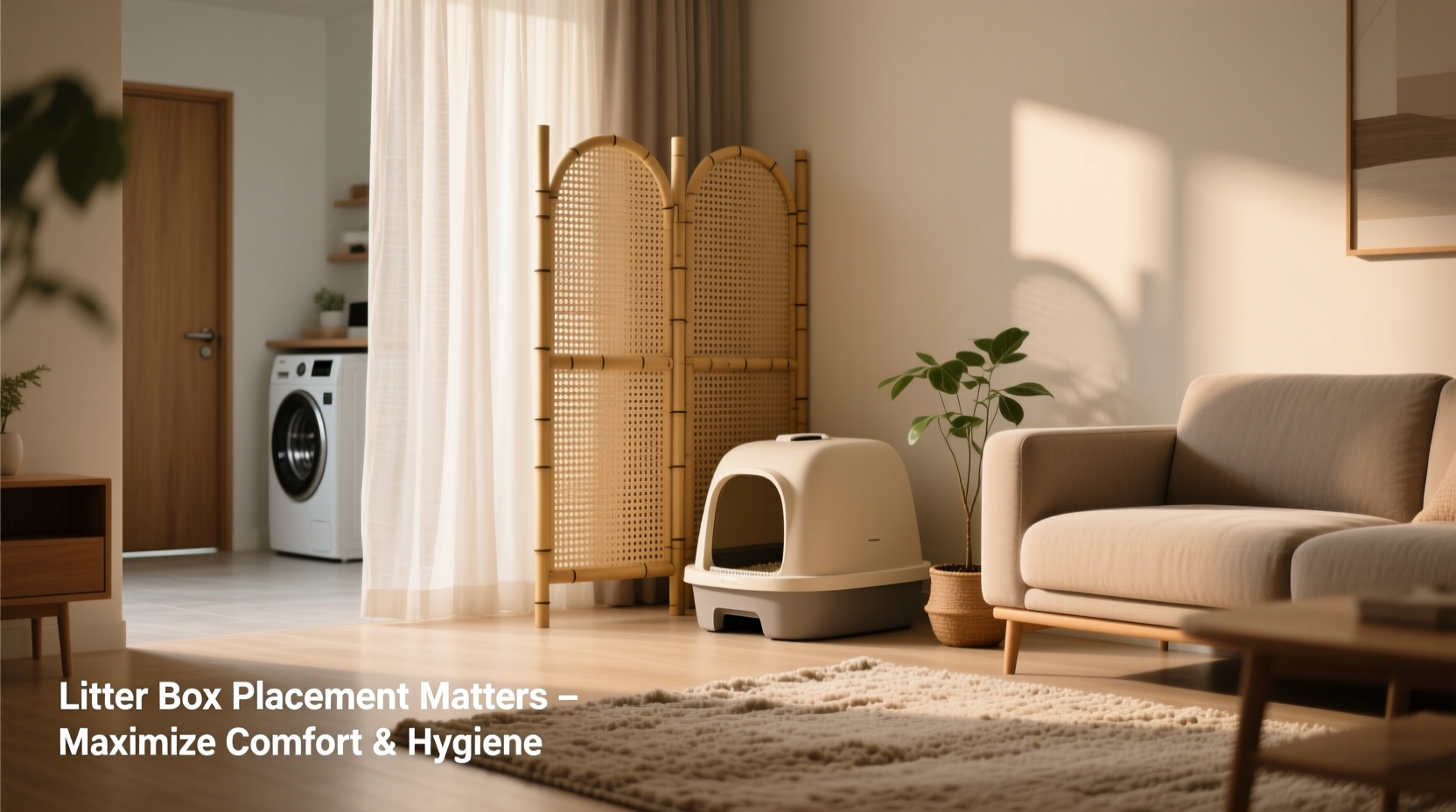
In compact spaces, prioritize separation from feeding areas and minimize noise. Use low-profile, open-top boxes in corners near quiet furniture. Consider decorative screens for visual privacy without full enclosure. Regular scooping becomes even more crucial in tight quarters.
Conclusion: Prioritize Comfort to Prevent Problems
Litter box placement isn’t a minor detail—it’s a cornerstone of feline well-being. A thoughtfully positioned box respects your cat’s instincts, reduces stress, and prevents behavioral issues before they start. By observing your cat’s habits, respecting their need for safety, and applying practical spatial planning, you create an environment where your pet feels secure and supported.
Start today by evaluating your current setup. Ask yourself: Is this location truly cat-centered, or designed for human convenience? Small adjustments can yield dramatic improvements in hygiene, harmony, and happiness. Remember, a comfortable cat is a healthy cat—and it begins with where they do their business.
💬 Have you found the perfect spot for your cat’s litter box? Share your experience or challenges in the comments—your insight could help another cat owner avoid common pitfalls.








