Dinner dates are more than just about food—they're moments of connection, conversation, and subtle confidence. One small detail can make or break the experience: your lipstick. You’ve spent time choosing the perfect shade, applying it with precision, only to find it smeared on your wine glass or fading unevenly by dessert. The culprit? Choosing the wrong formula for the occasion.
Liquid lipstick and lip tints dominate modern beauty shelves, each promising long wear, vibrant color, and effortless application. But when the stakes are high—like a first impression over candlelight—only one can truly endure the test of time, temperature, and tomato sauce. So, which wins in the battle of staying power: liquid lipstick or lip tint?
The Core Differences: Formula, Finish, and Function
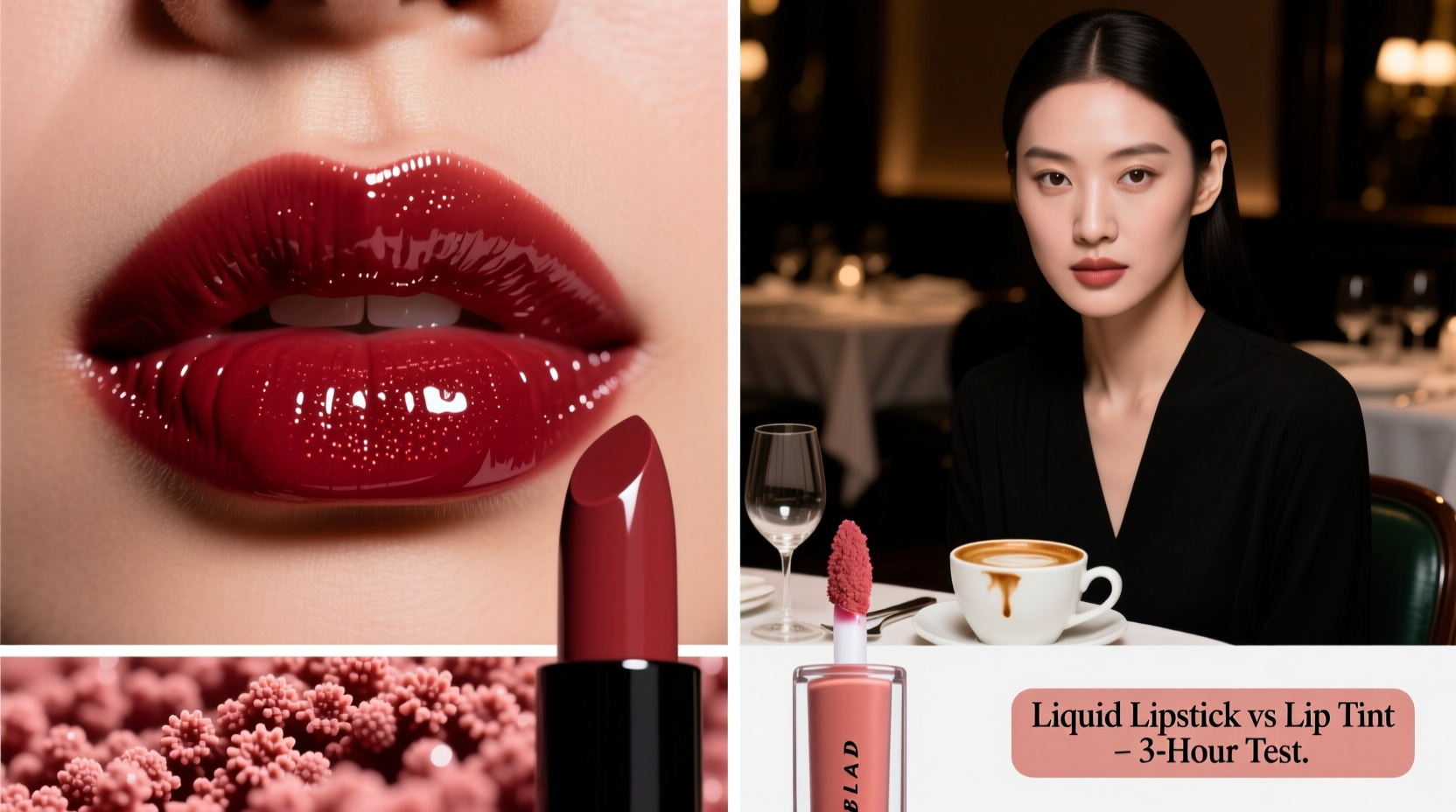
To understand performance, you must first understand composition. Liquid lipsticks and lip tints operate on entirely different principles, despite both being applied in liquid form.
Liquid lipstick typically uses a polymer-rich base that dries down to a matte, transfer-resistant film. Once set, it forms a thin layer bonded to the surface of the lips. This makes it highly resistant to friction and moisture, ideal for situations involving eating, drinking, or talking extensively.
Lip tints, on the other hand, are water-based or serum-like formulas designed to penetrate slightly into the top layer of skin, creating a “stained” effect. They often feel weightless and deliver a natural flush of color. However, because they don’t form a protective film, they’re more prone to gradual fading—especially when exposed to oils, heat, or physical contact.
Tip: If longevity is your priority, avoid lip tints labeled “hydrating” or “glossy”—these contain emollients that reduce staying power.Real-World Performance: A Dinner Date Breakdown
Let’s simulate a typical dinner scenario: appetizers (garlic bread), main course (spaghetti carbonara), a glass of red wine, and dessert (chocolate mousse). Throughout this meal, your lips will encounter oil, acidity, heat, and repeated wiping with napkins.
In this environment, liquid lipstick generally outperforms lip tint due to its structural integrity. Most high-quality liquid lipsticks dry down within 30–60 seconds and resist smudging even after direct contact with greasy foods. While the inner lip area may fade slightly from friction, the outer edge usually remains intact.
Lip tints behave differently. Their color fades evenly rather than smudging dramatically, which some prefer for a low-maintenance look. However, oily foods like pasta with cream sauce can strip away much of the pigment. By the end of the meal, what began as a rosy hue may have vanished entirely—leaving behind only a faint shadow on the inner lip.
“Long-wear isn’t just about pigment concentration—it’s about adhesion. Liquid lipsticks use film-forming polymers that cling to keratin, while tints rely on diffusion, which breaks down faster under stress.” — Dr. Lena Park, Cosmetic Chemist & Formulation Consultant
Comparative Analysis: Key Factors at a Glance
| Factor | Liquid Lipstick | Lip Tint |
|---|---|---|
| Smudge Resistance | High – dries to a transfer-proof finish | Low to Moderate – easily transfers and fades |
| Fade Pattern | Even fade; edges hold well | Gradual washout; disappears completely |
| Comfort During Eating | Moderate – can feel tight or crack over time | High – lightweight and flexible |
| Oily Food Resistance | Strong – resists breakdown from fats | Poor – oil lifts pigment quickly |
| Touch-Up Needs | Rarely needed mid-meal | Often required after first course |
| Natural Look | Less natural – bold, opaque finish | Very natural – mimics flushed lips |
When Lip Tint Might Be the Smarter Choice
Despite its inferior staying power, lip tint has strategic advantages in certain dinner contexts. For casual outdoor picnics, daytime brunches, or relaxed gatherings where reapplication is easy, a tint offers comfort and authenticity. It also suits those who prioritize hydration and dislike the drying effect of matte liquids.
Moreover, newer hybrid formulas—such as stain-serums and blotted-effect tints—have improved longevity. These products combine the staining ability of traditional tints with slight film formation, offering moderate resistance to light eating. Still, they fall short against full meals rich in oils and acids.
If you choose a lip tint for dinner, opt for alcohol-based versions labeled “long-lasting” or “kiss-proof.” These dry down slightly and adhere better than water-gel types. Avoid creamy or balm-infused tints—they’re beautiful but impractical for heavy dining.
How to Maximize Longevity: A Step-by-Step Guide
No product performs optimally without proper prep. Follow this routine to ensure maximum wear regardless of formula choice:
- Exfoliate gently: Use a soft toothbrush or sugar scrub to remove dead skin. Patchy texture causes uneven application and premature flaking.
- Prime the lips: Apply a minimal amount of primer or translucent powder to absorb natural oils. Excess moisture prevents adhesion.
- Line precisely: Use a matching lip liner to define edges. This creates a barrier that prevents feathering and extends edge retention.
- Apply in thin layers: For liquid lipstick, apply one thin coat, let it dry completely, then add a second only if needed. Thick layers crack and peel.
- Blot strategically: After application, press lips onto a tissue. This removes excess product without disturbing the bonded layer.
- Set with powder (optional): For extra security, lightly dust translucent powder over a tissue placed on lips—ideal for humid environments or nervous eaters.
Mini Case Study: The First Date Test
Sophia, a marketing executive in Chicago, had a first date scheduled at an Italian bistro known for its truffle pasta and house-made focaccia. She wanted to look polished but not overdone. Her initial instinct was to wear her favorite rosewater lip tint for a “your-lips-but-better” effect.
She tested both options at home: one evening with a popular matte liquid lipstick, another with a cult-favorite hydrating tint. During the trial run with the tint, she noticed significant fading after just one bite of olive oil-drenched bread. The color had migrated into fine lines and left residue on her glass.
With the liquid lipstick, she experienced minor tightness but no transfer—even after finishing a creamy mushroom risotto. Only the center of her bottom lip showed slight cracking, which she fixed with a dab of clear balm post-meal.
On the actual date, she chose the liquid lipstick. “I didn’t think about my lips once,” she said. “And when he complimented my ‘great color,’ I knew I’d made the right call.”
Expert-Backed Checklist: Surviving Dinner with Flawless Lips
- ✅ Choose a liquid lipstick with “transfer-proof” or “long-wear” claims
- ✅ Avoid glossy or moisturizing tints if eating oily or acidic foods
- ✅ Prep lips with gentle exfoliation and blotting
- ✅ Use a lip liner that matches your natural lip tone or lipstick shade
- ✅ Carry a travel-sized version for touch-ups (even if unlikely needed)
- ✅ Skip lip balm immediately before application—oil repels pigment
- ✅ Test the product during a solo meal before wearing it socially
Frequently Asked Questions
Can I make a lip tint last longer for dinner?
Yes, but with limitations. Apply it to clean, dry lips, then blot and set with a dusting of translucent powder. Reapply every hour if consuming oily foods. For best results, layer it under a clear, non-greasy lip sealant spray designed for makeup setting.
Do all liquid lipsticks smudge equally?
No. Performance varies widely by brand and formulation. Silicone-based liquids tend to be more flexible and resistant to cracking. Water-based polymers offer intense color but may feel drier. Look for ingredients like acrylates copolymer or film-forming resins—these enhance durability.
Is there a middle-ground option between liquid lipstick and tint?
Absolutely. Consider a liquid lip stain or matte serum lipstick. These hybrids deliver the deep pigmentation of liquid lipstick with the lightweight feel of a tint. Brands like Maybelline SuperStay Ink Crayon, Fenty Beauty Stunna Lip Paint, and Rare Beauty Soft Pinch Tinted Lip Oil (with primer) offer balanced solutions.
Final Verdict: The Winner for Dinner-Date Durability
When evaluating pure staying power and resistance to smudging, **liquid lipstick is the definitive winner**. Its engineered film-forming technology allows it to withstand prolonged exposure to food, drink, and conversation—three constants of any dinner date.
Lip tints excel in breathability and aesthetic subtlety, making them excellent for daytime wear or events where touch-ups are feasible. But in a high-stakes social dining situation, their fragility becomes a liability. Unless you're dining on salads and herbal tea, a tint alone won't carry you through the night.
That said, the ideal approach isn’t always binary. Many beauty enthusiasts now use a technique called “tint layering”: applying a lip tint first for depth and natural fade, then sealing the edges with a precise stroke of liquid lipstick. This combines comfort with structure—offering the best of both worlds.
💬 What’s your go-to lip product for date night? Share your favorite long-wear formula or pro tip in the comments below—we’d love to hear what works for you!








