
Choosing between flagship smartphones isn’t just about specs on paper—it’s about how the device fits into your daily life. The LG G7 ThinQ and Samsung Galaxy S9 were both released in 2018, targeting premium users who valued high-end performance, photography, and design. But if you're currently using one and considering a switch to the other—or wondering whether to upgrade at all—the decision hinges on real-world usability, longevity, and personal priorities.
This comparison cuts through marketing hype to focus on tangible differences that matter: display quality, audio, camera behavior in varied lighting, software support, and long-term ownership value. Whether you’re clinging to an older device or weighing trade-in options, understanding these nuances can save you money and frustration.
Display and Design: Brightness vs. Immersion
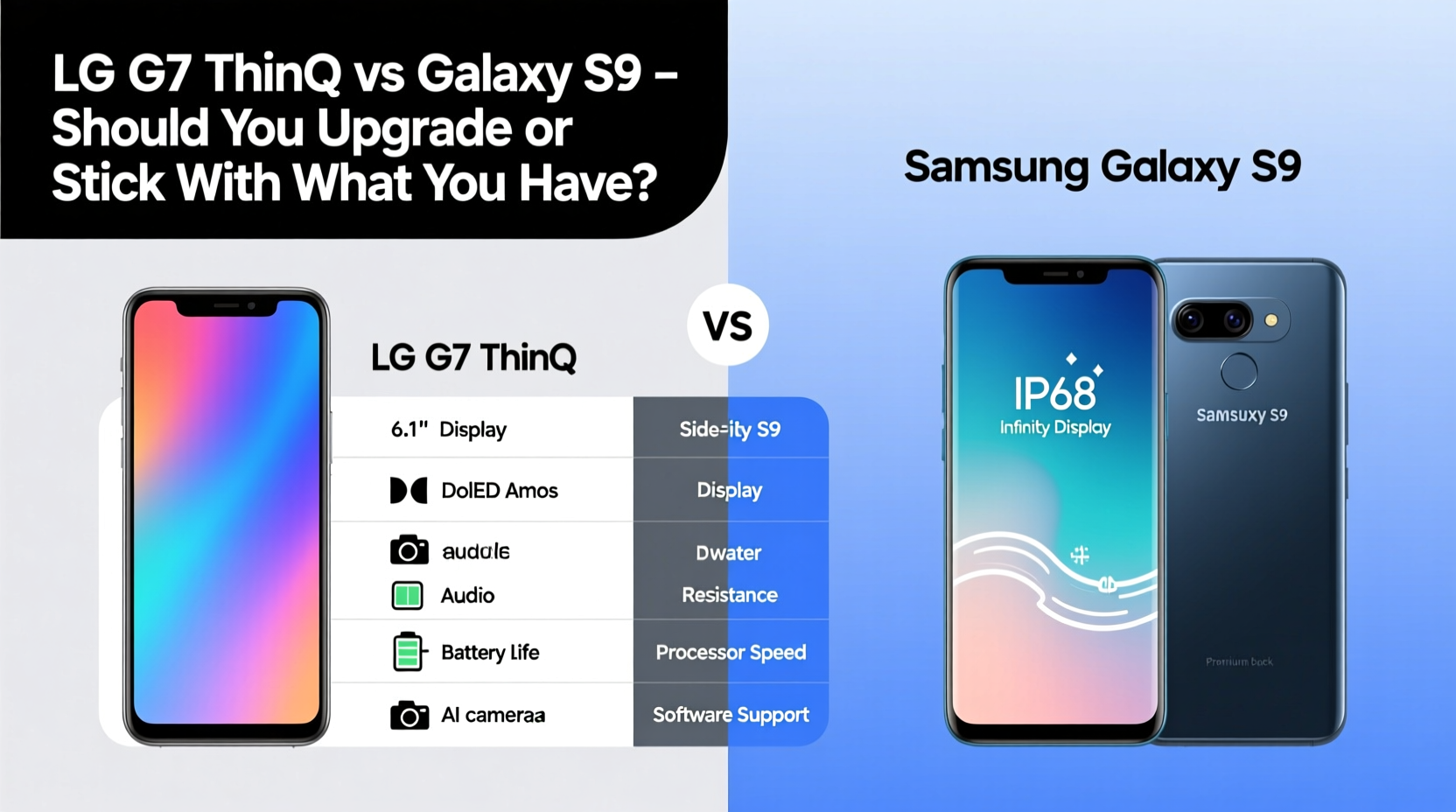
The LG G7 ThinQ features a 6.1-inch IPS LCD panel with a resolution of 3120x1440, marketed as an \"LCD that rivals OLED.\" It delivers excellent brightness—peaking over 1000 nits—making it one of the most readable screens under direct sunlight. Its True HD IPS panel offers accurate color reproduction and wide viewing angles, appealing to media consumers and outdoor users.
In contrast, the Samsung Galaxy S9 uses a 5.8-inch Quad HD+ Super AMOLED display. While smaller, its OLED technology provides deeper blacks, infinite contrast, and a more immersive bezel-less design with curved edges. Samsung’s screen is also brighter than most contemporaries, though not quite matching the G7’s peak luminance in daylight conditions.
Tip: If you spend significant time outdoors, the G7’s higher brightness gives a noticeable edge for readability without cranking up the volume.Design-wise, the S9 feels more compact and refined, with a glass body and metal frame that exudes premium craftsmanship. The G7, while solidly built, uses a more utilitarian approach with a glass front and plastic back (on some models), which can feel less luxurious. Both are IP68-rated for water and dust resistance, but the S9’s symmetrical layout and slimmer profile make it more pocket-friendly.
Camera Performance: Consistency vs. Versatility
Both phones feature single rear cameras (the G7 has a second wide-angle lens), but their philosophies differ. The LG G7 ThinQ packs a 16MP main sensor with an f/1.6 aperture and a secondary 16MP ultra-wide shooter. The wide-angle lens is ideal for architecture or group shots, though image quality on the secondary sensor is noticeably softer.
The Galaxy S9, meanwhile, uses a 12MP dual-aperture camera (f/1.5–f/2.4) that automatically adjusts based on lighting. In low light, the f/1.5 setting captures significantly more light than the G7’s fixed f/1.6. This adaptive system gives the S9 an edge in dim environments, producing cleaner, brighter night shots with better dynamic range.
“Samsung’s variable aperture was a game-changer in 2018. It allowed the S9 to adapt like a human eye, balancing exposure in ways fixed lenses couldn’t.” — David Kim, Mobile Imaging Analyst at TechPulse Asia
For video, both support 4K recording, but the S9 includes Super Slow-mo at 960fps, a fun but niche feature. The G7 counters with advanced audio capture via its AI-powered boombox speaker and noise reduction algorithms, useful for vloggers in windy conditions.
| Feature | LG G7 ThinQ | Samsung S9 |
|---|---|---|
| Main Camera | 16MP, f/1.6 | 12MP, f/1.5–f/2.4 (dual aperture) |
| Secondary Camera | 16MP ultra-wide | N/A |
| Low-Light Performance | Good | Excellent |
| Video Features | 4K, HDR10 | 4K, Super Slow-mo, stereo recording |
| Front Camera | 8MP, f/1.9 | 8MP, f/1.7 with autofocus |
Battery and Longevity: Real-World Endurance
The G7 ThinQ houses a 3000mAh battery, while the S9 comes with a slightly smaller 3000mAh unit (despite rumors of 3100). On paper, they’re equal, but actual endurance varies due to display efficiency and software optimization.
IPS LCDs typically consume more power than AMOLEDs when displaying bright content. However, the G7’s larger screen and higher resolution offset any potential gains. In typical mixed usage—browsing, messaging, streaming music, and light gaming—both last around 1.5 days with moderate use. Heavy users will need to charge by late afternoon.
Where the G7 shines is audio: its boombox speaker amplifies sound by turning the entire phone body into a resonance chamber. Volume peaks are louder than the S9’s mono-tuned speaker, making it superior for outdoor videos or shared media. The S9, however, supports Dolby Atmos through headphones and offers richer stereo separation via wired audio.
Tip: Disable Always-On Display and reduce screen timeout to extend battery life on either device—small tweaks yield measurable gains.Software and Future-Proofing
By today’s standards, neither phone receives official OS updates beyond Android 9 or 10, depending on region. Samsung provided three years of major OS upgrades for the S9 (up to Android 10), while LG offered only two (up to Android 9). Security patches ceased entirely by 2021.
This lack of long-term support affects app compatibility and security. Modern apps like banking tools, social platforms, and productivity suites increasingly require newer Android versions. Users still relying on these devices may encounter login issues or degraded performance over time.
If you’re holding onto either phone today, consider installing a lightweight custom ROM (like LineageOS) for extended functionality. However, this requires technical skill and voids warranties—only recommended for experienced users.
Mini Case Study: Sarah’s Upgrade Dilemma
Sarah has used her LG G7 ThinQ since 2018. She loves the loud speaker for morning yoga playlists and the wide-angle camera for travel photos. But in 2023, she noticed apps crashing more frequently, and WhatsApp stopped supporting her Android version. She considered switching to a used S9 for the better low-light camera and sleeker design.
After testing both in-store, she realized the S9’s smaller screen made reading e-books uncomfortable, and the lack of a wide-angle lens limited her landscape shots. Ultimately, she opted for a mid-range 2023 model with four years of guaranteed updates instead—prioritizing longevity over nostalgia.
Checklist: Should You Upgrade?
- ✅ Is your current phone struggling with modern apps or frequent crashes?
- ✅ Do you need better low-light photography or faster performance?
- ✅ Are you missing critical security updates or OS features?
- ✅ Have you maxed out storage and can’t expand further?
- ✅ Does your battery drain within half a day under normal use?
If you answered yes to two or more, upgrading makes sense—even if it’s to a newer mid-tier device rather than another aging flagship.
Frequently Asked Questions
Is the LG G7 ThinQ still usable in 2024?
Yes, but with limitations. Basic functions like calling, texting, and light browsing work fine. However, many modern apps may not install or run smoothly due to outdated Android versions and hardware constraints. Use it as a backup or secondary phone.
Which phone has better sound quality?
The LG G7 ThinQ wins for speaker volume and clarity, especially outdoors. The S9 excels in headphone audio with AKG tuning and Dolby Atmos support. Choose based on your primary listening method.
Can I expect software updates on either device?
No. Both devices reached end-of-life for official updates years ago. Samsung offered slightly longer support, but neither receives security patches anymore. Third-party ROMs are the only path to newer Android versions.
Final Verdict: Upgrade Only If You Need Specific Features
If you're deciding between the G7 ThinQ and S9 today, the S9 generally offers a more polished experience: superior low-light camera, sleeker design, and marginally better software support history. But if you already own the G7 and it meets your needs—especially for media playback and wide-angle photography—there’s little compelling reason to switch.
More importantly, ask yourself: are you upgrading from a functional device just for marginal gains? In 2024, both phones are legacy models. Instead of trading one aging flagship for another, consider stepping into a newer generation—even mid-range—with longer update cycles, better battery efficiency, and improved security.
🚀 Ready to make a smarter move? Evaluate your actual usage, prioritize long-term value over nostalgia, and choose a device that won’t leave you stranded in six months. Share your thoughts—what keeps you loyal to an older phone?








