The visibility of knuckles when making a fist or pressing the hand against a surface is something most people take for granted. However, if your knuckles don’t protrude as expected, it might raise questions about joint structure, soft tissue composition, or even underlying health concerns. While in many cases this is completely normal, there are specific situations where reduced knuckle prominence warrants medical evaluation. Understanding the anatomy, common causes, and warning signs can help you determine whether further assessment is needed.
Anatomy of the Knuckle: What Makes It “Stick Out”?
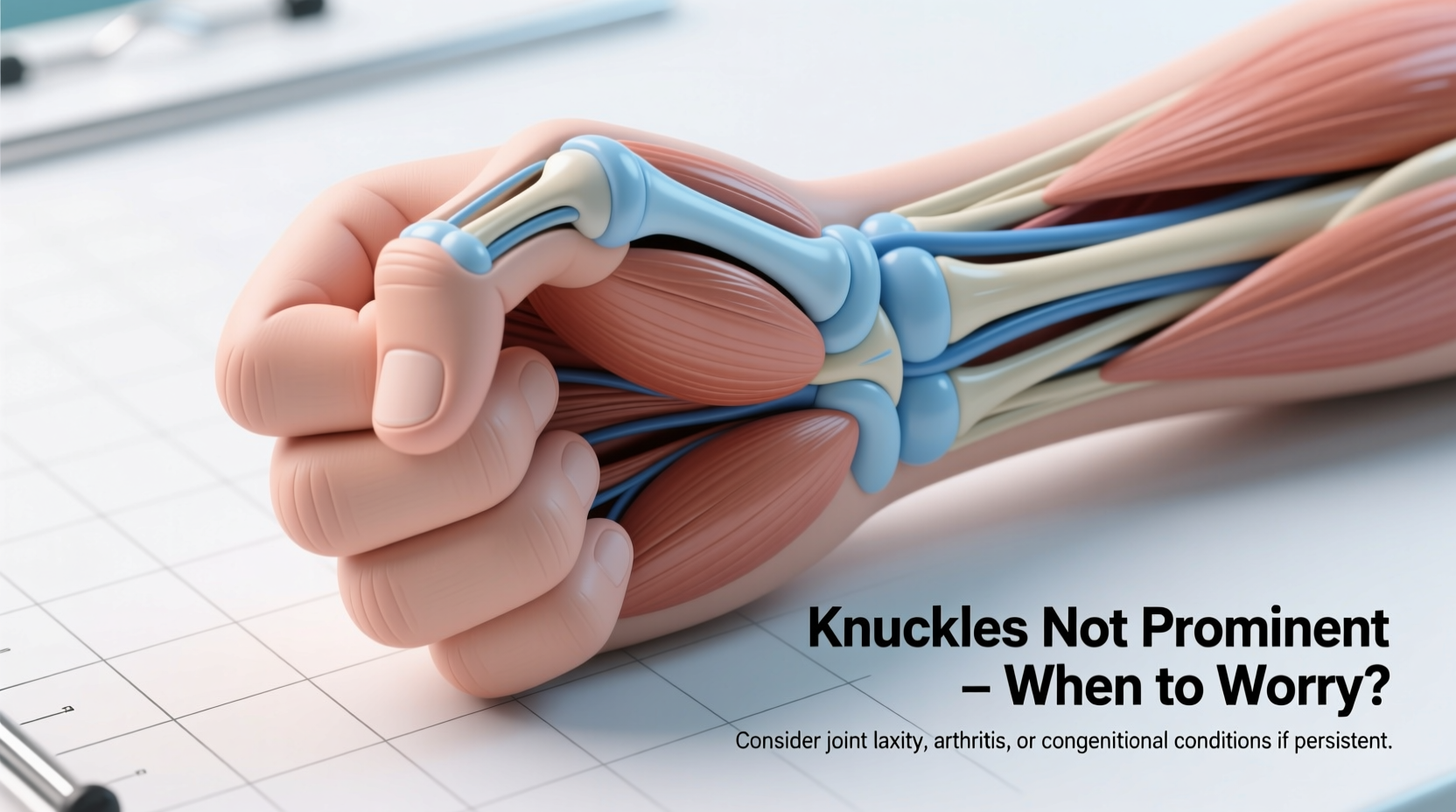
The knuckles—the raised parts on the back of the hand—are formed primarily by the metacarpophalangeal (MCP) joints, where the fingers meet the palm. When you make a fist, these joints extend outward due to the alignment of bones, tendons, and surrounding soft tissues. The degree to which knuckles protrude depends on several anatomical factors:
- Bone length and angle: Variations in metacarpal bone structure influence how sharply the knuckles rise.
- Subcutaneous fat: Higher fat deposits over the back of the hand can cushion the joints, reducing visible definition.
- Skin elasticity and thickness: Thicker or looser skin may obscure bony landmarks.
- Tendon tension: The extensor tendons that run over the knuckles affect how taut the back of the hand appears.
In healthy individuals, knuckle visibility varies widely. Some people naturally have very pronounced knuckles; others have smooth, rounded backs of the hands—even when clenching tightly.
Tip: If knuckle appearance has been consistent throughout life and doesn’t affect function, it’s likely a normal anatomical variation.Common Non-Pathological Causes of Less Visible Knuckles
Many reasons for less prominent knuckles are benign and require no intervention. These include:
- Genetics and body type: Individuals with higher body fat percentages or certain genetic traits often have more padding over joints.
- Age-related changes: As we age, loss of muscle mass and changes in connective tissue can alter hand contour, sometimes making knuckles appear flatter.
- Edema (fluid retention): Temporary swelling from prolonged standing, heat, or minor injury can mask knuckle definition.
- Hand positioning: How you flex your fingers or press your hand down affects knuckle projection. A relaxed grip may hide them, while a tight fist reveals more structure.
These factors alone rarely indicate a problem—especially if both hands are equally affected and there's no pain, stiffness, or functional limitation.
When to Worry: Red Flags That Demand Medical Attention
While subtle differences in knuckle appearance are usually harmless, certain symptoms suggest an underlying condition requiring diagnosis and treatment. Be alert for the following warning signs:
| Symptom | Possible Cause | Action Needed |
|---|---|---|
| New onset flattening of knuckles | Rheumatoid arthritis, Dupuytren’s contracture | See rheumatologist or hand specialist |
| Pain, warmth, or redness around joints | Inflammatory arthritis, infection | Seek prompt evaluation |
| Difficulty making a full fist | Tendon damage, scar tissue, joint fusion | Imaging and physical therapy referral |
| One-sided changes | Trauma, localized tumor, nerve compression | Urgent imaging recommended |
| Numbness or tingling in fingers | Carpal tunnel syndrome, cervical spine issues | Neurological assessment |
A sudden or asymmetric change in knuckle appearance should never be ignored. For example, if one hand suddenly loses knuckle definition while the other remains unchanged, this could point to trauma, inflammation, or even a space-occupying lesion like a ganglion cyst or lipoma compressing the joint.
“Changes in joint contour—especially when accompanied by pain or restricted motion—are often the earliest clues to inflammatory or degenerative disease.” — Dr. Lena Torres, Board-Certified Rheumatologist
Medical Conditions Associated With Flattened Knuckles
Several diagnosable conditions can lead to diminished knuckle prominence:
- Rheumatoid Arthritis (RA): Chronic inflammation damages joint capsules and erodes cartilage, leading to joint subluxation or collapse. In advanced RA, the MCP joints may sink into the hand, creating a \"boutonnière\" or \"swan-neck\" deformity and reducing knuckle visibility.
- Dupuytren’s Contracture: This fibrotic condition causes thickening of the palmar fascia, pulling fingers into a bent position. As the disease progresses, the extensor mechanism becomes unbalanced, altering knuckle alignment.
- Osteoarthritis: Though typically affecting finger joints (DIP/PIP), severe wear can impact MCP joints, especially in laborers or those with prior injuries.
- Joint effusion: Fluid buildup within the joint capsule swells the area, smoothing out contours and masking knuckle edges.
- Peripheral neuropathy or muscle atrophy: Nerve damage (e.g., from diabetes or cervical radiculopathy) can weaken intrinsic hand muscles, leading to a flattened dorsal profile.
Diagnosis usually involves physical examination, X-rays, ultrasound, or MRI. Blood tests may be ordered if autoimmune disease is suspected.
Mini Case Study: Recognizing Early Rheumatoid Arthritis
Sarah, a 42-year-old teacher, noticed her right hand looked “softer” than the left when she placed it flat on her desk. She didn’t recall any injury but admitted to occasional morning stiffness lasting over an hour. Over three months, she found it harder to grip chalk and experienced mild pain at the base of her fingers. Her primary care physician referred her to a rheumatologist after observing reduced knuckle prominence and detecting synovitis on ultrasound. Blood tests confirmed positive anti-CCP antibodies and elevated CRP. Diagnosed with early-stage RA, Sarah began disease-modifying therapy, preventing further joint damage. Her case illustrates how subtle changes in knuckle appearance, combined with functional symptoms, can signal serious pathology before major deformities occur.
Step-by-Step Guide: Assessing Your Knuckle Health
If you're concerned about your knuckles, follow this practical self-assessment and action plan:
- Compare both hands: Place them palm-down on a table. Are the knuckles symmetrically visible? Note any differences in shape, swelling, or color.
- Make a tight fist: Do all fingers close fully? Is there pain or resistance?
- Check for stiffness: How long does it take to get full motion in the morning?
- Press gently on the back of the hand: Is there tenderness, heat, or sponginess over the joints?
- Monitor changes weekly: Take photos to track progression.
- Consult a specialist if: You observe worsening asymmetry, pain, or functional decline.
Frequently Asked Questions
Can weight gain affect how my knuckles look?
Yes. Increased body fat can lead to more subcutaneous tissue on the hands, softening the appearance of knuckles. This is especially noticeable in individuals prone to fluid retention or those with hormonal fluctuations.
Is it normal for older adults to lose knuckle definition?
To some extent, yes. Aging leads to thinning skin, loss of muscle mass, and joint wear, all of which can reduce knuckle prominence. However, sudden or painful changes are not considered normal aging and should be evaluated.
Can exercises improve knuckle visibility?
Not directly. Exercises won’t reshape bone or remove fat from the back of the hand. However, hand strengthening can improve joint stability and delay functional decline in conditions like arthritis.
Checklist: When to Seek Medical Evaluation
- ☑ One hand looks noticeably different from the other
- ☑ Pain, swelling, or warmth around the knuckles
- ☑ Difficulty forming a complete fist
- ☑ Morning stiffness lasting more than 30 minutes
- ☑ Visible lumps, nodules, or skin dimpling on the hand
- ☑ Numbness or weakness in fingers
- ☑ Symptoms progressing over weeks or months
Conclusion: Listen to Your Body, Act Early
The absence of prominent knuckles isn’t inherently dangerous—but when it represents a change from your baseline, it deserves attention. Joints communicate through form and function, and alterations in either can be early signals of systemic or localized disease. By understanding what’s normal and recognizing red flags, you empower yourself to seek timely care. Don’t dismiss persistent changes as mere aging. Early diagnosis of conditions like rheumatoid arthritis or Dupuytren’s contracture can preserve mobility, reduce pain, and prevent irreversible damage.
💬 Have you noticed changes in your hand structure? Share your experience or questions in the comments—your story might help someone recognize a symptom they’ve overlooked.








