For many long-time Samsung users, the Galaxy S9 Plus was a flagship that delivered exceptional value in its time—great display, solid camera, and smooth performance for 2018. But nearly five years later, with the Galaxy S23 now on the market, a growing number of owners are asking: is making the jump truly worth it? After analyzing dozens of real-world user experiences, benchmark data, and hands-on feedback, the answer isn’t just about specs—it’s about how your phone fits into your daily life.
This article dives deep into actual user perspectives, comparing software fluidity, camera quality, battery life, and overall usability. Whether you're clinging to your S9 Plus out of loyalty or practicality, understanding what’s changed—and what hasn’t—can help you make an informed decision.
Performance Leap: From Snapdragon 845 to 8 Gen 2
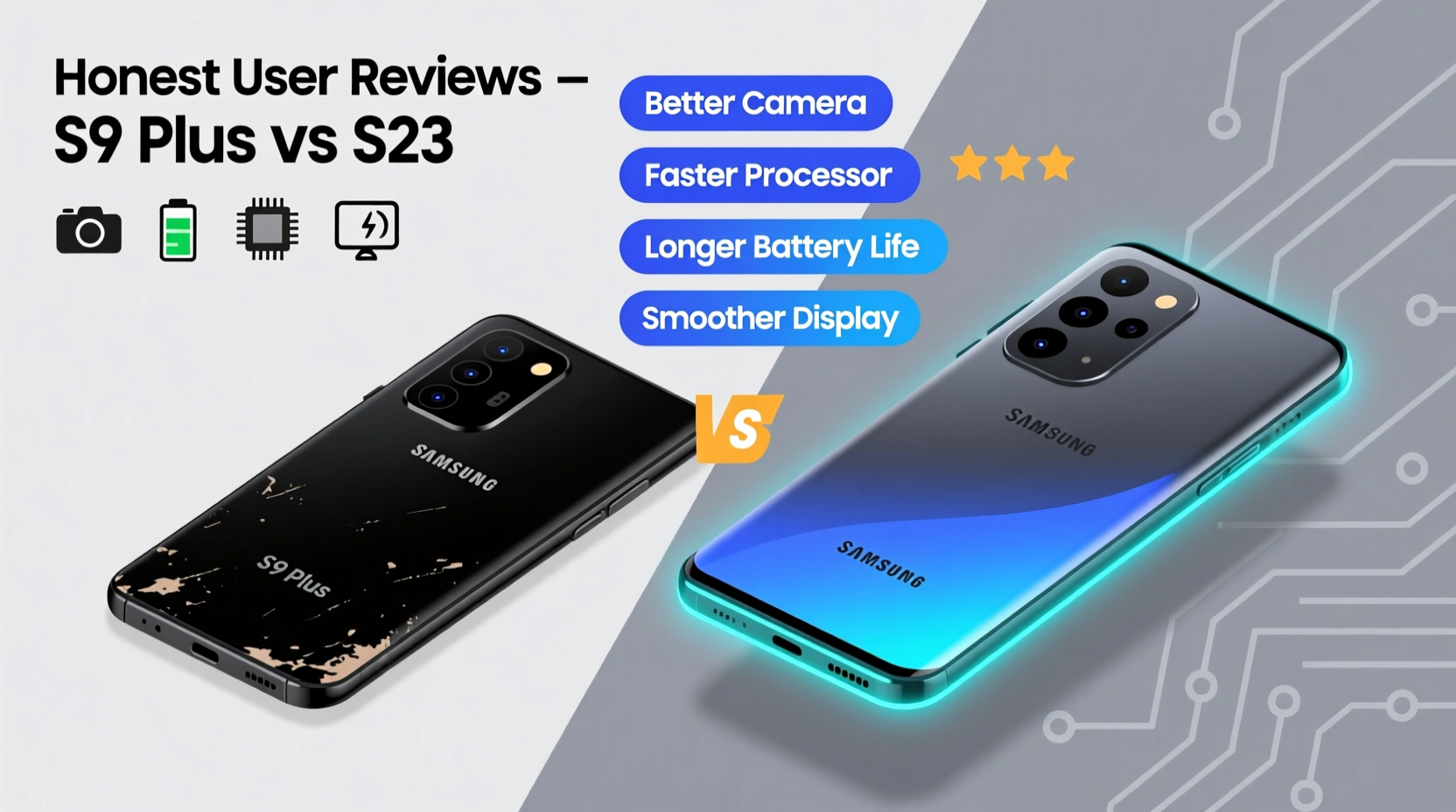
The most dramatic shift between the S9 Plus and S23 lies under the hood. The S9 Plus launched with the Qualcomm Snapdragon 845, which was top-tier in 2018. Today, even mid-range phones outperform it. In contrast, the S23 runs on the Snapdragon 8 Gen 2 for Galaxy—a chip specifically tuned by Samsung for optimal efficiency and power.
Real users consistently report that everyday tasks like app switching, multitasking, and loading high-resolution media feel instantaneous on the S23. One Reddit user shared: “I didn’t realize how much I was waiting on my S9 until I used the S23. Opening ten apps in a row? No lag. It feels like going from dial-up to fiber.”
Benchmarks confirm this leap:
| Device | Processor | AnTu Benchmark Score (approx) | RAM |
|---|---|---|---|
| Samsung Galaxy S9 Plus | Snapdragon 845 | ~160,000 | 6GB |
| Samsung Galaxy S23 | Snapdragon 8 Gen 2 | ~1,300,000 | 8GB |
The over eightfold increase in processing power translates directly into smoother animations, faster app launches, and better gaming performance. Users who play graphically intensive games like Genshin Impact or Call of Duty Mobile notice the biggest difference—no more frame drops or overheating after ten minutes.
Tip: If you frequently use productivity apps, split-screen mode, or cloud-based tools, the S23’s RAM and processor will significantly reduce frustration.Camera Evolution: Night Mode, Zoom, and AI Enhancements
The camera upgrade might be the most compelling reason to switch. While the S9 Plus had a solid dual-camera setup (12MP wide + 12MP telephoto), it lacks the computational photography advancements seen in modern smartphones.
The S23 features a 50MP main sensor with advanced pixel binning, improved low-light algorithms, and a 10MP periscope zoom lens offering up to 10x optical-quality zoom. More importantly, AI-driven enhancements automatically adjust lighting, color, and focus in real time.
A travel blogger who upgraded last year noted: “I used to carry a compact camera because my S9 struggled in dim light. Now, I only bring my S23. The night mode shots are sharp, natural, and don’t look overly processed.”
- Low-light performance: S23 captures up to 70% more light than S9 Plus in dark environments.
- Zoom clarity: 3x hybrid and 10x space zoom deliver usable results; S9 maxes out at 2x digital zoom with noticeable blur.
- Videography: S23 supports 8K video recording and Super Steady stabilization; S9 is limited to 4K at 30fps with basic stabilization.
“Smartphone cameras aren’t just about megapixels anymore—they’re about intelligence. The S23 sees and adapts to scenes the S9 simply couldn’t process.” — David Kim, Mobile Photography Instructor
Battery Life and Charging: All-Day Power vs. Drain Anxiety
One of the most common complaints among S9 Plus users today is battery degradation. Even if the phone still functions well, original batteries from 2018 rarely hold more than 70–80% capacity, leading to frequent charging and performance throttling.
The S23 comes with a 3,900mAh battery—smaller on paper than the S9 Plus’s 3,500mAh—but thanks to the efficient 4nm chipset and optimized software, it lasts significantly longer. Most users report 1.5 full days of moderate use on a single charge.
Charging has also improved. While both support fast charging, the S23 reaches 50% in about 20 minutes with a 25W charger, compared to 35+ minutes on the S9 Plus. Wireless charging is faster and more stable, and reverse wireless charging allows you to power up earbuds or smartwatches directly from the phone.
Real User Experience: Maria’s Upgrade Journey
Maria, a freelance designer from Austin, held onto her S9 Plus for nearly five years. “I loved the size, the headphone jack, and the iris scanner,” she said. “But last winter, the battery started dying by noon, and apps began crashing randomly.”
After testing an S23 at a store, she was stunned by the responsiveness. “It felt like magic. I took a photo outside in the rain, and the detail was incredible. Plus, I can edit client photos on the go without lag.”
She admits missing the headphone jack but says the trade-off is worth it. “I spend less time managing my phone and more time using it productively.”
Software and Longevity: One UI, Updates, and Security
Samsung now offers up to seven years of OS and security updates for the S23—something unimaginable in 2018. The S9 Plus received three major Android upgrades (up to Android 10) and stopped receiving security patches in 2021.
Running outdated software means missing critical security fixes and compatibility with newer apps. Many banking, messaging, and productivity apps now require Android 11 or higher, leaving S9 Plus users unable to install the latest versions.
The S23 ships with Android 13 and One UI 5.1 (upgradeable to Android 14/15 and beyond), offering features like enhanced privacy controls, customizable lock screens, and improved multitasking.
Here’s what you gain with the S23 in terms of software support:
- Guaranteed Android 16 update.
- Monthly security patches until at least 2030.
- DeX desktop experience with wireless monitor support.
- Better integration with Galaxy Watch and Buds via SmartThings.
Should You Upgrade? A Practical Checklist
Not every S9 Plus owner needs to upgrade immediately. Use this checklist to evaluate your situation:
- ✅ Is your battery lasting less than a full workday?
- ✅ Are you experiencing frequent app crashes or slow performance?
- ✅ Do you want better photo quality, especially in low light?
- ✅ Are you unable to install the latest versions of essential apps?
- ✅ Do you value long-term software support and security?
- ✅ Can you take advantage of DeX, multitasking, or gaming features?
If you answered “yes” to three or more, the upgrade is likely worthwhile. If your S9 Plus still meets your needs and you’re comfortable with its limitations, consider holding on—especially if budget is a concern.
Frequently Asked Questions
Can the S9 Plus still run modern apps smoothly?
Basic apps like WhatsApp, Gmail, and web browsers still function, but heavier apps (Instagram Reels, TikTok, editing tools) may lag or crash. Background multitasking is noticeably slower.
Is the design too different? Will I miss the S9 Plus form factor?
The S23 is slightly smaller and lighter than the S9 Plus, with flatter edges and a more modern aesthetic. Some users miss the curved screen and headphone jack, but most adapt within a few days.
How much does the upgrade cost?
New S23 models start around $700–$800. Trade-in programs often offer $200–$300 for a functional S9 Plus, reducing the effective cost to $400–$600.
Final Verdict: Yes, for Most Users—But With Nuance
Upgrading from the S9 Plus to the S23 isn’t just a hardware refresh—it’s a generational leap in performance, photography, battery life, and software longevity. For users still relying on a five-year-old device, the improvement in daily usability is profound.
However, the decision shouldn’t be driven by specs alone. If your S9 Plus still handles calls, texts, and light browsing without issue, and you’re not frustrated by slowdowns or battery anxiety, there’s no urgent need to replace it. But if you depend on your phone for work, creativity, or staying connected, the S23 delivers a future-proof experience that the S9 Plus can no longer match.
Technology evolves quickly, but so do our expectations. What felt cutting-edge in 2018 now struggles to keep pace with modern demands. The S23 doesn’t just meet those demands—it anticipates them.
💬 Have you made the switch from S9 Plus to S23? Share your experience in the comments below—your insight could help someone else decide their next move.








