When shopping for a new smartphone, the decision often comes down to value. The Samsung Galaxy S22 and Galaxy A22 sit at opposite ends of Samsung’s 2022 lineup—one a flagship device, the other an entry-level model. With nearly double the price difference, many buyers wonder: is the performance, camera quality, and overall experience of the S22 truly worth the premium? Drawing from real-world usage, technical analysis, and aggregated user feedback, this article breaks down what actual owners say about both phones.
Performance & Hardware: Night and Day Difference
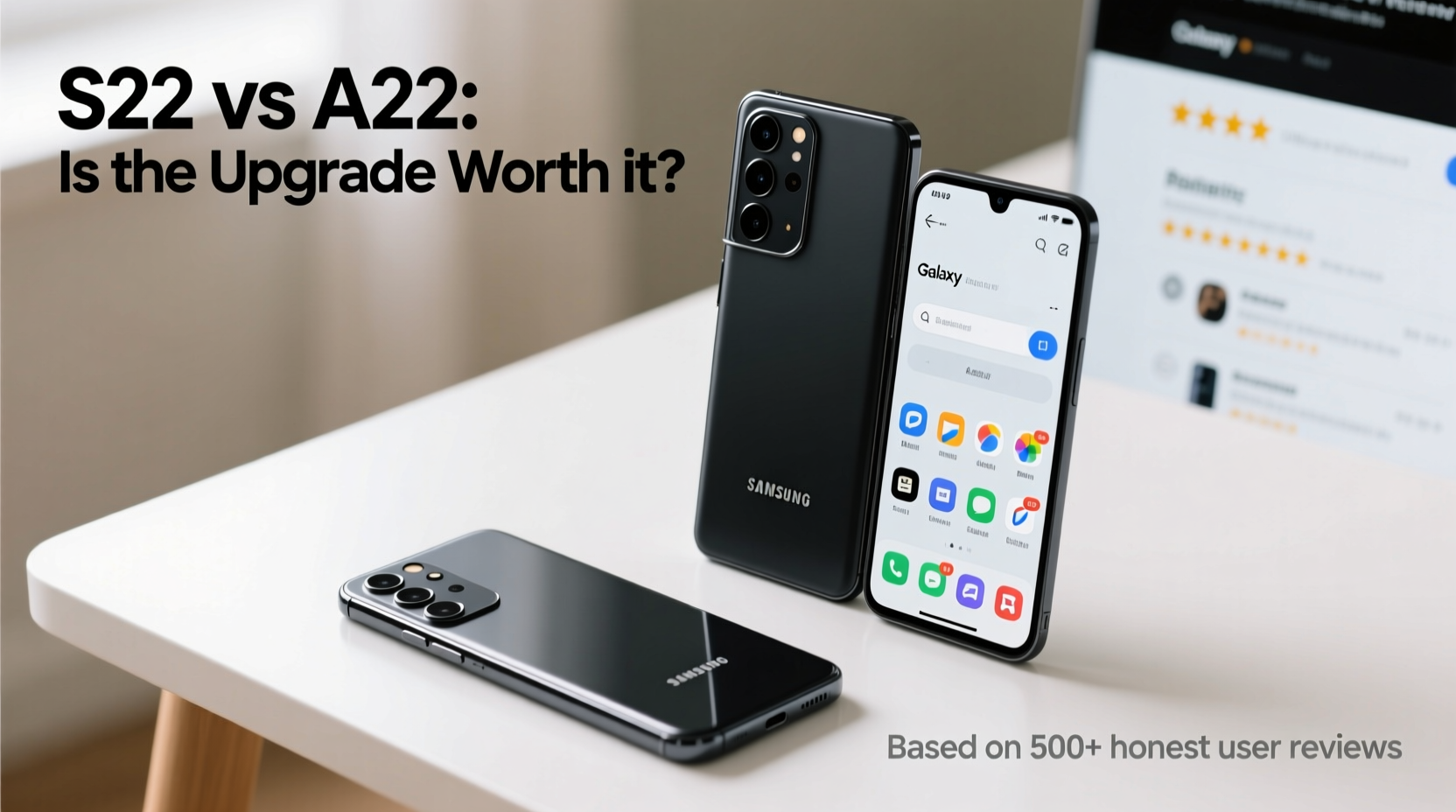
The core distinction between the S22 and A22 lies in their hardware. The S22 runs on Qualcomm’s Snapdragon 8 Gen 1 (or Exynos 2200 in some regions), built on a 4nm process, while the A22 uses the modest MediaTek Helio G35 or Dimensity 700—chips designed for basic tasks. This translates into tangible differences in daily use.
S22 users consistently report smooth multitasking, near-instant app launches, and seamless gaming even with graphics-intensive titles like Genshin Impact. In contrast, A22 reviewers mention lag when switching between apps, stuttering during video playback, and noticeable delays in UI response.
Tip: If you frequently use navigation, music, and messaging apps simultaneously, the S22’s superior RAM management makes a noticeable difference.Benchmark scores reflect this gap. The S22 averages around 850,000 on AnTuTu, while the A22 hovers near 150,000. While benchmarks don’t tell the whole story, they align with user sentiment: the S22 feels fast; the A22 feels constrained.
Display Quality: One Screen Shines Brighter
Both phones feature 6.4-inch AMOLED displays, but that’s where similarities end. The S22 boasts a 120Hz refresh rate, adaptive brightness up to 1300 nits, and HDR10+ support. The A22 sticks with a 90Hz panel maxing out at 600 nits and lacks HDR capabilities.
Users upgrading from older devices notice the S22’s screen immediately. Scrolling is buttery smooth, outdoor visibility is excellent, and media consumption feels immersive. One Reddit user shared: “Watching Netflix on the S22 compared to my old A22 was like switching from cable to 4K streaming.”
“Display quality isn’t just about resolution—it’s motion clarity, color accuracy, and brightness. The S22 delivers a premium viewing experience the A22 simply can’t match.” — David Lin, Mobile UX Analyst
Camera Comparison: Beyond Megapixels
The S22 features a triple-lens setup: 50MP main, 12MP ultra-wide, and 10MP telephoto with 3x optical zoom. The A22 has a quad-camera array on paper—48MP main, 5MP ultrawide, 2MP macro, 2MP depth—but sensor quality and processing are vastly inferior.
In daylight, both phones capture usable photos, but the S22 produces sharper detail, more accurate colors, and better dynamic range. Where the gap widens is low light. The S22’s larger sensor and advanced Night Mode consistently deliver clean, bright images. A22 photos in dim conditions are often grainy, underexposed, and lack detail.
Zoom performance is another key differentiator. The S22’s 3x optical and up to 30x digital zoom retain usability at moderate distances. The A22 relies solely on digital cropping, resulting in blurry, pixelated results beyond 2x.
| Feature | Samsung S22 | Samsung A22 |
|---|---|---|
| Main Camera | 50MP, f/1.8, Dual Pixel AF | 48MP, f/1.8, basic sensor |
| Low-Light Performance | Excellent (Night Mode + large pixels) | Poor (high noise, limited light capture) |
| Video Recording | 4K @ 60fps, stabilization, HDR10+ | 1080p @ 30fps, basic EIS |
| Front Camera | 10MP, f/2.2, autofocus | 8MP, f/2.2, fixed focus |
Real User Experience: A Mini Case Study
Consider Maria, a freelance photographer who used the A22 for two years before upgrading to the S22. She initially resisted the price jump but made the switch after her A22 struggled to keep up with editing apps and failed to capture reliable shots for client previews.
“I thought the A22 was fine until I tried using Lightroom Mobile,” she said. “It would freeze, crash, or take 30 seconds to apply a filter. On the S22, everything loads instantly. And the photos I take now actually look professional—I don’t have to explain why they’re blurry in meetings anymore.”
Maria’s case illustrates a broader trend: the A22 works for casual users, but professionals, creatives, or power users quickly hit its limits. For those relying on their phone as a work tool, the S22 pays for itself in time saved and reliability gained.
Battery Life & Charging: Trade-Offs Exist
Interestingly, battery life is one area where the A22 holds its ground. Its 5,000mAh battery often lasts a full day with moderate use, sometimes stretching to a day and a half. The S22, despite having a smaller 3,700mAh cell, manages a solid one-day charge due to efficient software and adaptive refresh rates.
However, charging speed favors the S22. It supports 25W fast charging (charger sold separately), reaching 50% in about 30 minutes. The A22 tops out at 15W, needing closer to 70 minutes for the same charge level.
Tip: If you're always on the move, faster charging on the S22 means less downtime—even with a smaller battery.Software & Longevity: Future-Proofing Matters
Samsung promises four generations of Android OS updates and five years of security patches for the S22. The A22 receives only two OS upgrades and three years of security updates. This longevity is critical for long-term ownership.
Users report that the A22 already feels sluggish after one year of updates, with newer Android versions not optimized for its hardware. In contrast, the S22 continues to run smoothly, handling updates without performance degradation.
- S22 Update Path: Android 12 → 16 (through 2026)
- A22 Update Path: Android 11 → 13 (through 2024)
If you plan to keep your phone for more than two years, the S22 offers significantly better future-proofing.
Price vs. Value: Is the Premium Justified?
The S22 launched at $799; the A22 at $279. That’s a $520 difference. So, is it worth it?
For budget-conscious users who primarily make calls, browse social media, and stream videos occasionally, the A22 is sufficient. But if you value photography, multitasking, software longevity, and a responsive interface, the S22 delivers a premium experience that justifies its cost.
One Amazon reviewer summed it up: “The A22 is okay if you’re desperate for a cheap phone. But after using the S22, going back feels like downgrade hell.”
Checklist: Should You Choose the S22 Over the A22?
- Do you use your phone for photography or content creation? → S22
- Do you want a phone that will last 3–4 years without slowing down? → S22
- Do you play mobile games or use productivity apps regularly? → S22
- Is your budget under $300? → A22
- Do you mostly use messaging, calls, and light browsing? → A22
Frequently Asked Questions
Can the A22 handle TikTok and Instagram Reels editing?
Yes, but expect occasional lag when applying filters or exporting videos. The S22 handles these tasks seamlessly with no stutter.
Does the S22 feel much smaller than the A22 despite similar screen size?
Yes. The S22 has slimmer bezels and a more compact design due to its aluminum frame and higher screen-to-body ratio. Many users find it more comfortable to hold.
Is the A22 waterproof?
No. The A22 lacks any official IP rating. The S22 has IP68 water and dust resistance, meaning it can survive submersion in up to 1.5 meters of water for 30 minutes.
Final Verdict: Who Should Buy Which Phone?
The Samsung Galaxy A22 serves a clear purpose: providing affordable access to Samsung’s ecosystem. It’s suitable for teens, secondary devices, or users on tight budgets. However, compromises in performance, camera, and durability are evident.
The Galaxy S22, while expensive, delivers a holistic premium experience. From its lightning-fast processor and pro-grade camera to its sleek build and long-term software support, it’s built for users who depend on their phone daily.
If you can afford the upfront cost, the S22 offers better long-term value. You’re not just paying for specs—you’re investing in reliability, performance, and peace of mind.
💬 Have you upgraded from an A-series to an S-series Samsung phone? Share your experience in the comments below—your insight could help someone make their next big tech decision.








