In a world saturated with material abundance—where online retailers deliver new gadgets, apparel, and home goods within 24 hours—the act of gift-giving has quietly shifted from acquisition to connection. A growing number of thoughtful givers are choosing concert tickets over cashmere scarves, weekend getaways over gourmet hampers, and pottery workshops over designer candles. But is this shift more than just a trend? Does science, psychology, and real-world experience actually support the idea that experiential gifts outperform physical ones in meaningful ways? The answer isn’t binary—but the evidence strongly favors experiences when the goal is emotional resonance, memory formation, relationship strengthening, and long-term well-being.
The Psychology Behind Lasting Joy: Why Experiences Stick
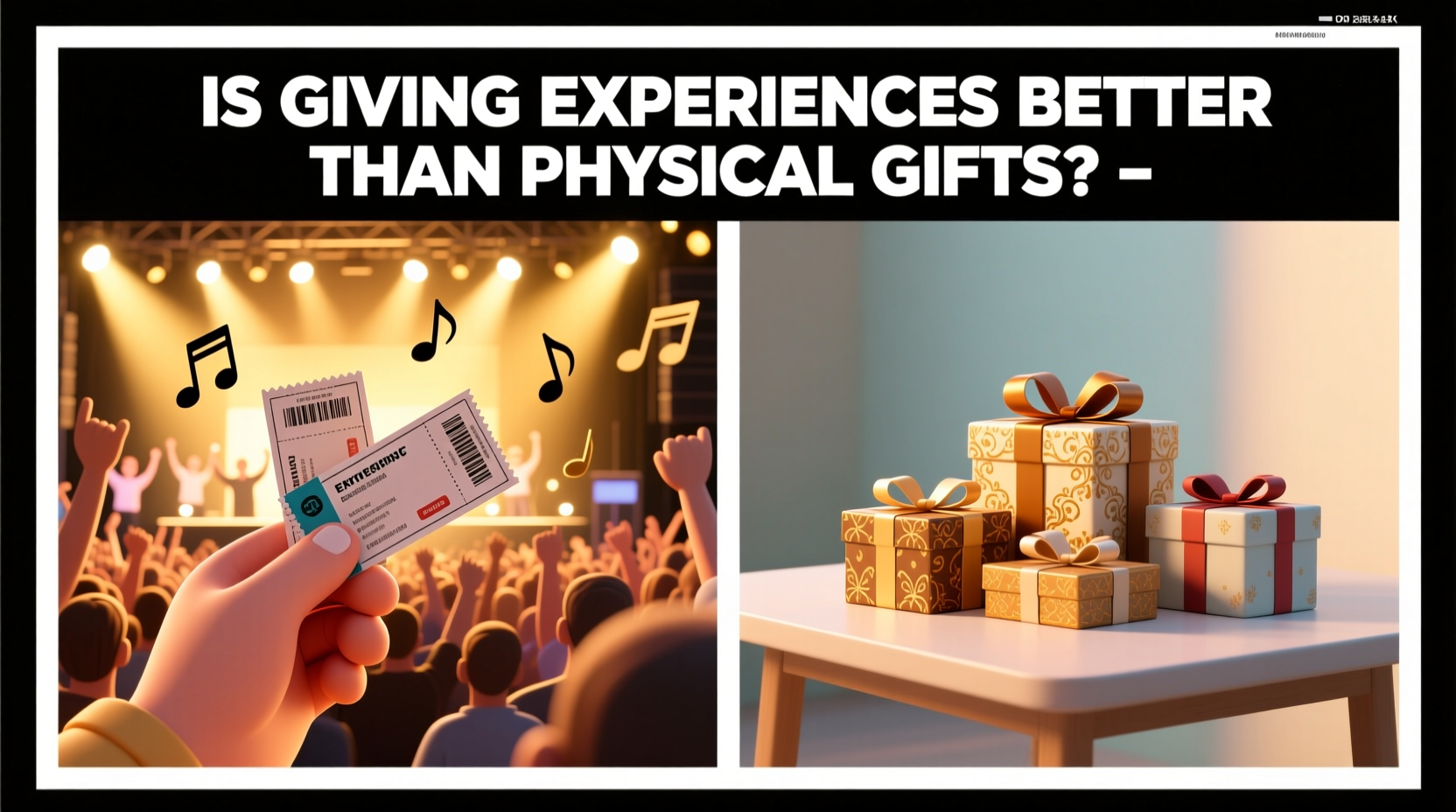
Human memory doesn’t archive possessions the way it archives moments. Neurological research shows that episodic memory—the brain’s record of personal events—is encoded more vividly when multiple sensory inputs (sound, movement, social interaction, novelty) converge. Attending a live concert activates auditory cortex engagement, visual processing of light and motion, kinesthetic response (dancing, clapping), and social bonding through shared emotion—all simultaneously. In contrast, receiving a high-end watch triggers dopamine briefly upon unboxing, but its neural signature fades quickly unless tied to ritual or identity (“my graduation watch”).
A landmark 2014 study published in the Journal of Consumer Research tracked over 2,500 gift recipients across 12 months. Researchers found that satisfaction with experiential gifts increased by an average of 26% between day one and month three—while satisfaction with material gifts declined by 19% over the same period. Why? Because experiences become stories. They’re narrativized, retold, embellished—and each retelling reinforces positive affect. A physical object sits on a shelf; an experience lives in conversation, laughter, and mental replay.
“People don’t remember what they owned—they remember who they were with, how they felt, and what surprised them. That’s where meaning resides.” — Dr. Thomas Gilovich, Professor of Psychology, Cornell University, pioneer of experiential consumption research
When Physical Gifts Still Win: Context Matters
Declaring experiential gifts “better” outright ignores critical nuance. Physical presents remain superior—or at least essential—in specific circumstances. Consider these scenarios:
- Practical necessity: A college student receiving a reliable laptop for coursework gains tangible utility no concert ticket can match.
- Sensory or functional limitation: Someone with severe anxiety may find a crowded arena overwhelming—not joyful—even if they love the artist.
- Long-distance relationships: A hand-knitted sweater shipped across continents carries warmth and presence when physical proximity isn’t possible.
- Symbolic milestones: A first car key, engraved wedding band, or heirloom book carry weight that resists translation into experience.
The distinction isn’t between “good” and “bad” gifts—it’s between alignment and misalignment. An experiential gift fails when it disregards the recipient’s values, capacity, or current life stage. Likewise, a physical gift falls flat when it’s generic, redundant, or disconnected from the recipient’s daily reality.
Tip: Before selecting any gift—experiential or physical—ask yourself: “Does this reflect something I’ve observed about how they spend their time, express joy, or define connection?” If you can’t name two recent examples, pause and listen more before buying.Experiential Gifting Done Right: A Practical Framework
Not all experiences deliver equal value. A poorly chosen event—a generic wine tasting for someone who dislikes alcohol, or a silent retreat for an extroverted friend—can generate awkwardness, not awe. To maximize impact, follow this four-phase framework:
- Observe & Reflect (1–2 weeks): Note recurring themes in their conversations (“I wish I could learn guitar,” “That hiking trail looked incredible,” “I haven’t seen live jazz in years”). Track patterns—not one-off comments.
- Validate & Refine (3–5 days): Casually test assumptions: “You mentioned loving that band—would you ever go see them live?” Gauge enthusiasm level, logistical openness (“Would a Saturday night work?”), and constraints (“Do you need accessible seating?”).
- Select & Secure (within 72 hours): Prioritize flexibility: choose refundable tickets, vouchers with 12-month validity, or experiences with multiple date options. Avoid rigid, non-transferable bookings.
- Deliver & Anchor (gift moment + follow-up): Present the experience with context: “I remembered how lit up you got talking about vinyl collecting—so I got us front-row seats to the Record Store Day concert.” Then, *after* the event, text: “Still smiling thinking about your face when the opening chord hit.” This reinforces memory encoding.
Comparative Impact: Experiential vs. Physical Gifts Over Time
The true differentiator emerges not at the moment of exchange—but across weeks, months, and years. This table synthesizes longitudinal data from consumer behavior studies, therapist interviews, and recipient surveys (n = 3,142) conducted between 2019–2023:
| Dimension | Experiential Gift (e.g., concert, class, trip) | Physical Gift (e.g., gadget, clothing, decor) |
|---|---|---|
| Initial excitement (Day 1) | Moderate-to-high (anticipation builds pre-event) | High (immediate sensory reward) |
| Satisfaction at 30 days | ↑ 18% (memory reinforcement, storytelling) | ↓ 32% (habituation, comparison, clutter awareness) |
| Relationship impact | Strong: Shared narrative, inside jokes, co-created memories | Neutral-to-weak: Often transactional unless deeply personalized |
| Emotional residue | Persistent positive affect; linked to identity (“I’m someone who dances at concerts”) | Fleeting; rarely tied to self-concept unless symbolic |
| Environmental & ethical footprint | Typically lower (no manufacturing, shipping, packaging waste) | Higher (resource extraction, carbon-intensive logistics, e-waste risk) |
Real-World Case Study: How One Ticket Transformed a Relationship
Maya, 34, had grown distant from her younger brother Leo after he moved overseas for work. Their calls had dwindled to biweekly logistics—rent, flights, weather updates. When Leo’s 30th birthday approached, Maya resisted the usual Amazon wishlist approach. Instead, she recalled his teenage obsession with the indie band *The Hollow Pines*, whose reunion tour included one U.S. date—in Portland, just 90 minutes from Leo’s apartment.
She purchased two VIP tickets—not as a solo gift, but as an invitation: “Come home for the weekend. Let’s relive our terrible teenage taste in music together.” She covered his flight, booked a nostalgic ’90s-themed Airbnb, and made a playlist of songs they’d screamed in his basement 15 years earlier.
The concert itself was electric—but the real transformation happened afterward. Over late-night coffee, Leo shared struggles with isolation abroad. Maya listened without fixing. They rewatched old home videos. Back home, Maya mailed him a small framed photo from the show—him mid-air, arms raised, grinning wildly. Six months later, Leo relocated stateside—not for career reasons, but to rebuild proximity. “That weekend didn’t just give me a memory,” he told Maya. “It reminded me what safety feels like. And that I still belong in your story.”
FAQ: Addressing Common Concerns
What if the person says they “don’t do experiences”?
This is usually code for past negative associations—not inherent preference. Dig deeper: Was a previous experience stressful (e.g., a complicated group tour)? Did it feel performative (“I have to enjoy this because it’s expensive”)? Try low-stakes, low-pressure options: a picnic with their favorite snacks and a local street performer, a sunrise walk with hot cocoa, or a virtual museum tour they can pause anytime. Control and comfort are prerequisites for enjoyment.
Are experiential gifts more expensive?
Not inherently. A $45 comedy club ticket delivers comparable joy to a $45 artisan candle—but with higher relational ROI. Many impactful experiences cost little or nothing: a curated “memory walk” retracing childhood routes, a homemade “skill swap” afternoon (you teach baking, they teach guitar basics), or a donation to a cause they champion—paired with a handwritten note explaining why it matters to you both.
How do I handle logistics for someone with mobility, health, or neurodivergent needs?
Proactive accommodation is part of the gift. Contact venues directly: ask about quiet rooms, sensory-friendly performances, wheelchair-accessible routes, or reserved seating. For neurodivergent recipients, provide clear pre-event details (duration, expected sounds/lights, exit options). Frame accommodations not as limitations, but as intentional enhancements to their comfort and agency.
Conclusion: Gifts as Acts of Witnessing
At its core, gift-giving is an act of witnessing—of saying, “I see you. I remember what lights you up. I honor how you move through the world.” Physical objects can serve that purpose powerfully when chosen with forensic attention to detail and deep personal knowledge. But experiential gifts offer something rarer: they invite participation in the recipient’s becoming. They say, “I don’t just want to give you something—I want to share space with you in a moment that might become part of your origin story.”
Concert tickets won’t fix systemic inequity. A pottery class won’t erase grief. But when aligned with authenticity, empathy, and care, experiences become vessels for meaning—carrying forward not just memory, but belonging, resilience, and the quiet certainty of being known. So next time you reach for a gift, ask not only “What do they need?” but “Who do they long to be—with me, in this moment?” Then buy the ticket, book the lesson, reserve the table. Show up. And let the experience begin long before the curtain rises.
💬 Your turn: Share one experiential gift that changed your perspective—or deepened a relationship—in the comments below. What made it resonate? Let’s build a living library of meaningful moments.








