At first glance, a soft, smiling Olaf plush might seem like nothing more than a charming keepsake from a favorite Disney movie. But for many children, this seemingly simple toy becomes a constant companion—a confidant during bedtime stories, a partner in imaginative adventures, and even a tool for learning. The question arises: can a character-based plush like Olaf truly be considered an educational toy, or is it purely entertainment? The answer lies not in a strict dichotomy, but in understanding how play itself is a powerful vehicle for development.
Educational toys are typically defined as those designed to teach specific skills—problem-solving, language acquisition, fine motor coordination, or emotional intelligence. While Olaf may not come with flashcards or STEM components, his role in a child’s daily life often aligns closely with the goals of early childhood education. When we shift our perspective from product design to developmental impact, the line between “educational” and “play” begins to blur.
The Hidden Curriculum of Stuffed Animals
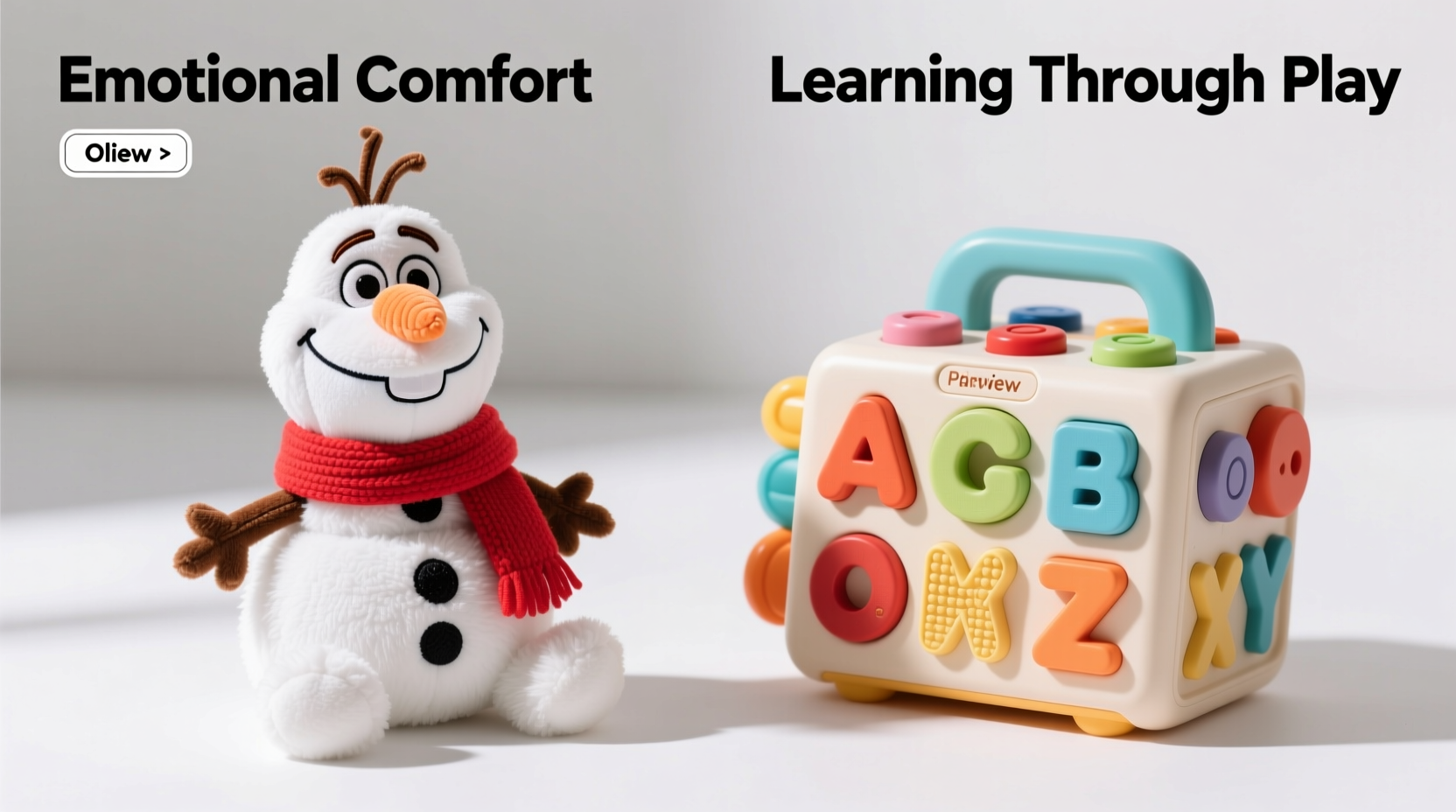
Children don’t learn only through structured lessons. Much of their growth happens during unstructured, self-directed play. A 2021 study by the American Academy of Pediatrics emphasized that imaginative play supports language development, empathy, and executive function. When a child pretends Olaf is cold and needs a blanket, they’re practicing cause-and-effect reasoning. When they have Olaf “talk” to other toys, they’re developing narrative skills and social scripts.
This kind of symbolic play—where one object stands in for another—is a critical milestone in cognitive development. Psychologist Lev Vygotsky argued that play creates a “zone of proximal development,” where children stretch their abilities just beyond what they can do alone. An Olaf plush becomes a scaffold in this process, offering a safe, non-judgmental partner for experimentation.
“Children use toys like stuffed animals to rehearse real-life scenarios. It’s not just fantasy—it’s practice for emotional regulation and social interaction.” — Dr. Laura Jana, Pediatrician and Early Childhood Development Expert
Emotional Intelligence and the Role of Comfort Objects
One of the most profound ways Olaf contributes to a child’s growth is through emotional support. For young children, managing big feelings—fear, sadness, excitement—is still a new skill. A plush toy provides tactile comfort and a sense of continuity. Research from the University of Wisconsin-Madison shows that familiar objects can reduce cortisol levels in children facing stress, such as starting school or visiting the doctor.
But beyond comfort, Olaf also becomes a mirror for emotions. A child might say, “Olaf is scared of the dark too,” projecting their own fear onto the toy. This projection allows them to externalize and discuss emotions in a less threatening way. Parents can gently engage: “Oh, Olaf feels scared? What could help him feel better?” In doing so, they guide emotional literacy without direct confrontation.
Tip: Encourage your child to describe how Olaf is feeling during play. This builds vocabulary for emotions and strengthens empathy.Language and Storytelling Development
Children who engage in pretend play with dolls or plush toys tend to develop richer vocabularies and stronger narrative structures. When a child narrates Olaf’s journey to find summer, they’re organizing events in time, using descriptive language, and experimenting with dialogue. These are foundational skills for reading comprehension and writing.
A longitudinal study published in Child Development found that preschoolers who frequently engaged in socio-dramatic play scored higher on language assessments six months later. The researchers noted that the presence of a consistent “character” toy—like a favorite stuffed animal—increased the complexity and duration of play episodes.
How Olaf Supports Language Growth
- Vocabulary expansion: Words related to weather, emotions, and relationships emerge naturally (“melting,” “happy,” “best friend”).
- Sentence structure: Children form longer, more complex sentences when narrating stories.
- Pragmatic skills: Taking turns in conversation—even with a plush—builds communication awareness.
Comparing Traditional vs. Character-Based Toys
It’s worth examining how a plush like Olaf compares to toys explicitly marketed as educational. The table below outlines key differences and overlaps:
| Feature | Traditional Educational Toy (e.g., alphabet puzzle) | Character Plush (e.g., Olaf) |
|---|---|---|
| Primary Purpose | Skill-building (letters, numbers, shapes) | Companionship and imaginative play |
| Cognitive Focus | Memory, recognition, logic | Narrative thinking, problem-solving in context |
| Social-Emotional Role | Limited | High—supports empathy, emotional expression |
| Play Duration | Often short, task-based | Extended, open-ended |
| Learning Outcome | Measurable (e.g., letter identification) | Developmental (e.g., confidence, creativity) |
The data suggests that while traditional educational toys target specific academic skills, character plushes like Olaf foster broader developmental domains—many of which are equally vital for school readiness and lifelong success.
Mini Case Study: Emma and Her Snowman Friend
Emma, age 4, received an Olaf plush after watching *Frozen* with her family. Initially, her parents saw it as a fun souvenir. But over the next few months, they noticed changes. Emma began including Olaf in her nightly routines—giving him a “bed,” brushing his “hair” with a small comb, and explaining why he couldn’t go outside (“He’ll melt!”). She started creating elaborate stories about Olaf helping animals stay cool in summer.
Her preschool teacher reported improvements in circle-time participation. “She used to be quiet,” the teacher said, “but now she volunteers to tell stories—and she always includes her snowman.” Speech evaluations later showed gains in expressive language, which her therapist attributed in part to the consistent narrative play at home.
In this case, Olaf was never labeled “educational,” yet he played a central role in Emma’s cognitive and linguistic growth.
Actionable Checklist: Maximizing Educational Value from a Plush Toy
To help parents and caregivers make the most of plush companions like Olaf, here’s a practical checklist:
- Encourage storytelling: Ask open-ended questions like, “What adventure did Olaf go on today?”
- Use the toy to discuss emotions: “Does Olaf seem happy or sad? How can we tell?”
- Incorporate learning themes: During a unit on weather, explore why Olaf loves snow but fears sun.
- Rotate accessories: Add hats, scarves, or small props to inspire new play scenarios.
- Respect the bond: Don’t dismiss the relationship as “just pretend”—it’s emotionally real to the child.
Frequently Asked Questions
Can a plush toy really teach my child something valuable?
Yes. While not designed like a textbook, plush toys support emotional regulation, language development, and creative thinking—all essential components of early education. The learning is indirect but deeply impactful.
Should I limit screen-based character toys in favor of “educational” ones?
No need to eliminate either. Character toys can bridge media and real-world learning. The key is active engagement: talk about the stories, extend the play, and connect themes to everyday experiences.
My child won’t sleep without Olaf. Is this unhealthy?
Not at all. Attachment to comfort objects is normal and healthy up to age 5 or 6. It indicates the child has developed a secure coping mechanism. Most children gradually phase it out as confidence grows.
Conclusion: Redefining What “Educational” Means
The distinction between “educational toy” and “fun plush” is increasingly outdated. Modern child development research recognizes that learning isn’t confined to flashcards or apps—it happens in moments of connection, imagination, and emotional exploration. An Olaf plush may not teach the alphabet, but it can teach compassion, resilience, and the joy of storytelling.
Rather than questioning whether Olaf is educational, perhaps we should ask: does this toy support my child’s growth in meaningful ways? For millions of families, the answer is a resounding yes. The soft snowman from Arendelle may be made of fabric and stuffing, but for a child, he’s a teacher, a friend, and a window into a growing mind.
🚀 Start today: Pick up your child’s favorite plush and ask, “What did you and Olaf do today?” You might be surprised by the depth of the answer.








