For pet owners, managing loose fur is an ongoing battle. Whether it's clumps of cat hair on the sofa or dog hair embedded in carpets, traditional sweeping rarely cuts it. As technology advances, two appliances have emerged as top contenders: robot vacuums and cordless stick vacuums. Both promise relief from pet hair, but they serve different needs and lifestyles. Understanding their strengths, limitations, and real-world performance is essential for choosing the right tool.
The answer isn’t one-size-fits-all. While robot vacuums offer hands-free convenience and daily maintenance, cordless stick vacuums deliver stronger suction, targeted cleaning, and versatility across floor types. This article breaks down how each performs specifically with pet hair, evaluates key features, and helps you decide which is truly better for your household.
How Pet Hair Challenges Vacuum Performance
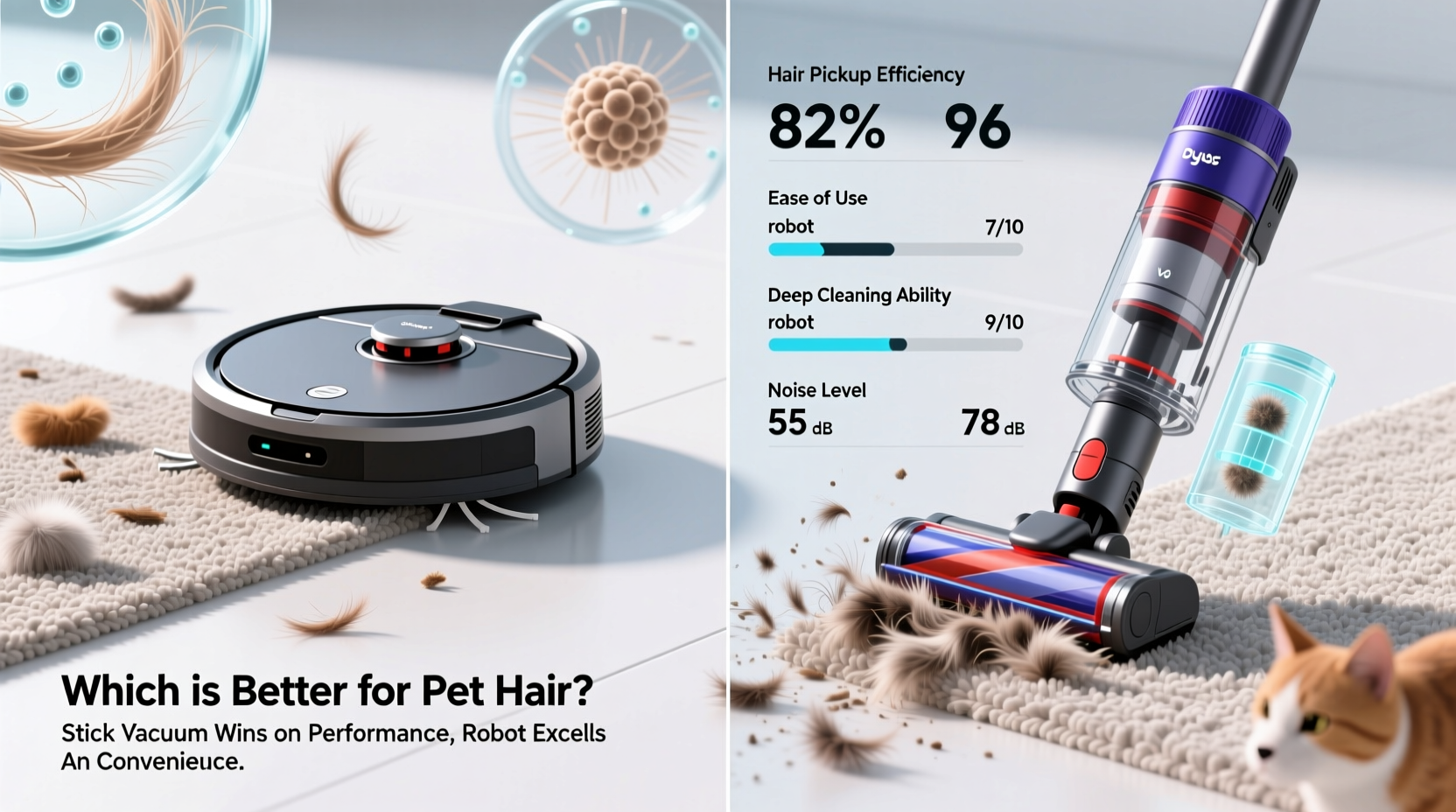
Pet hair presents unique cleaning challenges that go beyond typical dust and debris. It’s lightweight, clingy, and tends to wrap around moving parts like brush rolls and filters. Long-haired breeds like Golden Retrievers or Maine Coons shed heavily, creating mats in corners and under furniture. Even short-haired pets produce dander and fine hairs that embed into carpet fibers and upholstery.
Effective pet hair removal requires more than just suction. A vacuum must combine strong airflow, tangle-resistant brush design, and consistent filtration to capture allergens. Additionally, ease of emptying and maintenance matters—no one wants to manually pull hair off a roller every other day.
“Pet owners need vacuums that not only pick up hair but also prevent clogs and maintain performance over time. Design matters as much as power.” — Dr. Lena Patel, Home Appliance Researcher at CleanTech Labs
Robot Vacuums: The Case for Automated Cleaning
Robot vacuums excel in consistency. With scheduling features, they can clean daily without any effort from the user. For homes with heavy shedding, this automated frequency helps prevent hair buildup before it becomes unmanageable. Modern models come equipped with high-efficiency filters, anti-tangle brush systems, and smart navigation to avoid obstacles and focus on high-traffic zones.
Brands like iRobot (Roomba), Roborock, and Ecovacs have developed models specifically marketed for pet owners. These often include:
- Dual rubber rollers that resist hair缠绕 (tangling)
- HEPA filtration to trap dander and allergens
- Self-emptying dustbins for weeks of maintenance-free operation
- Mapping technology to learn room layouts and target problem areas
In practice, robot vacuums are ideal for maintaining cleanliness between deeper cleans. They work well on hard floors and low-pile carpets, pulling surface-level hair effectively. However, their limited suction power compared to upright or stick vacuums means they may struggle with deeply embedded fur or thick carpeting.
Tip: Run your robot vacuum daily during peak shedding seasons to prevent hair accumulation in corners and under furniture.Cordless Stick Vacuums: Power and Precision for Pet Hair
If deep cleaning and immediate results are priorities, cordless stick vacuums typically outperform robot models. With suction power measured in air watts (AW), many premium stick vacuums exceed 150 AW—significantly higher than most robots, which average between 10–30 AW.
This raw power translates into better pickup on carpets, stairs, furniture, and tight spaces. Most models come with motorized pet tools designed to agitate and extract hair from upholstery and car seats. Brands like Dyson, Shark, and Tineco lead the market with tangle-free turbine heads and multi-stage filtration.
Another advantage is control. You direct the vacuum exactly where needed, making it easier to spot-clean accidents or focus on freshly shed zones. Unlike robots, which rely on algorithms, stick vacuums respond instantly to user input—critical when dealing with sudden messes.
However, convenience comes at the cost of effort. Cordless vacuums require charging, manual operation, and regular bin emptying. Battery life, while improving, still limits runtime to 20–60 minutes per charge, depending on suction mode.
Key Features That Matter for Pet Hair
| Feature | Robot Vacuum | Cordless Stick Vacuum |
|---|---|---|
| Suction Power | Moderate (10–30 AW) | High (100–200+ AW) |
| Floor Type Effectiveness | Best on hard floors, limited on thick carpet | Excellent on all surfaces including rugs and stairs |
| Pet Tool Attachments | Rare; built-in brush only | Common (upholstery, crevice, turbo tools) |
| Hands-Free Operation | Yes, fully automatic | No, requires user operation |
| Maintenance Frequency | Weekly roller cleaning, monthly filter care | Regular bin emptying, frequent brush checks |
| Price Range (Entry to Premium) | $250–$1,200 | $150–$700 |
Real-World Example: A Multi-Pet Household Test
Sarah Thompson, a dog trainer in Austin, Texas, lives with two Labrador Retrievers and a long-haired cat. She tested both a high-end robot vacuum (Roborock S8 Pro Ultra) and a Dyson V15 Detect for six weeks to compare effectiveness on pet hair.
Her observations:
- The robot vacuum kept hardwood floors visibly cleaner with daily runs, reducing the need for manual sweeping.
- It struggled on her living room rug, leaving behind clumps of fur after each pass.
- The Dyson removed nearly all embedded hair in a single pass and was indispensable for cleaning the couch and car interior.
- She appreciated the self-emptying feature of the robot but found herself using the stick vacuum twice a week for thorough cleaning.
Sarah concluded: “The robot handles maintenance, but the stick vacuum does the real work. I use both now—one for prevention, one for deep cleaning.”
Step-by-Step: Choosing the Right Tool for Your Needs
Follow this decision-making process to determine which vacuum suits your lifestyle:
- Assess your pet’s shedding level. High-shedding breeds require more aggressive cleaning. If you find fur balls weekly, prioritize suction power.
- Evaluate your flooring. Homes with mostly hard floors benefit more from robot vacuums. Carpet-heavy homes need the deep-cleaning ability of a stick vacuum.
- Consider your time and energy. Busy households or those with mobility issues gain significant value from automation.
- Set a realistic budget. Premium robot vacuums with self-emptying stations can exceed $1,000. Powerful stick vacuums start around $300.
- Think about secondary uses. Need to clean stairs, furniture, or cars? A stick vacuum with attachments is far more versatile.
- Test hybrid solutions. Some users opt for both—a robot for daily upkeep and a stick vacuum for weekly deep cleans.
Expert Recommendations and Common Pitfalls
According to appliance reviewers at HomeClean Labs, one of the biggest mistakes pet owners make is assuming all \"pet-friendly\" vacuums perform equally. Marketing terms like “tangle-free” aren’t standardized, so real-world testing matters.
They recommend checking independent reviews that specifically test for pet hair pickup on multiple surfaces. Pay attention to maintenance reports—some models collect hair efficiently but become difficult to clean themselves.
“Don’t overlook filter quality. A HEPA filter won’t help if the vacuum loses suction because the brush roll is jammed with fur.” — Mark Tran, Lead Tester at HomeClean Labs
Additionally, avoid older robot models with bristle brushes—they tend to wind hair tightly around the roller, requiring frequent disassembly. Newer dual rubber rollers, like those on Roomba j-series or Roborock models, are far more resistant.
FAQ: Robot vs. Stick Vacuum for Pet Hair
Can a robot vacuum completely replace a stick vacuum for pet owners?
For most households, no. Robot vacuums are excellent for daily surface cleaning but lack the power and precision needed for deep carpet cleaning, furniture, or spot treatment. They’re best used as a supplement, not a full replacement.
Which vacuum type is better for allergies caused by pet dander?
Both can be effective if they have sealed systems and true HEPA filtration. However, stick vacuums generally have stronger airflow, capturing more microscopic particles in a single pass. Robots may require multiple passes to achieve similar air quality improvements.
Do self-emptying robot vacuums reduce maintenance with pet hair?
Yes. Models with self-emptying bases store up to 60 days of debris, minimizing contact with pet hair and dander. This is especially helpful for allergy sufferers. However, the main brush still needs monthly cleaning to prevent hair buildup.
Final Checklist: What to Look for in a Pet Hair Vacuum
Whether you choose a robot or stick vacuum, use this checklist to ensure it meets pet owner needs:
- ✅ Strong suction (150+ AW for stick vacs; look for carpet boost modes in robots)
- ✅ Tangle-resistant brush roll (rubber or hybrid design preferred)
- ✅ HEPA or comparable filtration system
- ✅ Easy-to-empty dustbin (preferably with one-touch release)
- ✅ Dedicated pet tool (for stick vacuums)
- ✅ Rechargeable battery with at least 30 minutes runtime (stick vacs)
- ✅ Smart navigation and mapping (robots)
- ✅ Positive user reviews specifically mentioning pet hair performance
Conclusion: Matching the Tool to Your Lifestyle
So, is a robot vacuum better than a cordless stick vacuum for pet hair? The answer depends on what “better” means to you. If your priority is convenience and consistent light cleaning, a robot vacuum delivers unmatched hands-free maintenance. But if you need powerful, reliable removal of embedded pet hair from carpets, furniture, and tight spaces, a cordless stick vacuum remains the superior choice.
Many modern pet owners find the optimal solution lies in combining both. Use a robot vacuum for daily upkeep on hard floors and open areas, then deploy a cordless stick vacuum weekly for deep cleaning and targeted tasks. This hybrid approach balances effort, efficiency, and effectiveness.
🚀 Ready to upgrade your pet hair cleanup routine? Assess your home’s layout, pet habits, and time availability—then choose the vacuum that fits your real life, not just the marketing claims.








