
Walking a small dog in a bustling city environment presents unique challenges. Owners often seek convenience and freedom of movement—qualities that retractable leashes seem to offer. But when it comes to navigating crowded sidewalks, traffic noise, and sudden distractions, the safety of using a retractable leash with a small breed becomes a serious concern. While these leashes are popular for their extended range and ease of use, they may pose hidden dangers, especially in high-traffic areas. This article explores whether retractable leashes are truly safe for small dogs on busy sidewalks, examining real-world risks, expert opinions, and better alternatives.
Understanding Retractable Leashes: How They Work
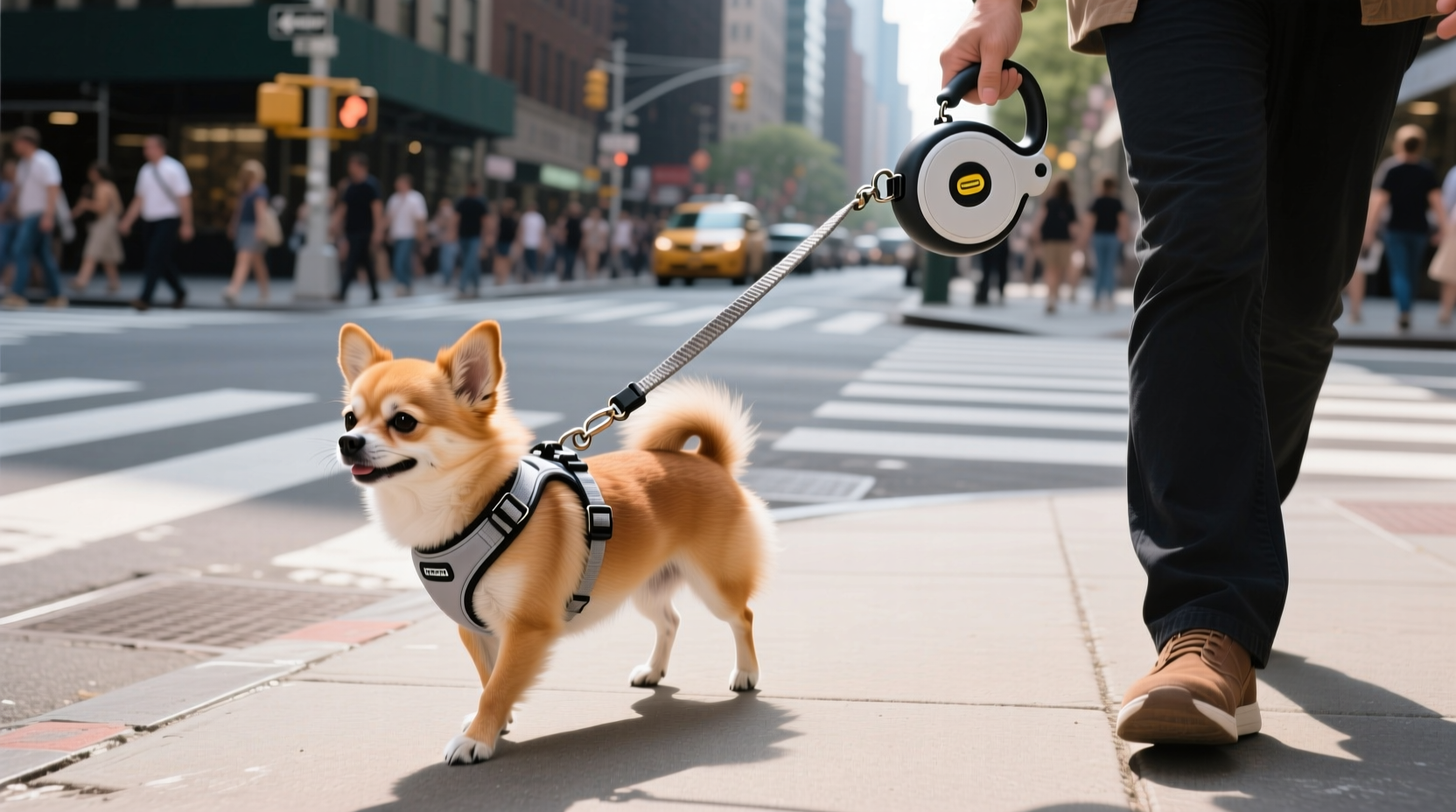
A retractable leash consists of a thin cord or tape housed in a plastic handle with a spring-loaded mechanism. The leash extends as the dog moves forward and retracts when pulled back. Most models allow between 10 to 26 feet of extension, giving the dog more room to explore than a standard 6-foot leash.
For small breeds like Chihuahuas, Pomeranians, or Shih Tzus, owners may believe this added length allows them to sniff and move naturally without constant tugging. However, the mechanics of the leash introduce several control issues, particularly in unpredictable environments.
The cord is typically made of durable nylon or polyester, but its thin profile can cause burns or cuts if it slips from the handler’s grip. Additionally, the automatic retraction feature can malfunction under stress, leading to sudden jerks or lock-ups that startle both dog and owner.
Tip: Never wrap the leash cord around your hand—even once. In an emergency, it can burn or slice skin during rapid extension.Risks of Using Retractable Leashes on Busy Sidewalks
Busy sidewalks are dynamic spaces filled with pedestrians, bicycles, strollers, and vehicles pulling up to curbs. For a small dog, even minor disturbances can trigger fear or excitement. A retractable leash amplifies the danger in such settings due to limited control and delayed response time.
Limited Control and Sudden Lunging
When a dog lunges toward a stimulus—another dog, a squirrel, or a passing cyclist—the retractable leash may extend rapidly. By the time the handler reacts, the dog could be several feet away, potentially stepping into traffic or colliding with a pedestrian. Unlike fixed-length leashes, which provide immediate feedback and tension, retractable leashes delay correction, increasing the risk of accidents.
Tangling and Tripping Hazards
The long, thin cord is prone to wrapping around legs—both the dog’s and nearby people’s. On a crowded sidewalk, this can cause falls, injuries, or panicked reactions. Small dogs, with their lower center of gravity, are especially vulnerable to tripping over tangled cords, which may lead to sprains or neck strain.
Injury Risk from Recoil or Breakage
If the leash mechanism fails or the cord snaps under tension, the sudden release of energy can whip the handle or cord toward the handler or bystanders. There have been documented cases of facial lacerations, eye injuries, and rope burns from malfunctioning retractable leashes. For a small dog, a broken leash means instant exposure to street dangers.
“Retractable leashes give a false sense of control. In urban environments, split-second reactions matter—and these leashes compromise responsiveness.” — Dr. Lisa Chen, Veterinary Behaviorist
Safer Alternatives for Small Breeds in Urban Settings
Given the risks, many animal behaviorists and veterinarians recommend avoiding retractable leashes altogether in high-traffic areas. Fortunately, several safer options exist that balance comfort, control, and mobility.
Standard 4–6 Foot Nylon or Leather Leash
A fixed-length leash offers consistent tension and immediate feedback. It keeps the dog close enough to respond quickly to commands and avoids overextension near roads or crowds. For small breeds, a lightweight 4-foot leash provides adequate space while maintaining proximity.
Hands-Free Leashes with Bungee Sections
These leashes attach to a waist belt and often include a bungee component that absorbs sudden pulls. Ideal for active owners who walk briskly or jog, they reduce strain on the arms and allow natural movement without sacrificing control.
Harness-Based Systems
Using a front-clip harness with a standard leash distributes pressure across the dog’s chest rather than the neck, reducing tracheal damage—a common issue in small breeds. Combined with a short leash, this setup gives maximum control and comfort.
| Leash Type | Best For | Risk Level (Busy Sidewalks) | Small Breed Suitability |
|---|---|---|---|
| Retractable (10–26 ft) | Open parks, quiet trails | High | Poor |
| Standard 6-ft | Urban walks, training | Low | Excellent |
| Hands-Free with Bungee | Jogging, multitasking | Moderate | Good |
| Short 4-ft + Harness | Crowded streets, reactive dogs | Very Low | Excellent |
Real-World Scenario: A Close Call on 5th Avenue
Consider the case of Maria, a New York City resident who regularly walks her 7-pound Maltese, Milo, along Midtown sidewalks. One afternoon, she used a retractable leash to let Milo sniff a flower display near a café. As a delivery bike sped past, Milo startled and bolted forward. The leash extended fully in seconds. Before Maria could react, the cord wrapped around a pedestrian’s ankle, causing the person to stumble. Simultaneously, Milo darted toward the bike lane, narrowly avoiding being clipped by a scooter.
Maria managed to stop the leash mechanism, but not before suffering a deep burn across her palm. The incident left both her and Milo anxious about future walks. After consulting her vet, she switched to a 4-foot leather leash paired with a front-clip harness. “I thought I was giving him freedom,” she said. “But I was actually putting him—and others—in danger.”
This scenario underscores how quickly things can go wrong—even with careful owners—when using retractable leashes in chaotic environments.
Expert Recommendations and Training Tips
Veterinary professionals and certified dog trainers consistently advise against retractable leashes for small dogs in urban areas. Their primary concern is predictability: in a city, you cannot anticipate every sound, movement, or distraction. A reliable leash must allow for instant correction and consistent communication.
- Use positive reinforcement to teach loose-leash walking. Reward your dog for staying close, reducing the need for long leashes.
- Practice in low-distraction areas first, such as empty parking lots or quiet side streets, before tackling busier routes.
- Train a solid “come” command so your dog returns reliably when called, minimizing the temptation to use long leashes for off-leash simulation.
- Choose a harness over a collar to prevent tracheal collapse, especially in brachycephalic breeds like Pugs or Boston Terriers.
Step-by-Step Guide to Transitioning from Retractable to Fixed Leash
- Start indoors: Practice walking your dog on a 6-foot leash inside your home or yard to rebuild focus and connection.
- Introduce distractions gradually: Walk in quieter neighborhoods first, rewarding calm behavior near stimuli like bikes or other dogs.
- Use treats strategically: Hold treats near your leg to encourage your dog to walk beside you, reinforcing the desired position.
- Incorporate verbal cues: Use consistent commands like “let’s go” or “this way” to redirect attention without pulling.
- Gradually increase complexity: Once your dog walks calmly in low-traffic areas, progress to busier sidewalks during off-peak hours.
- Monitor body language: Watch for signs of stress (tucked tail, panting) and adjust your route or pace accordingly.
Frequently Asked Questions
Can I ever use a retractable leash with a small dog?
Yes—but only in safe, controlled environments like large, enclosed dog parks or private yards with no traffic or pedestrians. Avoid using them on sidewalks, near roads, or in crowded areas where quick reactions are essential.
Are all retractable leashes equally dangerous?
While designs vary, most share the same core risks: reduced control, tangling, and potential for injury. Even higher-end models with locking mechanisms don’t eliminate the fundamental issue of delayed response time compared to fixed leashes.
What should I do if my retractable leash breaks during a walk?
Immediately call your dog firmly and move to a safe location. If the dog runs into traffic, do not chase—instead, use a high-value recall cue or treat bag to lure them back. Afterward, replace the leash with a durable fixed-length option and consider training refresher sessions.
Final Thoughts: Prioritizing Safety Over Convenience
The appeal of a retractable leash lies in its promise of freedom and flexibility. For small dogs on busy sidewalks, however, that freedom comes at too high a cost. Limited control, increased entanglement risks, and potential for injury make these leashes unsuitable for urban environments. Small breeds, often fragile and easily startled, need close supervision and reliable handling—qualities best delivered by a standard leash and well-fitted harness.
Choosing the right equipment isn’t just about compliance with local leash laws; it’s about protecting your dog, bystanders, and yourself from preventable harm. With proper training and the right tools, you can enjoy peaceful, confident walks—even in the busiest neighborhoods.
💬 Have you switched from a retractable leash? What worked for your small dog? Share your experience in the comments to help fellow pet owners make safer choices.








