The iPhone 6 Plus was a landmark device—Apple’s first large-screen flagship that helped define the phablet era. When the iPhone 7 Plus arrived a year later, it wasn’t just an incremental update; it introduced tangible improvements in durability, performance, and photography. But years later, many users still rely on their 6 Plus and wonder: is upgrading to the 7 Plus actually worthwhile? For those clinging to a functional but aging device, the decision isn’t just about specs—it’s about real-world value, longevity, and whether the benefits outweigh the cost.
Performance and Hardware: A Noticeable Leap
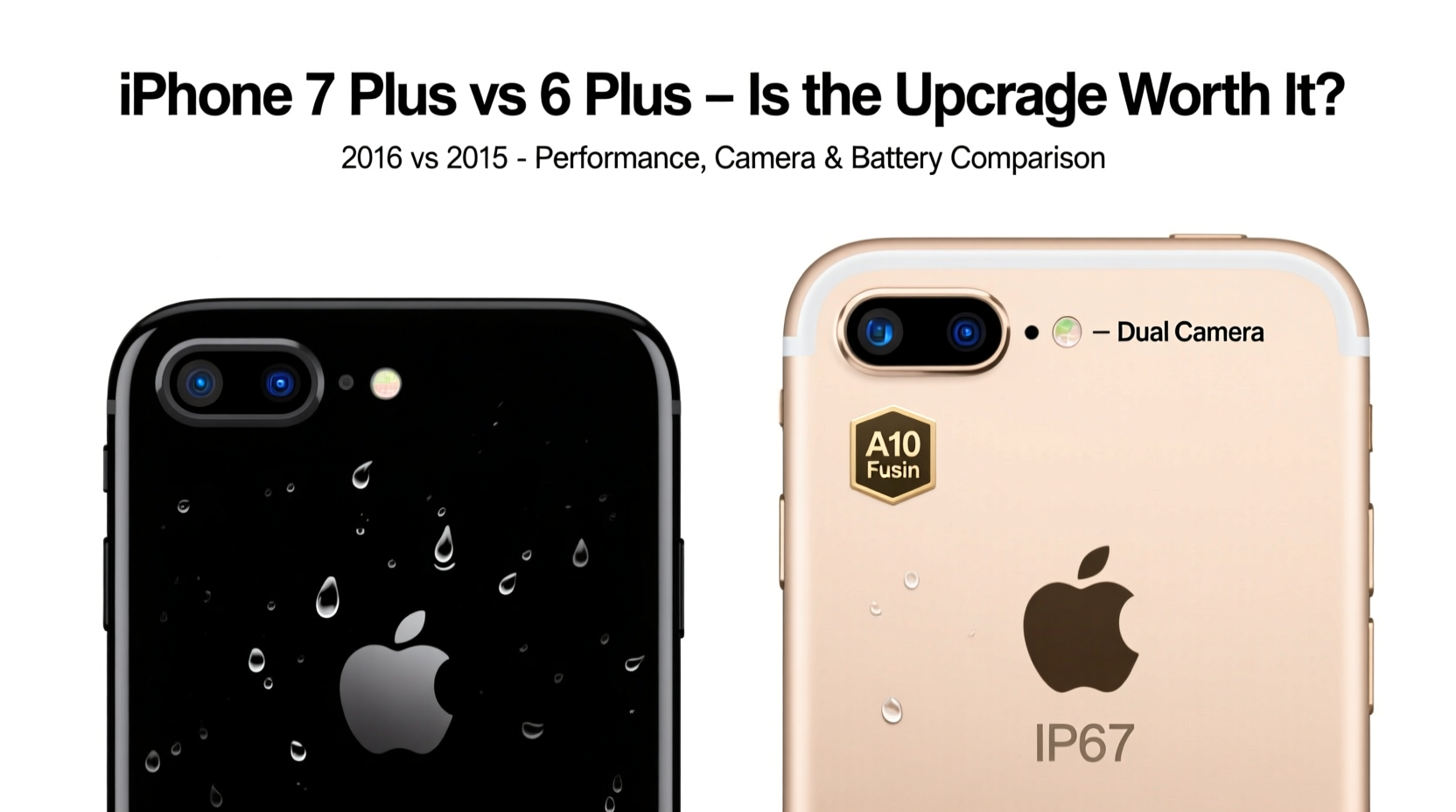
The core difference between the iPhone 6 Plus and 7 Plus lies in processing power and internal architecture. The 6 Plus runs on the Apple A8 chip with 1GB of RAM, while the 7 Plus features the A10 Fusion chip and 3GB of RAM. This may seem like a modest upgrade on paper, but in daily use, the difference is substantial.
Apps launch faster, multitasking is smoother, and iOS updates are better supported on the 7 Plus. While the 6 Plus officially supports up to iOS 12, the 7 Plus received updates all the way to iOS 16, giving it five additional years of security patches and feature enhancements. That extended software support alone makes the 7 Plus more future-proof, even today.
Tip: If your 6 Plus is running iOS 12 or earlier, upgrading to a 7 Plus means access to newer apps, improved privacy controls, and better iCloud integration.Camera Comparison: From Good to Great
The camera is where the iPhone 7 Plus truly outshines its predecessor. The 6 Plus has a single 8MP rear camera with basic autofocus and no optical image stabilization (OIS). In contrast, the 7 Plus introduced a dual-camera system: a 12MP wide-angle lens and a 12MP telephoto lens, enabling 2x optical zoom and Portrait Mode—a feature that simulates DSLR-style depth-of-field effects.
Low-light performance also improved significantly. The 7 Plus includes OIS on the primary lens, larger pixels, and better noise reduction algorithms. Photos taken in dim environments are noticeably clearer and more detailed. Front-facing video quality jumped too, with the 7 Plus supporting 720p HD video at 30fps compared to the 6 Plus’s standard-definition FaceTime recordings.
“Switching from the 6 Plus to the 7 Plus felt like moving from a point-and-shoot to a pro camera. The zoom and portrait features changed how I take photos.” — Marcus T., mobile photographer and tech reviewer
Battery Life and Efficiency
Battery degradation is common in older iPhones, especially after three to four years of daily charging cycles. Even if your 6 Plus originally had solid endurance, its current performance likely pales in comparison to when it was new. The 7 Plus starts with a slightly larger battery (2900mAh vs. 2915mAh) and benefits from the A10 chip’s improved energy efficiency.
In real-world testing, the 7 Plus delivers around 1–1.5 hours more screen-on time than a well-maintained 6 Plus. More importantly, the 7 Plus supports faster charging with a compatible adapter (though Apple didn’t include one in the box), and its battery management system is optimized for longer lifespan under regular use.
Table: Key Differences at a Glance
| Feature | iPhone 6 Plus | iPhone 7 Plus |
|---|---|---|
| Release Year | 2014 | 2016 |
| Processor | A8 chip | A10 Fusion chip |
| Rear Camera | 8MP, single lens | 12MP dual-lens (wide + telephoto) |
| Portrait Mode | No | Yes |
| Water Resistance | No | IP67 rated (up to 1m for 30 mins) |
| Headphone Jack | Yes | No (replaced with Lightning audio) |
| Max Supported iOS | iOS 12 | iOS 16 |
| Battery Capacity | 2915 mAh | 2900 mAh |
| Fingerprint Sensor | Touch ID (1st gen) | Touch ID (2nd gen, faster response) |
Durability and Design Upgrades
The 7 Plus brought meaningful design changes beyond aesthetics. Most notably, it was the first iPhone with official water and dust resistance (IP67 rating). This doesn’t make it waterproof, but it can survive brief submersion or exposure to rain—something the 6 Plus cannot handle at all.
The home button also evolved. Gone is the mechanical press; instead, the 7 Plus uses a solid-state button with haptic feedback. It feels more consistent and is less prone to wear over time. Additionally, the aluminum body is more resistant to bending—addressing early concerns about “bendgate” seen in the 6 series.
One controversial change: Apple removed the 3.5mm headphone jack. While this allows for internal space optimization and better sealing against moisture, it forces users to adapt—either using wireless earbuds, Lightning headphones, or a dongle. If you own high-quality wired headphones, this could be a genuine inconvenience.
Mini Case Study: Sarah’s Upgrade Dilemma
Sarah had used her iPhone 6 Plus since 2015. By 2020, she noticed apps crashing, slow loading times, and frequent battery drain. Her phone struggled with modern messaging apps and couldn’t run the latest version of Instagram smoothly. She considered buying a newer model but hesitated due to cost.
After researching, she found a refurbished iPhone 7 Plus for $120. The upgrade transformed her experience: apps ran instantly, photos looked sharper, and she finally got reliable battery life through the workday. Most importantly, her phone received critical iOS updates that improved security and app compatibility. For Sarah, the upgrade wasn’t just about new features—it restored usability.
When to Upgrade—and When Not To
Deciding whether to upgrade depends on your usage patterns, budget, and expectations. Consider the following checklist before making a move:
✅ Checklist: Should You Upgrade?
- Is your 6 Plus struggling with everyday tasks? Frequent crashes, lag, or inability to install updates signal it’s time.
- Do you value photo quality? The 7 Plus’s dual cameras offer far greater creative flexibility.
- Are you concerned about security? Older devices stop receiving updates, leaving them vulnerable.
- Do you need better battery life? Even with similar capacity, the 7 Plus lasts longer due to efficiency gains.
- Can you find a 7 Plus at a low price? Refurbished models often sell for under $150, offering excellent value.
On the flip side, if your 6 Plus still performs well, you’re satisfied with its camera, and you don’t mind missing out on newer iOS features, holding onto it might make sense—especially if you plan to eventually jump to a much newer model like an iPhone 12 or later.
FAQ
Can the iPhone 6 Plus still be used in 2024?
Yes, but with limitations. It can’t run most modern apps efficiently, lacks security updates, and won’t support upcoming services that require newer iOS versions. It’s best suited for basic calling, texting, and offline use.
Is the iPhone 7 Plus still supported by Apple?
While Apple no longer provides major iOS updates for the 7 Plus (last update was iOS 16), critical security patches may still be issued occasionally. However, new app development increasingly targets devices with A11 chips or later, so long-term app compatibility will continue to decline.
Does the lack of a headphone jack matter?
It depends on your habits. If you rely on wired headphones, the absence of a jack means carrying adapters or switching to Bluetooth. Many users adapt quickly, but it’s a trade-off worth considering.
Final Verdict: Upgrade If You Need Reliability
The iPhone 7 Plus isn’t revolutionary by today’s standards, but compared to the 6 Plus, it represents a meaningful step forward in speed, camera quality, durability, and software longevity. If your 6 Plus is showing signs of age—slow performance, poor battery, outdated software—the upgrade is absolutely worth it, especially at secondhand prices under $150.
However, if you're clinging to your 6 Plus simply because it still works and meets your minimal needs, skipping the 7 Plus in favor of saving for a newer iPhone (like an SE 2022 or iPhone 13) might be smarter. The 7 Plus is now seven years old; it’s near the end of its lifecycle.
🚀 Ready to make a change? Assess your current phone’s performance, check local listings for used 7 Plus units, and consider whether a small investment now can extend your mobile experience by another two years. Share your thoughts—have you upgraded or held on? Your experience could help others decide.








