If you're still holding onto your iPhone 6 Plus—perhaps out of loyalty, familiarity, or simple reluctance to change—the question of whether upgrading to a Samsung Galaxy Note 7 was ever worthwhile might cross your mind. Though both devices are now considered legacy models, their head-to-head matchup in 2016 sparked intense debate among mobile users. Understanding that context helps clarify not just historical value, but also what kind of upgrade experience you could have expected.
The iPhone 6 Plus, released in 2014, represented Apple’s first major push into the phablet market. By contrast, the Galaxy Note 7 arrived two years later as Samsung’s flagship powerhouse, boasting cutting-edge features and an aggressive design language. But was switching from iOS to Android—and from Apple’s ecosystem to Samsung’s—truly beneficial for long-time iPhone users?
Design and Build: A Clash of Philosophies
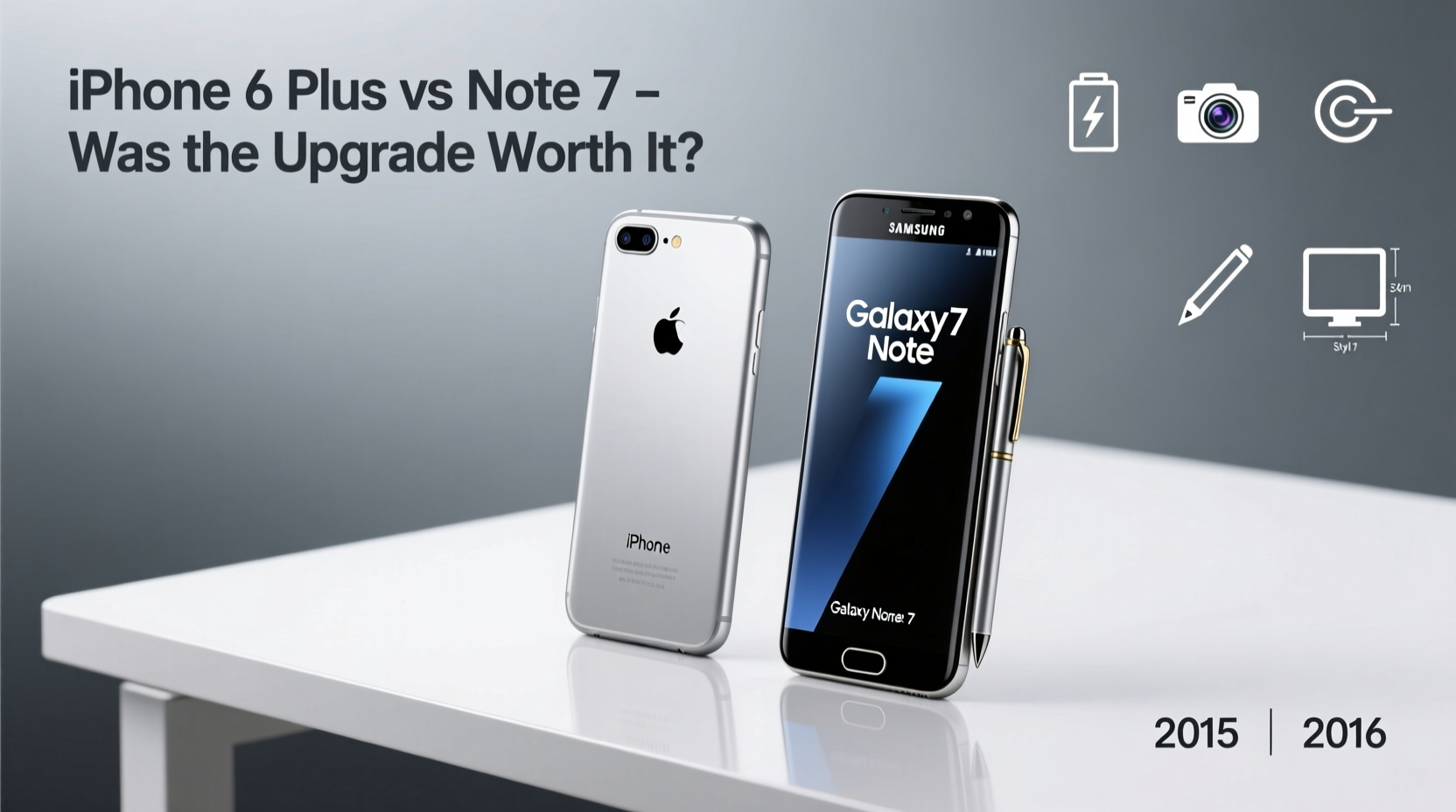
The physical differences between the iPhone 6 Plus and the Note 7 were stark. The iPhone 6 Plus featured a familiar aluminum unibody with rounded edges, delivering solid build quality but showing signs of aging by 2016. Its 5.5-inch display felt large at launch but began to look dated next to slimmer bezels and higher screen-to-body ratios emerging in competitors.
The Note 7, however, turned heads with its curved-edge Quad HD Super AMOLED display, glass front and back, and refined metal frame. It was smaller in footprint than the 6 Plus despite having a larger 5.7-inch screen, thanks to minimal bezels. For users seeking modern aesthetics and immersive visuals, the leap in design alone made the Note 7 feel like a significant upgrade.
Tip: If you value one-handed usability, measure how each phone fits in your hand—even small differences in width can impact comfort over time.Performance and Software Experience
Under the hood, the iPhone 6 Plus used Apple’s A8 chip with 1GB RAM. While optimized well through iOS, it struggled with multitasking and newer apps by 2016. iOS updates continued support, but performance lag became noticeable, especially when launching apps or switching between them.
The Note 7, powered by either the Snapdragon 820 or Exynos 8890 (depending on region), came with 4GB of RAM. This allowed smoother multitasking, faster app launches, and better handling of graphics-intensive tasks. Paired with Android 6.0 Marshmallow and Samsung’s TouchWiz (later rebranded as Samsung Experience), the software offered deep customization, split-screen mode, and advanced productivity tools—features absent on iOS at the time.
Switching from iOS to Android meant adapting to a new interface, file system, and ecosystem. iCloud users had to migrate photos, contacts, and messages to Google services, which wasn’t always seamless. However, those who embraced the flexibility often found Android more powerful for personalization and task automation.
“Moving from iPhone to Android in 2016 was less about raw specs and more about control. The Note 7 gave users options Apple simply didn’t offer.” — David Lin, Mobile Tech Analyst at TechPulse Weekly
Camera Comparison: Quality vs Consistency
The iPhone 6 Plus featured an 8MP rear camera with optical image stabilization—a capable shooter in daylight but limited in low light and lacking manual controls. Apple prioritized consistency and color accuracy over megapixel count, resulting in reliable point-and-shoot performance.
The Note 7 upgraded to a 12MP dual-pixel sensor with improved low-light performance, faster autofocus, and richer dynamic range. Its front-facing camera also jumped to 5MP, ideal for video calls and sharper selfies. With Pro Mode, users could adjust ISO, shutter speed, and white balance—something the iPhone didn’t allow without third-party apps.
In side-by-side tests, the Note 7 generally produced more vibrant, detailed images, especially indoors or at dusk. However, some users preferred the natural skin tones and balanced exposure of the iPhone’s camera, particularly for casual social media sharing.
Battery Life and Charging Innovations
Battery capacity favored the iPhone 6 Plus with 2915 mAh compared to the Note 7’s 3500 mAh. Yet due to inefficient hardware and iOS background processes, real-world endurance was comparable—both lasted around a full day under moderate use.
Where the Note 7 pulled ahead was in charging technology. It introduced fast charging and wireless charging—features absent on any iPhone until years later. Users could regain half their battery in under 30 minutes, a major convenience for travelers or heavy users.
However, the elephant in the room remains: the Note 7’s infamous battery overheating issue led to a global recall in late 2016. While replacement units were safe, the stigma affected resale value and consumer trust. For risk-averse users, this single flaw overshadowed every technical advantage.
Tip: Always check device history before buying a used flagship—especially for recalled models like the Note 7.Detailed Feature Comparison Table
| Feature | iPhone 6 Plus | Samsung Galaxy Note 7 |
|---|---|---|
| Release Year | 2014 | 2016 |
| Display | 5.5\" LCD, 1920×1080 | 5.7\" Quad HD AMOLED, Curved Edges |
| Processor | Apple A8 | Snapdragon 820 / Exynos 8890 |
| Rear Camera | 8MP, OIS | 12MP, Dual Pixel AF |
| Front Camera | 1.2MP | 5MP |
| Battery | 2915 mAh | 3500 mAh (Recall Affected) |
| Charging | Standard USB | Fast & Wireless Charging |
| Water Resistance | No | IP68 Rated |
| Stylus Support | No | Yes (S-Pen with Pressure Sensitivity) |
| Ecosystem | iOS, iCloud, App Store | Android, Google Services, Samsung DeX (later) |
Real-World Upgrade Scenario: A Mini Case Study
Consider Mark, a freelance photographer who used his iPhone 6 Plus for four years. He loved the camera’s reliability and integration with his MacBook but grew frustrated with slow app performance and lack of external storage. In mid-2016, he traded up to a Note 7.
Initially, he missed iMessage and AirDrop. Transferring RAW files required learning new cloud workflows. But within weeks, he appreciated the S-Pen for annotating client proofs, the superior screen for editing, and fast charging during shoots. The ability to expand storage via microSD meant he could carry thousands of high-res images without relying solely on cloud sync.
When the recall happened, Mark received a replacement unit and continued using it safely for over a year. His verdict? “The upgrade was absolutely worth it—for my work. But only because I was willing to adapt.”
Checklist: Should You Have Upgraded?
Before making such a switch, consider these factors:
- Evaluate Your Needs: Do you need stylus input, expandable storage, or multi-window functionality?
- Assess Ecosystem Ties: Are you invested in Apple devices (Mac, iPad, Watch)? Switching breaks seamless integration.
- Check Safety Records: For older models like the Note 7, verify if the unit is a post-recall replacement.
- Test Daily Drivers: Try borrowing a friend’s Android phone to gauge comfort with navigation and app layout.
- Consider Longevity: Even powerful phones degrade; ensure software support timelines align with your usage cycle.
Frequently Asked Questions
Was the Samsung Galaxy Note 7 safe after the recall?
Yes, Samsung issued a second batch of Note 7s with redesigned, non-flammable batteries. These \"safe\" units were rigorously tested and widely regarded as stable. However, many carriers discontinued sales entirely, and public perception never fully recovered.
Could I get all my iPhone apps on the Note 7?
Most major apps like WhatsApp, Instagram, and Gmail were available on both platforms. However, some iOS-exclusive apps (e.g., GarageBand, certain banking tools) had no Android equivalent or offered reduced functionality.
Did the Note 7 support iOS-style features like iMessage or FaceTime?
No direct equivalents existed. Samsung offered ChatON (discontinued) and later integrated RCS messaging, but none matched iMessage’s encryption and ecosystem lock-in. Video calling relied on third-party apps like Skype or Hangouts.
Final Verdict: Was the Upgrade Worth It?
For power users, creatives, and tech enthusiasts, the Galaxy Note 7 represented a meaningful leap in capability, design, and innovation over the iPhone 6 Plus. Features like the S-Pen, water resistance, fast charging, and superior multitasking justified the switch—if you were ready to leave Apple’s ecosystem behind.
But for casual users deeply embedded in iCloud, reliant on iMessage, or wary of hardware risks, sticking with the iPhone 6 Plus (or moving to a newer iPhone) made more sense. The Note 7’s brilliance was undeniable, but its legacy was tarnished—not by performance, but by safety concerns that eroded trust.
In hindsight, the upgrade was worth it only for those prioritizing functionality over familiarity and willing to navigate the transition challenges. Today, neither device is recommended for primary use, but understanding their trade-offs offers valuable insight into how personal priorities shape technology decisions.
💬 Have you made the jump from iPhone to Android—or stayed loyal? Share your experience and help others weigh their options when considering bold upgrades.








