Burgundy lipstick occupies a rare space in beauty: rich, intelligent, and deeply expressive—but also dangerously easy to misread. Worn incorrectly, it can read as funereal, overly corporate, or like you’re auditioning for a Victorian opera. Yet when balanced thoughtfully, burgundy becomes quietly magnetic—a shade that signals self-assurance without shouting, sophistication without stiffness, and warmth without compromise. The issue isn’t the color itself; it’s the context. Burgundy doesn’t demand formality—it responds to it. Strip away the assumptions, and you’ll find it’s one of the most versatile lip colors for real life: coffee runs, school drop-offs, creative meetings, weekend brunches, even hiking trails (yes, really). This guide cuts through outdated rules and offers actionable, skin-informed, wardrobe-anchored strategies—not trends, but translations—for wearing burgundy like it belongs to you, not the other way around.
1. Understand Your Burgundy—Not All Reds Are Created Equal
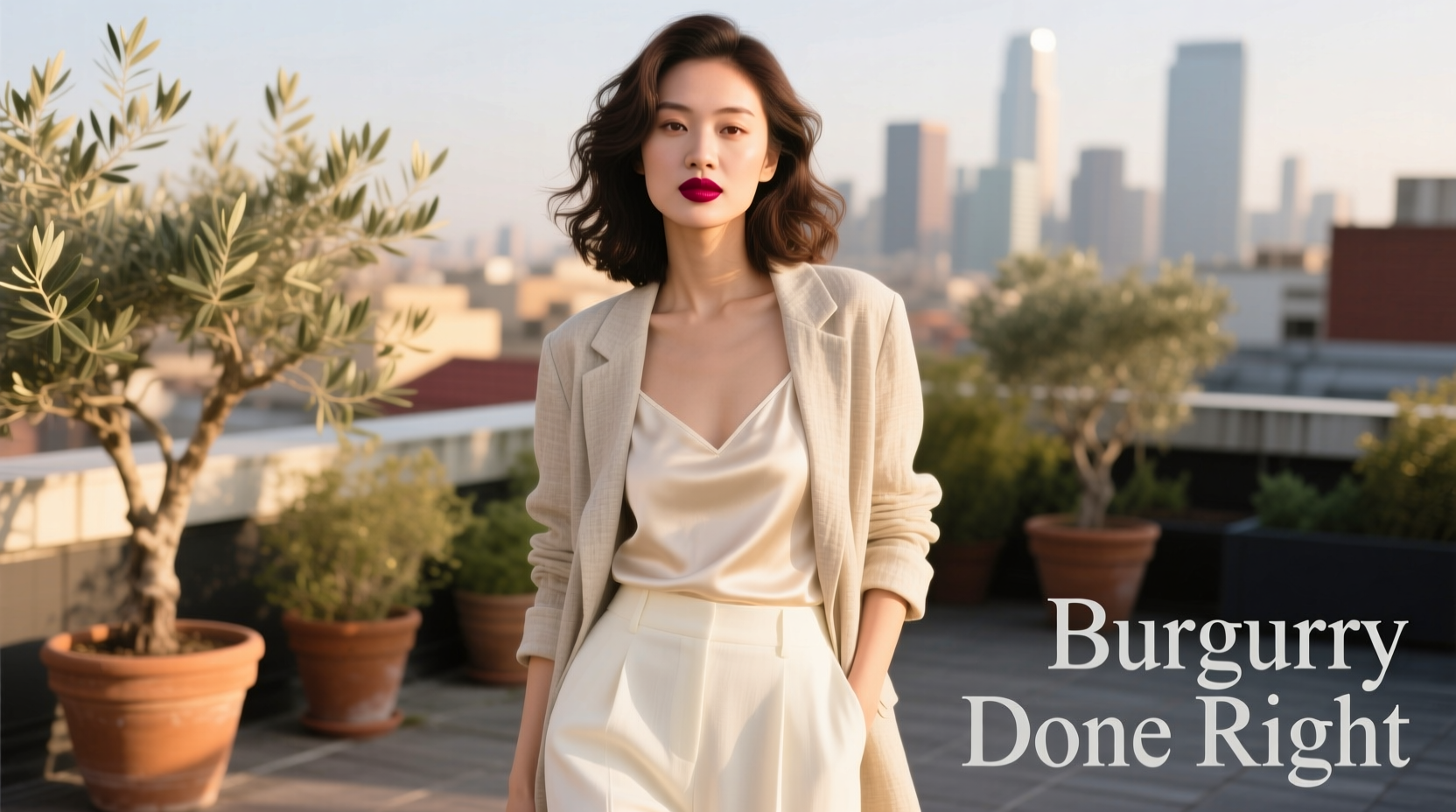
The word “burgundy” covers a surprisingly wide spectrum—from cool, blue-based blackberry to warm, brown-tinged plum, from sheer mulled-wine stains to opaque oxblood. Choosing the right undertone is the first and most consequential decision. A mismatched burgundy won’t just look “off”—it can dull your complexion, emphasize sallowness, or make eyes appear tired.
Here’s how to narrow it down:
- Cool burgundies contain visible blue or violet pigments. They flatter fair to medium complexions with pink or rosy undertones—and often enhance green or grey eyes. Think: “wine stain,” “black currant,” or “dried violet.”
- Warm burgundies lean toward brick, cinnamon, or burnt umber. They harmonize beautifully with olive, golden, or deeper skin tones—and bring out warmth in brown or hazel eyes. Think: “spiced plum,” “fig jam,” or “aged port.”
- Neutral burgundies balance red and brown evenly, with minimal blue or orange dominance. These are the most universally wearable—ideal for beginners or those who want flexibility across seasons and outfits.
Also consider finish. Matte burgundies carry the highest risk of looking severe—especially if over-applied or paired with heavy contouring. Sheer, satin, or creamy finishes diffuse intensity and introduce softness. A hydrating burgundy balm with subtle pigment, for example, delivers depth without definition—and feels entirely unceremonious.
2. Soften the Lip Line—Not With Erasers, But With Intention
A sharp, perfectly drawn burgundy lip is a masterpiece—but it’s also a visual anchor that commands attention and reads as deliberate, even ceremonial. To avoid that effect, embrace intentional softness: blurred edges, feathered transitions, and lips that look lived-in, not lacquered.
This isn’t about skipping liner—it’s about rethinking its role. Instead of tracing a precise border, use a matching or slightly deeper lip pencil to gently fill in the entire lip first. Then, apply your burgundy lipstick over top. Blot lightly with a tissue, then softly smudge the outermost edge with your fingertip or a clean lip brush. The result? A diffused halo of color—not a graphic outline.
For extra realism, try the “reverse gradient”: apply your lightest neutral lip balm to the center of both lips, then layer burgundy only on the outer third. The subtle contrast mimics natural blood flow and creates dimension without structure.
“Precision lip lines belong in editorial shoots—not daily life. What reads as ‘polished’ on camera often reads as ‘performative’ in person. Real confidence lives in the soft edges.��� — Lena Torres, Makeup Artist & Educator, 15+ years working with diverse skin tones and lifestyles
3. Balance the Rest of Your Face—The 80/20 Rule
Burgundy is a strong color—but strength doesn’t require dominance. Apply the 80/20 rule: let burgundy occupy 20% of your face’s visual weight, while the remaining 80% remains relaxed, neutral, and skin-forward.
This means scaling back elsewhere—not eliminating—contrast. Skip heavy eyeliner on the upper lash line. Opt instead for tightlining (filling the upper waterline only) or a single coat of brown-black mascara. Keep brows brushed up and full, but avoid over-defining with hard wax or pomade. Let your skin breathe: skip powder-heavy foundation in favor of a lightweight tinted moisturizer or serum foundation. If you use concealer, apply it only where needed—not as an all-over veil.
Eyes benefit especially from warmth. Swap cool-toned greys and silvers for copper, taupe, or soft terracotta shadows. A single swipe of bronze cream shadow on the lid, blended upward into the crease, adds quiet dimension without competing. Similarly, a hint of peachy blush on the apples of the cheeks warms the face from within—counterbalancing burgundy’s depth without clashing.
| Face Area | Do | Avoid |
|---|---|---|
| Eyes | Tightlining + brown-black mascara; warm metallic lid shade | Winged liner; matte charcoal shadow all over lid |
| Cheeks | Peach, apricot, or rose-gold cream blush applied with fingers | Matte cool pinks or stark nudes that mute warmth |
| Skin Finish | Dewy, hydrated base; minimal powder only on T-zone | Full matte foundation + heavy setting powder |
| Brows | Gel-only hold; slight lift at tail; natural hair strokes | Hard pencil outlining or blocky, filled-in shapes |
4. Anchor It in Your Wardrobe—Not Your Occasion
People assume burgundy belongs only in boardrooms or black-tie events because they’ve only seen it paired with charcoal suits and pearl studs. In reality, burgundy sings alongside denim, linen, oatmeal knits, and even faded band tees. The key is anchoring—not matching.
Think in terms of tonal companionship, not coordination. A deep burgundy lip pairs effortlessly with:
- Mid-wash or raw denim (especially when sleeves are rolled, hair is loose, and footwear is minimalist sandals or white sneakers)
- Oatmeal, camel, or mushroom-colored knits (the earthy warmth echoes burgundy’s richness without echoing its intensity)
- Soft ivory or off-white cotton shirts (creates gentle contrast—not stark opposition)
- Even faded indigo or sage green jackets (cool burgundies especially harmonize here)
Avoid pairing burgundy with other saturated darks—like navy blazers *and* black turtlenecks *and* patent pumps—unless that’s your deliberate aesthetic. One strong element is enough. Let the lip be the statement; everything else should feel grounded, effortless, and human-scaled.
Real-world example: Maya, a 34-year-old pediatric occupational therapist in Portland, wore a sheer burgundy lip stain with a slouchy oatmeal sweater, high-waisted light-blue jeans, and canvas slip-ons during a busy clinic day. Her patients’ parents commented twice on how “calm and capable” she looked—not “serious” or “intimidating.” Later, she added gold hoops and swapped her glasses for sunglasses and walked straight to a neighborhood wine bar. No reapplication, no change—just presence. Her secret? She used a burgundy lip oil (not a matte liquid lipstick), skipped eyeliner entirely, and dabbed a warm cream blush on her cheekbones with her ring finger. The color didn’t shout. It settled—in her smile, her confidence, her rhythm.
5. Master the Everyday Application Ritual—A 4-Step Sequence
How you apply burgundy matters as much as what you choose. A rushed, patchy application amplifies harshness. A thoughtful, tactile process invites softness. Follow this sequence—designed for speed, realism, and zero pressure:
- Prep with hydration, not exfoliation: Skip scrubs unless lips are visibly flaking. Instead, massage a pea-sized amount of plain petroleum jelly or squalane oil onto lips 5 minutes before application. Gently blot excess—this creates a smooth, plump base without removing natural texture.
- Blur, don’t outline: Using a lip brush or fingertip, dab a lip liner *one shade deeper than your burgundy* only along the outermost edge—then immediately smudge inward with your finger. Don’t draw a line; create a suggestion.
- Layer with breath: Apply burgundy in two thin layers—not one thick one. After the first, pause for 10 seconds. Breathe. Then apply the second, focusing only on the outer half of each lip. Let the center remain slightly lighter.
- Final softening: Press lips together gently on a tissue—don’t rub. Then, using your clean ring finger, lightly tap the very outer corners and Cupid’s bow to further diffuse any hard edge.
FAQ
Can I wear burgundy lipstick if I have yellow or olive skin?
Absolutely—and often with exceptional resonance. Olive and yellow-based complexions frequently harmonize best with warm or neutral burgundies (think fig, prune, or spiced cranberry). Cool burgundies can sometimes cast a greyish cast on these skin tones, so always test in daylight. When in doubt, swatch on your jawline, not your hand: the jawline matches your neck and face tone far more accurately.
What if my teeth aren’t perfectly white? Won’t burgundy highlight discoloration?
It’s a common concern—but rarely a real issue. Burgundy doesn’t inherently “highlight” teeth; high-contrast bright whites do. In fact, many warm burgundies (especially those with brown or terracotta notes) create a grounding effect that draws attention to your eyes and expression—not your enamel. If you’re sensitive, avoid cool, blue-based burgundies and steer clear of ultra-matte, flat finishes, which can exaggerate contrast. A satin or creamy formula reflects light softly and keeps focus where you want it: your presence.
How do I make burgundy work with glasses—especially bold frames?
Glasses already add structure, so simplify elsewhere. Choose a burgundy with a subtle sheen (not gloss, not matte) and keep your brow shape soft and natural—not sharply angled or overfilled. Avoid pairing with heavy eyeshadow or dramatic lashes, which compete for visual weight. Let your frames be the architectural element; let your lips be the warm, human counterpoint.
Conclusion
Burgundy lipstick isn’t a costume. It’s a choice—one that says you value depth, appreciate nuance, and refuse to flatten yourself into seasonal trends or occasion-based expectations. Wearing it without formality isn’t about diluting its power. It’s about redirecting it: from performance to presence, from precision to pulse, from “look at my lips” to “listen to what I’m saying.” You don’t need permission to soften the edges, lighten the finish, or pair it with ripped jeans and messy buns. You don’t need flawless skin, perfect teeth, or a closet full of neutrals. You just need to trust your intuition, honor your natural warmth, and treat the color like a collaborator—not a commander.
Start small: try a burgundy lip oil this week. Wear it with your favorite sweatshirt. Notice how people respond—not to the color alone, but to the ease it lets you inhabit. Then try the blurred-liner technique with a creamy bullet. Then experiment with that terracotta eye wash. Each step isn’t about mastering burgundy. It’s about remembering how confidently, comfortably, and completely you can take up space—exactly as you are.
💬 Your turn. Which burgundy moment changed how you saw yourself? Did a certain finish surprise you? Share your real-life insight in the comments—we’re building a library of authenticity, not aesthetics.








