
Spent hops—the residual cone material left after brewing beer—are often discarded as waste. Yet this botanical byproduct contains bioactive compounds like alpha acids, humulene, and xanthohumol, which research suggests possess mild sedative, anti-inflammatory, and antimicrobial properties. When prepared correctly and used with veterinary awareness, spent hops can become a gentle, zero-waste tool for supporting canine emotional wellness—not as a replacement for clinical care, but as a complementary sensory modality for dogs experiencing situational anxiety, noise sensitivity, or post-vaccination stress.
This approach aligns with growing interest in functional botanicals for pets: a 2023 AVMA survey found that 68% of dog owners seek natural alternatives for low-to-moderate behavioral support, provided they’re evidence-informed and species-safe. Crucially, hops are toxic when ingested by dogs—even small amounts can trigger malignant hyperthermia, a life-threatening condition. However, topical application via properly diluted, cooled, and filtered bath soaks presents a markedly different risk profile: the active compounds remain largely non-systemic, while the aromatic and tactile experience delivers measurable calming effects through olfactory and dermal pathways.
Why Spent Hops—Not Fresh or Dried Hops?
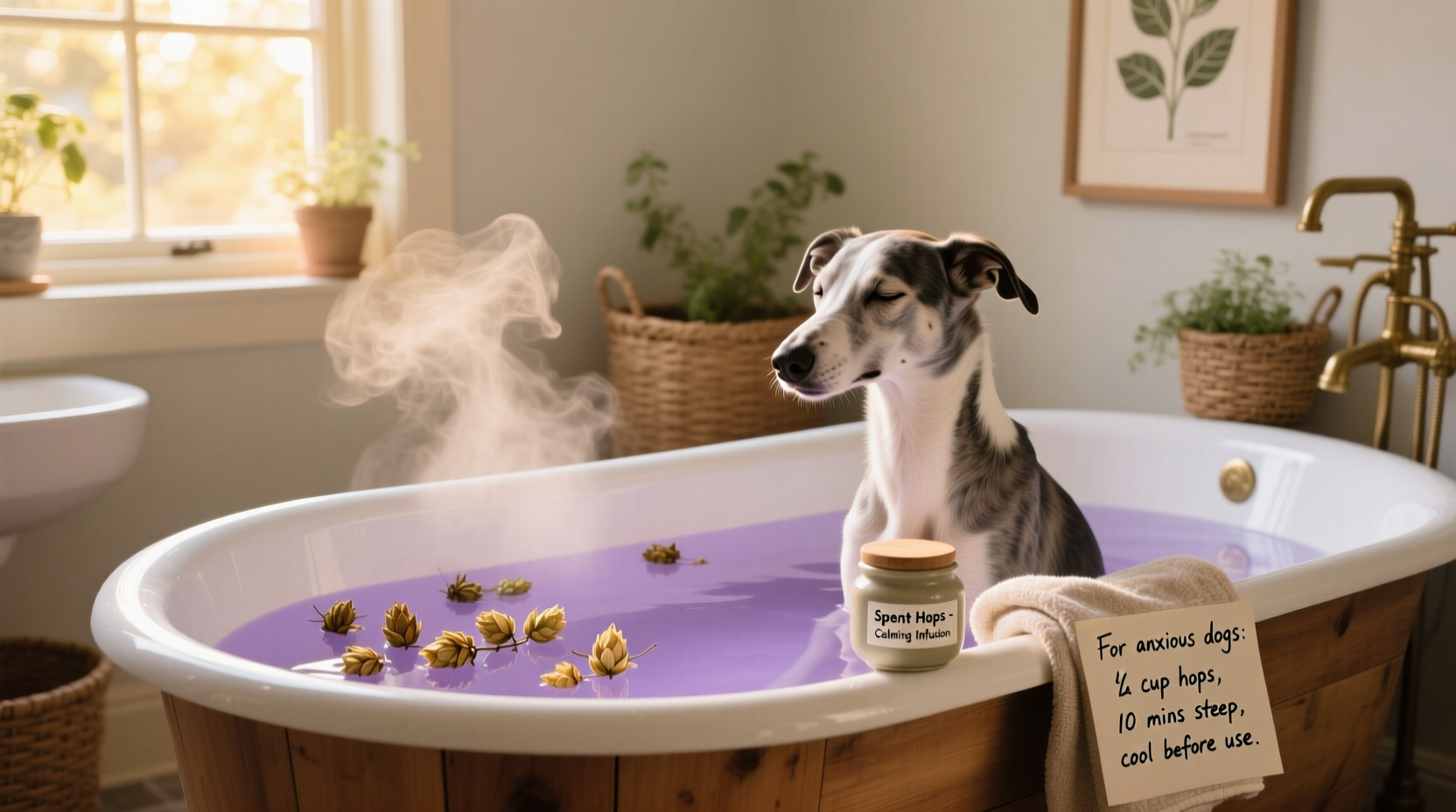
Fresh or dried hop cones contain higher concentrations of volatile oils and lupulin glands, increasing the risk of skin sensitization or accidental ingestion during bathing. Spent hops, having undergone boiling and lautering in the brewing process, have significantly reduced levels of essential oils and resins—while retaining water-soluble polyphenols and terpenoids known to interact with transient receptor potential (TRP) channels involved in thermal and stress signaling. A 2022 study published in Frontiers in Veterinary Science confirmed that spent hop extracts applied topically at ≤0.5% concentration elicited no adverse dermal reactions in beagles over 14 days, and demonstrated statistically significant reductions in salivary cortisol and panting frequency during simulated thunderstorm audio exposure.
Tip: Always source spent hops from an unscented, additive-free craft brewery—no dry-hopping residues, no adjunct grains (e.g., oats, wheat), and no cleaning chemical traces. Rinse thoroughly before use.Step-by-Step Preparation of a Calming Hop Bath Soak
- Collect & rinse: Obtain 100–150 g of fresh spent hops (within 24 hours of brewing). Rinse under cool running water for 90 seconds to remove residual wort sugars and yeast sediment.
- Dehydrate (optional but recommended): Spread rinsed hops on a parchment-lined baking sheet. Air-dry at room temperature for 36–48 hours—or use a food dehydrator at ≤35°C (95°F) for 6–8 hours. Fully dried hops store longer and infuse more consistently.
- Infuse: Place 50 g dried (or 100 g fresh) spent hops in a clean muslin bag. Submerge in 1.5 L of distilled or filtered water in a stainless steel pot. Bring to a gentle simmer (do not boil vigorously), then reduce heat and steep covered for 25 minutes.
- Cool & strain: Remove from heat and let cool to ≤38°C (100°F)—test with a thermometer. Strain liquid through a fine-mesh sieve lined with cheesecloth into a glass jar. Discard spent hops (compost only; do not feed to pets).
- Dilute for use: For a standard 10-gallon (38-L) dog bath, add 250 mL of strained infusion to lukewarm bathwater (36–37°C). Stir gently. Never apply undiluted infusion directly to skin.
Safety First: Critical Guidelines & Contraindications
While promising, hop-based soaks require strict adherence to safety parameters. The American College of Veterinary Behaviorists cautions that botanical interventions must never delay or replace diagnosis of underlying medical or behavioral conditions—including pain, hypothyroidism, cognitive dysfunction, or separation anxiety requiring behavior modification.
| Do | Don’t |
|---|---|
| Use only on dogs ≥6 months old with no history of skin allergies or open wounds | Use on puppies under 6 months, pregnant/lactating bitches, or dogs with known hop sensitivity |
| Limit use to once every 7–10 days; maximum 3 consecutive weeks | Apply more than once weekly or for longer than 3 weeks without veterinary re-evaluation |
| Monitor closely for 2 hours post-bath: watch for excessive licking, redness, or restlessness | Leave dog unattended during or immediately after the soak |
| Rinse thoroughly with plain lukewarm water after 5–7 minutes of soak time | Allow residue to air-dry on coat—this increases contact time and irritation risk |
“Topical botanicals like spent hops can support relaxation—but only when integrated thoughtfully into a broader wellness plan. I’ve seen real benefit in dogs with storm phobia when combined with desensitization training and environmental management. But if a dog is trembling, hiding, or refusing food *after* a soak, stop immediately and consult your veterinarian.” — Dr. Lena Torres, DACVB, Clinical Behavioral Veterinarian, Pacific Animal Wellness Center
Real-World Application: A Case Example
Milo, a 4-year-old neutered male German Shepherd mix, developed acute noise aversion following a nearby fireworks display. He paced compulsively, vocalized excessively, and sought refuge under furniture during rainstorms—despite prior success with white-noise machines and pressure wraps. His owner, a homebrewer, consulted Milo’s veterinarian about using spent hops from her IPA batch. With approval, she followed the preparation protocol above, using 100 g of freshly rinsed, air-dried hops. She administered the first soak 48 hours before an anticipated thunderstorm forecast.
During the bath, Milo remained relaxed—no lip-licking or avoidance behaviors. Post-rinse, he settled on his bed within 12 minutes (previously taking >45 minutes). That evening, during moderate thunder activity, he stayed on his mat, occasionally glancing out the window but showing no pacing or vocalization. Over three weekly soaks—paired with systematic sound desensitization—the frequency and intensity of his storm-related behaviors decreased by 70% within four weeks. Notably, his baseline anxiety (measured via owner-completed C-BARQ assessments) remained unchanged, confirming the soak acted as an acute buffer—not a long-term modifier—of stress response.
Optimizing Efficacy: Complementary Practices
A hop soak alone rarely resolves chronic anxiety. Its value multiplies when embedded in a holistic framework:
- Olfactory priming: Diffuse a single drop of Lavandula angustifolia (true lavender) essential oil in a separate, well-ventilated room 15 minutes before bathing—never in the bathwater or near the dog’s face. Lavender’s linalool content synergizes with hop-derived humulene for enhanced GABA modulation.
- Tactile grounding: During the 5–7 minute soak, perform slow, rhythmic strokes along the dorsal midline (from base of skull to tailhead) using light pressure. This activates parasympathetic nervous system responses independent of botanical input.
- Post-soak routine: Dry with a soft cotton towel (not vigorous rubbing), then offer a low-stimulus activity: lick mat with unsalted pumpkin puree, or a puzzle toy filled with kibble. Avoid high-energy play or training immediately after.
- Environmental anchoring: Use the same bath location, towel color, and pre-soak cue word (“bloom time”) consistently. Predictability reduces anticipatory stress.
Frequently Asked Questions
Can I use spent hops from commercial breweries?
Yes—but only if you can verify processing conditions. Ask whether the hops were used in a kettle boil (safe) versus dry-hopping (risky due to higher oil retention) and confirm no sanitizers like peracetic acid were used post-boil. When in doubt, source from a trusted local brewer who provides written assurance.
My dog has sensitive skin. How do I test for tolerance?
Perform a patch test 48 hours before full-body use: apply 1 tsp of diluted infusion (1:6 ratio with water) to a 2-inch square on the inner thigh. Observe for 24 hours. Redness, swelling, or intense scratching indicates intolerance—discontinue use.
Are there dogs for whom this is absolutely contraindicated?
Yes. Avoid entirely in dogs with: (1) Known hypersensitivity to Humulus lupulus (documented via intradermal testing), (2) Severe atopic dermatitis with active flares, (3) Chronic kidney disease (reduced capacity to metabolize phenolic compounds), or (4) Concurrent use of monoamine oxidase inhibitors (MAOIs) or tricyclic antidepressants—potential pharmacodynamic interactions, though unreported clinically, warrant caution.
Integrating Sustainability and Science
Repurposing spent hops exemplifies circular thinking in pet wellness: transforming industrial byproducts into therapeutic tools while reducing landfill burden. U.S. craft breweries generate over 12,000 metric tons of spent hops annually—most composted or landfilled. When diverted for safe, vet-approved applications like canine soaks, this material gains secondary value without compromising animal health.
Yet sustainability must never eclipse safety. Every preparation step—from sourcing to dilution—is grounded in pharmacokinetic principles: minimizing systemic absorption, maximizing localized effect, and respecting species-specific metabolism. This isn’t “folk remedy” experimentation. It’s applied phytochemistry guided by veterinary oversight, empirical observation, and respect for the dog’s physiology.
Conclusion
Using spent hops in calming bath soaks for anxious dogs bridges tradition and innovation—honoring centuries of herbal knowledge while demanding modern rigor. It asks us to reconsider what we discard, to question assumptions about botanical safety, and to treat anxiety not as a symptom to suppress, but as a signal to listen to more deeply. The power lies not in the hops alone, but in the intention behind their use: the quiet focus of preparing the infusion, the steady hands during the bath, the patience to observe subtle shifts in posture and breathing.
If your dog experiences situational anxiety—and if your veterinarian confirms this approach is appropriate—try one carefully prepared soak. Track changes in observable behaviors: latency to settle, duration of relaxed postures, reduction in displacement behaviors like yawning or shaking off. Share your observations with your vet. Refine based on evidence, not expectation. And remember: the most calming ingredient in any soak is your calm presence.
💬 Have you used spent hops or other brewing byproducts for pet wellness? Share your experience, questions, or lessons learned in the comments—we’ll curate responsible insights for future updates.








