
Parrots are among the most intelligent birds in the animal kingdom, capable of mimicking human speech with remarkable clarity. While not all parrots will become fluent conversationalists, many—especially species like African Greys, Amazon parrots, and Budgerigars—can learn words and phrases when trained correctly. The key lies in understanding their natural behavior, leveraging repetition, and building trust through positive reinforcement. Bird behaviorists emphasize that successful vocal training isn’t about forcing sounds but creating an environment where mimicry becomes a rewarding social activity.
This guide breaks down practical, research-supported methods used by avian experts to teach parrots to talk. From choosing the right words to recognizing subtle behavioral cues, these steps are designed to align with how parrots naturally learn in the wild and in captivity.
Understanding Parrot Vocal Learning: The Science Behind Talking Birds
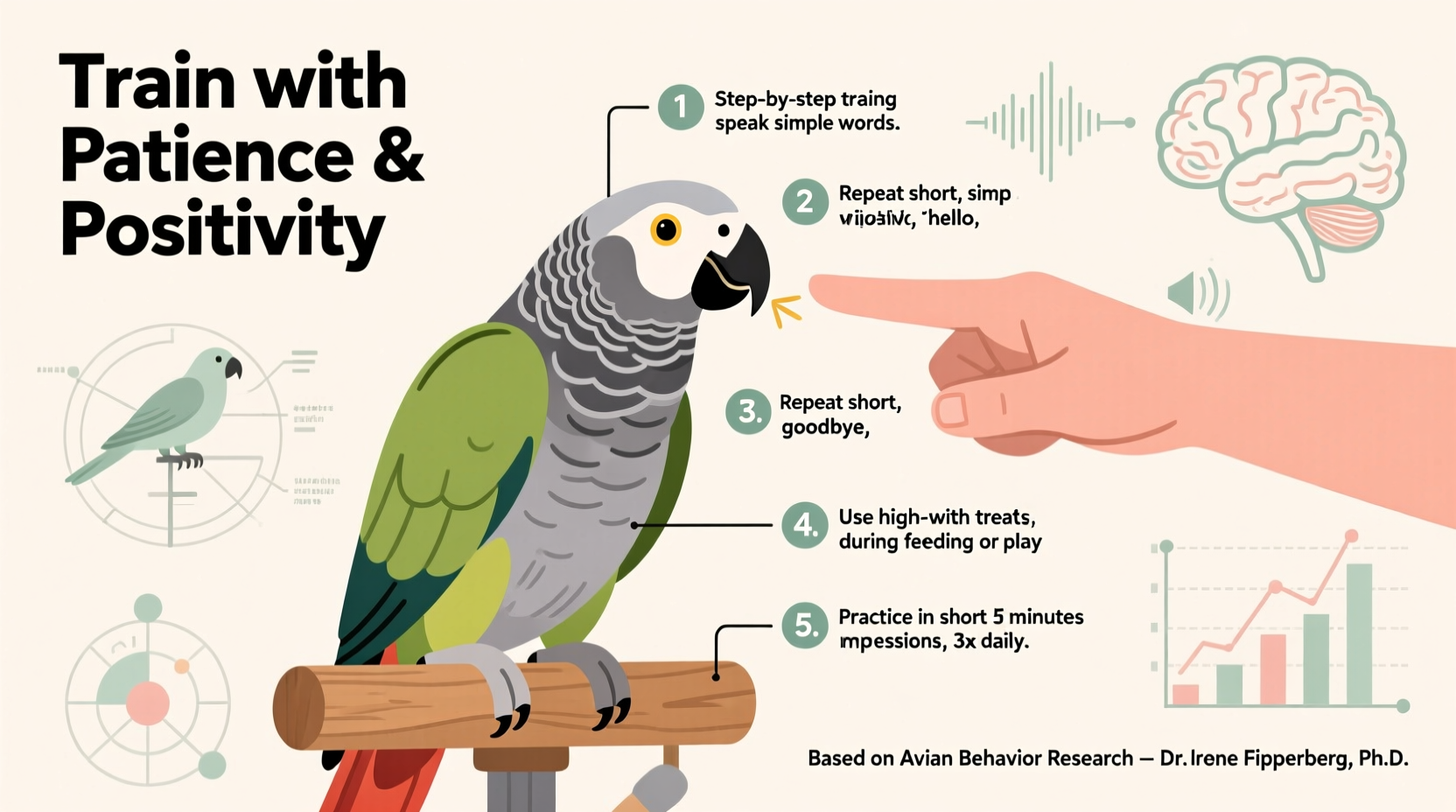
Unlike most animals, parrots possess a unique brain structure that enables complex vocal learning. Studies conducted at institutions like the Max Planck Institute for Ornithology show that parrots have specialized neural circuits connecting auditory processing centers with motor control regions responsible for sound production. This allows them to hear a sound, memorize it, and reproduce it accurately—a skill shared only with humans, some songbirds, and cetaceans.
In the wild, parrots use vocalizations to maintain flock cohesion, signal danger, or establish territory. In captivity, they transfer this instinct to interact with their human \"flock.\" According to Dr. Irene Pepperberg, renowned researcher and developer of the Model/Rival Training technique used with her famous African Grey, Alex:
“Parrots don’t just imitate—they associate sounds with meaning. When we treat their vocal attempts as communication, not noise, we open pathways for real language comprehension.” — Dr. Irene Pepperberg, Avian Cognitive Scientist
This insight shifts the goal from mere mimicry to meaningful interaction. A well-trained parrot doesn’t just repeat “Hello!”; it may begin to use the word contextually when someone enters the room.
Step-by-Step Guide: Training Your Parrot to Speak Clearly
Effective training follows a predictable sequence grounded in behavioral psychology. Below is a six-phase timeline based on protocols used in avian cognition labs and recommended by certified bird behavior consultants.
- Build Trust (Days 1–7): Spend quiet time near the cage daily. Offer treats through the bars without reaching in. Let the bird initiate contact.
- Select Target Words (Day 8): Choose 2–3 short, high-frequency words like “hello,” “good,” or the bird’s name. Use consistent pronunciation.
- Modeling Phase (Days 9–21): Say the target word clearly every time you pass the cage or during feeding. Pair each utterance with eye contact and a smile.
- Reinforcement Loop (Weeks 4–6): Reward any approximation—whistle, babble, or mumble—that resembles the word with praise and a small treat.
- Contextual Practice (Weeks 7–10): Use the word in real situations. Say “hello” when entering the room. Repeat immediately after the bird makes a similar sound.
- Expansion & Fluency (Month 3+): Once one word is mastered, introduce a second. Avoid overloading—wait until consistent before adding complexity.
Best Practices vs. Common Mistakes: What Works and What Doesn’t
Misguided approaches can slow progress or create stress. The table below summarizes evidence-based best practices contrasted with frequent errors observed in home training settings.
| Do’s | Don’ts |
|---|---|
| Use a calm, upbeat tone when speaking | Yell or exaggerate sounds dramatically |
| Repeat words consistently in context | Change pronunciations or use nicknames |
| Keep sessions under 5 minutes, multiple times per day | Force prolonged attention or isolate for drilling |
| Reward effort, not perfection | Punish incorrect attempts or silence |
| Minimize background noise during training | Play TV, music, or radio while teaching new words |
One common misconception is that louder volume helps learning. In reality, parrots are sensitive to harsh tones. Overstimulation can lead to fear-based silence or feather plucking. Keep interactions gentle and predictable.
Species-Specific Potential: Which Parrots Are Most Likely to Talk?
Not all parrots have equal aptitude for speech. Genetics, brain size, and social drive influence vocal capacity. Here's a breakdown of popular pet species ranked by average vocabulary size and clarity, according to data compiled by the Association of Avian Veterinarians:
- African Grey Parrot: Up to 1,000 words; exceptional contextual understanding
- Amazon Parrots (e.g., Yellow-Naped): 100–300 words; strong enunciation
- Budgerigar (Domesticated): 50–100+ words; fast learners despite small size
- Cockatiel: Limited vocabulary (~10–20 words), but often whistles melodies clearly
- Conure: Minimal talking ability; prefers chirps and contact calls
Even within highly vocal species, individual variation exists. Some African Greys never speak, while others develop full sentences. Early exposure—before six months of age—is strongly correlated with greater success, though older birds can still learn with patience.
Real Example: How Mia Taught Her Quaker Parrot “Want Cuddle?”
Mia, a parrot owner from Portland, adopted a young Quaker parrot named Peepo at 14 weeks old. Initially, Peepo made soft chattering sounds but showed no interest in human speech. Following advice from a certified avian behaviorist, Mia implemented a structured routine:
Each evening at 7 PM, she sat beside the cage with a favorite millet spray. Before handing it over, she clearly said, “Want cuddle?” while gently opening her palm. She repeated this phrase twice per interaction, always followed by either a brief hold or a treat if Peepo stepped up.
After three weeks, Peepo began making a raspy version of “cuddle.” By week six, he would say “cuddle?” whenever he approached the front of the cage at night. Within ten weeks, he used the phrase spontaneously when seeking attention—even outside feeding times.
What made this work? Consistency in timing, location, reward, and phrasing turned “Want cuddle?” into a functional communication tool—not just a trick. Peepo wasn’t reciting—he was requesting.
Tip: Link new words to daily routines: “Good morning” at sunrise, “Night-night” during bedtime cover-up, or “Apple?” before offering fruit.Checklist: Essential Tools for Successful Speech Training
Before beginning, ensure you have the following elements in place:
- ✅ A healthy, well-adjusted parrot showing signs of curiosity (eye pinning, head tilting, vocalizing)
- ✅ A quiet space free from sudden noises or distractions
- ✅ Small, preferred treats (e.g., sunflower seeds, cooked quinoa, or dried fruit)
- ✅ A consistent daily schedule for interaction (same times, same people)
- ✅ Patience measured in weeks, not days—progress is gradual
- ✅ A journal to log first vocal attempts, frequency, and triggers
Training fails most often not due to lack of intelligence, but inconsistency. One family member saying “Hi, buddy!” while another says “Hey there!” confuses the bird. Pick one phrase and stick to it.
Frequently Asked Questions
Can female parrots talk as well as males?
Yes—this myth stems from canaries and songbirds, where males sing more. In parrots, both sexes have equal potential to talk. Species like budgies were once thought to have male-only speakers, but modern research shows females can be equally vocal, especially when socialized early.
My parrot hasn’t spoken after six months. Should I give up?
Not necessarily. Some parrots remain silent for nearly a year before suddenly starting. Focus on strengthening your bond and maintaining a stimulating environment. Silence doesn't mean disinterest—it may indicate caution. Continue modeling speech calmly without pressure.
Is it okay to play recordings of words?
Generally, no. Parrots learn best through live social interaction. Recordings lack emotional cues and response feedback, which are critical for engagement. In some cases, constant playback can cause anxiety or obsessive behavior. Stick to face-to-face training.
Expert Insight: Why Context Matters More Than Repetition Alone
Dr. Susan Friedman, a pioneer in applied animal behavior, stresses that effective training hinges on functional communication:
“We must ask: Is the bird learning labels—or is it learning to communicate? When a parrot says ‘water’ as you walk past with a glass, that’s not rote memory. That’s cognition. Our job is to make speech useful to them.” — Dr. Susan Friedman, Psychologist & Animal Behavior Consultant
This perspective reframes training as a two-way conversation. Instead of drilling “Polly wants a cracker,” respond when your bird makes a sound: “Yes! Polly *does* want a cracker! Here you go.” Over time, the bird learns that vocalizing produces results.
Conclusion: Start Small, Think Long-Term
Teaching a parrot to talk is less about speed and more about relationship-building. The most eloquent birds aren’t those subjected to hours of drills, but those raised in enriched environments where speech is part of daily bonding. By applying insights from bird behaviorists—consistent modeling, positive reinforcement, contextual learning, and species-appropriate expectations—you lay the foundation not just for mimicry, but for meaningful connection.
Your parrot is watching, listening, and waiting for cues on how to engage with your world. With calm persistence and respect for its natural instincts, you may one day hear your own voice calling back—not as imitation, but as invitation.
💬 Have a story about your parrot’s first word? Share your experience in the comments and inspire fellow bird lovers with what works in real-life homes.








