Wet bars—those compact, stylish entertainment zones with sinks, glassware, ice buckets, and often open shelving—are increasingly common in modern homes. But for dogs, they’re magnetic: cool surfaces, intriguing smells, clinking sounds, and sometimes accessible snacks or water bowls create a high-value zone that invites exploration. Unchecked, this can lead to broken stemware, spilled liquor, chewed cork stoppers, or even accidental ingestion of harmful substances like essential oils, cleaning sprays, or alcohol residue. Traditional approaches—yelling, spraying water, or physically blocking access—undermine trust, increase anxiety, and rarely produce reliable, long-term results. Positive cue training offers a more effective, humane, and sustainable solution. It doesn’t rely on fear or suppression; instead, it teaches your dog *what to do* rather than what not to do, using reward-based learning grounded in behavioral science. This method builds confidence, strengthens your bond, and creates a home where both humans and dogs coexist with mutual respect.
Why “Avoidance” Is the Wrong Goal—and What to Train Instead
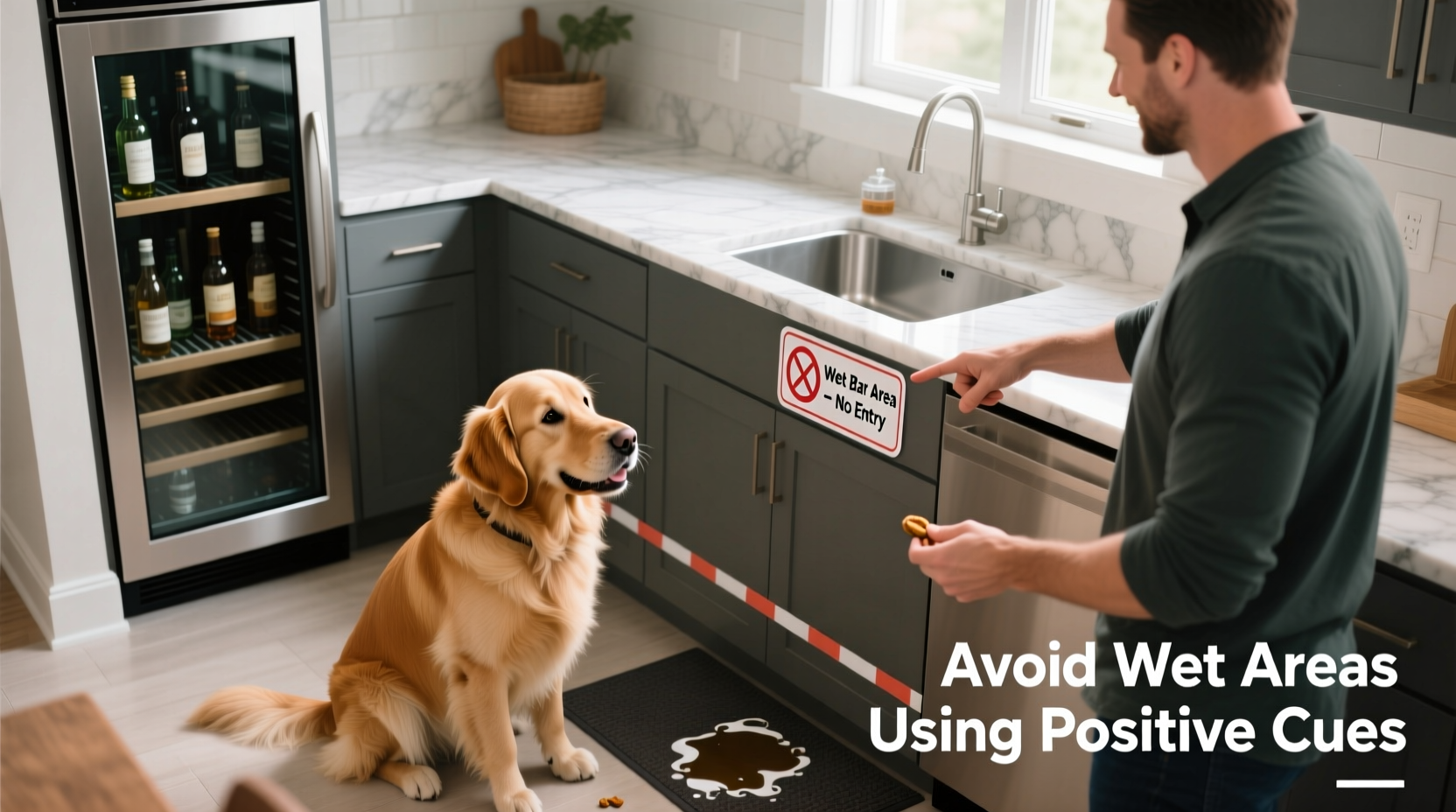
Many owners begin with the intention of “keeping the dog out” of the wet bar. That framing is problematic—not because the goal is unreasonable, but because it focuses on absence rather than presence. Dogs don’t understand abstract concepts like “off-limits” unless those boundaries are paired with clear, consistent alternatives. Asking a dog to simply “not go there” without offering a meaningful, reinforced alternative is like asking a child not to touch a hot stove—but never showing them where the safe, engaging toys are kept. Research in canine cognition confirms that dogs learn most effectively when behaviors are shaped through successive approximations toward a desired action—not through suppression of unwanted ones.
Instead of training avoidance, focus on teaching two complementary skills: (1) a reliable “leave it” cue applied specifically to wet bar objects (e.g., wine bottles, coasters, open cabinets), and (2) a joyful, well-rewarded “go to your spot” behavior that directs the dog to a designated, comfortable area *near*—but outside—the wet bar zone. This dual approach satisfies the dog’s need for engagement while honoring human safety and spatial needs.
Tip: Never use the wet bar itself as a source of correction—even a stern “no” near the area can unintentionally associate the space with heightened arousal or stress, making future relaxation there harder to achieve.The Science Behind Positive Cue Training
Positive cue training leverages operant conditioning principles established by B.F. Skinner and refined by modern veterinary behaviorists. When a dog performs a behavior followed immediately by a meaningful reward (e.g., high-value treat, play, praise), the likelihood of that behavior repeating increases. Crucially, the *timing*, *consistency*, and *value* of the reward determine success—not the frequency of repetition alone.
A 2022 study published in Applied Animal Behaviour Science tracked 127 dogs undergoing boundary training in home environments. Those trained exclusively with positive reinforcement showed 3.2× faster acquisition of location-specific cues and maintained compliance at 91% after six months—compared to 54% in groups using mixed or aversive methods. The key differentiator wasn’t just reward use, but *predictability*: dogs learned fastest when the cue (“back up,” “settle,” “go to mat”) was always followed by the same type of reward, delivered within 0.8 seconds of correct performance.
“Dogs don’t disobey—they respond to what’s been reinforced. If your dog keeps entering the wet bar, ask not ‘why won’t they listen?’ but ‘what have I accidentally rewarded there?’ Often, it’s attention, sniffing freedom, or even the sound of ice clinking.” — Dr. Sarah Lin, Certified Applied Animal Behaviorist and Director of the Canine Cognition Lab at UC Davis
A Step-by-Step 14-Day Training Timeline
Effective boundary training requires structure—not intensity. This timeline balances consistency with realistic expectations for both owner and dog. Each session lasts 3–5 minutes, conducted 2–3 times daily. No session should induce frustration in either party. If your dog appears stressed (panting, avoiding eye contact, whale-eye), pause and return to an easier step the next day.
- Day 1–2: Build Value for Your Chosen “Spot”
Place a low-profile, non-slip mat or bed 3 feet from the wet bar entrance. Every time your dog walks past it, drop a high-value treat (e.g., small piece of cooked chicken or freeze-dried liver) onto the mat. Do not cue anything yet—just build positive association. - Day 3–4: Add the Verbal Cue “Go to Spot”
Once your dog reliably pauses or glances at the mat when passing, say “Go to spot” *as* they look at it—and immediately reward on the mat. Repeat 6x/session. Reward only if all four paws land on the mat. - Day 5–6: Introduce “Leave It” with Low-Distraction Objects
Place an empty wine glass on the counter (not inside the wet bar). Say “Leave it” clearly. Cover the glass with your hand if your dog moves toward it. The *instant* they look away—even briefly—say “Yes!” and reward *away* from the glass. Never reward near the object. - Day 7–9: Combine Cues in Context
With your dog on leash, walk toward the wet bar entrance. As you approach, cue “Go to spot.” Reward generously *on* the mat. After 3 seconds, cue “Leave it” toward the open cabinet door or sink faucet. Reward for stillness and orientation away from the zone. Gradually increase duration (to 10 sec) before rewarding. - Day 10–14: Add Real-World Complexity
Practice with the wet bar in “active” mode: ice bucket visible, glasses on counter, soft music playing. Use higher-value rewards (e.g., cheese slivers). Introduce brief distractions: have a family member walk past, or gently tap a glass. Reinforce calm orientation toward your chosen spot—not just absence from the bar.
Do’s and Don’ts for Wet Bar Boundary Training
| Do | Don’t |
|---|---|
| Use a consistent verbal cue paired with a distinct hand signal (e.g., flat palm facing forward for “leave it”) | Use vague language like “uh-uh,” “hey,” or “stop”—these lack specificity and dilute learning |
| Keep the “spot” mat clean, comfortable, and always accessible—not stored away between sessions | Move the mat frequently or place it inconsistently (e.g., sometimes near the bar, sometimes in the hallway) |
| Store wet bar items in closed cabinets or behind latched doors *during training*—reduce temptation while building reliability | Leave tempting items (corks, napkins, cocktail shakers) out “to test” your dog—this sets them up to fail |
| Mark correct behavior with a sharp, cheerful “Yes!” or clicker *before* delivering the treat | Reach for the treat before marking—this delays feedback and confuses timing |
| End each session on a success—even if it’s a tiny one—so your dog associates training with positivity | Push past signs of fatigue or disengagement (e.g., yawning, sniffing the floor, turning away) |
Real Example: How Maya Trained Her Rescue Terrier Mix, Finn
Maya lived in a downtown loft with a built-in wet bar adjacent to her open-concept living room. Finn, a 3-year-old Jack Russell–Cairn mix adopted six months prior, loved investigating the bar—particularly the ice bucket and the faint scent of citrus cleaner on the granite countertop. He’d jump up, paw at cabinet doors, and once knocked over three glasses during a dinner party. Frustrated, Maya initially tried baby gates and scolding—both escalated Finn’s fixation. She shifted to positive cue training after consulting a certified trainer.
She began by placing a blue memory-foam mat 4 feet from the bar entrance. For two days, she dropped tiny bits of smoked salmon every time Finn passed within 6 feet. By Day 4, he’d sit on the mat unprompted. She added the cue “Go to blue,” then introduced “Leave it” using an empty martini glass. Within nine days, Finn would trot to the mat upon hearing “Go to blue,” then hold a 12-second “leave it” while Maya opened the cabinet to retrieve a bottle. Crucially, Maya also taught Finn a “touch” cue (nose to her palm) he could perform *from* the mat—giving him an active, rewarded role during social gatherings. At week six, Finn calmly settled on his mat during a full house party—ignoring the clink of glasses and aroma of mint juleps—because he knew exactly how to earn attention and treats in that environment. “He didn’t learn to fear the bar,” Maya says. “He learned that staying put near it pays better than exploring it.”
Essential Tools & Setup Adjustments
Training succeeds only when the environment supports learning. Before starting, make these practical adjustments:
- Install soft-close cabinet hinges—prevents loud bangs that startle dogs and trigger chase instincts toward opening doors.
- Use nonslip matting under the “spot” to prevent sliding and reinforce stability—especially important for older or arthritic dogs.
- Choose a cue word with a hard consonant (e.g., “Spot,” “Mat,” “Settle”)—dogs hear these more clearly than softer words like “rest” or “chill.”
- Stock high-value rewards in a dedicated pouch on your person—not in the kitchen drawer. Delayed rewards erode connection between cue and behavior.
- Block visual access temporarily during early training using a sheer curtain or freestanding room divider—reduces initial distraction without full isolation.
Frequently Asked Questions
What if my dog is food-motivated but ignores treats near the wet bar?
This signals the distraction level exceeds your current reward value—or your timing isn’t precise enough. First, lower the challenge: move the “spot” farther away, close all cabinets, and remove visual triggers. Second, upgrade your reward: try fresh cheese, turkey meatballs, or commercial treats with strong scent (e.g., Greenies Pill Pockets stuffed with peanut butter). Third, practice “treat tossing” away from the bar—reward movement *away* from the zone, not just stillness.
Can I use a clicker instead of verbal markers?
Yes—and often, it’s more effective. A clicker provides a consistent, emotion-free sound that marks the exact millisecond of correct behavior. Unlike voice cues, which vary in tone and volume, a click is neutral and unmistakable. Pair the click with a treat *every single time*, even during setup phases. Once your dog associates the click with reward, it becomes a powerful bridge between action and consequence.
How long before I can stop carrying treats?
Transition gradually. After two weeks of reliable performance, begin “variable ratio reinforcement”: reward 3 out of 4 correct responses, then 2 out of 3, then intermittently—but never drop below 20% reward rate in high-distraction settings. Even after months, occasionally surprise your dog with a jackpot reward (3–5 treats) for exceptional self-control near the wet bar. This maintains motivation without dependency.
Conclusion: Building Trust, One Cue at a Time
Training your dog to respect the wet bar isn’t about control—it’s about clarity. It’s the difference between a household governed by reactive corrections and one guided by shared understanding. When you replace “don’t” with “do this instead,” you invite your dog into partnership. You acknowledge their natural curiosity while giving them tools to navigate human spaces safely and confidently. The wet bar ceases to be a forbidden zone and becomes a backdrop for calm coexistence—where the clink of ice signals not chaos, but the quiet pride of a job well done. Start today—not with perfection, but with presence. Choose one cue, one mat, one moment of focused attention. Celebrate the micro-wins: the glance away from the cabinet, the pause before stepping forward, the tail wag directed toward *you* instead of the countertop. These are the building blocks of lifelong harmony. Your dog isn’t resisting your home—they’re waiting for you to show them how to belong in it, fully and joyfully.
💬 Your experience matters. Did a particular cue or setup adjustment transform your wet bar dynamic? Share your insight in the comments—your story could help another dog parent find calm, confidence, and connection.








