Parrots don’t curse out of malice—they mimic sounds that reliably trigger strong reactions. A startled “Oh my god!” or a frustrated “What the hell?!” lands with emotional weight and repetition, making it irresistible to a socially intelligent bird. But that same neurological wiring—their extraordinary capacity for associative learning, vocal plasticity, and social reinforcement—means you can intentionally shape their repertoire. Replacing profanity with “Mojito,” “Old Fashioned,” or “French 75” isn’t just whimsical; it’s behaviorally sound, ethically grounded, and deeply rewarding. This isn’t about suppressing natural expression—it’s about guiding it toward shared joy, mutual respect, and even a little cocktail-hour charm.
Why Parrots Pick Up Curse Words (and Why That’s Actually Good News)
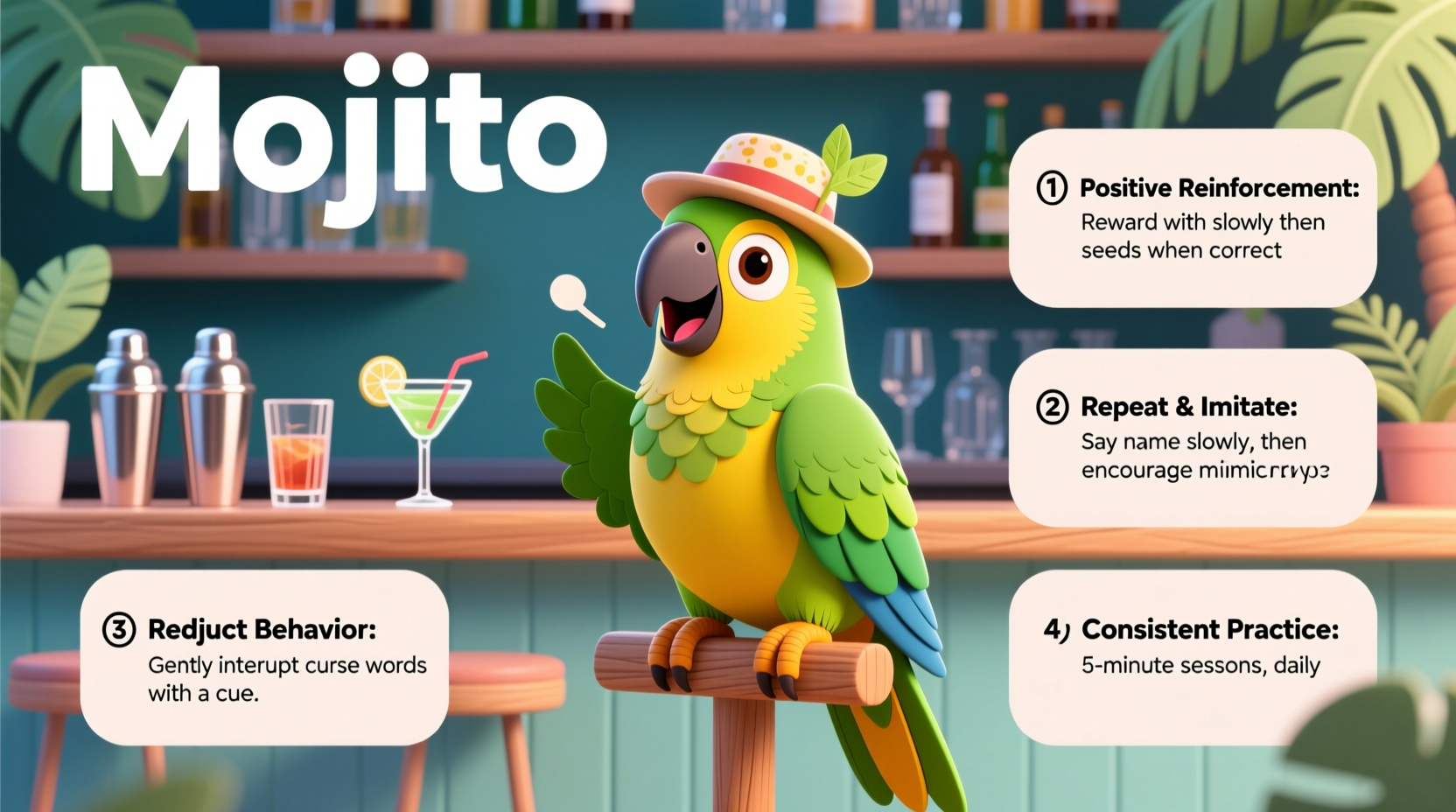
Parrots learn speech through social operant conditioning: they repeat sounds that produce attention, laughter, surprise, or even flustered correction. Swear words are often high-pitched, sharply articulated, and emotionally charged—making them acoustically “sticky.” Crucially, this reflects cognitive strength—not defiance. A parrot that swears is demonstrating advanced auditory memory, fine motor control over its syrinx (vocal organ), and an acute understanding of cause-and-effect in human interaction.
This is where the opportunity lies. If your bird already grasps that *certain sounds yield big responses*, you can pivot that learning toward new targets—cocktail names—that are equally distinct, rhythmic, and socially reinforcing. The key isn’t erasing the old word; it’s making the new one more rewarding, more predictable, and more fun.
Tip: Never punish or scold your parrot for swearing. Stress inhibits vocal learning and damages trust. Instead, treat unwanted words like static noise—ignore them completely while enthusiastically reinforcing alternatives.The Science-Backed Foundation: How Parrot Vocal Learning Really Works
Research from the University of Auckland’s Avian Cognition Lab confirms that parrots learn best when three conditions align: high motivation, clear auditory models, and immediate, consistent reinforcement. Unlike dogs or cats, parrots don’t respond well to delayed rewards or vague praise (“Good bird!”). They need precise timing—reinforcement delivered within 1.5 seconds of the target sound—and tangible value: a favorite nut, a head scratch, or animated verbal praise paired with eye contact.
Cocktail names are ideal training targets because they’re phonetically rich: consonant-vowel-consonant patterns (“Man-hat-tan”), alliteration (“Bloody Mary”), and rhythmic cadence (“Piña Colada”) match how parrots naturally chunk sounds. Their syllabic structure also supports gradual shaping—starting with “Mo-” and building to “Mojito” over days.
“Parrots aren’t ‘talking’—they’re participating in dialogue. When we replace a swear word with a cocktail name, we’re not silencing them; we’re offering a new, socially meaningful phrase to contribute to our shared environment.” — Dr. Irene Pepperberg, Comparative Cognition Researcher & Author of The Alex Studies
A 5-Step Training Timeline (With Realistic Timeframes)
This timeline assumes daily 5–10 minute sessions, conducted at your parrot’s peak alertness (typically morning or early evening). Consistency matters more than duration.
- Days 1–3: Observe & Isolate Triggers
Log every instance of swearing: time of day, who was present, what happened immediately before (e.g., dropped spoon, door slam, phone ring). Identify the top 1–2 most frequent curse words and their contextual triggers. Note your own reaction—did you laugh? Yell? Turn away? Your response is the reinforcer. - Days 4–7: Introduce the Target Word (Silent Phase)
Choose *one* cocktail name to start—ideally one with clear, punchy syllables like “Daiquiri” or “Negroni.” Say it slowly, cheerfully, and repeatedly *only* when your bird is calm and attentive—never during or after swearing. Pair it with a treat *as you say it*. Do this 5x/day, spaced by at least 30 minutes. No expectation of mimicry yet—this is imprinting the sound. - Days 8–14: Capture Approximations
Listen closely. Reward *any* sound resembling the target—even “Dah?” or “Qui-ri!” Click (or say “Yes!”) instantly, then deliver treat. If your bird says the full word, double the reward (two treats + enthusiastic praise). Ignore all swearing completely—no eye contact, no turning, no “shhh.” - Days 15–21: Add Context & Choice
Introduce a visual cue: hold up a small blue cup (for “Blue Lagoon”) or shake an empty shaker (for “Martini”). Say the cocktail name *once*, clearly, as you do the action. Reward only if the bird vocalizes *after* the cue. This builds intentional communication—not just mimicry. - Day 22+: Generalize & Celebrate
Use the cocktail name in real contexts: “Would you like a *Mojito*?” while holding mint leaves. “Here’s your *Pimm’s Cup*!” while offering a grape. Gradually phase out food rewards, replacing them with social rewards—shared laughter, a dance move, or tapping beaks gently. The goal is spontaneous, joyful use—not robotic repetition.
Do’s and Don’ts: A Practical Training Table
| Category | Do | Don’t |
|---|---|---|
| Vocal Modeling | Say the cocktail name with crisp articulation, moderate pitch, and warm enthusiasm. Record yourself saying “Espresso Martini” and play it softly during calm moments. | Mumble, rush, or say it flatly. Avoid exaggerated “baby talk”—parrots prefer clear adult prosody. |
| Reinforcement | Use high-value treats (shelled pistachios, soaked almonds) *only* for target sounds. Pair treats with immediate verbal praise (“Yes! *Margarita!*”). | Give treats for silence, general good behavior, or unrelated vocalizations. This dilutes the association. |
| Environment | Train in a quiet room with minimal distractions. Keep a “cocktail station” (small tray with safe props: citrus wedge, cinnamon stick, tiny cup) visible but not accessible. | Train near TVs, loud appliances, or other pets. Background noise fragments auditory focus. |
| Patience & Progress | Accept approximations. “Gin Fizz” might start as “Giiii… fizz!”—reward that. Track progress in a notebook: date, attempt, approximation, reward type. | Expect perfection in under two weeks. Frustration cues (feather plucking, pacing) mean you’ve moved too fast—return to silent modeling. |
Real Example: Luna the Blue-Crowned Conure and the “Dirty Shirley” Breakthrough
Luna, a 4-year-old blue-crowned conure, had mastered “F*** off!” after her owner repeatedly yelled it during a plumbing emergency. Her swearing escalated when guests arrived—clearly a learned attention-getter. Her trainer, avian behaviorist Maya Chen, began by documenting triggers: Luna swore most often when the front door opened (guest arrival) or when her owner reached for the coffee maker (a pre-stress cue).
Chen chose “Dirty Shirley” as the replacement—three syllables, strong “D” and “Sh” sounds, and thematic relevance (Luna loved cherries). For five days, Chen said “Dirty Shirley!” brightly each time she placed a single maraschino cherry in Luna’s bowl—no expectation of response. On day six, Luna squawked “Shiii!” and got two cherries and a head scratch. By day twelve, she’d shaped “Shir-ley!” and associated it with the cherry ritual. Then came the pivot: when guests arrived, Chen would open the door, say “Dirty Shirley!” once, and immediately offer a cherry. Within three weeks, Luna greeted visitors with “DIRTY SHIRLEY!”—followed by eager chirping for her treat. The curse word faded entirely—not erased, but evolutionarily outcompeted.
Essential Tools & Prep Checklist
Before your first session, gather these non-negotiable items. Skip any, and progress stalls.
- ✅ High-value treats: Shelled walnuts, dried mango strips, or toasted sunflower seeds—small enough for instant consumption.
- ✅ A clicker or consistent marker word: “Yes!” works if said in the same bright, clipped tone every time.
- ✅ A quiet training zone: A perch away from windows, fans, or household traffic—no competing sounds.
- ✅ A shortlist of 3 cocktail names: Start with one, master it, then add “Mojito” and “Sazerac” as secondary targets. Avoid names with soft “th” or “v” sounds initially (e.g., “Vieux Carré”).
- ✅ A journal or notes app: Log date, time, target word, approximation, reward, and your bird’s body language (relaxed crest? pinned eyes? tail fanning?). Patterns emerge in 72 hours.
FAQ: Addressing Common Concerns
My parrot only swears when I’m stressed—will training make it worse?
No—if done correctly, it reduces stress for both of you. Swearing is often a bid for control in unpredictable moments. By giving your bird a reliable, positive way to engage (“Say *Aperol Spritz* and get a berry!”), you restore predictability. Monitor your own breathing during sessions: slow exhales signal safety to your bird.
What if my parrot refuses to try new sounds—or just screams instead?
That signals either low motivation (wrong treat, tired bird) or sensory overload. Pause training for 48 hours. Offer the treat without speaking. Then reintroduce the word *while* your bird is eating—pairing sound with comfort. If screaming persists, consult an avian veterinarian: chronic screaming can indicate pain, hormonal shifts, or environmental deprivation.
Can older parrots learn new words, or is this only for babies?
Age is rarely a barrier. Dr. Pepperberg’s research with Alex, a 31-year-old grey parrot, proved lifelong neuroplasticity. Older birds may take longer to generalize, but they often learn faster once engaged—because they’ve mastered the *game* of vocal exchange. Start with shorter, more frequent sessions (3x/day for 3 minutes) and prioritize consistency over speed.
Conclusion: Raise a Glass to Shared Language
Training your parrot to say cocktail names isn’t a party trick—it’s an act of deep interspecies collaboration. It honors your bird’s intelligence, respects their need for agency, and transforms a source of embarrassment into a thread of connection. Every “Whiskey Sour!” is a testament to patience, observation, and joyful reinforcement. You’re not teaching words—you’re co-creating a dialect, one syllable at a time. And when your parrot calls out “Pisco Sour!” as you pour your first drink of the evening, you’ll feel it: not just pride, but kinship. That’s the real cocktail—the blend of science, empathy, and shared delight.
💬 Your turn: Which cocktail name did your parrot master first? Share your story, your struggles, or your favorite “bartender bird” moment in the comments—your experience could help another person build trust, one syllable at a time.








