
Cats are masters of stealth, curiosity, and mischief—often in equal measure. One of their most baffling habits? Knocking objects off shelves with what seems like uncanny precision. Whether it’s a glass vase at 3 a.m., your favorite pen just before a meeting, or a carefully arranged photo frame moments after you’ve straightened it, the behavior can feel personal. But it isn’t. This isn’t revenge or spite—it’s instinct. Understanding why your cat does this is the first step toward stopping it. The good news: with targeted environmental adjustments, behavioral redirection, and consistency, you can significantly reduce or even eliminate this frustrating habit.
Why Cats Knock Things Off Shelves
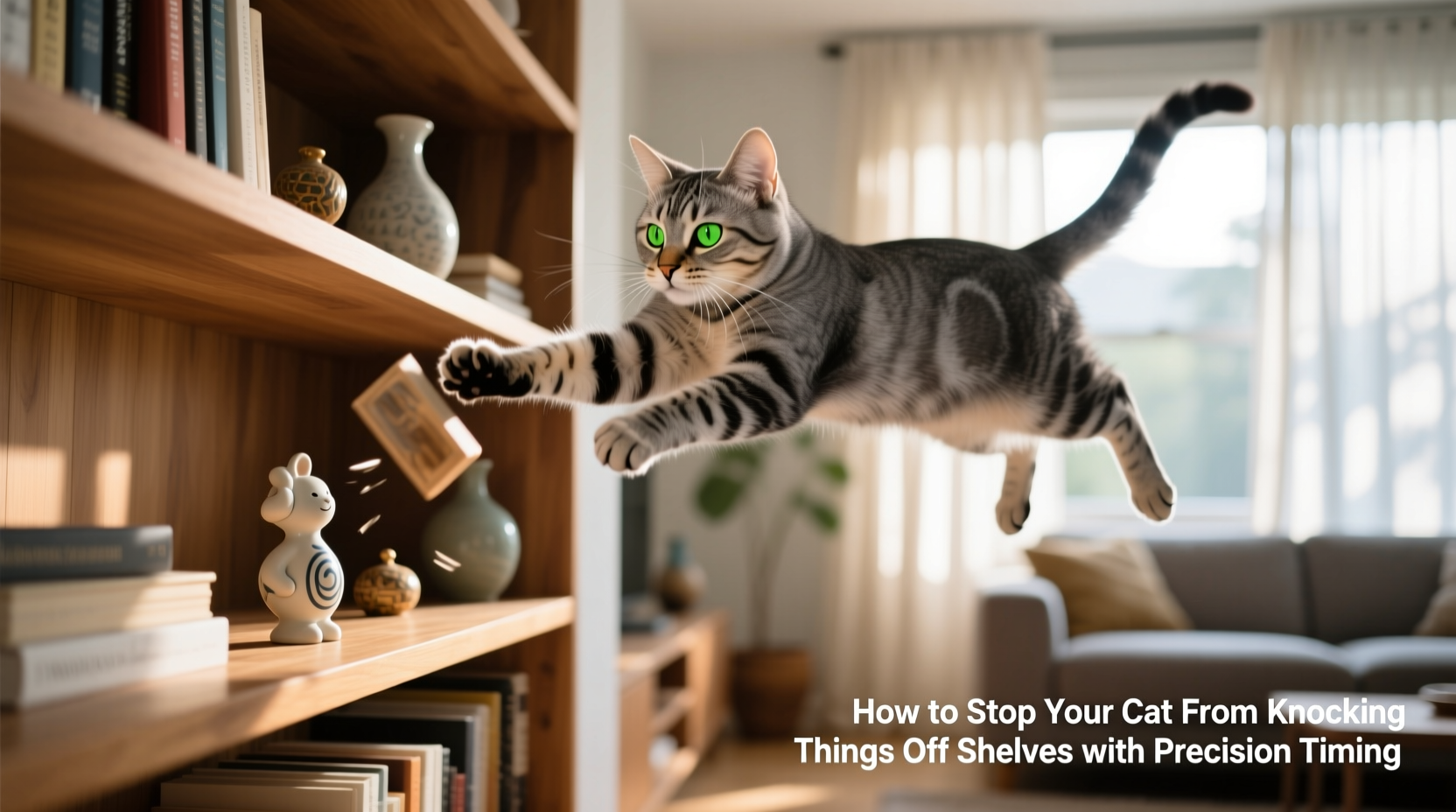
Cats don’t knock items over simply to annoy you. Their actions stem from deeply rooted behaviors shaped by evolution and sensory exploration. The primary reasons include:
- Hunting simulation: Swatting at dangling or partially hanging objects mimics capturing prey. The movement triggers their predatory instincts.
- Sensory investigation: Cats use their paws to explore texture, weight, and motion. An object that wobbles or dangles invites interaction.
- Attention-seeking: If knocking something down results in a reaction—even yelling—the cat learns it’s an effective way to engage you.
- Environmental enrichment deficit: A bored cat will create its own entertainment. Shelves full of knickknacks become interactive puzzles.
- Vertical territory marking: Some cats nudge objects as a way of asserting presence or testing stability in their environment.
Understanding these motivations shifts the approach from punishment to problem-solving. You’re not training a defiant pet—you’re guiding a curious animal through a stimulating but safe environment.
Tip: Never punish your cat for knocking things over. It creates fear, damages trust, and doesn’t address the root cause.Step-by-Step Guide to Prevent Shelf Knockovers
Eliminating this behavior requires a multi-phase strategy focused on prevention, redirection, and reinforcement. Follow this timeline to see measurable improvement within 4–6 weeks.
- Week 1: Assess and Secure
Walk through each room and identify high-risk zones—shelves, side tables, window sills where your cat has access. Remove breakable, valuable, or noisy items. Replace them with stable, non-tempting decor such as heavy books, anchored plants, or textured stones.
- Week 2: Modify the Environment
Install shelf dividers, nonslip matting (like drawer liner), or low barriers to prevent paw access. Rearrange items so nothing dangles or protrudes. Use adhesive putty to secure lightweight objects.
- Week 3: Introduce Alternative Outlets
Provide interactive toys that satisfy swatting and batting urges—feather wands, motorized mice, or puzzle feeders. Schedule two 10-minute play sessions daily to burn energy and reinforce bonding.
- Week 4: Reinforce Positive Behavior
When your cat ignores tempting objects or interacts appropriately with toys, reward immediately with treats or affection. Consistency here builds new habits.
- Weeks 5–6: Monitor and Adjust
Gradually reintroduce decorative items only when your cat consistently avoids shelf interference. Continue enrichment and observe patterns—timing, location, triggers.
Effective Tools and Tactics
Not all deterrents work equally well. Some repel cats temporarily; others offer long-term solutions. Below is a comparison of common methods.
| Method | Effectiveness | Duration | Notes |
|---|---|---|---|
| Double-sided tape on shelves | High | Short-term | Cats dislike sticky paws. Reapply weekly. |
| Nonslip shelf liners | Medium-High | Long-term | Reduces object mobility; won’t deter paw contact. |
| Aluminum foil coverage | Medium | Short-term | Sound and texture deter some cats. Loses effect over time. |
| Automatic air sprayers (e.g., Ssscat) | High | Medium-term | Startles cat upon approach. Use near shelves; pair with positive redirection. |
| Interactive feeding toys | High (indirect) | Long-term | Reduces boredom-driven behavior. Best used daily. |
| Essential oil sprays (citrus, eucalyptus) | Low | Very short-term | Risk of toxicity. Not recommended for cats. |
The most sustainable results come from combining physical modifications with behavioral enrichment. Relying solely on aversive tools without offering alternatives often leads to displacement behavior—your cat may stop knocking things off shelves but start scratching furniture or over-grooming instead.
Checklist: Cat-Safe Shelf Management
Use this checklist weekly to maintain a cat-friendly yet clutter-safe home:
- ✅ Remove fragile or sentimental items from accessible shelves
- ✅ Secure loose cords and dangling strings
- ✅ Place non-slip mats under decorative objects
- ✅ Provide at least one interactive toy per floor of the home
- ✅ Conduct two scheduled play sessions daily
- ✅ Rotate toys weekly to maintain novelty
- ✅ Reward calm behavior near shelves with treats or praise
- ✅ Monitor for signs of stress (excessive licking, hiding)
Real Example: From Chaos to Calm
Sarah, a graphic designer in Portland, struggled with her 3-year-old tuxedo cat, Miso, who had developed a habit of toppling her desk organizer every morning—usually just as she joined a client call. “It was like clockwork,” she said. “He’d wait until my camera was on, then bat the cup full of pens onto the hardwood. I tried scolding, covering the desk, even using tape—but nothing stuck.”
After consulting a feline behaviorist, Sarah realized Miso wasn’t being malicious—he was seeking stimulation during her work hours. She implemented changes: she moved her desk supplies to a closed cabinet, installed a shelf-mounted cat perch nearby, and introduced a timed puzzle feeder that dispensed treats mid-morning. She also began a 7 a.m. play session with a wand toy to simulate a “hunt” before work.
Within three weeks, the pen-tipping stopped. “He still watches the shelf,” Sarah noted, “but now he jumps up, stretches, and naps in his perch. He got what he wanted—engagement—and I got my peace.”
Expert Insight: What Feline Behaviorists Recommend
Dr. Lena Reyes, a certified feline behavior consultant with over 15 years of clinical experience, emphasizes proactive design over reactive correction.
“Cats aren’t destructive by nature—they’re exploratory. When we label their actions as misbehavior, we miss the opportunity to meet their needs. Instead of asking, ‘How do I stop this?’ ask, ‘What is my cat trying to tell me?’ In most cases, the answer is environmental enrichment.” — Dr. Lena Reyes, Feline Behavior Consultant
She recommends treating your home like a cat-centric habitat: vertical spaces for climbing, multiple play zones, and scheduled mental challenges. “A tired cat is a well-behaved cat,” she adds. “But tired doesn’t mean exhausted—it means mentally and physically satisfied.”
FAQ: Common Questions About Shelf-Knocking Behavior
Is my cat doing this out of anger or spite?
No. Cats don’t act out of spite. Their behavior is driven by instinct, curiosity, or learned outcomes. If knocking things over gets attention—even negative—it becomes reinforced. Focus on redirecting rather than punishing.
Will neutering or spaying stop this behavior?
While spaying or neutering can reduce overall hyperactivity and territorial behaviors, it won’t directly stop shelf-knocking unless the behavior is linked to mating-related restlessness. Most cases are unrelated to reproductive status.
Are certain breeds more prone to this?
Yes. Breeds with high intelligence and activity levels—such as Siamese, Bengals, and Abyssinians—are more likely to engage in manipulative behaviors like swatting objects. These cats require more mental stimulation and structured play.
Conclusion: Turn Instinct Into Harmony
Your cat’s precision timing isn’t a flaw—it’s a testament to their sharp senses and keen observation. They notice patterns, anticipate reactions, and interact with their world in dynamic ways. Rather than suppress this intelligence, channel it constructively. By rethinking your space, enriching your cat’s daily routine, and responding with empathy, you transform a frustrating habit into an opportunity for deeper connection.
Start today: clear one high-risk shelf, introduce a new toy, and schedule a five-minute play session. Small steps lead to lasting change. Your home can be both beautiful and cat-proof—with a little insight and a lot of understanding.
💬 Have a clever solution that worked for your cat? Share your story in the comments and help fellow cat owners find peace—alongside their playful companions.








