Drying citrus peels isn’t just a bar trick—it’s a craft that bridges botany, food safety, and mixology. A single misstep—too much humidity, uneven slicing, or premature storage—can yield leathery, sour-smelling shreds instead of crisp, aromatic curls that perfume an Old Fashioned or elevate a gin sour. Many home bartenders abandon the process after encountering sticky residue, fuzzy gray patches, or peels that never fully harden. The truth? Mold and tackiness aren’t inevitable. They’re signals—not of failed effort, but of overlooked variables: water activity, surface-to-mass ratio, ambient vapor pressure, and enzymatic behavior in fresh rind. This guide distills field-tested methods used by award-winning cocktail programs and small-batch bitters makers into actionable, science-informed practice.
Why Citrus Peels Spoil (and Why It’s Not Your Fault)
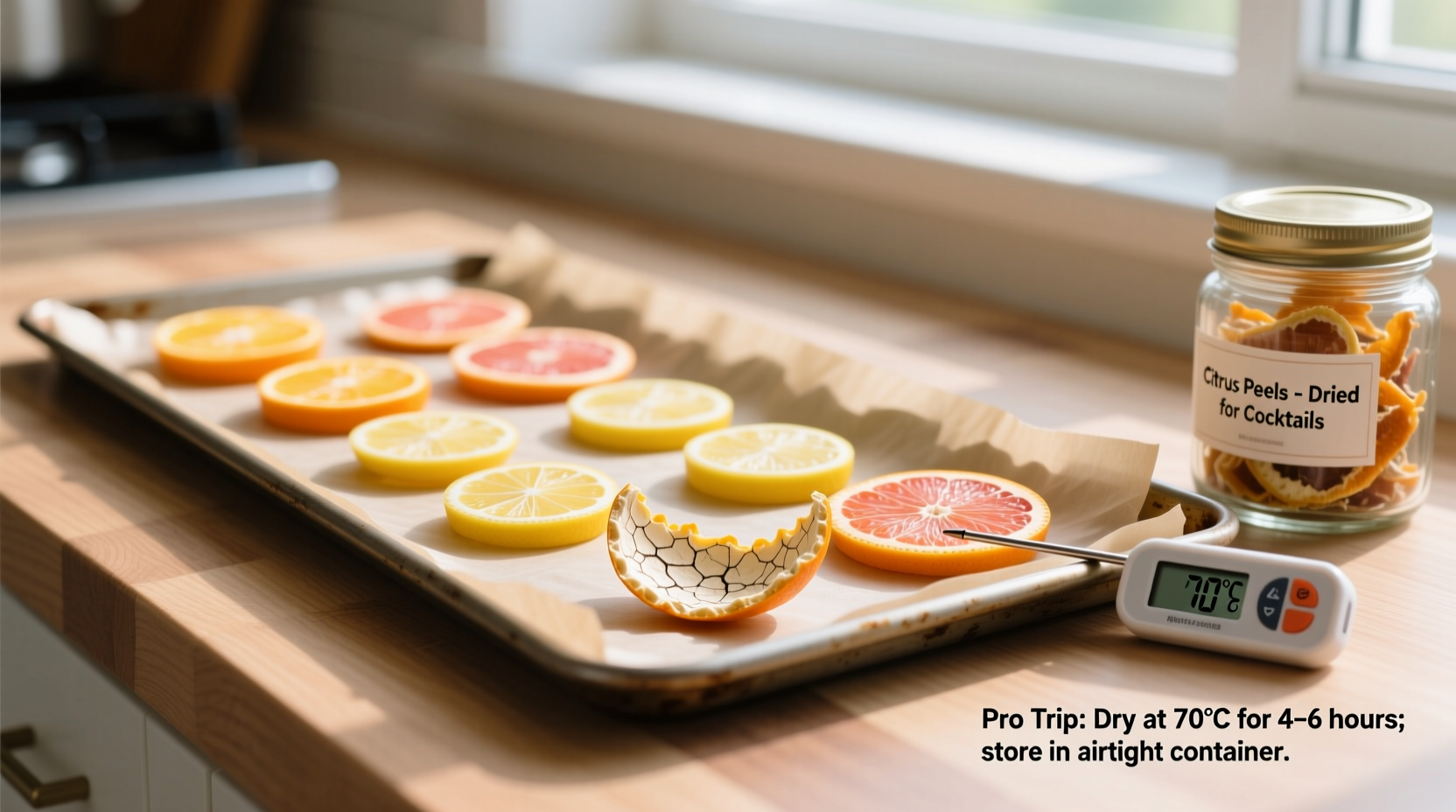
Citrus zest contains 75–85% water by weight—mostly in the spongy albedo layer beneath the colored flavedo. That moisture is trapped within cellulose microfibrils and pectin networks, not pooled freely. When air-drying, evaporation begins at the surface, creating a moisture gradient. If ambient humidity exceeds 60%, or airflow is stagnant, evaporating water recondenses on cooler peel surfaces—especially where slices overlap or curl inward. This localized condensation fosters Penicillium citrinum and Aspergillus niger, common molds that thrive at water activity (aw) levels above 0.70. Stickiness, meanwhile, stems from sugar migration: sucrose and glucose dissolve in residual moisture, then migrate to the surface as water evaporates, crystallizing incompletely and forming a hygroscopic film that attracts ambient moisture—creating a vicious cycle.
“Most ‘sticky peel’ failures occur not from too little drying time—but from drying *before* the peel has been properly blanched or acid-washed to deactivate surface enzymes and reduce microbial load.” — Dr. Lena Torres, Food Microbiologist & Beverage Science Advisor, BarLab Collective
The 5-Step Air-Drying Protocol (Room Temperature, No Oven)
This method prioritizes control, consistency, and flavor integrity. It works year-round—even in humid climates—when executed precisely.
- Prep with Precision: Use a Y-peeler or channel knife to remove only the colored outer zest (flavedo), avoiding white pith. Pith contributes bitterness and holds excess water. Cut peels into uniform ⅛-inch-wide strips—no longer than 2 inches—to maximize surface area and minimize internal moisture retention.
- Acid-Rinse (Non-Negotiable): Submerge strips in a solution of 1 part fresh lemon juice to 3 parts cold filtered water for 90 seconds. This lowers surface pH to ≤3.2, inhibiting mold spore germination and dissolving surface sugars before they migrate.
- Blot—Don’t Rub: Lay strips on triple-layered, lint-free paper towels. Gently press with a second towel—never rub or twist. Excess surface moisture must be removed *before* drying begins; residual droplets create micro-pools where mold initiates.
- Arrange for Maximum Airflow: Place strips on a stainless steel cooling rack set over a rimmed baking sheet. Elevate the rack on two wooden spoons so air circulates *beneath* as well as above. Space strips at least ¼ inch apart—no touching, no overlapping.
- Dry with Discipline: Place in a cool (60–68°F), dark, low-humidity room (<55% RH) with gentle air movement (e.g., a ceiling fan on low, 6 feet away). Flip strips once at 12 hours. Total drying time: 48–72 hours. Test readiness: a properly dried strip snaps cleanly with audible crispness—not bends, not tears.
Oven & Dehydrator Methods: When Speed Is Essential
While air-drying preserves volatile top notes best, controlled heat accelerates moisture removal when time is limited. Success hinges on temperature discipline—not wattage or fan speed.
| Method | Temp & Time | Key Precautions | Flavor Impact |
|---|---|---|---|
| Convection Oven | 135°F for 2.5–3.5 hrs; door cracked ½ inch with wooden spoon | Rotate tray every 45 mins; never exceed 140°F (citral degrades rapidly above) | Mild loss of limonene; retains linalool and γ-terpinene—ideal for stirred drinks |
| Food Dehydrator | 115°F, 8–10 hrs on mesh trays (no stacking) | Wipe trays with vinegar-water before loading; clean fan filter daily | Best balance: full terpene profile preserved, zero cooked-off notes |
| Freeze-Drying (Home Unit) | 24–36 hrs per batch | Pre-freeze peels flat on parchment at −10°F for 2 hrs first | Exceptional aroma retention; texture is brittle, not crisp—best for infusions |
Avoid “low-temp oven” hacks like 170°F for 1 hour: this caramelizes surface sugars, creates irreversible stickiness, and volatilizes >60% of key aromatic compounds. Likewise, skip microwave attempts—uneven heating causes steam pockets and scalding, accelerating enzymatic browning.
Storage That Prevents Rehydration and Off-Flavors
Dried peels are hygroscopic sponges. Even at 20% moisture content, they’ll absorb ambient humidity within hours if improperly stored. The goal isn’t just “airtight”—it’s *oxygen-limited*, *light-blocked*, and *temperature-stable*.
- Immediate Post-Dry Handling: Let peels cool completely to room temperature (≥2 hours) before packaging. Trapped residual heat creates condensation inside containers.
- Container Choice: Use amber glass mason jars with rubber gaskets—not plastic bags or clear glass. Amber blocks UV light, which degrades limonene into bitter, off-aroma compounds.
- Oxygen Control: Add one food-grade oxygen absorber (300 cc capacity per quart jar) *after* sealing. Do not use silica gel here—it competes with peels for moisture and may overdry them into dust.
- Location Matters: Store jars in a cool, dark cupboard—not near the stove, dishwasher, or windowsill. Fluctuating temps cause condensation cycles inside sealed jars.
Properly stored, dried citrus peels retain peak aroma for 6 months. After 12 months, expect ~30% loss of volatile oils—still usable, but better suited for syrups or tinctures than garnishes.
Real-World Case Study: The Humidity Challenge in New Orleans
At Cane & Table, a James Beard-nominated New Orleans bar known for its house-dried Seville orange peels, humidity routinely hits 85% RH in summer. For years, their air-dried batches developed sticky edges and faint mustiness by Day 2. Bartender Marcus Chen collaborated with a local food scientist to redesign their protocol: they now pre-rinse peels in citric acid solution (0.5% w/v), use chilled stainless racks suspended over silica gel beds in climate-controlled drying rooms (62°F, 48% RH), and implement mandatory 24-hour “resting” in open jars before final sealing. Result: zero mold incidents since 2022, and peels now snap at 58 hours—14 hours faster than previous methods. Their secret? Treating peel drying not as passive waiting, but as active moisture management.
FAQ: Troubleshooting Common Failures
My peels are still bendy after 72 hours—should I keep drying?
No. Bendiness indicates either excessive pith (cut deeper next time) or high ambient humidity. Extend drying only if you’ve confirmed RH <55% and airflow is unobstructed. Otherwise, discard—partial drying creates ideal conditions for osmophilic yeasts that produce off-flavors undetectable until infusion.
Can I salvage slightly sticky peels?
Yes—if no visible mold or sour odor exists. Spread them on a parchment-lined tray, sprinkle lightly with cornstarch (1 tsp per cup), and return to your dehydrator at 115°F for 1 hour. The starch absorbs surface moisture and prevents further sugar migration. Sift off excess starch before storing.
Why do my grapefruit peels always turn brown while orange stays bright?
Grapefruit contains higher levels of enzymatic polyphenol oxidase (PPO). To prevent browning, soak strips in 0.1% ascorbic acid solution (1/8 tsp powdered vitamin C per cup water) for 60 seconds before acid-rinsing. This inhibits PPO without affecting aroma.
Conclusion: Dry With Intention, Garnish With Confidence
Drying citrus peels well isn’t about patience alone—it’s about precision in preparation, physics in execution, and respect for the fruit’s biology. Every step, from the angle of your peeler to the dew point in your drying space, shapes the final result. When your orange twist releases a fine, fragrant oil mist over a chilled coupe, or your lemon peel curls perfectly around a rocks glass without drooping or weeping, you’re not just garnishing a drink—you’re completing a sensory circuit built on care and understanding. Don’t settle for leathery, bland, or suspiciously damp peels. Apply these methods deliberately. Track your variables: note humidity, peel thickness, and drying duration in a simple log. Refine. Repeat. In time, you’ll develop an intuition that no recipe can teach—because you’ll know, in your hands and nose, exactly what “ready” feels and smells like.
💬 Share your peel-drying breakthrough—or your toughest failure. Drop your story, tip, or question in the comments. Let’s build a smarter, mold-free cocktail community—one crisp twist at a time.








