Home bars are more than decor—they’re social hubs, personal sanctuaries, and expressions of taste. But when you share your space with cats, that elegant whiskey shelf, open bottle rack, or low-slung cocktail cabinet becomes an invitation to chaos. Cats don’t see “vintage bourbon display”; they see a vertical playground with dangling coasters, aromatic liquids, and surfaces just begging for a nap. Worse, many common bar elements—ethanol, hops, grapes, xylitol-sweetened mixers, and even certain essential oils in bitters—are toxic at minute doses. A single spilled glass of wine or a chewed-open bottle of herbal liqueur can land your cat in emergency care.
Designing a pet-safe home bar isn’t about sacrificing style or convenience. It’s about intentional architecture—layering physical barriers, behavioral redirection, and material intelligence to create a space where hospitality and feline well-being coexist seamlessly. This guide draws on veterinary toxicology research, certified feline behaviorist protocols, and real-world renovations by homeowners who’ve balanced aesthetics with animal safety—not as an afterthought, but as the foundational principle.
Why Standard Bar Designs Fail Cats (and Owners)
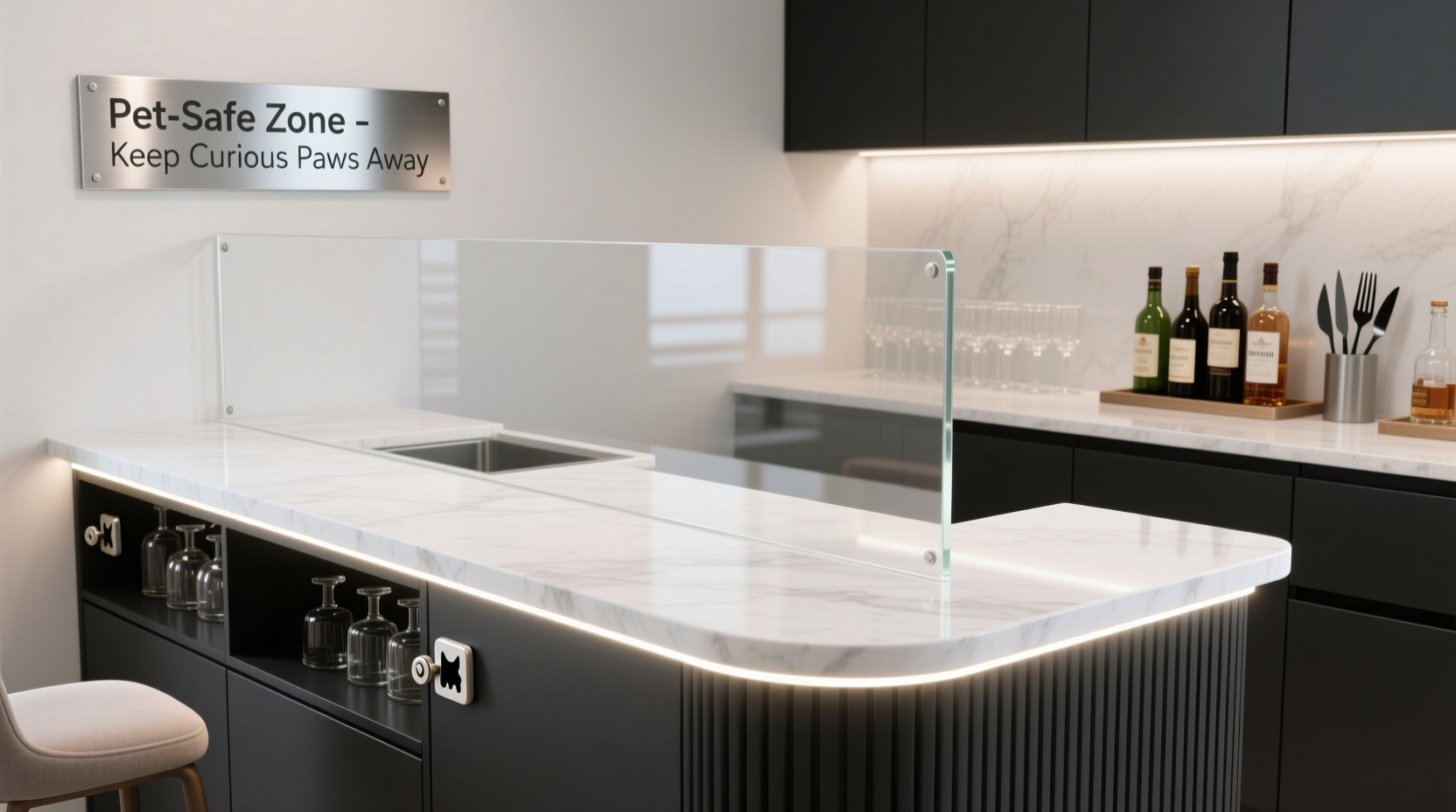
Most home bars follow one of three flawed patterns: open shelving (for visual impact), low-profile cabinets (for modern minimalism), or island-mounted setups (for entertaining flow). All three present consistent hazards:
- Open shelves allow cats to leap, perch, and investigate bottles—risking falls, broken glass, and access to spills.
- Low cabinets with exposed handles tempt paw-pulling; many cats learn to open latches within days of observing human use.
- Island bars with overhangs create ideal ambush perches—cats often jump from above, landing directly on bar tops where glasses, shakers, or uncapped syrups sit unattended.
A 2023 survey by the ASPCA Animal Poison Control Center found that household alcohol exposure ranked among the top 10 toxin categories reported for cats—most incidents occurred during informal gatherings when bar areas were left unmonitored for under two minutes. The issue isn’t negligence; it’s design mismatch.
Core Principles of Feline-Safe Bar Architecture
Effective pet-safe bar design rests on three non-negotiable pillars: inaccessibility, non-toxicity, and behavioral neutrality. Inaccessibility means no surface, shelf, or compartment is reachable without deliberate human action. Non-toxicity requires eliminating all substances—even trace residues—that pose risk if licked, inhaled, or ingested. Behavioral neutrality means removing visual or olfactory cues that trigger curiosity: no dangling cords, no reflective surfaces that mimic water, no lingering food scents from citrus peels or fruit garnishes.
Tip: Test your bar’s feline accessibility using the “cat-height rule”: kneel on all fours and scan eye-level. If you can see or reach anything without standing, your cat likely can too.Step-by-Step: Building Your Pet-Safe Bar (From Planning to Final Touches)
- Assess your space and cat’s behavior profile. Observe for 48 hours: Where does your cat linger? What surfaces do they jump onto? Do they paw at cabinets? Chase reflections? Note habitual paths and favorite vantage points—this informs barrier placement.
- Select enclosed, wall-mounted cabinetry. Prioritize floor-to-ceiling units with recessed or touch-latch doors. Avoid base cabinets entirely—cats exploit toe-kick gaps. Opt for matte-finish laminates over glossy surfaces to reduce reflection-based attraction.
- Install dual-layer security on all access points. Use magnetic child locks *plus* mechanical latches (e.g., Blum Clip Top) on every door and drawer. Test each with a 5 lb weight hung from the handle—no movement should occur.
- Design vertical storage with gradient height zoning. Reserve bottom 36” for non-toxic, heavy items (glassware, decanters); middle 36–60” for spirits (behind locked doors); top 60”+ for decorative but inert objects (wooden trays, ceramic jars). Never store liquor bottles on open ledges—even 12” deep.
- Integrate passive deterrents into finishes. Apply double-sided tape or citrus-scented (non-toxic) sprays along countertop edges where cats typically perch. These create subtle aversive feedback without punishment.
- Establish a “bar reset” ritual. After every use, return all items to locked storage, wipe surfaces with vinegar-water (safe for cats), and stow bar tools in wall-mounted magnetic strips—not on countertops.
What to Store—and Where—to Eliminate Risk
The safest bar isn’t the emptiest—it’s the most intelligently organized. Below is a practical storage matrix based on toxicity risk, frequency of use, and feline temptation level.
| Item Category | Safe Storage Method | Risk Level (1–5) | Notes |
|---|---|---|---|
| Spirits (whiskey, gin, rum) | Locked wall cabinet, minimum 60\" high | 5 | Ethanol causes rapid CNS depression in cats; as little as 1 tsp can induce coma. |
| Wine & beer | Refrigerated, behind magnetic-lock door | 4 | Grapes and hops are nephrotoxic; even empty bottles retain residue. |
| Citrus peels, fresh herbs | Sealed glass jar inside fridge or freezer | 3 | Limonene (in citrus oils) causes tremors; mint varieties may trigger GI upset. |
| Bitters & syrups | Locked drawer with spill-proof container | 5 | Xylitol (common in craft syrups) triggers fatal hypoglycemia in cats within 30 minutes. |
| Glassware & shakers | Open shelf >60\" high OR wall-mounted racks | 1 | Ensure no residual liquid remains; avoid etched or textured glass that traps scent. |
| Bar tools (jiggers, muddlers) | Magnetic strip mounted >72\" high | 2 | Prevents chewing; metal tools pose choking hazard if dropped near litter boxes. |
Real-World Example: The Brooklyn Loft Renovation
When Maya R., a mixologist and cat guardian to two 3-year-old Maine Coons, renovated her 700 sq ft loft, she faced a dilemma: her dream floating oak bar ran parallel to a sun-drenched window ledge—their daily lookout post. Initial attempts failed: acrylic barriers were scratched off, motion-sensor lights startled the cats into jumping *onto* the bar, and decorative rope trim became a chew toy.
Her solution combined structural and behavioral insight. She replaced the floating bar with a built-in unit anchored to load-bearing studs, added a 4” overhanging lip (angled downward at 15°) to prevent perching, and installed a recessed LED strip beneath the lip—activated only when motion is detected *below* the bar (not above). The light creates a gentle visual boundary cats instinctively avoid. She also relocated their primary perch to a custom catio-style window seat across the room, complete with bird feeder view and heated pad. Within three days, both cats ignored the bar entirely. “It wasn’t about making the bar ‘cat-proof,’” Maya notes. “It was about making the alternative *more rewarding*.”
Expert Insight: Veterinary Toxicology Meets Interior Design
“Owners often underestimate how little toxin a cat needs to absorb. A drop of spilled tequila on the floor, licked during grooming, can cause ataxia. A single grape garnish left overnight? Acute kidney failure. Safe bar design starts with recognizing that cats live in a world of scent, texture, and vertical exploration—not human logic. Every surface must be evaluated through that lens.” — Dr. Lena Torres, DVM, DACVECC, Director of Emergency Toxicology, Angell Animal Medical Center
Essential Safety Checklist Before Your First Cocktail Night
- ✅ All spirit bottles secured in cabinets with dual-lock mechanisms (magnetic + mechanical)
- ✅ No open containers—bottles capped, syrups sealed, bitters in opaque, childproof jars
- ✅ Countertops wiped with 1:3 vinegar-water solution (no essential oils)
- ✅ Bar tools stored vertically on wall-mounted magnetic strips ≥72” high
- ✅ Trash can emptied and lid secured (no discarded citrus, olive pits, or coffee grounds)
- ✅ Floor swept for stray ice cubes, sugar crystals, or spilled syrup (attractive to cats)
- ✅ Alternate cat zone activated: fresh water fountain, new toy rotation, and elevated perch stocked
FAQ: Addressing Common Concerns
Can I still use glass decanters for my favorite spirits?
Yes—but only if permanently mounted behind locked, tempered-glass cabinet doors. Free-standing decanters attract paw swipes and static cling from fur, leading to spills and breakage. If aesthetics matter, choose lead-free crystal with weighted bases and install anti-tip brackets directly into wall studs.
Are “cat-safe” essential oil diffusers okay near the bar?
No. Even oils labeled “pet-safe” like lavender or chamomile can irritate feline respiratory tracts when concentrated in small spaces. Citrus, tea tree, eucalyptus, and ylang-ylang are outright toxic. Skip diffusers entirely. Instead, use ventilation fans or open windows for air circulation—and never place them above or adjacent to bar zones.
My cat loves sitting on cold surfaces—will stainless steel bar tops deter them?
Not reliably. While some cats avoid cold metal, others seek it for thermoregulation, especially in summer. Stainless steel also reflects light and movement, increasing visual stimulation. Matte-finish stone or wood composites with integrated heating elements (set to ambient room temp) are safer alternatives—less reflective, less tempting, and easier to clean.
Conclusion: Where Style and Safety Converge
A pet-safe home bar isn’t a compromise—it’s a refinement. It reflects deeper values: responsibility without rigidity, elegance without exclusion, and hospitality that extends beyond human guests. When you design with your cat’s instincts in mind—not as obstacles to overcome, but as parameters to honor—you create a space that feels calmer, more intentional, and genuinely welcoming. The cocktails taste better when you’re not glancing over your shoulder. The conversations flow easier when you’re not rushing to rescue a curious paws from a precarious perch. And your cat? They’ll thrive in an environment that respects their nature while keeping them profoundly safe.
Start small: this weekend, audit one access point in your current bar setup. Install a latch, reposition a shelf, or clear a countertop zone. Then build outward—layering security, simplicity, and sensory awareness until your bar feels as effortless for your cat as it does for you. Because the best-designed spaces don’t just look good. They work—for everyone who calls them home.
💬 Share your pet-safe bar hack or challenge in the comments. Whether it’s a clever latch solution, a favorite non-toxic cleaner, or how you redirected your cat’s attention—your experience helps others design with confidence and compassion.








