Home bars have evolved from novelty accents to essential lifestyle features—spaces for connection, creativity, and calm after a long day. But if you share your home with a cat, that sleek open shelving, dangling bottle stoppers, or low-slung liquor cabinet may pose more than aesthetic challenges. Cats explore with mouths, paws, and noses; they’re drawn to movement, texture, scent, and height—and alcohol, essential oils, glass shards, and even certain herbs (like hops in craft beer) can be toxic in minute amounts. Designing a pet-friendly home bar isn’t about sacrificing style or function. It’s about intentional architecture: integrating feline behavior science with smart storage, material selection, and spatial logic. This guide draws on veterinary toxicology data, certified interior designers’ pet-aware workflows, and real-world homeowner experiences to help you build a bar that works beautifully—for you *and* your cat.
Why “Cat-Proof” Isn’t Enough—It’s About Behavior-Informed Design
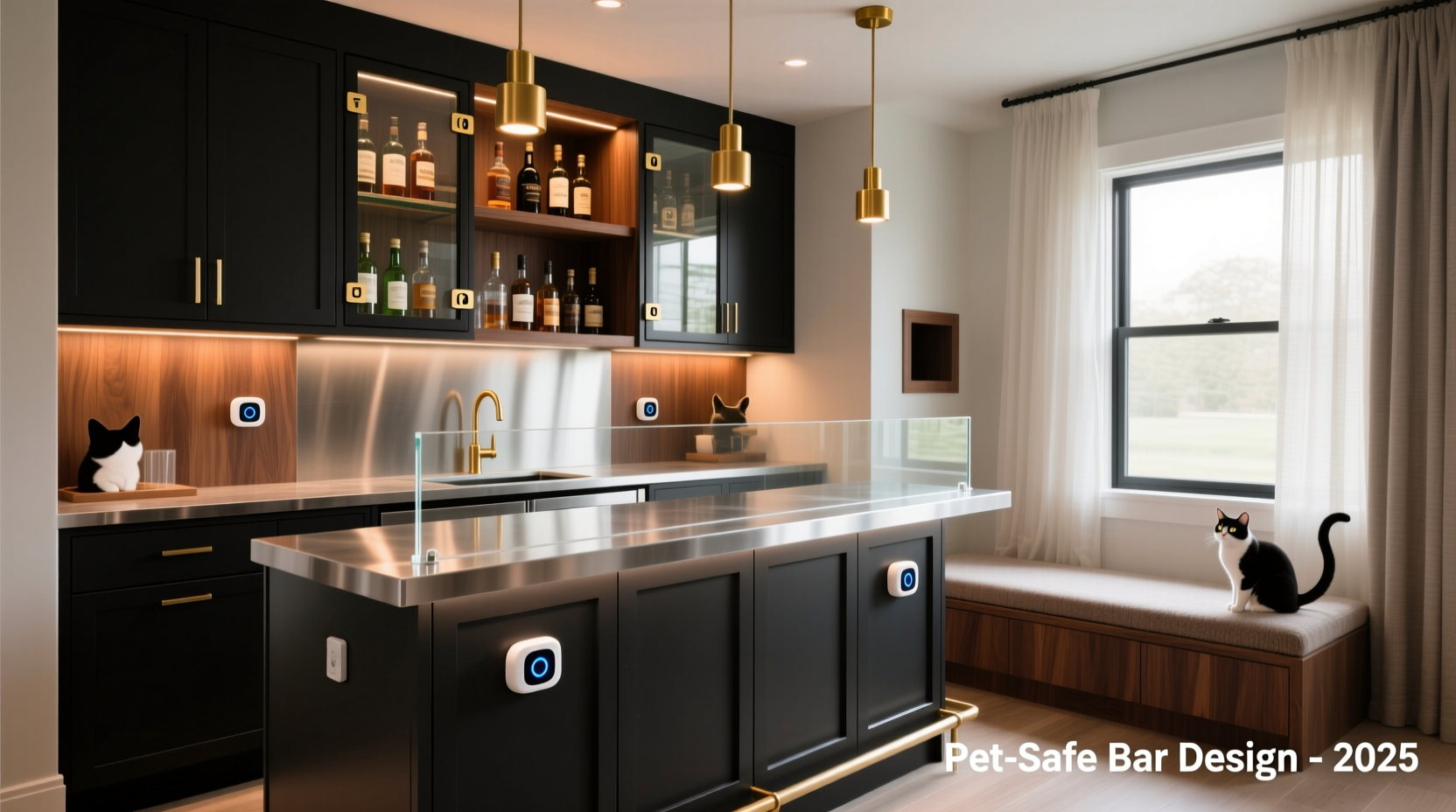
Cats don’t “get into things” out of mischief—they respond predictably to environmental cues. A 2023 study published in Applied Animal Behaviour Science observed over 1,200 indoor cats and found that 87% investigated vertical surfaces within 90 seconds of entering a new room, especially those with reflective finishes, hanging elements, or accessible ledges. Another key insight: cats rarely target alcohol itself—but they *will* bat at swinging pour spouts, lick residue from uncapped bottles, or chew on cork, rubber, or silicone stoppers that smell like food or carry trace scents. The danger lies not only in ingestion but in knock-down hazards: a falling decanter can shatter, a tipped shaker can spill ethanol-based bitters, and an unstable shelf invites both injury and stress.
“Designing around cats means respecting their sensory world—not just blocking access. If a surface is shiny, warm, or has airflow near it (like behind a bar fridge), it’s already on their radar. Your bar should satisfy human ritual *without* triggering feline investigation.” — Dr. Lena Torres, DVM, Board-Certified Veterinary Behaviorist and founder of Pet-Safe Interiors Initiative
This shifts the goal from reactive “cat-proofing” to proactive, behavior-informed design: eliminating temptation *before* it registers as opportunity.
5 Non-Negotiable Structural & Layout Principles
Start with the bones of your bar—its physical structure and placement. These decisions shape everything else.
- Elevate the primary work zone: Position the main countertop between 42–48 inches above floor level. This places mixing tools, shakers, and open bottles out of natural paw-reach for most cats (average feline vertical jump: 36–42 inches unassisted). Avoid “breakfast bar” heights (30–36\") unless fully enclosed.
- Eliminate horizontal ledges under shelves: Cats use narrow ledges as launchpads. Replace open floating shelves with fully recessed cabinetry or shelves with a 2-inch vertical lip (angled inward) to disrupt paw purchase.
- Anchor all freestanding units: Use anti-tip brackets secured into wall studs. Even a 20-lb bar cart becomes dangerous if a cat jumps atop it and shifts its center of gravity.
- Route cords *behind*, not beside: Never run power cords for fridges, LED strips, or blenders along baseboards or exposed edges. Cats chew cords out of teething instinct or boredom—not because they’re “misbehaving.” Conceal them in raceways or inside built-in cabinetry.
- Position away from vertical pathways: Avoid placing your bar directly beneath windowsills, bookshelves, or cat trees. These are natural feline highways. Instead, locate it adjacent to a solid wall or in a corner where approach is limited to one clear angle—making monitoring easier.
Smart Storage: What Goes Where (and Why)
Storage isn’t just about hiding bottles—it’s about organizing by risk profile and frequency of use. Group items using a three-tier system:
| Risk Tier | Examples | Recommended Storage Method | Rationale |
|---|---|---|---|
| High-Risk | Open bottles (wine, spirits), bitters, syrups, citrus peels, hops-infused infusions | Airtight, latched glass-front cabinets *above 48\"*, or refrigerated drawers with child-lock mechanisms | Prevents scent dispersion (a major attractant) and eliminates accidental licking or spilling. Refrigeration also slows spoilage of fresh ingredients. |
| Moderate-Risk | Corks, silicone stoppers, jiggers, muddlers, cocktail picks, napkin rings | Deep-drawers with soft-close mechanisms + magnetic lid locks; or closed cabinets with push-to-open latches | Removes visual and tactile temptation. Magnetic locks are silent, reliable, and impossible for paws to trigger—unlike spring-loaded handles. |
| Low-Risk | Glassware (non-etched), stainless steel shakers, bar spoons, ice buckets (when empty) | Open shelving *only* if mounted ≥52\" high *and* backed with non-reflective matte panels; otherwise, recessed display niches with angled fronts | Reduces reflection glare while allowing aesthetic enjoyment. Angled fronts prevent cats from gaining footing to perch and stare. |
Note: Avoid bamboo, rattan, or woven baskets for storage—even if sealed. Cats are drawn to organic textures and will scratch, chew, or burrow into them. Opt for powder-coated steel, matte ceramic, or solid hardwood with smooth, rounded edges.
A Real Home Bar Transformation: The Chen Family Case Study
The Chens installed a custom walnut bar in their Portland bungalow—open shelving, copper lighting, and a built-in wine fridge. Within two weeks, their 3-year-old Maine Coon, Mochi, had knocked over three cordials, chewed through two silicone pour spouts, and left claw marks on the cabinet’s lower rail. A vet visit confirmed mild ethanol exposure (from licked gin residue) and stress-induced cystitis.
Working with a pet-aware interior designer, they reconfigured in phases:
- Week 1: Installed anti-tip brackets and replaced all pour spouts with weighted, magnetic-closure stainless steel versions (no dangling parts).
- Week 2: Added a 3-inch matte black aluminum fascia to the underside of every shelf—eliminating the “ledge effect.”
- Week 3: Swapped open lower cabinets for soft-close drawers with neodymium magnetic locks (tested with Mochi’s paw—no engagement).
- Week 4: Relocated citrus and herb garnishes to a dedicated, lockable drawer in their kitchen pantry—removing scent triggers entirely.
Three months later, Mochi ignores the bar entirely. The Chens report improved workflow, zero breakages, and—unexpectedly—better guest experience: “People compliment how ‘calm’ the space feels. Turns out, removing visual clutter and tension benefits everyone.”
Your Pet-Friendly Bar Checklist
Before pouring your first drink in the redesigned space, verify each item:
- ✅ All cabinets and drawers have latching mechanisms tested with gentle paw pressure (no accidental release)
- ✅ No cords visible below 18 inches from the floor
- ✅ Countertop surface is non-porous (quartz, solid surface, or honed granite)—no grout lines where liquid can pool and attract licking
- ✅ Lighting fixtures are recessed or fully shielded—no exposed bulbs or dangling pendants within 24 inches of any surface a cat could jump onto
- ✅ No plants (real or artificial) placed *on* or *immediately beside* the bar—cats associate greenery with exploration and chewing
- ✅ Ice bucket is stored *inside* a cabinet when not in use—or is weighted stainless steel (≥5 lbs) with no handles
- ✅ All cleaning supplies (bar sprays, vinegar solutions, polish) are stored in a separate, locked utility closet—not under the bar
FAQ: Addressing Common Concerns
Can I still use decorative bottles or vintage decanters?
Yes—but only if they’re permanently affixed. Use museum putty (repositionable, non-toxic, holds up to 10 lbs per pea-sized dab) to secure bases to shelves. Avoid adhesive tapes or glues that degrade or emit odors. And never fill decorative decanters with actual spirits unless they’re sealed with tamper-proof, childproof caps—cats detect ethanol vapor at concentrations far below human perception.
What if my cat loves sitting *on* the bar top?
This signals unmet environmental needs—not defiance. Provide a designated, equally elevated perch nearby: a wide, cushioned window seat with a view, or a wall-mounted cat shelf 6–12 inches *above* the bar surface. Place it where your cat naturally pauses during patrols. Over time, they’ll prefer the sanctioned spot—it’s higher, safer, and offers better surveillance.
Are “cat-safe” essential oil diffusers okay near the bar?
No. Even oils labeled “pet-safe” (like lavender or frankincense) can irritate feline respiratory tracts when concentrated in enclosed spaces. Alcohol-based cocktail ingredients amplify volatility. Skip diffusers entirely. Instead, enhance ambiance with textured wall panels, acoustic fabric inserts, or low-voltage, cool-touch LED strips embedded in crown molding—no scent, no heat, no hazard.
Conclusion: Design With Empathy, Not Exclusion
A truly pet-friendly home bar doesn’t sideline your cat—it acknowledges their presence as part of the home’s living ecosystem. It recognizes that safety and beauty aren’t trade-offs, but co-requisites. When you elevate the work surface, conceal cords, eliminate ledges, and store by toxicity rather than aesthetics, you’re not just protecting your cat—you’re refining your own experience. You’ll move more deliberately, appreciate materials more deeply, and host with greater ease. The bar becomes less of a “display” and more of a dialogue between human ritual and feline reality.
Start small: tonight, swap one dangling pour spout for a magnetic version. Next week, add museum putty to your favorite whiskey decanter. In a month, reassess your bar’s sightlines from 12 inches off the floor. Each adjustment compounds—not just in safety, but in serenity. Your cat won’t thank you with words. But when they pass the bar without pause, curl instead on their sun-warmed perch, and let you shake a martini in peace—that quiet trust is the highest endorsement any design can earn.
💬 Share your pet-friendly bar win or challenge! Did a specific solution surprise you? What did your cat do when you made the change? Comment below—we read every one and feature reader-tested tips in our monthly Pet-Safe Living Roundup.








