
Glitter transforms a simple cocktail into a celebration—but not all sparkle is safe to swallow. In recent years, bars, home mixologists, and event planners have embraced edible glitter as a premium garnish for champagne flutes, rimmed glasses, and dessert cocktails. Yet a troubling reality persists: many products marketed as “edible” or “food-safe” contain undisclosed synthetic pigments, aluminum-based particles, or industrial-grade binders that are neither approved nor tested for human ingestion. Unlike topical cosmetics, edible glitter must meet strict regulatory thresholds—because once it’s in the drink, it’s in the body. This guide cuts through marketing hype with verifiable criteria, lab-tested standards, and actionable steps to ensure every shimmer you serve complies with food safety law—not just packaging claims.
Why “Edible” Labels Alone Are Not Enough
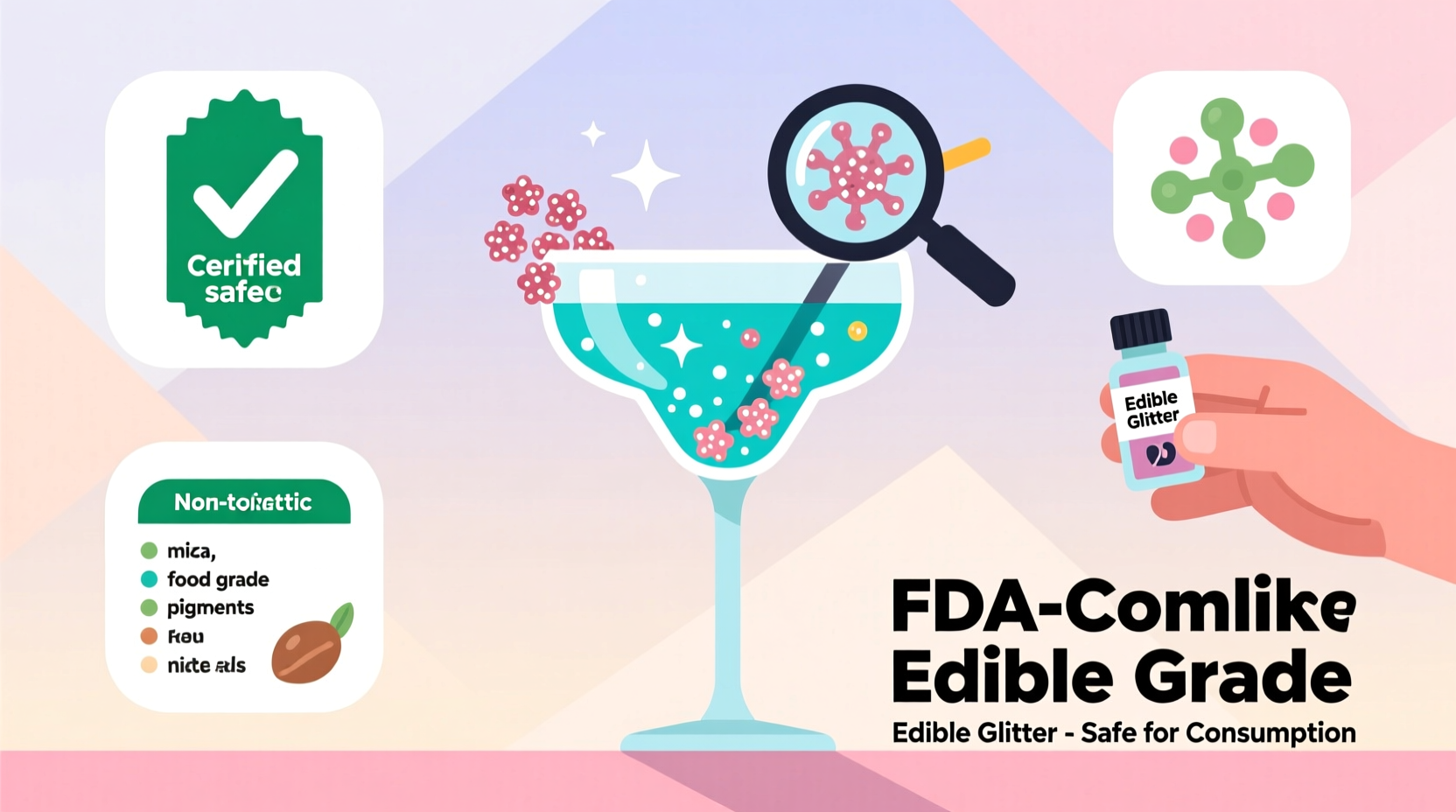
The U.S. Food and Drug Administration (FDA) does not approve “edible glitter” as a single category. Instead, it regulates each component—colorants, substrates (the base material), and binders—under Title 21 of the Code of Federal Regulations. Only specific color additives listed in 21 CFR §73 and §74 are permitted for direct food use. Most commercial glitters—even those labeled “non-toxic” or “cosmetic grade”—fall outside this list. Cosmetic-grade mica, for example, may contain iron oxides or titanium dioxide approved for external use only; when ingested, these compounds lack established safety data for repeated exposure. A 2022 study published in Food Additives & Contaminants found that 63% of 47 “edible” glitters sampled from online retailers contained detectable levels of unapproved colorants or heavy metals—including lead and arsenic—at concentrations exceeding California’s Prop 65 limits.
“‘Non-toxic’ means the substance isn’t acutely poisonous in large doses—but it says nothing about whether it’s safe to consume regularly, in small amounts, over time. For food contact, we need affirmative regulatory approval—not absence of harm.” — Dr. Lena Torres, Toxicologist and Former FDA Center for Food Safety Advisor
This distinction is critical: toxicity is dose-dependent, but food safety is regulatory and intentional. A product can be non-toxic in a lab setting yet still violate federal food additive regulations if its ingredients lack prior sanction for ingestion.
How to Decode Ingredient Lists Like a Regulator
True edible glitter contains only three types of components—and each must be explicitly named and compliant:
- Substrate: The physical “flake” base. Only food-grade mica (listed as mica-based pearlescent pigment or natural mineral mica) or food-grade titanium dioxide (E171, only where permitted—note: banned in the EU since 2022 but still FDA-permitted in limited applications) qualify. Avoid “synthetic mica,” “polyester film,” “PET film,” or “rayon”—these are plastics not approved for food use.
- Colorants: Must be FDA-certified batch-certified dyes (e.g., FD&C Blue No. 1, FD&C Red No. 40) or exempt color additives (e.g., beetroot powder, spirulina extract, annatto). Never accept vague terms like “natural colors,” “plant-derived hues,” or “mineral pigments” without full INCI or E-number disclosure.
- Binders & Coatings: Must be food-grade gum arabic, maltodextrin, or cornstarch. Avoid “acrylic polymer,” “polyvinyl alcohol,” or “shellac” unless explicitly labeled “food-grade shellac (E904)” and certified for direct food contact.
Step-by-Step Verification Process: From Shelf to Serving
Follow this seven-step protocol before purchasing or using any glitter in food or drink:
- Check the manufacturer’s website for a current Certificate of Analysis (CoA): It must include batch-specific testing for heavy metals (lead, cadmium, arsenic, mercury), microbial load (total plate count, E. coli, Salmonella), and colorant compliance. CoAs older than 6 months are invalid.
- Confirm FDA Facility Registration: Search the FDA’s Unified Registration and Listing System (URLS) using the company’s facility number. Unregistered facilities cannot legally manufacture food-contact items in the U.S.
- Look for third-party certification: NSF/ANSI Standard 2—Food Equipment certification is strongest. GMP (Good Manufacturing Practice) certification alone is insufficient—it applies to process, not formulation.
- Verify the product carries an explicit “For Direct Food Use” statement: Not “for cosmetic use,” “for decorative purposes,” or “safe for skin.” Phrases like “meets FDA 21 CFR 172.575” (the regulation covering food-grade mica) are strong indicators.
- Test solubility and dispersion: Stir 1 pinch into 2 oz of warm water. Edible glitter should disperse evenly without clumping, oil slicks, or sedimentation within 60 seconds. Industrial glitters often leave a greasy film or metallic residue.
- Review the SDS (Safety Data Sheet): Section 3 (Composition) must list only ingredients approved for food use. If Section 11 (Toxicological Information) cites “no data available for oral toxicity,” do not use it.
- Perform a visual inspection under magnification: Genuine food-grade mica flakes appear irregular, translucent, and layered under 10x magnification. Plastic-based glitters show sharp, geometric edges and uniform thickness—signs of extruded film.
What to Buy vs. What to Avoid: A Compliance Table
| Product Type | Regulatory Status | Red Flags | Acceptable Alternatives |
|---|---|---|---|
| Cosmetic-grade mica glitter (e.g., “body glitter”) | ❌ Not approved for ingestion | Label says “for external use only,” no CoA, sold in beauty aisles | Food-grade mica + FD&C dyes, certified by NSF |
| “Natural” glitter made from eucalyptus cellulose | ⚠️ Unregulated & untested | No FDA listing, no batch testing, vague “plant-based” claims | None—cellulose glitter lacks FDA approval and peer-reviewed safety data for ingestion |
| Aluminum-coated polyester glitter | ❌ Prohibited for food use | Shiny, mirror-like finish; often labeled “metallic”; contains “aluminum” or “PET” | None—aluminum flakes are banned in food per 21 CFR §184.1133 |
| FD&C-certified sugar-based glitter | ✅ Fully compliant | May dissolve quickly in liquid; requires refrigeration; shorter shelf life | Sugar, citric acid, FD&C Blue No. 1, gum arabic—ideal for short-service cocktails |
| Organic-certified glitter (e.g., USDA Organic) | ⚠️ Misleading—organic certification does not equal food-safe | Focuses on agricultural inputs, not mineral purity or heavy metal limits | Only accept if paired with explicit FDA food additive compliance and CoA |
Real-World Case Study: The Rooftop Bar Recall
In June 2023, a high-profile rooftop bar in Portland, Oregon, began offering “Stardust Spritz” cocktails garnished with gold-dusted prosecco. The glitter was sourced from a popular online supplier marketed as “vegan, natural, and edible.” Within four weeks, three patrons reported gastrointestinal discomfort after consumption. Though no hospitalizations occurred, the Oregon Health Authority launched an investigation. Lab analysis revealed the product contained 0.8 ppm lead—nearly double California’s Prop 65 limit—and used non-certified iron oxide (E172) not approved for direct food use. The supplier had no FDA facility registration and provided no batch-specific CoA. The bar removed the item immediately, issued refunds, and retrained staff using the verification checklist outlined in this guide. Crucially, they switched to a U.S.-based manufacturer whose glitter carried NSF/ANSI 2 certification and published quarterly heavy-metal test reports. Since then, they’ve served over 12,000 glittered cocktails with zero incidents—proving due diligence isn’t theoretical. It’s operational hygiene.
FAQ: Critical Questions Answered
Can I make my own edible glitter at home?
No—homemade glitter (e.g., crushed luster dust, ground mica stones, or DIY “gold leaf” from craft stores) carries unacceptable risks. Mica mined from natural deposits often contains asbestos fibers or heavy-metal contaminants undetectable without ICP-MS lab equipment. Even food-grade luster dust requires precise particle-size control to prevent esophageal abrasion. Commercial production includes micronization, sterilization, and batch testing impossible to replicate safely in home kitchens.
Is “FDA-approved” the same as “FDA-compliant”?
No. The FDA does not “approve” food additives in the way it approves drugs. Instead, ingredients are either “FDA-certified” (batch-tested dyes like FD&C Red No. 40), “exempt from certification” (e.g., turmeric), or “Generally Recognized As Safe” (GRAS) for specific uses. A product claiming “FDA-approved” is misleading. Look for phrases like “complies with 21 CFR §73.1645” (for mica) or “certified per FDA color additive regulations.”
Do edible glitters affect taste or texture?
High-quality, food-grade glitter is flavorless and dissolves without grittiness. Lower-tier products may impart a chalky mouthfeel (from excess titanium dioxide) or slight bitterness (from unrefined beetroot extracts). Sugar-based glitters add minimal sweetness—equivalent to less than 1/100th of a teaspoon per serving. Always taste-test a single grain on your tongue before service: it should vanish cleanly within 10 seconds.
Expert Checklist: Before You Garnish
- ☐ Manufacturer is FDA-registered (verified via URLS database)
- ☐ Product label states “For Direct Food Use” or cites specific CFR sections
- ☐ Current Certificate of Analysis (≤6 months old) shows heavy metals <0.1 ppm each
- ☐ Ingredient list names *all* components—including colorants by FD&C or E-number
- ☐ No mention of “cosmetic grade,” “body glitter,” “PET,” “aluminum,” or “synthetic mica”
- ☐ Third-party certification displayed (NSF/ANSI 2 preferred; GMP alone is insufficient)
- ☐ Tested dispersion in water: no oil film, no sediment, full dispersion in ≤60 sec
Conclusion: Sparkle With Integrity
Choosing edible glitter isn’t about aesthetics alone—it’s an act of responsibility. Every grain placed atop a cocktail represents a choice: to prioritize convenience over compliance, or to uphold the trust your guests place in your craft. Regulatory gaps won’t close overnight, but informed decisions create market pressure for transparency. Start today—not with a new supplier, but with a new standard. Pull out your last order confirmation. Cross-check it against the verification steps and compliance table in this guide. If it falls short, contact the vendor and ask for the CoA, facility number, and exact CFR citation. If they hesitate, you already have your answer. Authentic luxury in hospitality isn’t defined by how brightly something shines—but by how thoroughly it’s vetted. Your guests deserve glitter that delights the eye, satisfies the palate, and leaves no question in the mind. Now go garnish with confidence—and never assume “edible” means “examined.”
💬 Have you encountered misleading “edible” glitter claims? Share your experience, supplier names, or verification wins in the comments—help build a community standard for responsible sparkle.








