
Dog owners often face the same frustrating challenge: their dog pulls on the leash. Whether it’s a powerful pull that nearly drags them down the sidewalk or a constant forward tug that turns walks into battles, this behavior affects both enjoyment and safety. Many turn to equipment—collars or harnesses—as a quick fix. But does simply switching gear solve the problem? More importantly, which option truly stops pulling while keeping the dog physically and emotionally safe?
The debate between harnesses and collars isn’t just about comfort—it’s about biomechanics, behavior modification, and long-term training outcomes. While some tools may reduce pulling in the short term, not all do so without compromising a dog’s well-being. This article breaks down the science, compares common designs, and provides actionable insights from trainers and veterinary professionals.
Understanding Why Dogs Pull
Before evaluating tools, it's essential to understand why dogs pull in the first place. It’s rarely defiance. Instead, pulling is typically driven by:
- Excitement: The world is full of smells, sights, and sounds. A dog eager to explore will naturally surge forward.
- Lack of Training: Most dogs aren’t taught how to walk politely on a leash. Without clear cues and reinforcement, pulling becomes habitual.
- Reinforcement History: Every time a dog pulls and moves forward (toward something interesting), that behavior is reinforced. The dog learns: “Pull = progress.”
- Instinct: Breeds developed for work—like Huskies, Malamutes, or herding dogs—are genetically predisposed to pull.
Equipment can influence behavior, but it cannot replace training. The best tool supports positive reinforcement, reduces strain, and aligns with canine physiology.
Tip: Never punish a dog for pulling. Punishment increases anxiety and can damage trust. Focus instead on rewarding loose-leash walking.How Collars Work—and Their Risks
Traditional flat collars are the most common choice, primarily because they’re used for ID tags and are familiar to owners. However, when used during walks, especially with dogs who pull, they pose significant risks.
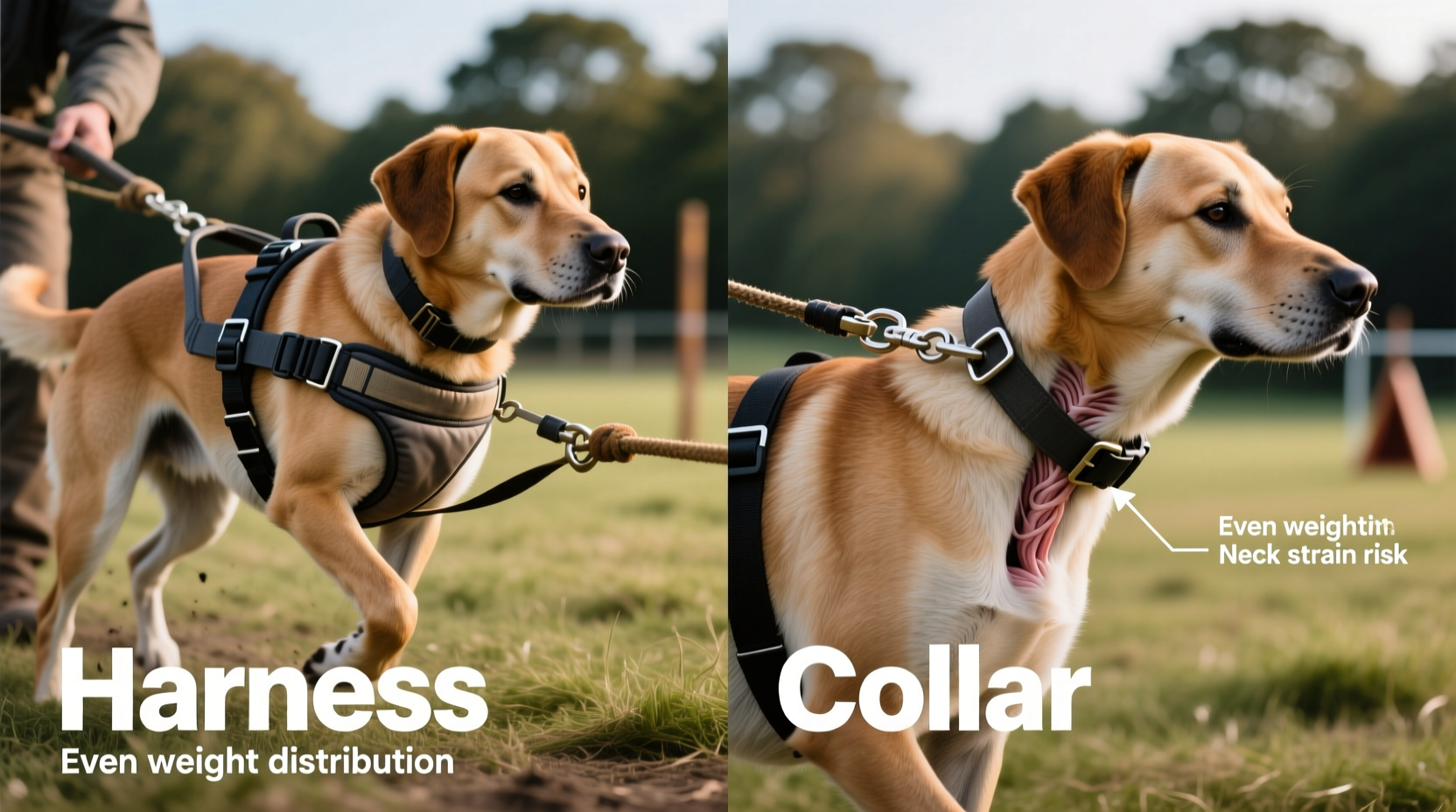
When a dog pulls against a neck collar, pressure is applied directly to the trachea, cervical spine, and surrounding soft tissues. Repeated or forceful tugging can lead to:
- Tracheal collapse or irritation
- Nerve damage in the neck
- Increased intraocular pressure (dangerous for dogs with glaucoma)
- Thyroid gland trauma
- Chronic coughing or gagging
“Applying force to a dog’s neck—even briefly—can cause lasting structural and neurological issues. We strongly recommend alternatives for dogs who pull.” — Dr. Karen Bennett, DVM, Veterinary Neurologist
Even so-called ‘anti-pull’ collars like choke chains or prong collars rely on discomfort or pain to suppress pulling. These tools may reduce forward motion temporarily, but they don’t teach the dog what to do instead. Worse, they can trigger fear-based aggression or increase reactivity over time.
Harnesses: Safer, But Not All Are Equal
Harnesses distribute pressure across the chest and shoulders rather than concentrating it on the neck. This makes them inherently safer for dogs who pull. However, not all harnesses are created equal. Design matters significantly in terms of safety, control, and training efficacy.
There are three main types of harnesses used for dogs who pull:
- Front-Clip Harnesses: The leash attaches at the dog’s chest. When the dog pulls, the harness gently turns them back toward the handler.
- Rear-Clip Harnesses: The leash connects at the back, near the shoulders. Offers more freedom but less directional control.
- No-Pull Harnesses with Dual Clips: Combine front and rear attachment points, allowing flexibility in training phases.
Front-clip harnesses are widely recommended by veterinarians and certified trainers because they redirect momentum without pain. Studies have shown that dogs wearing front-clip harnesses exhibit fewer signs of stress and resistance compared to those using neck collars or aversive devices.
Advantages of Front-Clip Harnesses
- Distributes force across the torso, minimizing injury risk
- Gently redirects the dog when pulling begins
- Encourages the dog to stay close to the handler
- Reduces strain on the owner’s arms and shoulders
Potential Drawbacks
- Some dogs may initially resist turning or feel restricted
- Poorly fitted harnesses can rub or slip
- Not all brands offer proper adjustability or durability
Comparing Tools: What Really Works?
To help clarify the differences, here’s a comparison of common walking tools based on safety, effectiveness, and training compatibility.
| Tool Type | Safety | Effectiveness at Reducing Pulling | Training Support | Vet Recommended? |
|---|---|---|---|---|
| Flat Neck Collar | Low (risk to trachea) | Low | Poor | No |
| Prong/Choke Collar | Very Low (causes pain) | Moderate (suppression only) | Poor | No |
| Rear-Clip Harness | High | Low to Moderate | Fair (can encourage pulling if misused) | Yes, with caution |
| Front-Clip Harness | High | High | Excellent | Yes |
| Head Halter (e.g., Gentle Leader) | Moderate (if properly introduced) | High | Good (requires gradual acclimation) | Sometimes |
Note: Head halters control direction via the muzzle and are effective for strong pullers, but require careful introduction to avoid fear responses. They are not suitable for all dogs or owners.
A Real-World Example: Transforming a Puller
Consider Max, a two-year-old Australian Shepherd adopted from a shelter. Max was enthusiastic but pulled so hard on walks that his owner, Sarah, developed shoulder pain. She tried a standard collar, then a prong collar after advice from a neighbor. Max pulled less—but became reactive to other dogs, barking and lunging.
Concerned, Sarah consulted a certified professional dog trainer. The trainer assessed Max’s behavior and recommended switching to a front-clip harness (specifically the Freedom No-Pull Harness) and beginning a structured loose-leash walking program using treats and redirection.
Over six weeks, Sarah practiced short, focused walks in low-distraction areas. She rewarded Max every time he walked beside her without tension. The harness helped redirect him when he surged ahead, and gradually, Max learned that walking calmly resulted in more forward movement and rewards.
By week eight, Max walked with a loose leash 80% of the time. His reactivity decreased, and Sarah reported enjoying walks again. The combination of the right tool and consistent positive reinforcement made the difference.
“The harness didn’t stop the pulling on its own. It created the conditions where training could succeed.” — Lisa Monroe, CPDT-KA, Canine Behavior Consultant
Step-by-Step Guide to Stopping Pulling Safely
Equipment is only one piece of the puzzle. Here’s a proven method to eliminate pulling using humane, science-based techniques:
- Choose a Front-Clip Harness: Select a well-fitted, comfortable model designed to discourage pulling.
- Start Indoors or in a Quiet Area: Begin training where distractions are minimal.
- Use High-Value Treats: Carry small, smelly treats your dog loves (e.g., chicken, cheese).
- Mark and Reward Attention: Click or say “yes” the moment your dog looks at you or walks beside you.
- Stop When the Leash Tightens: The instant the leash goes taut, stop moving. Wait for slack, then mark and reward.
- Turn and Go the Other Way: If your dog continues forward, pivot and walk in the opposite direction. This teaches that pulling doesn’t get them where they want to go.
- Practice Frequently, Briefly: Three 5-minute sessions per day are more effective than one long walk.
- Gradually Increase Difficulty: Move to busier sidewalks only after success in calm environments.
- Add Verbal Cues: Once reliable, introduce a cue like “Let’s go” or “Heel” to signal desired behavior.
- Be Consistent: Everyone in the household must use the same method.
Checklist: Choosing and Using the Right Tool
Before buying a harness or collar, ask yourself these questions:
- ✅ Does it distribute pressure away from the neck?
- ✅ Is it adjustable for a secure, comfortable fit?
- ✅ Does it allow full range of motion without chafing?
- ✅ Is it made from durable, breathable materials?
- ✅ Does it support positive reinforcement training?
- ✅ Have I introduced it gradually to my dog?
- ✅ Am I pairing it with consistent training, not relying on it alone?
If you answered “no” to any of these, reconsider your choice.
Frequently Asked Questions
Can a harness completely stop pulling without training?
No. While front-clip harnesses make pulling less effective by redirecting the dog, they do not teach alternative behaviors. Without training, dogs may adapt—such as leaning or zig-zagging—and pulling can persist. The harness is a management tool, not a substitute for learning.
Are no-pull collars safe?
Most “no-pull” collars are still neck devices (like martingales or limited-slip collars) and apply pressure to sensitive areas. Even if they restrict pulling, they carry risks. Veterinarians and animal welfare organizations generally recommend harnesses over any collar designed to restrict or correct.
My dog backs out of harnesses. What should I do?
This usually indicates a poor fit or negative association. Measure your dog carefully and choose a harness with multiple adjustment points. Introduce it slowly with treats and praise. Avoid forcing it on. If escape persists, consult a trainer for fitting tips or try a different brand with a secure leg loop design.
Conclusion: Safety First, Training Always
When it comes to stopping pulling, the safest and most effective approach combines the right equipment with consistent, positive training. Harnesses—especially front-clip models—offer a humane advantage over collars by protecting the dog’s neck and encouraging better walking posture. But no tool can replace the need for teaching, patience, and reinforcement.
The goal isn’t just to stop pulling; it’s to build a relationship where walking together is enjoyable for both dog and owner. That requires empathy, understanding, and methods that respect the dog’s physical and emotional needs.
🚀 Ready to transform your walks? Start today: swap to a front-clip harness, grab some high-value treats, and practice five minutes of loose-leash walking. Small steps lead to big changes. Share your journey or ask questions in the comments below—we’re all learning together.








