Pet ownership brings joy, companionship, and a steady stream of fur. Whether it's a golden retriever shedding across the living room or a cat leaving tufts on the sofa, pet hair is an inevitable part of daily life. While regular sweeping helps, only a vacuum can truly remove embedded hair from carpets, upholstery, and crevices. But with so many options, choosing the right tool becomes critical—especially when comparing handheld vacuums and cordless stick cleaners.
Both are marketed as convenient, lightweight solutions, but they serve different needs. For pet owners, the decision isn’t just about convenience—it’s about effectiveness. Which device removes more hair from high-traffic areas? Which handles furniture and stairs better? And which offers long-term value without constant maintenance?
This article breaks down the strengths and limitations of each type, using real-world performance data, expert insights, and practical comparisons to help you decide which machine earns its place in your home.
Suction Power and Motor Design
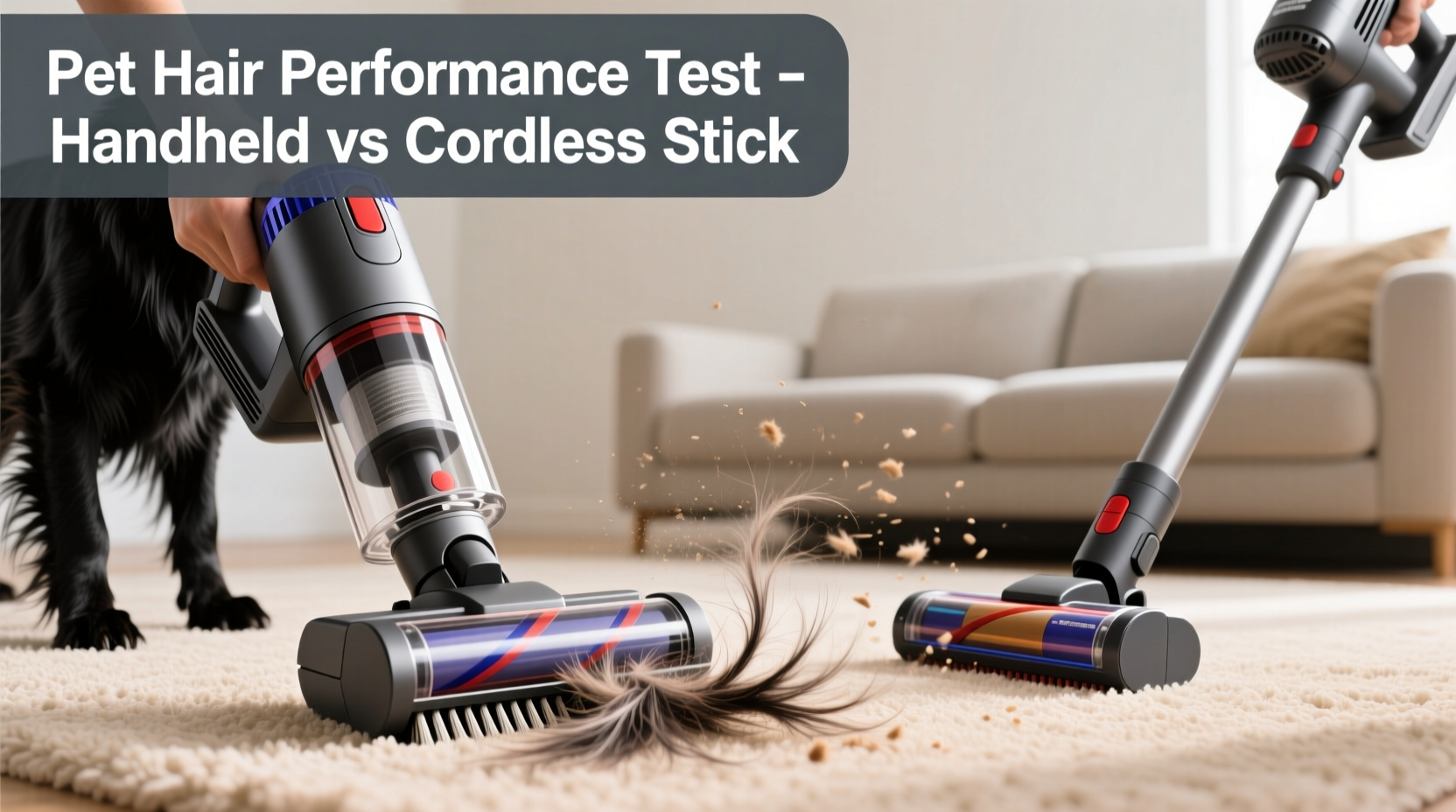
The ability to lift pet hair depends heavily on suction strength and airflow design. Cordless stick vacuums typically feature larger motors than handheld models, allowing them to generate higher airwatts—usually between 70 and 130 for premium models. This enables deeper cleaning on carpets and area rugs where pet hair embeds into fibers.
Handheld vacuums, by contrast, prioritize portability over power. Most operate in the 20–50 airwatt range, sufficient for surface-level debris but less effective on thick carpeting. However, some high-end handhelds now include cyclonic technology and brush-roll enhancements that narrow this gap.
What matters most is how the motor interacts with the cleaning head. Stick vacuums often use motorized roller brushes that agitate carpet fibers, dislodging trapped hair. Handhelds may lack this feature unless designed specifically for upholstery (e.g., models with mini turbo brushes).
“Suction alone isn’t enough. The combination of airflow, brush roll speed, and nozzle design determines how well a vacuum extracts pet hair.” — Dr. Alan Tran, Home Appliance Engineer at CleanTech LabsTip: Look for devices with sealed filtration systems and HEPA filters if you or your pets suffer from allergies.
Maneuverability and Access to Problem Areas
Pet hair doesn’t stay on floors. It clings to baseboards, settles under furniture, and accumulates in car seats and between couch cushions. Here, handheld vacuums shine due to their compact size and detachable tools.
A typical handheld weighs under 3 pounds and fits into tight spaces with ease. Many come with crevice tools, dusting brushes, and upholstery nozzles—ideal for quick cleanups after pets shed on furniture or track dirt indoors. Their cordless nature means you can carry them from room to room, up stairs, or even into the garage without tripping over cords.
Cordless stick vacuums offer decent agility but are bulkier. While swivel heads improve navigation around furniture legs, their length makes them awkward for overhead cleaning or reaching deep into car interiors. Detachable handheld components on hybrid models (like the Dyson V15 Detect or Shark Vertex) bridge this gap by letting users convert the stick into a portable unit.
If your pet spends significant time on sofas, beds, or vehicles, a standalone handheld or a stick vacuum with a removable handheld section provides superior flexibility.
Performance on Different Surfaces
Pet owners face diverse cleaning challenges across flooring types. A vacuum must transition seamlessly from hardwood to rugs while maintaining consistent pickup. Here’s how each type performs:
| Surface Type | Handheld Vacuum | Cordless Stick Cleaner |
|---|---|---|
| Hardwood/Laminate | Moderate – picks up loose hair but struggles with static-cling strands | Strong – wide nozzle covers more area; anti-static bristles reduce clinging |
| Low-Pile Carpet | Fair – limited reach; requires multiple passes | Excellent – motorized brush rolls dig into fibers effectively |
| High-Pile/Plush Rug | Poor – lacks power and depth penetration | Very Good – powerful suction lifts deeply embedded hair |
| Upholstery/Furniture | Excellent – precise control and specialized tools | Good – possible with attachments, but bulkier to handle |
| Stairs | Excellent – lightweight and easy to carry upward | Fair – top-heavy; battery strain during prolonged use |
The table shows a clear trade-off: stick vacuums dominate on floor coverage and carpet cleaning, while handhelds excel in targeted, above-floor tasks.
Maintenance and Hair Wrap Resistance
No matter how strong the suction, a vacuum that constantly tangles will frustrate users. Pet hair is notorious for wrapping around brush rolls, clogging filters, and reducing efficiency over time.
Many modern cordless sticks now feature tangle-free brush rolls made with rubber fins or anti-wrap coatings. Brands like LG and Tineco use dual-layer combs that cut through hair before it wraps. These designs significantly reduce maintenance, though occasional manual cleaning remains necessary every few weeks.
Handheld vacuums usually have smaller brush heads or none at all, minimizing wrap risk. However, their small dust bins fill quickly when dealing with large amounts of fur. Emptying them frequently is essential, especially after grooming sessions.
Filters also require attention. Washable HEPA filters should be cleaned monthly to maintain suction. In households with multiple pets, neglecting filter care can halve a vacuum’s lifespan.
- Empty dustbin after every major use involving pet hair
- Inspect brush roll weekly for缠绕 (tangling)
- Rinse filters every 4–6 uses; let dry completely before reinserting
- Use compressed air to clear hidden crevices in nozzles
Real-World Example: Life With Two Dogs and One Cat
Sarah M., a pet owner in Portland, Oregon, shares her experience managing fur from two Labrador mixes and a long-haired Maine Coon. “I started with a basic stick vacuum,” she says, “but found myself grabbing a separate handheld every time the cats left hair on the bed or the dogs tracked mud near the door.”
After six months, she upgraded to a convertible stick model with a detachable handheld unit. “Now I do the floors quickly with the full stick, then pop off the handheld to clean the couch, stairs, and car seats. It cuts my cleaning time in half and actually gets more hair out.”
Her biggest surprise? The handheld portion removed more fur from upholstery than her old dedicated handheld because it had stronger suction and a turbo brush attachment. “It proved that integration beats having two separate weak machines,” she notes.
Sarah’s case illustrates a growing trend: hybrid models offering both reach and precision are becoming the go-to choice for multi-pet homes.
Which One Tackles Pet Hair Better? A Balanced Verdict
There’s no universal answer—but there is a context-based solution.
Choose a cordless stick cleaner if:
- You have mostly carpeted floors or large open areas
- Your pets shed heavily on rugs and hallways
- You want faster whole-room cleaning with minimal effort
- Battery life (typically 30–60 minutes) meets your square footage needs
Opt for a handheld vacuum if:
- Your main concern is furniture, stairs, cars, or tight corners
- You live in a small apartment or don’t need full-floor cleaning
- You prefer ultra-lightweight tools for spot-cleaning throughout the day
- You already own a reliable upright or canister vacuum for deep cleans
For maximum effectiveness, consider a **2-in-1 cordless stick vacuum with a detachable handheld component**. These hybrids combine the best of both worlds: powerful floor cleaning and precise above-floor detailing. Models like the Dyson Outsize, Samsung Jet 100, and Bissell AirRam Max offer such functionality and are increasingly optimized for pet owners.
Checklist: Choosing the Right Vacuum for Pet Hair
- Assess your primary cleaning zones (floors, furniture, stairs, vehicles)
- Determine whether you need whole-room coverage or spot-cleaning focus
- Look for tangle-free brush roll technology
- Verify bin capacity (at least 0.5L recommended for pet-heavy homes)
- Ensure washable, HEPA-grade filtration
- Test weight and balance—anything over 6 lbs becomes tiring during extended use
- Check runtime: aim for at least 30 minutes on medium suction
- Confirm availability of pet-specific tools (turbo brush, upholstery nozzle)
Frequently Asked Questions
Can a handheld vacuum replace a full-sized vacuum for pet owners?
Only in very small spaces or for minimal shedding. Handhelds lack the coverage and sustained power needed for complete floor cleaning. They’re best used as supplements to a primary vacuum system.
Do cordless stick vacuums lose suction over time?
Yes, especially if filters aren’t maintained or bins are overfilled. Lithium-ion batteries also degrade after 2–3 years, reducing motor performance. Regular cleaning and proper charging habits extend peak efficiency.
Are robot vacuums better than handheld or stick models for pet hair?
Robot vacuums offer convenience but generally lack the suction and brush-roll engineering of high-end cordless sticks. They work well for daily maintenance but often miss concentrated hair build-up. Most pet owners still rely on manual vacuums for thorough weekly cleaning.
Final Recommendation
When it comes to tackling pet hair, the cordless stick vacuum generally outperforms the standalone handheld—especially on floors and carpets. Its superior suction, wider cleaning path, and advanced brush-roll designs make it the better all-around option for homes with heavy shedding.
However, the handheld vacuum remains unmatched for targeted jobs. When integrated into a convertible stick system, it enhances versatility without sacrificing performance.
The ideal solution isn’t choosing one over the other—it’s selecting a smart hybrid that adapts to your home’s unique demands. Prioritize models built for pet owners: look for tangle-free tech, HEPA filtration, strong bin capacity, and tools designed for upholstery.
💬 Ready to upgrade your pet-hair cleanup routine? Evaluate your daily challenges, test models in-store if possible, and invest in a vacuum that works as hard as you do. Share your favorite pet-cleaning tips in the comments below!








