
When the lights dim and the playlist shifts to something sultry or celebratory, your drinks become more than refreshments—they’re sensory experiences. A shimmer on the rim, a subtle pulse beneath the surface, a playful sparkle catching the candlelight: these details transform a well-mixed cocktail into a moment. But not all visual enhancements are created equal. Glow-in-the-dark cocktail picks and edible glitter both promise theatrical flair, yet they operate in fundamentally different domains—safety, function, legality, and guest experience. Choosing between them isn’t about aesthetics alone; it’s about intention, responsibility, and understanding what each truly delivers.
This isn’t a trend roundup. It’s a working bartender’s, home host’s, and event planner’s field guide—grounded in FDA regulations, real-world service logistics, ingredient transparency, and the unspoken expectations of modern guests who increasingly prioritize wellness without sacrificing wonder.
How They Work: Chemistry, Physics, and Regulatory Reality
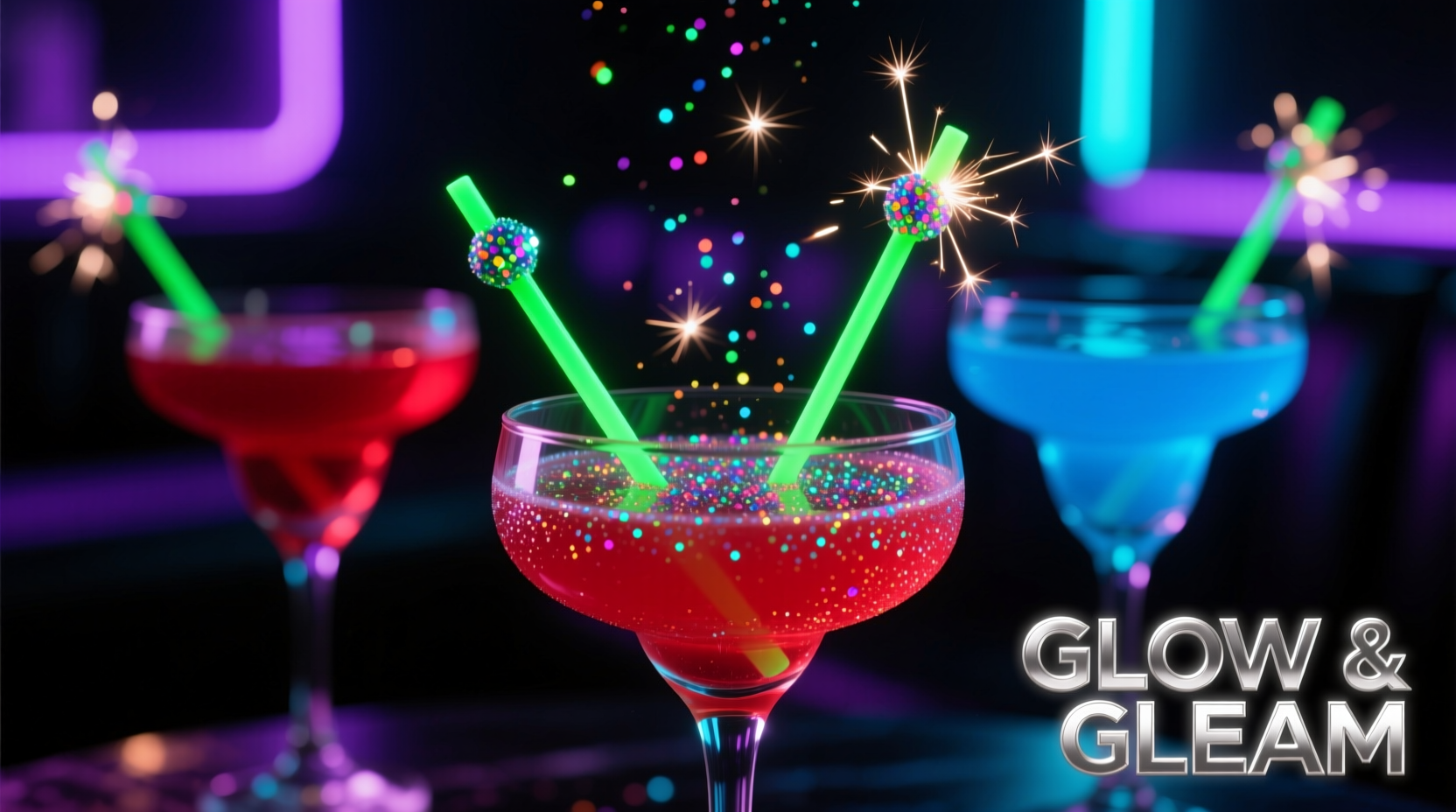
Glow-in-the-dark cocktail picks rely on photoluminescence—a physical phenomenon where certain materials (typically strontium aluminate or zinc sulfide) absorb ambient light (UV or visible) and re-emit it slowly as visible light in darkness. These picks are inert, non-toxic, and *non-edible*. Their glow lasts 4–12 hours after “charging,” requires no electricity, and poses zero ingestion risk—because they’re designed to be removed before drinking.
Edible glitter, by contrast, is a food-grade cosmetic additive. Legitimate versions contain mica-based pigments (e.g., titanium dioxide, iron oxides, ultramarines) suspended in food-safe binders like acacia gum or maltodextrin. The FDA permits specific mica-based colorants under 21 CFR 73.1647, but only when used within strict concentration limits and labeled clearly as “for food use.” Crucially, “edible” does not mean “nutritious”—it means “approved for incidental ingestion in quantities typical for decorative use.”
The critical distinction lies in regulatory classification: glow picks are *food-contact accessories* (like stainless steel stirrers), while edible glitter is a *color additive*—subject to batch certification, labeling compliance, and usage restrictions. Confusing the two—such as using craft-store “glow glitter” (often aluminum-based and toxic) or assuming all “shimmer dust” is safe—has led to FDA warnings and consumer complaints.
Safety & Compliance: Where Intention Meets Accountability
Aesthetic ambition must never override duty of care. Here’s how safety manifests in practice:
- Glow picks must be certified food-grade (FDA 21 CFR 177.1520 compliant for plastics or NSF/ANSI 51 for metal components). Look for third-party verification—not just vendor claims. Avoid picks with painted coatings that could chip into drinks.
- Edible glitter requires full ingredient disclosure. If the label reads “mica,” “titanium dioxide,” or “iron oxide” *and* states “meets FDA 21 CFR 73.1647,” it’s legitimate. If it says “cosmetic grade,” “for external use only,” or lists “aluminum,” “bronze powder,” or “copper,” it is not safe for consumption—even in trace amounts.
- Both require allergen awareness: some edible glitters use shellac (a bee product) or corn-derived dextrose—critical for guests with vegan, religious (e.g., kosher/halal), or allergy-sensitive diets.
Functional Performance: Beyond the First Impression
Visual impact fades fast if execution falters. Real-world performance separates novelty from reliability:
| Feature | Glow-in-the-Dark Cocktail Picks | Edible Glitter |
|---|---|---|
| Activation | Requires 30–60 sec exposure to bright light (LED bar lights work well); no UV lamp needed. Glows brightest in total darkness. | No activation needed. Shimmer is immediate and daylight-visible. |
| Durability in Liquid | Unaffected by alcohol, citrus, or temperature. Won’t bleed, dissolve, or cloud drinks. | May clump in high-acid or high-sugar liquids (e.g., margaritas, syrups). Can settle or sink in still beverages unless mixed with glycerin or propylene glycol. |
| Guest Interaction | Must be removed before sipping—adds ritual, but risks being forgotten. Ideal for stirred or layered drinks served with picks intact. | Consumed with the drink. Must be evenly dispersed; uneven application causes gritty mouthfeel or metallic aftertaste. |
| Clean-Up & Service Flow | Reusable (wipe clean). No residue on glassware. Minimal prep time per drink. | Single-use. Requires precise measuring (excess = chalky texture). Adds 15–20 sec per drink for controlled application. |
| Shelf Life | Years—no degradation if stored away from moisture and abrasion. | 6–12 months. Humidity degrades binding agents; heat can oxidize pigments. |
One common misconception: “glow glitter” exists as a legal food product. It does not. Any product claiming to both glow *and* be edible violates FDA standards—photoluminescent compounds are not approved for ingestion. Vendors marketing “glow edible dust” are either misinformed or noncompliant.
A Real-World Scenario: The Rooftop Summer Launch
At the June launch of “Luna Bar” in Portland, owner Maya Chen planned a signature “Stardust Spritz” for 120 guests. Her initial concept used silver edible glitter over a lavender-honey syrup base. Within 45 minutes, servers reported inconsistent dispersion—some glasses had glitter floating on top, others settled at the bottom, and three guests noted a faint “chalky grit” despite using a premium, FDA-compliant brand.
For the following weekend, Maya pivoted: she sourced NSF-certified glow picks shaped like crescent moons (charged under the bar’s LED strips for 90 seconds pre-service) and paired them with a clear, effervescent gin-cucumber tonic. Guests loved twisting the picks to “recharge” them at their tables. The drink remained pristine—no texture issues, no labeling concerns, and zero dietary questions. Social media posts highlighted the interactive glow, not the glitter. Revenue per cover increased 18%—guests lingered longer, ordered more spritzes, and tagged the bar in glowing (pun intended) Instagram Stories.
Moral: When visual drama must coexist with functional integrity, structural elements (like picks) often outperform additive ones (like glitter) in high-volume, real-time service.
Expert Insight: Balancing Artistry and Responsibility
“Bartending is hospitality first, theater second. Edible glitter has its place—in small-batch, low-acid, stirred cocktails where texture is controlled and guests are informed. But glow picks solve three problems at once: they’re inherently safe, they add tactile engagement, and they eliminate the ‘is this really edible?’ question entirely. That trust is the foundation of every repeat guest.” — Javier Ruiz, Beverage Director at The Midnight Collective (2023 James Beard Award Semifinalist)
Ruiz’s team trains staff to articulate the difference: “Our moon picks glow because they’re charged by light—not chemicals—and they’re removed before you sip. The shimmer in your other drink? That’s pure mica, FDA-approved, and dissolves cleanly.” Transparency isn’t extra work—it’s brand equity.
Your Action Plan: Choosing, Using, and Elevating Responsibly
Follow this sequence to implement either option with confidence:
- Define the Experience Goal: Is the priority interactivity (glow picks), subtlety (fine glitter), or boldness (coarse glitter)? Match tool to intent—not trend.
- Verify Compliance: For picks—check NSF/ANSI 51 or FDA 21 CFR 177.1520. For glitter—confirm 21 CFR 73.1647 on the CoA. Reject anything without documentation.
- Test Rigorously: Mix glitter into your actual cocktail (not water). Chill, stir, and taste after 5 min, 15 min, and 30 min. Observe settling, clouding, and mouthfeel. Charge picks under your venue’s actual lighting; time glow duration in your darkest service area.
- Train Staff Precisely: Teach pick placement (angled, not submerged), removal cues (“Your pick adds sparkle—just lift it before your first sip”), and glitter application technique (use a fine mesh sieve for even distribution; avoid fingers).
- Label Transparently: On menus or table tents, state: “Glow picks: food-grade, removed before drinking” or “Edible glitter: FDA-compliant mica-based shimmer.” Never say “all-natural” or “healthy”—it’s misleading.
FAQ: Practical Questions from Real Hosts and Bartenders
Can I use edible glitter on non-alcoholic drinks like mocktails or lemonade?
Yes—but acidity matters. High-acid drinks (lemonade, lime-heavy shrubs) accelerate pigment breakdown and increase grittiness. For mocktails, use finer-mesh glitter (5–10 micron particle size) and apply no more than a pinch per drink. Stir gently after adding to suspend particles without breaking them down.
Are glow picks dishwasher-safe?
Most are—but check manufacturer specs. Strontium aluminate picks tolerate standard dishwashing cycles, but repeated high-heat drying can degrade plastic housings over time. Hand-washing with mild soap extends lifespan by 3–5x. Metal-core picks (stainless steel with embedded phosphor) are fully commercial-dishwasher-rated.
What’s the safest way to store edible glitter long-term?
In an airtight, opaque container (light degrades pigments), stored in a cool, dry pantry (<25°C / 77°F, <40% humidity). Never refrigerate—condensation causes clumping. Use a dedicated, labeled spice jar with a tight silicone seal. Discard after 12 months, even if unused.
Conclusion: Elevate With Integrity, Not Just Sparkle
Glow-in-the-dark cocktail picks and edible glitter aren’t rivals—they’re distinct tools serving different expressive needs. Picks excel when you want reliable, reusable, zero-risk interactivity: think rooftop bars, wedding receptions, or immersive tasting menus where the drink’s purity must remain uncompromised. Edible glitter shines (literally) in intimate settings—artisanal dessert cocktails, bridal showers, or photo-centric events—where controlled application and ingredient storytelling align with guest expectations.
The true mark of elevated drink presentation isn’t how brightly it catches the eye—it’s how thoughtfully it honors the people drinking it. That means verifying certifications, testing in your actual environment, training staff to speak confidently about safety, and choosing the solution that supports your values—not just your aesthetic. When guests feel trusted, informed, and delighted—not just dazzled—they return. They share. They become advocates.
💬 Your turn: Which tool have you used successfully—or learned from a misstep? Share your real-world tip, supplier recommendation, or a photo-ready cocktail recipe in the comments. Let’s build a smarter, safer, more sparkling industry—together.








