
Setting up a freshwater aquarium is exciting, but one of the most overlooked decisions can have long-term consequences on maintenance: choosing between gravel and sand as your substrate. For beginners, ease of cleaning is often the deciding factor—after all, no one wants to spend hours scrubbing their tank every week. While both materials serve essential functions like anchoring plants and hosting beneficial bacteria, they differ significantly in how they respond to vacuuming, waste accumulation, and algae growth. Understanding these differences helps new aquarists make informed choices that align with their lifestyle and commitment level.
How Substrate Impacts Tank Maintenance
The base layer at the bottom of your aquarium does more than just look good—it plays a critical role in biological filtration, root support for live plants, and water chemistry stability. However, it also traps fish waste, uneaten food, and decaying plant matter. If not managed properly, this debris breaks down into ammonia and nitrites, threatening fish health.
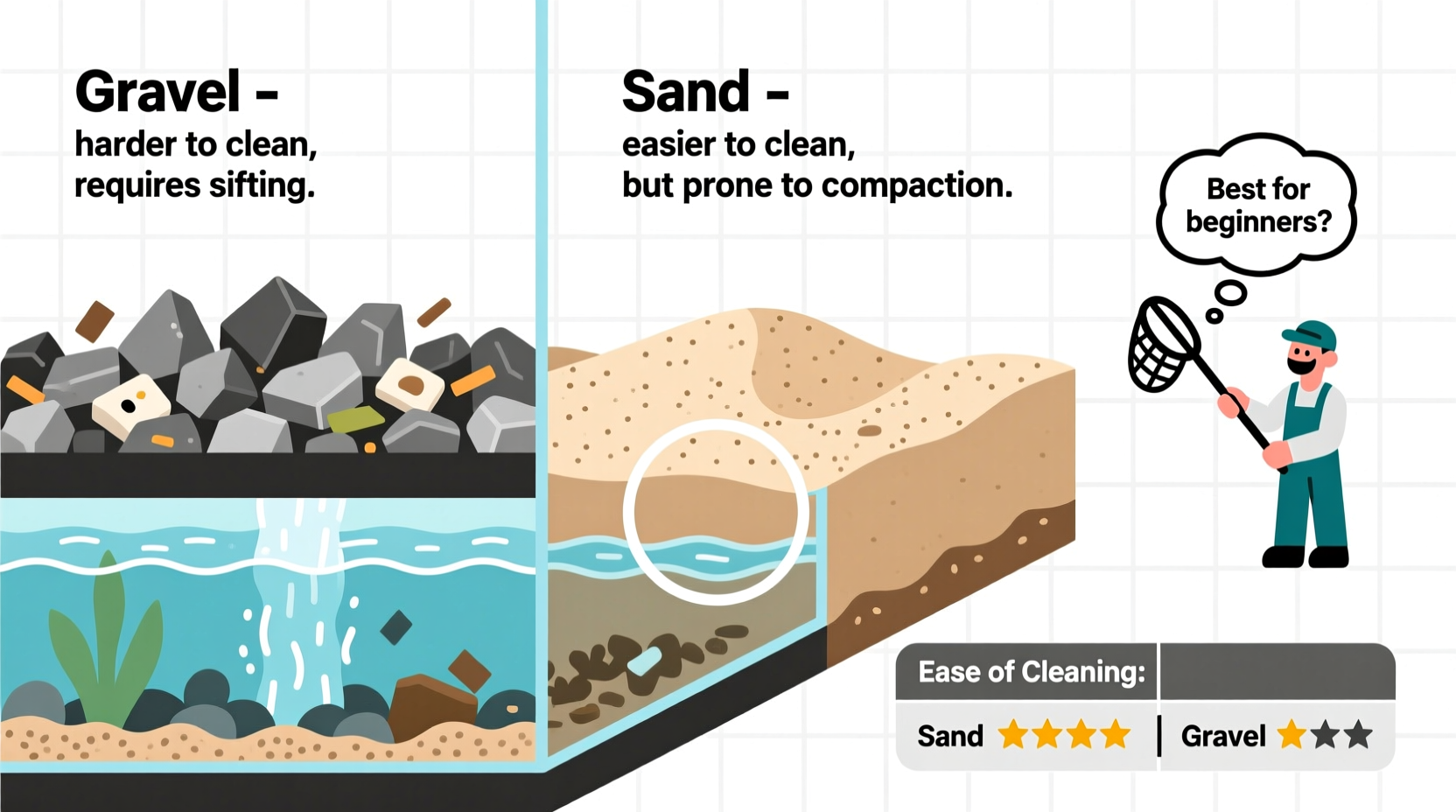
Gravel and sand handle this organic load very differently due to particle size and compaction. Gravel consists of small, rounded stones typically 2–4 mm in diameter. Its larger gaps allow detritus to settle deeper but also let water circulate more freely. Sand, made of fine particles less than 1 mm wide, packs tightly together, creating a denser surface.
This structural difference affects everything from oxygen flow within the substrate to how easily a siphon can extract waste. For beginners still learning the rhythm of weekly water changes and filter maintenance, selecting the right substrate can mean the difference between a thriving tank and constant battle with cloudy water and odors.
Tip: Whichever substrate you choose, invest in a quality gravel vacuum early—it’s the most important tool for keeping your tank clean.Cleaning Gravel: Pros and Practical Challenges
Gravel has long been the default choice for beginner aquariums, and there's good reason for that. Its coarse texture makes mechanical cleaning relatively straightforward. During water changes, an aquarium vacuum can be plunged directly into the gravel bed, agitating the top layer while suction pulls out suspended debris without removing too much material.
Because waste tends to sit on or slightly below the surface rather than sinking deep, most of it becomes visible quickly—often appearing as dark specks between stones. This visibility helps beginners identify problem areas and target them during cleaning. Additionally, many common fish like Corydoras and loaches naturally stir the upper layers, reducing compaction and helping prevent anaerobic pockets.
However, gravel isn’t foolproof. Over time, especially in overstocked tanks or those with heavy feeders, organic matter can sink past the upper layer and become trapped deeper down. Without regular stirring or deep-cleaning routines, these pockets may decompose anaerobically, producing hydrogen sulfide—a toxic gas that smells like rotten eggs and can harm fish when disturbed.
Another issue is uneven distribution. In some setups, water currents push gravel into corners, leaving bare spots elsewhere. This not only looks unappealing but can expose heater elements or create dead zones where detritus accumulates unchecked.
“Gravel offers excellent mechanical filtration and is forgiving for first-time aquarists, but only if cleaned consistently.” — Dr. Alan Perez, Aquatic Biologist
Sand Substrates: Simpler Surface, Hidden Complexities
Sand provides a sleek, natural appearance reminiscent of riverbeds or lake floors. It’s favored in planted tanks and setups housing bottom-dwellers like stingrays or certain cichlids that prefer soft surfaces. From a visual standpoint, sand gives the illusion of cleanliness because debris tends to rest on top, making it easy to spot.
But here lies a paradox: while waste is more visible on sand, removing it effectively requires greater care. Standard gravel vacuums often struggle with sand because the fine grains are easily sucked up along with debris. To avoid losing large amounts of substrate, users must hold the tube just above the surface, relying on gentle suction to pull away floating particles without disturbing the bed.
Moreover, sand compacts over time, limiting water and oxygen penetration. Without adequate circulation, anaerobic zones form beneath the surface—again risking hydrogen sulfide buildup. Unlike gravel, where agitation occurs naturally through fish activity or cleaning, sand needs occasional manual stirring (using a chopstick or plastic rod) to prevent stagnation.
Some beginners report frustration with \"plumes\" of dust when initially setting up a sand substrate. Though this settles after rinsing and a few days, it can cloud the water and stress sensitive species. Pre-washed sand reduces this risk but often comes at a higher price point.
Real Example: A Beginner’s Experience with Sand
Lena, a first-time aquarist in Portland, chose black sand for her 30-gallon community tank housing tetras and shrimp. She loved the polished look and assumed the smooth surface would be easier to maintain. After six weeks, however, she noticed persistent bubbles rising from the substrate whenever she disturbed the bottom. Research revealed these were gases from decomposing matter trapped underneath.
She began gently stirring the sand weekly with a plastic spoon and adjusted her vacuum technique to hover just above the surface. Within a month, gas production stopped, and clarity improved. “I didn’t realize sand needed proactive care,” she said. “Now I see it’s not low-maintenance—it’s *different*-maintenance.”
Direct Comparison: Gravel vs Sand for Cleaning Ease
| Factor | Gravel | Sand |
|---|---|---|
| Waste Visibility | Moderate – sinks between stones | High – sits on top |
| Vacuum Efficiency | High – can penetrate substrate safely | Moderate – risk of sucking up sand |
| Detritus Trapping | Moderate – settles mid-layer | Low – mostly on surface |
| Compaction Risk | Low – allows water flow | High – prone to anaerobic zones |
| Initial Setup Mess | Minimal – rinses easily | High – creates dust clouds |
| Fish Compatibility | Broad – suits most species | Niche – ideal for burrowers/sifters |
| Long-Term Maintenance | Consistent but simple | Requires precision and routine |
This comparison shows that while sand appears cleaner visually, it demands more nuanced handling. Gravel, though coarser, allows for more aggressive cleaning without damage. For someone just learning aquarium basics, predictability and forgiveness matter more than aesthetics.
Tip: When using sand, rinse thoroughly before adding to the tank—run water through it until the runoff runs clear to minimize cloudiness.Step-by-Step Guide to Cleaning Each Substrate
Cleaning Gravel
- Turn off filters and heaters to prevent overheating or dry running.
- Insert the gravel vacuum into the substrate, letting it sink about halfway into the top layer.
- Pump the siphon to start water flow, then move the tube slowly across the tank floor.
- Agitate the gravel gently by lifting and dropping the vacuum slightly to release trapped debris.
- Focus on high-traffic areas near feeding zones or under filters where waste accumulates.
- Remove 10–25% of total water volume, depending on your schedule.
- Refill with dechlorinated water matched to tank temperature.
Cleaning Sand
- Prepare your vacuum but do not plunge it into the sand.
- Hold the intake just above the surface (1–2 cm), allowing suction to draw loose particles.
- Move slowly across the tank, pausing briefly over clusters of detritus.
- If waste is embedded, lightly disturb the surface with a fork or toothpick first.
- Perform partial water changes as with gravel, ensuring new water is temperature-balanced.
- Once monthly, gently stir compacted areas with a non-metal tool to release gases.
Note: Never use metal utensils in your tank—they can leach harmful substances or scratch acrylic.
Checklist: Choosing the Right Substrate for Your Skill Level
- ✅ Are you new to aquariums? → Gravel is more forgiving.
- ✅ Do you plan to keep burrowing fish? → Sand may be necessary.
- ✅ Will you have live plants? → Fine sand supports rooting but needs root tabs.
- ✅ Can you commit to careful vacuuming techniques? → Sand becomes manageable.
- ✅ Is appearance a top priority? → Sand offers a polished, natural look.
- ✅ Do you overfeed or have messy eaters? → Gravel handles excess waste better.
Frequently Asked Questions
Can I mix gravel and sand in the same tank?
Mixing substrates is possible but not recommended for beginners. Heavier gravel tends to sink below sand, causing separation and uneven layers. If attempted, lay sand first, then add gravel sparingly on top. Be aware that cleaning becomes more complex, as tools must accommodate both textures.
Does sand really produce harmful gases?
Yes—when organic matter decomposes in oxygen-poor environments beneath compacted sand, it can generate hydrogen sulfide. While small amounts are processed by beneficial bacteria, large releases during deep cleaning can spike toxicity. Regular surface maintenance and occasional stirring reduce this risk significantly.
Which substrate promotes better plant growth?
Fine grain substrates like sand hold nutrients more effectively and provide stable anchorage for delicate roots. However, pure sand lacks essential minerals. Many planted tank enthusiasts use nutrient-rich soil beneath a sand cap or supplement with root fertilizers. Gravel alone offers poor nutrient retention unless paired with enriched additives.
Final Recommendation for Beginners
For most newcomers to fishkeeping, **gravel is easier to clean** and more adaptable to common mistakes. It allows robust vacuuming, resists compaction, and works well with a wide range of fish and equipment. While sand offers aesthetic appeal and benefits specific species, its maintenance requires patience, precision, and consistent attention to detail—qualities that often develop over time.
That said, success depends less on the material itself and more on routine. Whether you choose gravel or sand, establishing a weekly cleaning habit, monitoring water parameters, and observing how waste behaves will determine your tank’s long-term health. The best substrate is one you’re willing and able to maintain.
“The easiest substrate isn’t always the best teacher. Sometimes, the slight extra effort with sand builds better habits faster.” — Marina Chen, Certified Aquarium Technician🚀 Start simple with gravel if you're new. Master the basics of cycling, feeding, and cleaning—then explore sand with confidence. Share your journey or ask questions in the comments below!









