
In rural areas, where cell coverage can be spotty and terrain rugged, pet owners face unique challenges when their dogs go missing. Unlike urban environments with dense Wi-Fi networks and frequent Bluetooth relays, remote regions demand reliable, long-range tracking solutions that don’t depend on crowdsourced data alone. Two popular options—Fi’s GPS-enabled smart collars and Apple’s AirTag—have emerged as contenders. But which one truly performs better when your dog bolts into the woods or wanders across miles of open land?
This article compares Fi dog collars and Apple AirTags head-to-head, focusing on signal reliability, battery longevity, network dependency, ease of use, and actual field performance in rural settings. The goal is to help pet owners make an informed decision based on real-world conditions—not just marketing claims.
How Tracking Works: Core Technology Differences
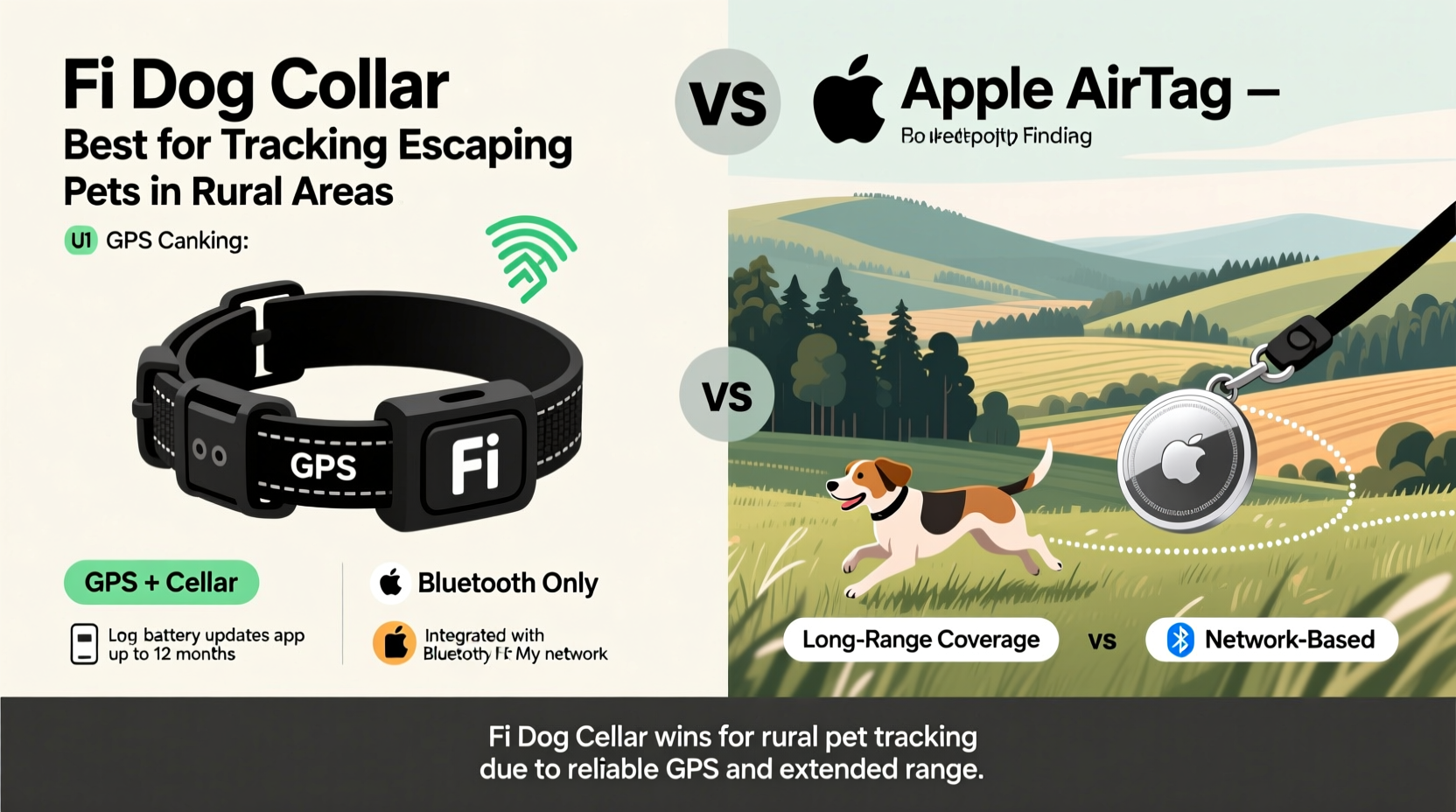
The fundamental difference between Fi and AirTag lies in how they locate your pet. Understanding this distinction is crucial, especially in low-connectivity zones.
Fi Dog Collar: Uses built-in GPS and LTE-M cellular connectivity. It actively sends location updates through the mobile network, independent of nearby smartphones. This means it can report position even in isolated areas—as long as there’s some cellular signal.
Apple AirTag: Relies entirely on Bluetooth and the Find My network. It does not have GPS or cellular capabilities. Instead, it emits a Bluetooth signal picked up by nearby iPhones, iPads, or Macs, which then relay its location to iCloud. If no Apple device passes within range (typically 30–50 feet), the tag remains invisible on the map.
Tip: In areas with fewer than 50 Apple users per square mile, AirTag may not provide timely location updates—or any at all.This technological divide creates a stark contrast in reliability. For example, if your dog escapes into a forest two miles from the nearest home, a Fi collar might still ping every few minutes via satellite-assisted GPS and weak LTE signals. An AirTag, however, could remain undetected for hours or days until someone with an iPhone walks nearby.
Performance Comparison in Rural Environments
Rural tracking success depends on three key factors: network independence, update frequency, and geofencing capability. Let's break down how each device performs.
| Feature | Fi Dog Collar | Apple AirTag |
|---|---|---|
| Location Method | GPS + LTE-M Cellular | Bluetooth + Crowd-Sourced Find My Network |
| Network Dependency | Low (only needs minimal cellular signal) | High (requires nearby Apple devices) |
| Battery Life | Up to 3 months (non-replaceable) | ~1 year (replaceable CR2032) |
| Update Frequency | Every 30 seconds to 15 minutes (configurable) | Only when detected by Apple device |
| Real-Time Tracking | Yes | No (passive detection only) |
| Geofencing Alerts | Yes (customizable boundaries) | Limited (“Last Seen” notifications) |
| Works Offline? | Partially (stores location, uploads when connected) | No (no local storage; relies on external relays) |
The table reveals a critical limitation: AirTag cannot function without infrastructure support. While Apple boasts over 2 billion active devices globally, their density drops sharply outside cities. According to a 2023 study by Statista, rural U.S. counties average only 18 Apple devices per square mile—far below the threshold needed for consistent Bluetooth detection.
“AirTags are brilliant in cities but nearly useless in remote areas. Without proximity to Apple hardware, they’re just inert metal.” — Dr. Alan Reyes, IoT Researcher at University of Colorado Boulder
Real-World Case Study: Lost Dog in Montana
In January 2024, a border collie named Scout escaped from his owner’s ranch near Bozeman, Montana. The property borders national forestland, with no homes within a five-mile radius. The owner had attached both a Fi Series 3 collar and an AirTag inside a waterproof case.
Within ten minutes, the Fi app sent a geofence alert indicating Scout had left the yard. Live GPS tracking showed him moving northeast at about 3 mph. Every 90 seconds, a new location updated on the map. After 40 minutes, he stopped near a creek bed. The owner, using turn-by-turn navigation in the Fi app, hiked directly to the spot and recovered Scout before nightfall.
The AirTag did not register a single location during the entire episode. It only appeared on the map the next morning—when a wildlife biologist conducting a survey walked within 40 feet of where Scout had been found.
This case illustrates a vital point: in emergencies, waiting for passive detection isn't acceptable. Real-time GPS tracking saved time, energy, and potentially Scout’s life.
Step-by-Step Guide: Choosing the Right Tracker for Rural Use
Selecting the best option requires evaluating your environment, lifestyle, and risk tolerance. Follow this sequence to decide:
- Assess Your Area’s Connectivity: Check cellular coverage maps (Verizon, AT&T) for your region. If you have at least 1–2 bars of LTE-M or NB-IoT signal, Fi will likely work.
- Evaluate Human Traffic: Are there frequent hikers, mail carriers, or neighbors passing near common escape routes? High foot traffic improves AirTag odds.
- Determine Escape Risk Level: Does your dog bolt frequently? Chase wildlife? If yes, proactive monitoring (Fi) is essential.
- Consider Battery Access: Can you easily recharge or replace batteries? Fi requires recharging every ~90 days; AirTag lasts longer but needs replacement.
- Set a Budget: Fi costs $10–$15/month subscription plus $129+ for hardware. AirTag is $29 one-time, no fees. However, cost should not outweigh effectiveness in emergencies.
- Test Before Relying: Simulate a loss scenario. Place the tracker in a backpack and walk off-property. See how quickly it reports location.
When AirTag Might Still Be Useful
Despite its limitations, AirTag has niche applications in rural contexts:
- Secondary Backup: Attach alongside a primary GPS collar. If the main tracker fails, AirTag might still be detected later.
- Urban Recovery: If your dog escapes while visiting town, AirTag becomes far more effective due to higher device density.
- Indoor Tracking: Useful if your pet hides in barns or sheds—Bluetooth signals work well indoors.
However, relying solely on AirTag in rural areas is risky. It functions more like a “last seen” marker than a live tracker. There’s no way to initiate a search or force a signal refresh. You simply wait and hope someone passes by.
Expert Recommendations and Common Pitfalls
Veterinarians and animal rescue teams increasingly advise against using AirTag as a standalone solution for high-risk pets.
“We’ve seen too many cases where owners thought an AirTag would help, only to realize days later it never updated. By then, the trail is cold.” — Dr. Lena Patel, DVM, Western States Animal Rescue
Common mistakes include:
- Assuming AirTag works like GPS because it shows locations on a map.
- Placing AirTag in non-waterproof containers, leading to corrosion.
- Not testing the device under real-world conditions before depending on it.
- Using outdated mapping apps that don’t show precise timestamps.
Additionally, AirTag lacks motion sensors or activity monitoring. Fi provides insights into daily movement patterns, helping detect restlessness or anxiety that might precede escape attempts.
Frequently Asked Questions
Can I use AirTag with Android phones?
Not effectively. While Android users can scan lost AirTags via NFC, they cannot actively monitor them. Only iOS devices contribute to the Find My network. Android-only households gain almost no benefit from AirTag tracking.
Does Fi work internationally?
Fi uses global LTE bands but operates primarily in the U.S., Canada, and Puerto Rico. International roaming is limited. Always verify coverage before traveling abroad with your pet.
Is there a way to improve AirTag performance in rural areas?
Some users install “private” Find My-compatible receivers (like Chipolo’s tracker hubs) on their property to extend detection range. However, these only cover small zones (up to 100 feet) and require power and internet access.
Final Verdict: Which Is Better for Rural Pet Tracking?
For pet owners in rural areas, Fi dog collars are objectively superior for tracking escaping pets. Their independent GPS and cellular connectivity enable real-time monitoring, proactive alerts, and reliable recovery—even in regions with sparse human presence.
Apple AirTag, while affordable and sleek, is fundamentally unsuited as a primary tracking tool in low-population zones. Its reliance on opportunistic Bluetooth detection makes it unpredictable and often ineffective when most needed.
That said, combining both technologies offers a layered approach: Fi for active tracking and immediate response, AirTag as a fallback in case the collar comes off or dies. This dual-system strategy maximizes recovery chances without sacrificing peace of mind.
Action Plan Checklist
- ✅ Test cellular signal strength around your property using your phone or carrier map.
- ✅ Purchase a Fi collar if you have basic LTE coverage.
- ✅ Subscribe to Fi’s premium plan for faster update intervals.
- ✅ Attach an AirTag as secondary backup (waterproofed).
- ✅ Set up geofences for yard boundaries and common trails.
- ✅ Train yourself to respond immediately to escape alerts.
- ✅ Share access to the Fi app with family members or neighbors.









