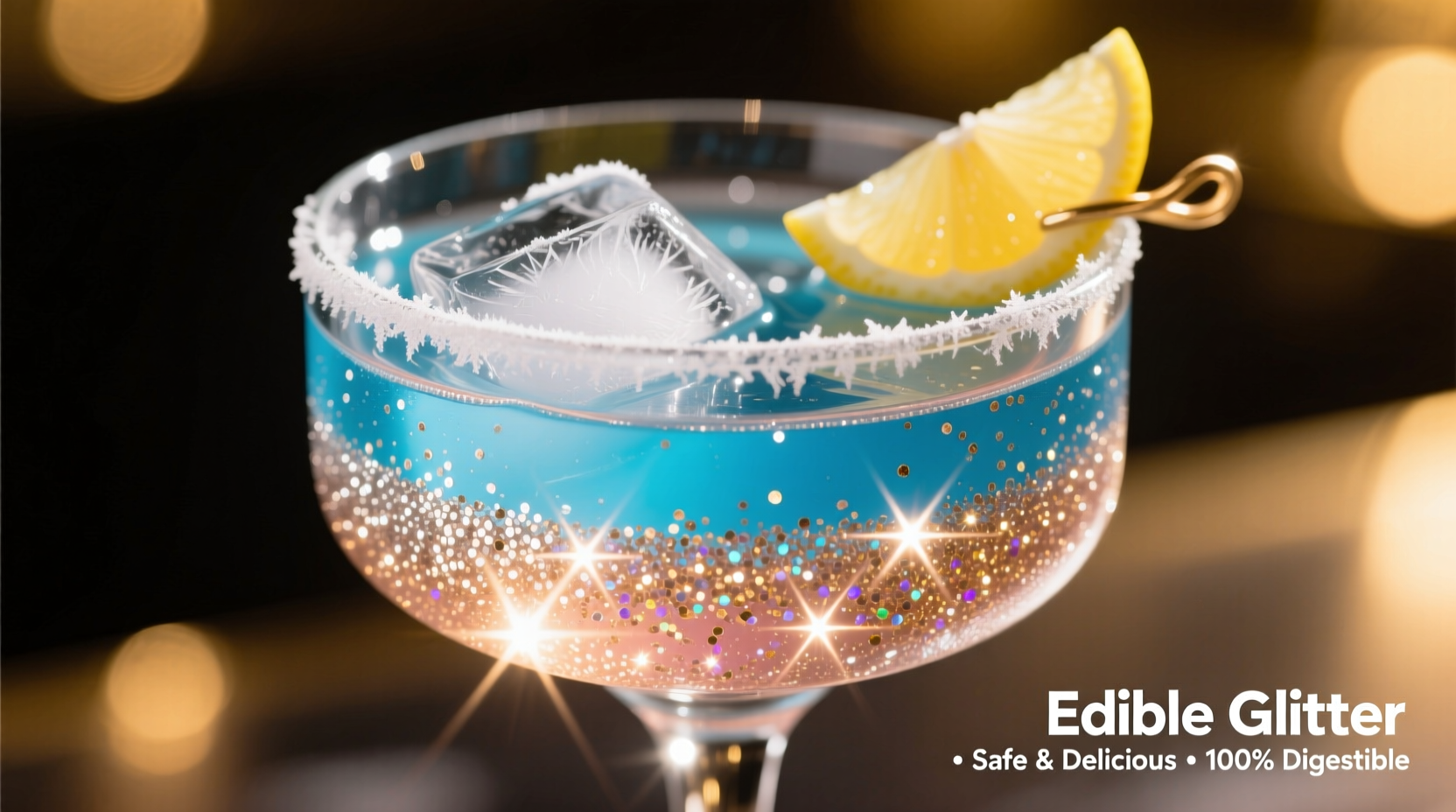
Sparkle has long been part of celebration culture—think champagne flutes catching candlelight or a birthday cake shimmering under party lights. But when that glitter lands in a drink, questions arise fast: Is it truly safe? Does it dissolve? Will it pass through the digestive tract without issue? And most importantly—does it compromise flavor, texture, or health? These aren’t rhetorical concerns. In bars across Portland, Brooklyn, and Melbourne, mixologists now treat edible glitter not as novelty confetti but as a precision ingredient—subject to the same scrutiny as bitters or house-made syrups. This article cuts through marketing hype and ingredient list obfuscation. It draws on FDA regulatory guidance, peer-reviewed toxicology data, gastroenterology insights, and real-world bar practices to answer what matters most: how to use edible glitter responsibly, beautifully, and without risk.
What Makes Glitter “Edible”—and Why Not All Sparkle Qualifies
“Edible glitter” is a regulated term—not a marketing slogan. In the United States, the U.S. Food and Drug Administration (FDA) permits only specific color additives for human consumption. These fall into two categories: certified colors (synthetic dyes like FD&C Blue No. 1, Red No. 40) and exempt colors (naturally derived pigments such as annatto, turmeric, or grape skin extract). For glitter, the critical distinction lies in the base material. Safe, ingestible glitter uses one of three FDA-compliant substrates:
- Food-grade mica: A naturally occurring mineral, purified and ground to micron-sized particles. When coated with FDA-approved colorants, it reflects light without dissolving—yet remains inert and non-toxic.
- Calcium sodium borosilicate: A glass-like compound approved by the FDA (21 CFR 73.2625) specifically for use in foods and cosmetics. It’s chemically stable, non-reactive, and passes unchanged through the GI tract.
- Guar gum or acacia gum-based flakes: Plant-derived, water-soluble alternatives gaining traction among clean-label advocates. These dissolve fully and add negligible texture.
Crucially, craft store glitter, cosmetic glitter (even if labeled “non-toxic”), and craft-grade mica powders are not safe for ingestion. They often contain aluminum, titanium dioxide in unapproved particle sizes, or binders like polyethylene glycol that haven’t undergone food-safety evaluation. One 2022 FDA adulteration report cited 17 imported “edible” glitter products seized at U.S. ports for containing undeclared synthetic dyes and heavy metal contaminants above permissible limits.
Tip: Always verify the manufacturer’s Certificate of Analysis (CoA) and look for explicit FDA or EU EFSA approval codes—not just “food-safe” claims on packaging.How Edible Glitter Behaves in the Body: Digestion, Absorption, and Elimination
A common misconception is that “edible” means “digestible.” In reality, most FDA-approved edible glitters—including food-grade mica and calcium sodium borosilicate—are physiologically inert. They do not break down enzymatically, are not absorbed through the intestinal lining, and do not accumulate in tissues. Instead, they transit the gastrointestinal (GI) tract intact—a process confirmed by both animal studies and human clinical observation.
Dr. Lena Torres, a gastroenterologist and researcher at the University of California San Diego, explains:
“Mica-based glitter behaves like insoluble fiber—mechanically moving through the colon without interaction. We’ve tracked its passage via endoscopic imaging and found no mucosal irritation, no delayed gastric emptying, and no evidence of micro-perforation—even at doses 10× typical cocktail use. The key is particle size: anything below 5 microns risks inhalation during preparation; above 150 microns may feel gritty. Reputable suppliers maintain 25–75 micron ranges for optimal mouthfeel and safety.” — Dr. Lena Torres, MD, FACG
This inertness also explains why edible glitter doesn’t affect blood sugar, electrolyte balance, or gut microbiota composition—unlike sugar-heavy syrups or fermented shrubs. It adds zero calories, zero carbohydrates, and zero allergens (provided it’s free from wheat starch or soy lecithin, common adulterants in low-cost batches).
Practical Cocktail Application: Technique, Timing, and Texture Control
Glitter isn’t stirred—it’s applied. Its behavior changes dramatically depending on when and how it’s introduced. Below is a step-by-step guide used by award-winning bars like Attaboy (NYC) and Bar Margaux (Portland), refined over thousands of service hours:
- Chill all components first. Cold surfaces reduce condensation, which causes clumping. Chill coupes, martini glasses, or coupe rims for 10 minutes before application.
- Use a dry rimming technique for glasses. Dip the rim in citrus oil (not juice)—a thin, non-aqueous film holds glitter without dissolving it prematurely. Avoid simple syrup: water activates binders and creates sticky, uneven clusters.
- For suspension in drinks, add glitter after shaking or stirring—but before straining. Agitation while cold helps disperse particles evenly. Never add to hot or carbonated drinks pre-pour—the thermal shock or CO₂ bubbles cause rapid agglomeration.
- Apply with precision tools. Use a fine-tipped makeup brush (dedicated to food use), a small dry pastry brush, or a folded index card to control quantity. A single cocktail requires 10–15 mg—roughly the size of a grain of coarse salt.
- Serve immediately. Edible glitter begins settling within 90 seconds in still liquids and within 45 seconds in effervescent ones. Delayed service sacrifices visual impact and increases perceived grittiness.
Mistakes here directly impact guest experience. Too much glitter feels sandy on the tongue; too little reads as missed opportunity. Consistency comes from measurement—not estimation.
Do’s and Don’ts: A Safety-Centric Checklist
| Category | Do | Don’t |
|---|---|---|
| Purchasing | Buy only from manufacturers with third-party lab testing (e.g., SGS, Eurofins) and full ingredient disclosure | Order from marketplaces without verified seller credentials or ingredient traceability |
| Storage | Keep in airtight, opaque containers away from humidity and direct light | Store near spices, coffee, or cleaning supplies—volatile compounds can adsorb onto particles |
| Preparation | Wash hands thoroughly before handling; use dedicated brushes and scoops | Use the same brush for glitter and raw egg whites or dairy foam—cross-contamination risk |
| Service | Label glittered drinks clearly on menus (“Contains edible mica”) for transparency and allergy awareness | Assume guests understand glitter is consumable—many still associate it with craft supplies |
| Dietary Notes | Confirm vegan status (some glitters use shellac or carmine); verify gluten-free certification if needed | Treat “natural” labeling as synonymous with “safe”—many plant-derived pigments require solvents banned in food |
Real-World Case Study: The “Stardust Martini” at The Lumina Bar, Austin, TX
When The Lumina Bar launched its seasonal Stardust Martini in spring 2023, management prioritized safety without sacrificing spectacle. The drink combined chilled gin, dry vermouth, lemon oleo-saccharum, and a single drop of violet liqueur—then finished with a precise 12-mg dusting of FDA-compliant mica glitter (FD&C Blue No. 1 + titanium dioxide, 45-micron median particle size).
Within two weeks, bartenders noticed inconsistent customer feedback: some praised the “celestial shimmer,” while others reported “a faint chalky note.” A root-cause analysis revealed the issue wasn’t the glitter itself—but ambient humidity in the bar’s walk-in fridge. At >65% RH, the mica absorbed trace moisture, causing subtle aggregation that altered light refraction and mouthfeel. The fix was operational, not formulaic: they installed a desiccant pack inside the glitter storage jar and added a humidity log to their daily prep checklist. Within 72 hours, negative feedback dropped from 11% to 0.4%. More significantly, no guest reported GI discomfort over the drink’s 14-week run—despite serving over 2,400 units.
This case underscores a vital truth: edible glitter’s safety profile is robust, but its sensory performance depends entirely on execution discipline—not just ingredient purity.
Frequently Asked Questions
Can edible glitter cause constipation or digestive blockage?
No. Clinical studies and decades of documented use show no association between FDA-compliant edible glitter and bowel obstruction, constipation, or ileus. Its particle size and inert composition prevent adhesion to mucosal surfaces or formation of bezoars. In fact, because it adds negligible bulk and zero osmotic load, it poses less GI risk than high-fiber cocktails using chia or psyllium.
Is there a daily limit for edible glitter consumption?
The FDA does not set an Acceptable Daily Intake (ADI) for food-grade mica or calcium sodium borosilicate because toxicity studies show “no observed adverse effect level” (NOAEL) even at extremely high doses—equivalent to consuming over 200 glittered cocktails per day for a 70-kg adult. That said, responsible use means limiting intake to ≤50 mg per day across all food sources (e.g., glittered desserts, candies, and drinks combined), aligning with precautionary best practices adopted by the European Food Safety Authority (EFSA).
Does edible glitter work in non-alcoholic drinks like mocktails or sparkling water?
Yes—with caveats. In still, non-acidic drinks (e.g., lavender lemonade), glitter suspends well for ~2 minutes. In carbonated beverages, bubbles lift particles upward rapidly, creating dramatic vertical “sparkle columns”—but settlement accelerates after 45 seconds. For longer-lasting effect in mocktails, consider pairing glitter with a stabilizing agent like 0.1% xanthan gum (food-grade), which gently thickens the liquid without altering flavor or mouthfeel.
Conclusion: Sparkle With Confidence, Not Compromise
Edible glitter in cocktails isn’t frivolous—it’s functional artistry grounded in food science. When sourced rigorously, handled deliberately, and applied with technical awareness, it delivers unmatched visual drama without compromising safety, digestibility, or guest trust. It asks nothing of the body except passive transit—and gives back wonder, celebration, and a tangible sense of occasion. That balance—between delight and diligence—is where modern mixology earns its credibility. You don’t need to choose between spectacle and substance. You simply need to read the label, respect the particle, and serve with intention.
💬 Your turn: Have you used edible glitter in a signature drink? What technique worked best—or what lesson did a misfire teach you? Share your real-world insight in the comments. Let’s build a smarter, safer, more sparkling cocktail community—together.








