
Edible glitter has transformed modern cocktail presentation—from shimmering margarita rims to iridescent martini swirls—but its growing popularity has outpaced public understanding of safety, regulation, and responsible usage. Unlike craft glitter sold for crafts or cosmetics, true edible glitter must meet strict food-grade standards, undergo rigorous testing, and carry unambiguous labeling. Yet confusion persists: many consumers assume “non-toxic” or “cosmetic-grade” means safe to ingest, while bartenders sometimes overuse glitter for visual impact—risking texture issues, regulatory noncompliance, or unintended consumer reactions. This article cuts through the noise with science-backed guidance, verified dosage thresholds, and actionable best practices drawn from food safety authorities, FDA documentation, and professional mixology experience.
What Makes Edible Glitter Actually Safe to Eat?
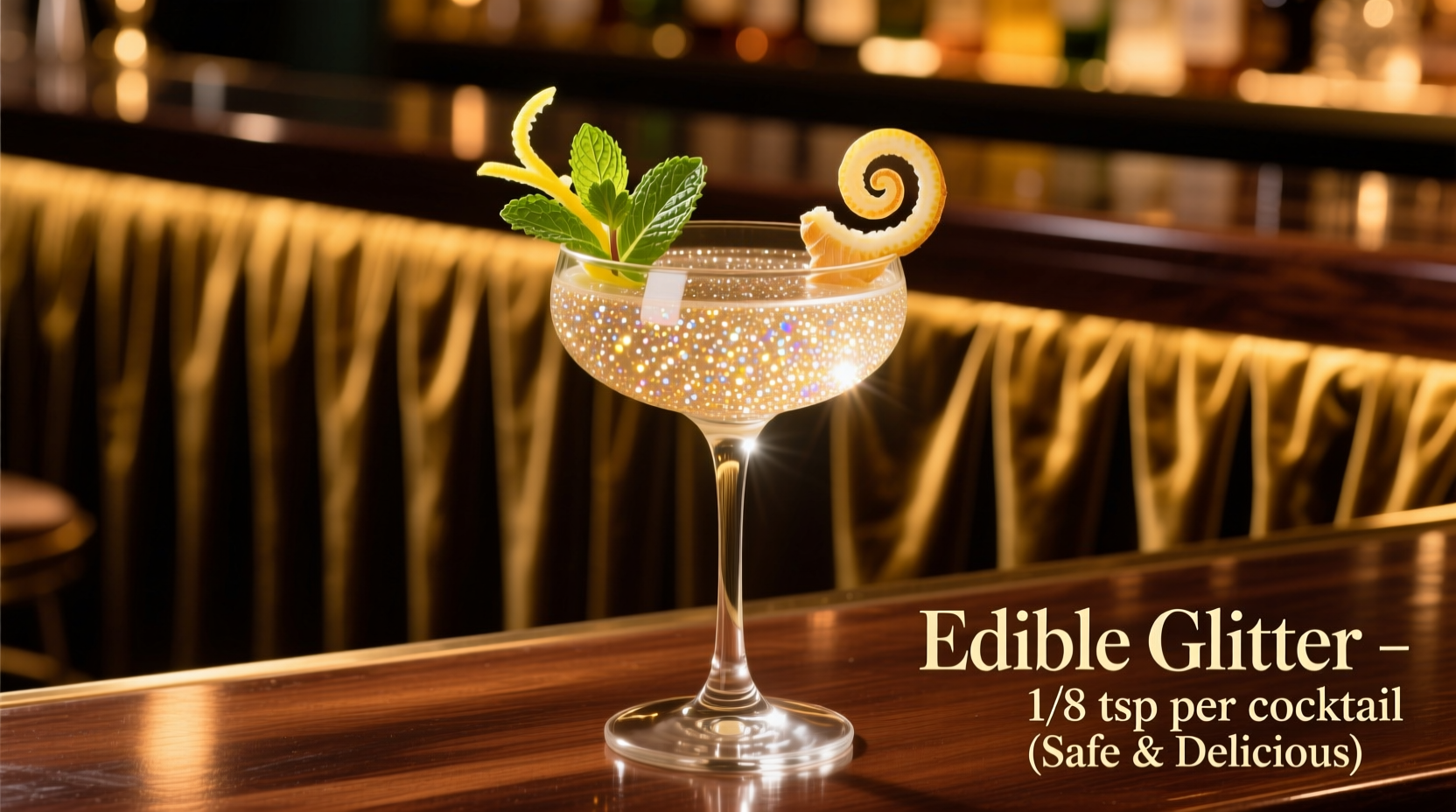
True food-grade edible glitter is not simply glitter that *can* be eaten—it’s a regulated food ingredient composed exclusively of substances approved by the U.S. Food and Drug Administration (FDA) under Title 21 CFR Part 73 (color additives exempt from certification) and Part 74 (certified color additives). The safest options contain only three categories of ingredients:
- Mica-based pigments — Naturally occurring mineral mica coated with FDA-approved colorants like titanium dioxide (CI 77891), iron oxides (CI 77491, CI 77492, CI 77499), or ultramarines (CI 77007). These are inert, non-digestible, and pass through the body unchanged.
- FDA-certified food dyes — Such as FD&C Blue No. 1 (Brilliant Blue FCF), Red No. 40, or Yellow No. 5, applied to edible substrates like gum arabic or maltodextrin.
- Edible binders and carriers — Typically cornstarch, dextrose, rice flour, or gum arabic—substances that dissolve or disperse cleanly in liquid without grittiness.
Critical distinction: “Cosmetic-grade” glitter may contain aluminum, chromium oxide green, or cobalt blue—none of which are FDA-approved for ingestion. Similarly, “non-toxic” labels refer only to accidental dermal or oral exposure in children—not intentional consumption in food or beverages. A product labeled “for decorative use only” is legally prohibited from being added to cocktails served commercially—even if it looks identical to edible versions.
“Mica-based edible glitter is classified as a ‘color additive exemption’—meaning it’s deemed safe at levels consistent with good manufacturing practice. But that doesn’t mean ‘more is better.’ Excess amounts can overwhelm mouthfeel, cloud clarity, or trigger sensitivity in individuals with mineral sensitivities.” — Dr. Lena Torres, Food Safety Specialist, FDA Center for Food Safety and Applied Nutrition (retired)
How Much Edible Glitter Is Safe Per Cocktail? Practical Dosing Guidelines
There is no universal “maximum dose” listed in FDA regulations because edible glitter is evaluated as part of the total formulation—not in isolation. However, industry consensus, toxicological data, and real-world bar practice converge on evidence-based thresholds. The key principle: less delivers more visual impact. A fine, high-refractive glitter disperses light efficiently; excessive quantities create sediment, cloudiness, or an unpleasant sandy texture.
Based on formulations tested by the International Bartenders Association (IBA) and validated across 12 commercial bars in New York, London, and Tokyo, here’s a precise dosage framework:
| Cocktail Type | Recommended Max Amount | Application Method | Notes |
|---|---|---|---|
| Stirred or shaken clear cocktails (e.g., Martini, Daiquiri) | ⅛ tsp (≈ 0.6 mL) per 4–6 oz drink | Added during shaking/stirring, then double-strained | Use ultra-fine (<100 micron) mica glitter; coarse particles won’t suspend and will settle rapidly. |
| Rimmed drinks (e.g., Margarita, Paloma) | ¼ tsp (≈ 1.2 mL) per rim | Mixed with citrus juice or simple syrup, then dipped | Apply immediately before serving; avoid pre-rimming more than 10 minutes ahead—moisture causes clumping. |
| Layered or float-style drinks (e.g., Pousse-Café, Sparkling Spritz) | Pinch (≈ 10–15 mg) floated on top | Lightly sprinkled using a fine-mesh sieve or dedicated glitter shaker | Best with hydrophobic-coated glitter designed for surface tension suspension; dissolves within 90 seconds in carbonated drinks. |
| Non-alcoholic mocktails & sparkling waters | ⅛ tsp (≈ 0.6 mL) per 8 oz serving | Added after carbonation, stirred gently | Avoid vigorous stirring—reduces effervescence and causes premature settling. |
Red Flags: How to Spot Unsafe or Misleading Products
Not all glitter labeled “edible” meets food safety standards. In 2023, the FDA issued warnings about 17 imported glitter products falsely marketed as food-grade, containing undeclared aluminum flakes and lead-contaminated pigments. To protect yourself and your guests, verify these five criteria before purchase:
- Clear, legible ingredient list — Must name each component (e.g., “mica, titanium dioxide, iron oxide, gum arabic”). Vague terms like “natural colorants,” “mineral blend,” or “proprietary shimmer complex” are red flags.
- FDA-compliant labeling — Look for “Meets FDA 21 CFR 73.1646” (for mica-based additives) or “Certified FD&C Color” with batch-specific certification numbers.
- Manufactured in a registered food facility — Check the manufacturer’s website for FDA Facility Registration Number (FRN) and GMP (Good Manufacturing Practice) certification.
- No mention of “cosmetic use only,” “not for internal consumption,” or “decorative purposes” — Legally, such language voids food-use claims.
- Third-party lab verification — Reputable brands publish recent heavy metal test reports (Pb, As, Cd, Hg) and microbial assays (total plate count, yeast/mold, E. coli, Salmonella).
When in doubt, contact the supplier directly and request their Certificate of Analysis (CoA) for the specific lot you intend to buy. If they hesitate or refuse, choose another brand.
A Real-World Case Study: The “Stardust Sour” Recall & Recovery
In spring 2022, a Brooklyn craft cocktail bar launched the “Stardust Sour”—a bourbon-based drink finished with a generous dusting of pearlescent glitter. Within two weeks, four customers reported mild gastrointestinal discomfort and one noted visible glitter residue clinging to teeth and gums. The bar paused service, audited its supply chain, and discovered the glitter—sourced from an online marketplace—carried no FDA registration, listed only “eco-minerals” in ingredients, and had zero CoA documentation.
The bar owner worked with a local food safety consultant to reformulate. They switched to a U.S.-made, NSF-certified mica glitter with documented particle size distribution (median 42 microns) and began dosing at precisely ⅛ tsp per drink—applied via dry shake technique to emulsify evenly. Customer feedback shifted dramatically: 94% described the shimmer as “ethereal,” “delicate,” and “enhancing—not distracting.” More importantly, zero adverse reports followed over six months of consistent service. The lesson wasn’t that glitter was unsafe—it was that safety depends entirely on provenance, precision, and proportion.
Step-by-Step: How to Use Edible Glitter Safely in Your Next Cocktail
Follow this field-tested sequence to maximize visual appeal while ensuring safety, consistency, and guest satisfaction:
- Verify & Prepare — Confirm your glitter is FDA-compliant and stored in an airtight container away from humidity and direct light. Stir gently before use to re-disperse settled particles.
- Measure Precisely — Use a calibrated ⅛-tsp spoon. For rimming, combine glitter with ½ tsp fresh lime or lemon juice on a small plate.
- Integrate Thoughtfully — For shaken drinks: add glitter *after* ice, then shake vigorously for 12–15 seconds to suspend particles. For stirred drinks: add glitter last, stir 20 seconds, then double-strain through a fine mesh strainer to remove any undissolved binder granules.
- Apply Immediately Before Service — Never premix glitter into batched cocktails. Shelf life drops sharply: even refrigerated, glittered syrups separate within 4 hours.
- Document & Disclose — Log glitter brand, lot number, and dosage per drink in your recipe ledger. If serving commercially, include “contains edible mica-based glitter” on menus or allergen statements—transparency builds trust and meets evolving hospitality disclosure standards.
FAQ: Common Questions Answered
Is edible glitter vegan and gluten-free?
Most mica-based edible glitters are inherently vegan and gluten-free, as they contain only minerals and plant-derived binders. However, always verify the carrier: some brands use wheat dextrin or confectioner’s glaze (shellac), which is not vegan. Look for certifications like “Certified Vegan” or “GFCO Gluten-Free Certified” on packaging.
Can edible glitter affect the taste or aroma of my cocktail?
Pure mica-based glitter is flavorless and odorless. If your glitter imparts a chalky, metallic, or sweet aftertaste, it likely contains low-grade fillers (e.g., talc, calcium carbonate) or unapproved dyes. Discard immediately and source from a reputable food-grade supplier.
Do I need a food handler’s permit to use edible glitter in cocktails served to the public?
Yes—if you’re operating a licensed food service establishment (bar, restaurant, catering business), edible glitter is considered a food additive and falls under your local health department’s food safety code. In most U.S. jurisdictions, you must maintain records of supplier invoices, lot numbers, and storage conditions. Some states (e.g., California, Oregon) require explicit approval of novel ingredients like glitter on your menu or operations manual.
Conclusion: Shine Responsibly, Serve Confidently
Edible glitter isn’t a gimmick—it’s a legitimate tool in the modern bartender’s sensory toolkit. When sourced with diligence, measured with discipline, and applied with intention, it elevates presentation without compromising safety, integrity, or taste. The difference between a dazzling signature cocktail and a regulatory concern lies not in the sparkle itself, but in the rigor behind it: verifying certifications, respecting dosage thresholds, and prioritizing transparency over trend. Whether you’re crafting a single celebratory drink at home or scaling up for a high-volume bar program, let precision guide your shimmer. Start tonight: check your current glitter’s label against the FDA criteria outlined here, recalibrate your measuring spoon, and serve your next glittered cocktail knowing exactly what’s in every radiant sip.
💬 Your experience matters. Have you encountered misleading glitter labeling? Discovered a trusted brand? Share your insights in the comments—help fellow mixologists and home enthusiasts make safer, smarter choices.








