When it comes to high-end fashion accessories, few details draw attention like a bag adorned with sparkling stones. Designers such as Judith Leiber, Dolce & Gabbana, and even Chanel have released clutches and handbags encrusted with either genuine diamonds or high-quality rhinestones. To the untrained eye, they may look identical under gallery lighting or in a flash photograph. But in reality, there are subtle yet significant differences—both physical and perceptual—that determine whether someone can tell the real from the replica.
The question isn't just about material science; it's also about context, confidence, and culture. Does the average person at a cocktail party know how to distinguish between a $50,000 diamond-encrusted minaudière and a $500 Swarovski-studded evening bag? Or is the illusion so convincing that only trained professionals would spot the discrepancy?
How Diamonds and Rhinestones Differ Physically
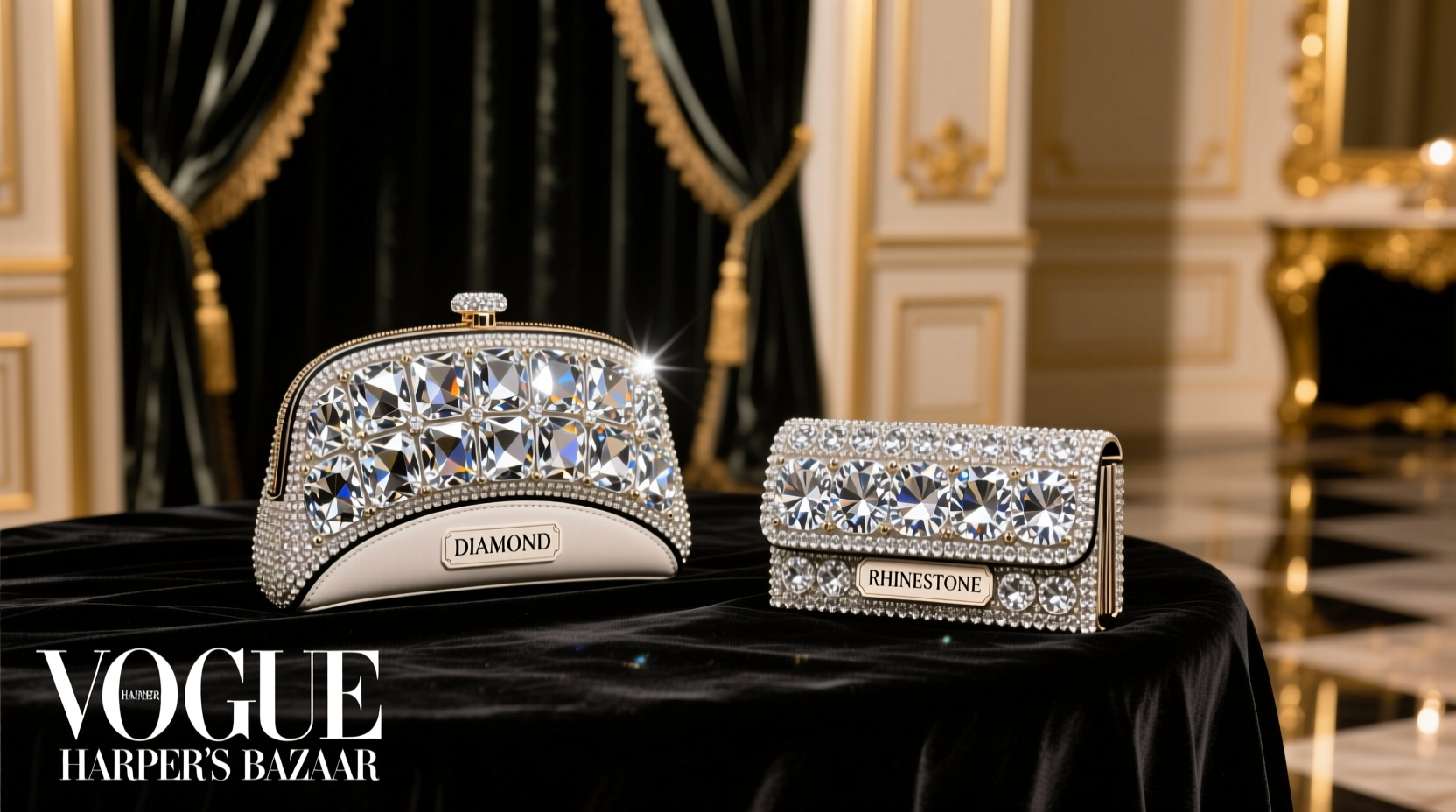
The foundation of any comparison lies in the materials themselves. While both diamonds and rhinestones are designed to catch light and project brilliance, their composition, durability, and optical properties vary dramatically.
- Diamonds are naturally occurring (or lab-grown) crystalline forms of carbon, rated 10 on the Mohs hardness scale. They refract light uniquely, producing intense fire and scintillation.
- Rhinestones, traditionally made from leaded glass or acrylic, are synthetic imitations. Modern versions, like Swarovski crystals, use precision-cut crystal with metallic coatings to enhance reflectivity.
Diamonds exhibit greater dispersion—the ability to split white light into spectral colors—giving them a rainbow-like \"fire\" effect. Rhinestones often appear brighter in direct light due to surface coatings but lack depth. Under magnification, diamonds show natural inclusions and irregular facets, while rhinestones have uniform, machine-perfect cuts.
“Light behaves differently on a diamond versus a rhinestone. One sparkles from within; the other reflects from the surface.” — Dr. Lena Moretti, Gemologist at the American Gem Society
Situational Awareness: When the Difference Becomes Obvious
Perception depends heavily on setting and proximity. At a dimly lit gala, a rhinestone bag might pass for diamond-encrusted simply because ambient lighting exaggerates surface shine. However, in daylight or under professional photography lights, flaws become apparent.
Consider this scenario:
Tip: If you're attending a daytime event or being photographed outdoors, genuine gemstones will outperform rhinestones in subtlety and longevity of sparkle.Mini Case Study: The Charity Gala Mix-Up
Sophia, a public relations executive, rented a crystal-embellished clutch for a high-profile charity dinner. From across the room, guests assumed it was diamond-set due to its dazzling presence under chandeliers. But when a jewelry editor sat beside her and casually leaned in to admire the piece, she noticed two things: the stones were uniformly flawless (a red flag for natural gems), and upon closer inspection, tiny scratches on several facets indicated softer material. Within minutes, whispers circulated that it was “just” a rhinestone bag.
The takeaway? Distance preserves illusion. Intimacy reveals truth.
Comparison Table: Diamond vs Rhinestone Bags
| Feature | Diamond-Encrusted Bag | Rhinestone-Adorned Bag |
|---|---|---|
| Material Hardness | 10 (Mohs scale) | 6–7 (glass-based) |
| Long-Term Durability | Resists scratches, maintains luster | Prone to chipping, clouding over time |
| Price Range | $20,000 – $200,000+ | $300 – $3,000 |
| Weight | Heavier due to metal settings and stones | Lighter, more comfortable for extended wear |
| Sparkle Quality | Deep refraction, natural fire | Bright surface reflection, less depth |
| Authenticity Verification | Certified by gem labs, serial-numbered | No certification; brand authenticity only |
Who Actually Notices the Difference?
The average consumer is unlikely to scrutinize a handbag’s embellishments unless they have a background in jewelry, design, or luxury retail. Most people react emotionally—to glamour, shine, and status symbolism—rather than analytically.
However, certain groups are far more perceptive:
- Jewelers and gemologists can identify diamond settings by cut symmetry, inclusion patterns, and thermal conductivity.
- Fashion editors and stylists study accessories up close during fittings and photo shoots.
- Luxury buyers familiar with brands like Graff or Harry Winston recognize craftsmanship markers such as prong settings versus glued-in stones.
- Counterfeit detectors employed by auction houses or insurers use UV lights and loupes to verify authenticity.
In social circles where conspicuous consumption is common, subtle cues matter. A handbag with glued-on stones instead of individually set ones raises suspicion. So does perfect uniformity—real diamonds vary slightly in size and clarity, whereas rhinestones are mass-produced clones.
Step-by-Step: How to Assess a Sparkling Bag’s Authenticity
If you're evaluating a bag—whether buying, borrowing, or simply curious—follow this sequence:
- Examine in natural light: Look for depth of sparkle. Diamonds glow internally; rhinestones glare.
- Check stone settings: Are stones held by metal prongs or simply glued? Prongs suggest higher value.
- Inspect for wear: Scratches on the stones indicate softer materials—common in rhinestones.
- Feel the weight: Genuine diamond pieces are noticeably heavier due to metal backing and dense stones.
- Review documentation: Authentic diamond bags come with certificates of authenticity and appraisals.
- Consult an expert: A local jeweler can test thermal conductivity or use a diamond tester non-invasively.
FAQ: Common Questions About Diamond vs Rhinestone Bags
Can a jeweler tell if a bag uses real diamonds just by looking?
Yes, experienced jewelers can often identify real diamonds through visual cues like facet sharpness, internal inclusions, and mounting technique. They may also use a handheld diamond tester to confirm.
Do celebrities wear real diamond bags?
Sometimes—but rarely daily. High-profile events may feature loaned pieces from designers or jewelers. For example, Kim Kardashian wore a Judith Leiber crystal alligator minaudière worth over $100,000 to the Met Gala, though it used premium Swarovski elements, not mined diamonds. True diamond-encrusted bags are typically custom museum pieces or part of limited art collections.
Is it worth investing in a rhinestone bag?
Absolutely, if your goal is aesthetic impact without six-figure spending. High-end rhinestone bags from reputable brands offer exceptional craftsmanship and can last years with proper care. They’re ideal for special occasions where maximum shine is desired.
Final Checklist Before Buying a Sparkling Bag
- ✅ Determine your budget and intended use (daily wear vs. event-only)
- ✅ Research the brand’s reputation for using real gems
- ✅ Ask for proof of authenticity if diamonds are claimed
- ✅ Inspect the bag under multiple lighting conditions
- ✅ Compare weight and construction quality with known authentic models
- ✅ Consider resale value—diamond bags retain or appreciate; rhinestones depreciate
“Luxury isn’t just about what something is—it’s about what it represents. But representation collapses when the details don’t hold up.” — Marcus Tran, Luxury Goods Appraiser
Conclusion: Perception Meets Reality
The difference between a diamond and a rhinestone bag isn’t always visible to everyone—but it’s felt by those who know. In fleeting moments, under soft light, the illusion holds. A well-crafted rhinestone bag can command attention, elevate an outfit, and deliver undeniable glamour. But over time, scrutiny increases. Scratches form. Light reveals inconsistencies. And authenticity becomes harder to fake.
Ultimately, whether people notice comes down to proximity, knowledge, and expectations. At arm’s length, many won’t care. Up close, connoisseurs will. The real question isn’t whether others will see the difference—it’s whether you want to own something truly rare or simply play the part for one night.
💬 Have you ever been asked if your bag’s stones were real? Share your story or tips for spotting fakes in the comments below.








