Bringing home a new puppy is an exciting milestone, but it comes with serious responsibilities. One of the earliest challenges owners face is managing their puppy’s environment during those critical first months. Two popular tools—crates and playpens—are often used to create safe spaces, but each serves different purposes and offers distinct benefits. Understanding when and how to use them—and how to strike the right balance between structure and freedom—is essential for raising a well-adjusted, confident dog.
The goal isn’t just to keep your puppy out of trouble (though that helps), but to build habits that support long-term behavioral health. Used correctly, both crates and playpens can be powerful tools in housebreaking, preventing destructive chewing, and fostering emotional security. Misused, they can lead to anxiety, boredom, or even aggression. The key lies in understanding the strengths and limitations of each approach and knowing how to transition between them as your puppy grows.
Understanding the Purpose: Crate vs Playpen
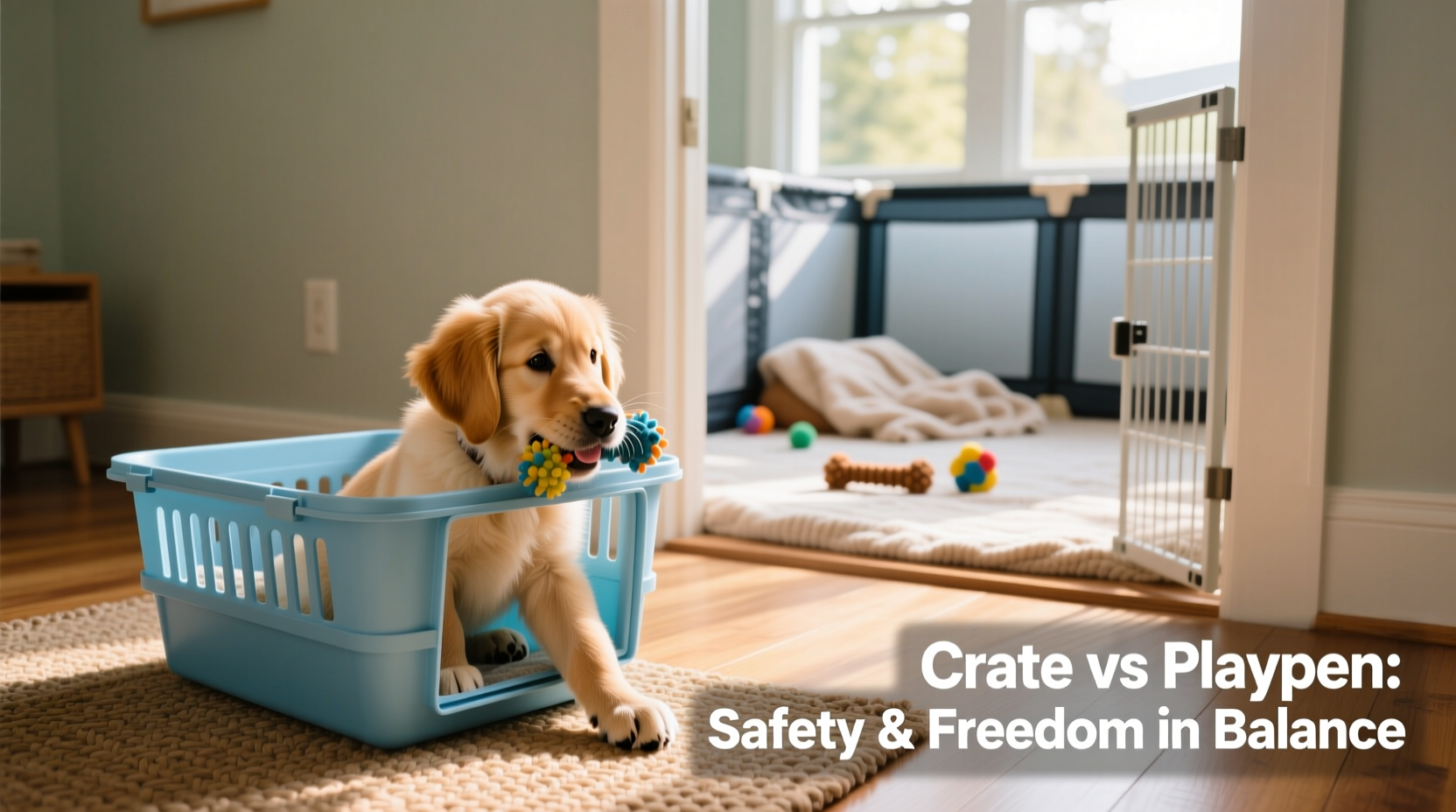
A crate is a confined, enclosed space—typically made of wire, plastic, or fabric—that mimics a den. Dogs are naturally den-dwelling animals, and a properly introduced crate can become a comforting retreat where a puppy feels safe. Crates are excellent for house training because puppies instinctively avoid soiling their sleeping area. They’re also indispensable for travel, vet visits, and managing behavior when supervision isn’t possible.
In contrast, a playpen—often a collapsible metal or plastic gate system—creates a larger, open enclosure. It allows room for movement, toys, water, and potty pads, making it ideal for times when you need to step away briefly but still want your puppy active and engaged. Unlike a crate, a playpen gives freedom within boundaries, encouraging exploration without full access to the house.
Tip: Never use either tool as long-term confinement. Both should support temporary management, not replace human interaction.When to Use Each Tool: Timing and Context Matter
The decision to use a crate or playpen shouldn’t be arbitrary—it should align with your puppy’s age, developmental stage, and daily routine.
Crate best uses:
- Nighttime sleep (to encourage bladder control and prevent accidents)
- Short absences (e.g., quick errands or showers)
- Travel or vet visits
- Teaching focus and calmness
Playpen best uses:
- Daytime downtime when you're home but busy (e.g., cooking or working)
- Potty training with designated indoor zones
- Providing exercise and mental stimulation in a controlled space
- Transitioning from constant supervision to limited freedom
For example, a 10-week-old puppy may only hold their bladder for about one hour per month of age. That means a two-month-old pup needs a bathroom break every two hours. During the day, a playpen with a potty pad on one side and a bed on the other allows them to relieve themselves without being left unsupervised in the entire house. At night, switching to a crate reinforces the habit of holding it through sleep cycles.
Step-by-Step: Building a Daily Routine with Both Tools
- Morning wake-up: Take puppy directly outside after crate time; reward elimination.
- Post-potty play: Move to playpen with toys, water, and chew items for 30–60 minutes.
- Supervised free time: Allow household access under watch for socialization and learning.
- Pre-nap or pre-absence: Place in crate with a stuffed Kong for calming downtime.
- Evening wind-down: Return to crate for overnight rest, ensuring last potty break was recent.
This rhythm establishes predictability, which reduces stress and accelerates learning. As your puppy matures and gains better bladder control (usually by 4–6 months), you can gradually increase off-leash time and reduce reliance on enclosures.
Striking the Balance: Safety Without Over-Restriction
Safety is non-negotiable—but so is development. Puppies need exposure to sights, sounds, people, and textures to grow into confident adults. Overuse of either tool can backfire. A puppy crated for 8+ hours a day may develop separation anxiety or nuisance barking. A puppy left endlessly in a playpen may become overstimulated, frustrated, or start digging at the gates.
The solution? Intentional rotation. Think of these tools as phases in a progression—not permanent fixtures. Start with high structure (more crating and playpen time) and slowly expand freedom as reliability increases.
| Factor | Crate Advantage | Playpen Advantage |
|---|---|---|
| Housetraining | Strong—den instinct discourages soiling | Moderate—if potty zone is clearly separated |
| Freedom of Movement | Limited—good for rest, poor for activity | High—encourages play and muscle development |
| Destructive Behavior Prevention | Excellent—full containment | Good—within defined space |
| Socialization Potential | Low—unless placed in living areas | High—can be set up near family activity |
| Long-Term Emotional Impact | Risk of anxiety if misused | Risk of boredom if under-stimulated |
“Dogs thrive on predictability and boundaries. The crate provides security; the playpen offers growth space. Together, they form a balanced foundation.” — Dr. Laura Sanders, Certified Veterinary Behaviorist
Common Mistakes and How to Avoid Them
Even well-meaning owners make errors when using crates and playpens. Recognizing these pitfalls early can save months of behavioral setbacks.
- Mistake 1: Using the crate as punishment. If a puppy associates the crate with isolation or scolding, they’ll resist entering it. Always make crate time positive with treats, chews, and calm praise.
- Mistake 2: Leaving a playpen unattended for too long. More space doesn’t mean more independence. Puppies can injure themselves trying to climb out or ingest inappropriate items left within reach.
- Mistake 3: Ignoring signs of distress. Whining, pacing, or excessive licking in either setup may signal fear, discomfort, or medical need. Rule out pain or illness before assuming behavioral causes.
- Mistake 4: Skipping gradual introduction. Throwing a puppy into full-time crate use without acclimation leads to panic. Build tolerance in 5–10 minute increments with rewards.
Mini Case Study: Max, the Overstimulated Beagle Puppy
Max, a 12-week-old beagle, was adopted into a busy household with two young children. His owners initially let him roam freely during the day, leading to frequent accidents and chewed shoes. In response, they began crating him all day while at work—up to 8 hours. Within a week, Max started crying persistently and refused to enter the crate.
A trainer assessed the situation and recommended a shift: Max needed structured downtime, not isolation. They replaced the all-day crate with a large playpen in the kitchen, equipped with a camera-monitored potty pad, water, and durable toys. When someone was home, Max had supervised floor time. At night and for short errands, the crate returned—but now paired with frozen peanut butter Kongs.
Within 10 days, Max stopped resisting the crate and began signaling when he needed to go outside. By 5 months, he could stay alone for 3 hours in the playpen and sleep through the night. The balance of safety and engagement transformed his behavior.
Action Plan: Your First 30 Days
To successfully integrate both tools, follow this checklist tailored to a typical puppy’s first month at home.
✅ Crate & Playpen Setup Checklist
- Choose a crate size where puppy can stand, turn, and lie down—but not much more (use dividers if needed).
- Select a playpen at least 4x the puppy’s length in diameter.
- Place both in a low-traffic but connected area of the home (not basement or garage).
- Outfit crate with soft bedding and a chew-safe toy.
- In the playpen, separate zones: sleep, eat, potty, play.
- Introduce each space gradually with treats and praise—never force entry.
- Monitor for escape attempts, chewing on bars, or excessive vocalization.
📅 Weekly Progression Guide
- Week 1: Focus on crate introduction. Use it for naps and nighttime. Supervise all other time.
- Week 2: Add 1–2 short playpen sessions (30 mins) while you're nearby. Reinforce potty routines.
- Week 3: Extend playpen time to 1–2 hours. Begin leaving the room briefly during crate naps.
- Week 4: Alternate tools based on context. Use crate for focused rest, playpen for daytime activity.
Frequently Asked Questions
Can I leave my puppy in a playpen overnight?
No. Puppies lack bladder control for extended periods, and overnight confinement in a large space may encourage potty zone misuse. Use a crate at night to reinforce clean habits and ensure comfort.
My puppy cries in the crate—should I let them out?
Not immediately. First, rule out urgent needs (potty, injury, extreme temperature). If none exist, wait for a pause in crying before opening the door. Reward quiet behavior. Giving in during distress teaches that whining works.
Is it okay to use both a crate and playpen in the same day?
Yes—and recommended. They serve complementary roles. Use the crate for rest and travel, the playpen for active downtime. Just ensure total confinement time doesn’t exceed your puppy’s age in months plus one (e.g., a 3-month-old shouldn’t be confined more than 4 hours at a stretch).
Conclusion: Building Trust Through Structure
Crate training and playpen use aren’t about restriction—they’re about creating a framework where your puppy can thrive. The crate offers sanctuary; the playpen fosters exploration. When used wisely, together they lay the groundwork for a dog who is secure, housebroken, and emotionally resilient.
The real measure of success isn’t how long your puppy stays in a crate, but how confidently they navigate the world once they’re out. Start with structure, then gradually grant freedom as trust and training grow. Your puppy isn’t just learning where to sleep or play—they’re learning how to be part of your life.
💬 Have questions about your puppy’s setup? Share your experience or ask for personalized advice in the comments—let’s build smarter spaces for our dogs together.








