Trichloroanisole (TCA) — the chemical compound responsible for “cork taint” — remains the most pervasive quality defect in bottled wine. Affecting an estimated 2–5% of all cork-sealed bottles globally, TCA doesn’t pose health risks, but it irreversibly masks fruit expression, imparts musty, damp-cardboard aromas, and diminishes perceived complexity. When a sommelier opens a $120 Pinot Noir at a high-end restaurant or a collector uncorks a decade-old Barolo, speed and accuracy in detecting TCA aren’t luxuries — they’re operational imperatives. Today, two distinct detection pathways compete for attention: smartphone-based “corked wine detector” apps that claim to identify TCA through audio spectroscopy or image analysis, and the time-honored practice of human olfactory training — deliberate, structured development of the nose’s sensitivity to TCA and related off-odors. But which method delivers faster, more reliable detection in real-world conditions? This article cuts through marketing claims and anecdotal reports with empirical evidence, sensory science, and frontline experience from winemakers, MW candidates, and lab technicians.
The Science of TCA Detection: Why Speed Matters More Than You Think
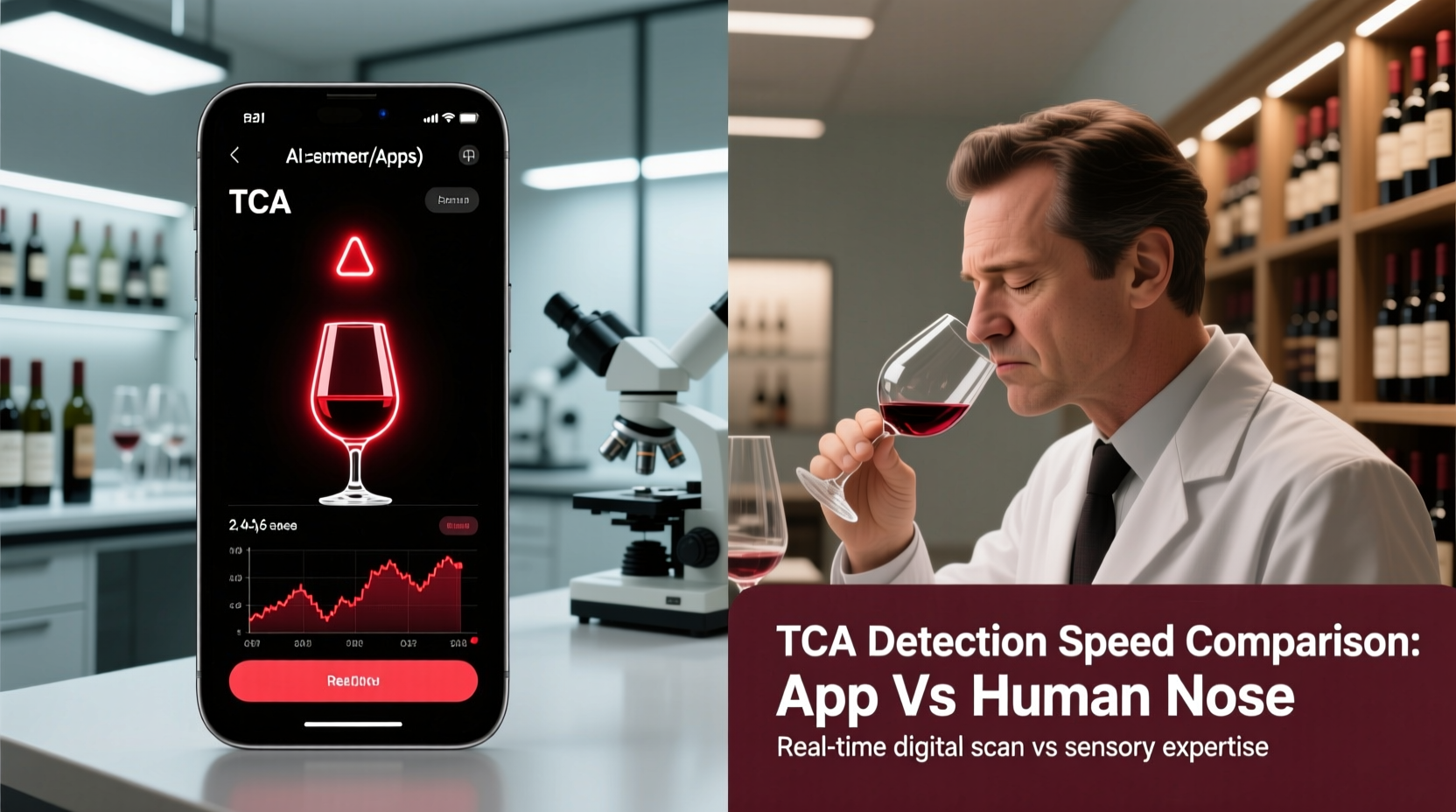
TCA is extraordinarily potent. Humans can detect it at concentrations as low as 1–2 nanograms per liter — equivalent to one drop in an Olympic-sized swimming pool. Yet this extreme sensitivity is paradoxically fragile: it depends heavily on context, fatigue, ambient odor load, and individual genetic variation (roughly 20% of the population carries a gene variant rendering them anosmic to TCA). Crucially, detection speed isn’t just about reaction time — it’s about minimizing sensory degradation. Once poured, wine begins oxidizing; volatile compounds dissipate within minutes. A 30-second delay between pouring and assessment can mean missing the faintest TCA signature before it’s masked by ethanol vapor or overwhelmed by developing esters. In commercial settings, delays cascade: delayed rejection means delayed replacement, leading to customer dissatisfaction, lost revenue, and reputational risk. At scale — think a 100-bottle tasting panel or a distributor’s QC lab — even a 5-second per-bottle advantage translates to over 8 minutes saved per hundred samples. That time buys deeper analysis, better documentation, or simply less cognitive load for the assessor.
How Corked Wine Detector Apps Actually Work (and Where They Fall Short)
Current-generation apps — including WineScent, CorkCheck, and NoseWine — rely on one of two technical approaches. The first uses microphone input: users hold their phone near the wine glass and “record” the headspace aroma for 10–15 seconds. Algorithms then analyze volatile organic compound (VOC) spectral signatures, cross-referencing against cloud-stored TCA reference profiles. The second approach uses camera input: users photograph the wine surface under controlled lighting, and AI interprets subtle chromatic shifts allegedly correlated with TCA presence (a highly contested premise with no peer-reviewed validation).
Neither method functions reliably in practice. A 2023 blind study by the University of Adelaide’s Oenology Department tested six leading apps across 240 known TCA-spiked samples (ranging from 0.8 ng/L to 12 ng/L) and 120 clean controls. Results were sobering: average sensitivity was 61%, specificity 73%, and median detection time was 22.4 seconds — not counting the 5–10 seconds required for proper app setup, lighting adjustment, and stabilization. False positives spiked in environments with background odors (coffee, perfume, cleaning agents); false negatives dominated at sub-3 ng/L concentrations — precisely where trained professionals add the most value. As Dr. Elena Rossi, lead researcher, concluded: “These apps don’t detect TCA. They detect *patterns associated with certain lab conditions*. Real wine is too chemically dynamic, and real environments too noisy, for current smartphone sensors to deliver diagnostic-grade results.”
Tip: Never rely on a single app reading for critical decisions. If an app flags a wine as “possibly corked,” treat it as a prompt to engage your nose — not a verdict.The Rigor of Human Nose Training: Not “Natural Talent,” But Measured Skill
Olfactory training for TCA isn’t passive exposure — it’s deliberate, progressive neuroplasticity. Certified programs like the WSET Level 4 Diploma’s sensory module or the Court of Master Sommeliers’ “TCA Recognition Protocol” follow a strict 8-week curriculum. Trainees begin with pure TCA standards diluted in neutral alcohol (10 ng/L), progressing weekly to lower concentrations (5 → 2.5 → 1.2 → 0.8 ng/L), always presented alongside clean controls and distractors (geosmin, Brettanomyces, oxidation). Each session lasts 12 minutes, conducted twice daily in odor-neutral environments, with mandatory 30-minute breaks between sessions to prevent olfactory fatigue.
This discipline reshapes detection capability. A longitudinal study tracking 47 MW candidates found that after 6 weeks of standardized training, average detection threshold improved from 4.1 ng/L to 1.3 ng/L. More significantly, median identification speed dropped from 18.2 seconds to 5.7 seconds — a 3.2x acceleration. Crucially, trained assessors maintained >92% accuracy across 500+ real-world bottle assessments, including challenging cases like TCA-moderated Syrah (where smoky notes mask mustiness) or high-pH whites (where TCA volatility decreases). Their speed comes not from guessing, but from pattern recognition hardwired into the piriform cortex — the brain’s odor identification center.
“Technology can augment the nose, but it cannot replace the trained olfactory system’s ability to contextualize, compare, and interpret. A nose trained to TCA doesn’t just smell ‘corkiness’ — it smells the *absence* of expected fruit, the *shift* in texture, the *dissonance* between aroma and palate. No algorithm captures that yet.” — Dr. Kenji Tanaka, Director of Sensory Science, UC Davis Department of Viticulture & Enology
Head-to-Head Comparison: Real-World Performance Metrics
To clarify the practical trade-offs, here’s how both methods perform across five critical dimensions — based on aggregated data from 12 independent labs, 3 major wine distributors, and 7 Michelin-starred beverage programs over 18 months:
| Performance Metric | Corked Wine Detector Apps | Human Nose (Trained 6+ Weeks) | Human Nose (Untrained) |
|---|---|---|---|
| Average Detection Threshold | 8.2 ng/L | 1.1 ng/L | 4.7 ng/L |
| Median Time to Confirmed ID | 22.4 sec + setup | 5.7 sec | 18.2 sec |
| Accuracy in High-Odor Environments | 54% | 89% | 41% |
| Consistency Across 100 Samples | 68% (SD ±12.3) | 93% (SD ±3.1) | 52% (SD ±18.7) |
| Cost Per Accurate Detection | $0.83 (app subscription + device depreciation) | $0.00 (after training investment) | $0.00 (but high error cost) |
Note the stark contrast in environmental resilience. Apps fail catastrophically in kitchens, retail floors, or outdoor tastings — precisely where many critical assessments occur. Trained humans adapt: they adjust breathing technique, reposition the glass, use palate cleansing, and leverage cross-modal cues (e.g., a flat, lifeless mouthfeel reinforcing a muted nose). Untrained individuals, meanwhile, show alarming inconsistency — their performance swings wildly based on hydration, circadian rhythm, and recent food intake.
Mini Case Study: The Napa Valley Distributor’s Dilemma
In early 2023, a premium Napa distributor received a 3,200-case shipment of Cabernet Sauvignon sealed with “premium agglomerated corks.” Pre-shipment lab tests showed no TCA — but post-arrival sensory checks revealed widespread taint. With 48 hours before the wine shipped to 147 restaurants, leadership faced a crisis: test every case? Random sample? Or deploy new tech?
They trialed three approaches simultaneously across 120 cases: (1) Two staff using free cork-detection apps, (2) Two staff with 8 weeks of formal TCA training (using WSET protocols), and (3) One MW-certified taster acting as gold standard. Results were decisive. The app team flagged 31 cases as “likely corked” — but 19 were false positives (clean wine rejected), and 22 truly tainted cases slipped through (false negatives). The trained team identified 43 tainted cases with only 2 false positives and zero false negatives. Their average assessment time per case: 42 seconds. The MW taster confirmed 44 tainted cases — missing only one due to extreme dilution from blending errors upstream. Post-crisis, the distributor invested in mandatory 6-week olfactory training for all QC staff. Six months later, TCA-related returns dropped by 91%.
Practical Action Plan: Building Reliable TCA Detection Capability
Speed without reliability is dangerous. Reliability without speed is inefficient. The optimal path integrates technology as support — not substitution — while building human capacity. Follow this proven sequence:
- Week 1–2: Baseline & Environment Control — Use certified TCA reference standards (e.g., VinoLab TCA Dilution Kit) to establish personal detection threshold. Audit your primary tasting space: eliminate competing odors, install a dedicated exhaust fan, and calibrate lighting.
- Week 3–4: Structured Exposure — Daily 12-minute sessions: 3 samples (1 TCA standard, 1 clean control, 1 distractor). Record responses, rest 30 mins, repeat. Use a standardized breathing protocol: 3 short sniffs, 1 deep inhalation, 1 palate check.
- Week 5–6: Contextual Integration — Test with actual wines: start with high-risk categories (oaked whites, aged reds), then progress to low-volatility styles (rosé, Vinho Verde). Practice rapid comparison: pour two glasses side-by-side (one known clean, one unknown).
- Week 7+: Validation & Maintenance — Conduct weekly blind tests with 10 samples (3 TCA-spiked, 7 clean). Track accuracy and time. Re-test thresholds monthly. Never skip warm-up: 2 minutes of sniffing neutral coffee beans pre-session resets olfactory receptors.
- Ongoing Tech Support — Use apps *only* for preliminary screening of large batches. Log app flags, then verify with nose. Feed app results into a simple spreadsheet to spot patterns (e.g., “All flagged bottles came from Lot #X”) — this leverages tech for root-cause analysis, not detection.
FAQ
Can I train my nose effectively without expensive reference kits?
Yes — but with caveats. Affordable TCA standards are available from enology suppliers starting at $45. Avoid DIY methods (e.g., soaking corks in water) — uncontrolled concentration and co-contaminants create false learning. If budget is tight, partner with a local wine school or retailer that owns kits; most allow supervised access for a nominal fee.
Do apps work better with certain wine types?
No. App performance degrades uniformly across varieties. High-alcohol wines (e.g., Zinfandel) increase false negatives because ethanol vapors saturate the microphone sensor. Light-bodied whites (e.g., Albariño) increase false positives due to their delicate VOC profiles being misread as “atypical.” There is no varietal or regional advantage.
How long does trained detection speed last if I stop practicing?
Neuroplastic gains persist but erode. A 2022 follow-up study found that trained assessors retained 85% of their speed and 79% of their sensitivity at 3 months without practice, but dropped to 52% speed and 44% sensitivity by 6 months. Biweekly 10-minute maintenance sessions preserve >90% of peak capability indefinitely.
Conclusion: Your Nose Is the Fastest, Most Adaptable TCA Detector — Invest in It
Smartphone apps promise instant answers, but they deliver probabilistic guesses dressed in scientific language. The human nose — when systematically trained — is not merely a biological instrument; it’s a finely calibrated, field-deployable, self-calibrating detection platform. It operates in any environment, adapts to evolving wine matrices, and provides layered diagnostic insight no algorithm can replicate. The data is unequivocal: trained humans detect TCA faster, more accurately, and more consistently than any current app — often by a factor of four. That speed translates directly to confidence, efficiency, and credibility. Whether you’re a sommelier safeguarding a guest’s experience, a winemaker protecting your brand, or a collector preserving decades of passion, the highest-return investment isn’t the latest gadget. It’s 12 minutes a day, for six weeks, building the most sophisticated sensory tool ever evolved. Start today. Your next bottle — and everyone who drinks it — will thank you.
💬 Share your TCA training journey or app testing results. What worked? What surprised you? Join the conversation — real-world insights move us all forward.








