
For pet owners, managing loose fur is a daily battle. Whether it's tumbleweeds of dog hair rolling across hardwood floors or cat hair clinging to area rugs, choosing the right cleaning tool makes all the difference. Two popular options dominate modern homes: cordless stick vacuums and robot vacuums. But when it comes to tackling pet hair—especially on multiple surfaces and in high-traffic zones—which one truly performs better? The answer isn’t as straightforward as marketing claims suggest. It depends on your lifestyle, flooring types, and how much control you want over your cleaning routine.
Cleaning Power and Suction Performance
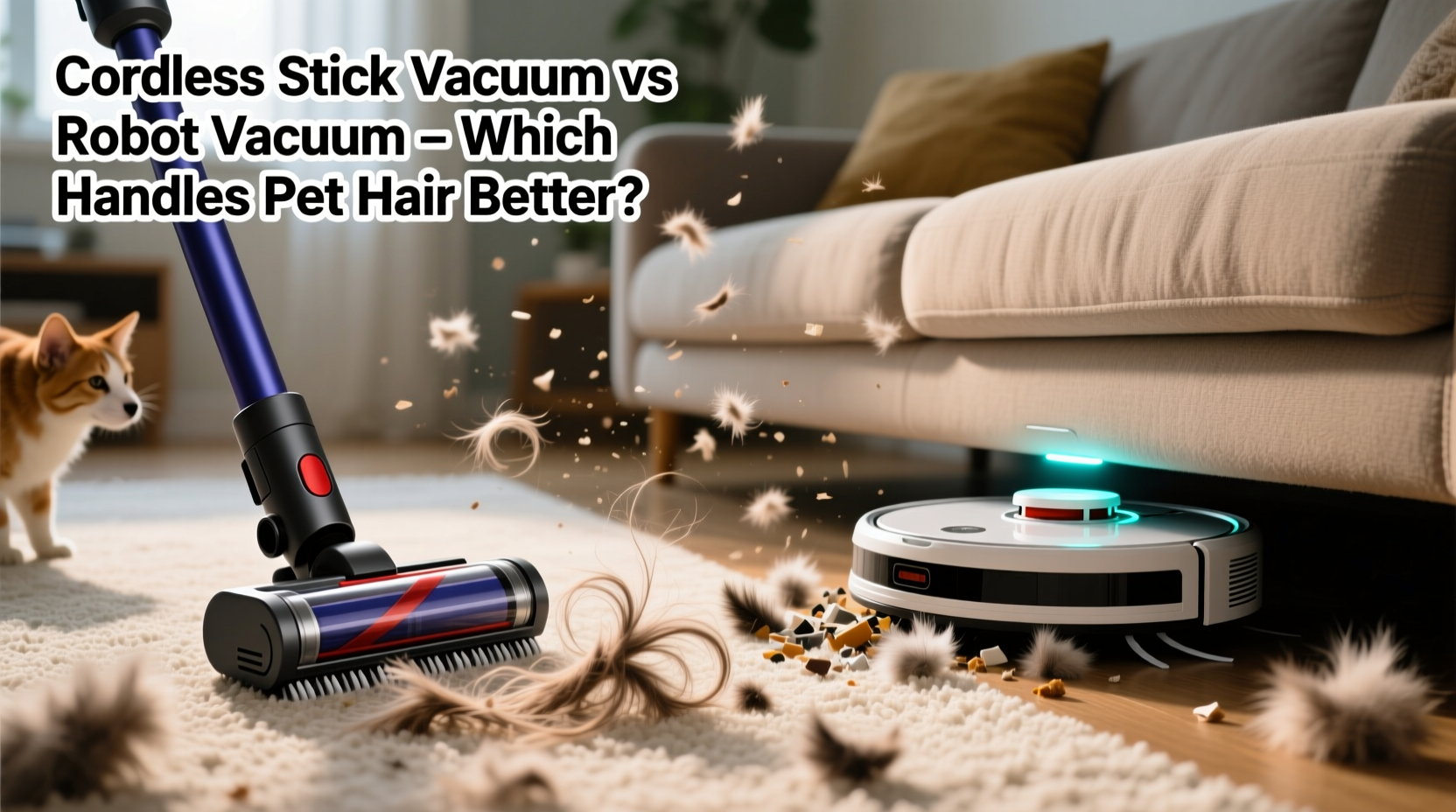
The core function of any vacuum is suction—and here, cordless stick vacuums have a clear advantage. Most models today offer suction power ranging from 150 to over 240 air watts, with specialized pet-focused versions like the Dyson V15 Detect or Shark Vertex delivering targeted performance for embedded pet hair. These machines use powerful motors and cyclonic technology to separate debris and maintain consistent airflow, even as the dustbin fills.
Robot vacuums, while improving, generally max out around 2,500–3,000 Pa (Pascals) of suction—roughly equivalent to mid-tier stick vacuums—but their compact design limits motor size and airflow volume. High-end models like the Roborock S8 Pro Ultra or Ecovacs Deebot X2 Omni advertise strong suction, but physics remains a constraint: smaller intake paths and lower brush roll torque reduce effectiveness on thick carpets or matted fur.
Stick vacuums also allow direct user control over where and how long suction is applied. You can hover over a stubborn patch of dog hair on a rug and hold the nozzle there for several seconds. Robot vacuums follow algorithms—they might pass over the same spot once and move on, missing deeply embedded hair.
Tip: For homes with heavy shedding pets, prioritize a cordless stick vacuum with a motorized pet tool—it’s specifically designed to loosen and extract hair from upholstery and stairs.Mobility, Coverage, and Daily Maintenance
Where robot vacuums shine is consistency. They clean autonomously, often scheduled to run daily while you're at work or asleep. This frequent maintenance prevents pet hair from accumulating into larger clumps that are harder to remove later. Models with self-emptying bases can operate for weeks without intervention, making them ideal for busy households.
However, robots struggle with obstacles. Pet toys, cords, low furniture, and thresholds can block navigation. Some advanced units use LiDAR or AI-powered cameras to map rooms and avoid collisions, but they still require regular oversight. A robot stuck under a coffee table won’t finish its job, leaving behind layers of fur.
Cordless stick vacuums require manual operation but offer unmatched flexibility. You can quickly clean up an accident after your dog shakes off water, target baseboards where hair collects, or switch between floorheads for hardwood versus carpet. Their lightweight design allows for easy storage and portability between floors.
If your goal is thorough weekly deep-cleaning, a stick vacuum wins. If you prefer light daily upkeep to minimize buildup, a robot vacuum provides hands-off convenience.
“Frequent, low-effort cleaning is more effective than occasional deep cleans when managing pet hair.” — Dr. Lena Patel, Indoor Air Quality Researcher, University of Minnesota
Surface Compatibility and Hair Tangle Resistance
Pet hair behaves differently across surfaces. On hard floors, it slides easily and can be picked up efficiently by both types of vacuums. On medium-pile carpets, especially looped Berber styles, it embeds quickly and tangles around fibers. This is where brush roll design becomes critical.
Many robot vacuums now feature tangle-free brush rolls—either bristle-less rubber extractors or dual anti-tangle rollers. These reduce hair wrap, a common pain point. However, rubber rollers aren't always as effective at lifting hair from carpet depths. They excel on hard floors but may leave behind fuzz on textured rugs.
Cordless stick vacuums typically use powered rotating brushes with stiff bristles and metal-reinforced ends. These agitate carpet fibers aggressively, dislodging trapped hair. The downside? They’re prone to hair wrapping unless cleaned regularly. Premium models include features like automatic brush cutters or removable end caps for easier maintenance.
For homes with mixed flooring—wood, tile, area rugs, and wall-to-wall carpet—a hybrid approach may be best. Use a robot for daily sweeps on open floors, then deploy a stick vacuum weekly for carpets and corners.
Real-World Example: The Thompson Household
The Thompsons own two golden retrievers and live in a three-bedroom ranch with hardwood throughout and medium-pile carpet in the bedrooms. Initially, they invested in a high-end robot vacuum with self-emptying and tangle-free brushes. It ran every morning and kept the main living areas looking tidy.
But within six months, they noticed persistent fur buildup along baseboards and under furniture. The robot avoided these edges due to sensor limitations, and the carpet in the bedroom began to mat. Weekly, they found themselves pulling out a handheld vacuum to supplement.
They switched to a cordless stick vacuum with a pet turbo tool and LED headlights. Now, they do a full-home pass every Sunday, focusing on problem zones. They still use the robot on weekdays for quick pickups after the dogs come inside from the yard. The combination reduced visible hair by over 80%, according to their own logs.
Their experience reflects a growing trend: dedicated pet owners benefit most from using both devices strategically, rather than relying on one alone.
Comparison Table: Key Features at a Glance
| Feature | Cordless Stick Vacuum | Robot Vacuum |
|---|---|---|
| Suction Power | High (150–240+ AW) | Moderate to High (up to 3,000 Pa) |
| Pet Hair Removal (Carpet) | Excellent | Good to Fair |
| Daily Maintenance | Manual effort required | Fully automated |
| Hair Wrap Risk | Higher (requires cleaning) | Lower (tangle-free designs) |
| Edge & Corner Cleaning | Precise control | Limited by sensors |
| Best For | Deep cleaning, pet accidents, stairs | Daily upkeep, open layouts |
Step-by-Step: Building a Pet Hair Cleaning Routine
Instead of choosing one device over the other, many pet owners achieve the best results by integrating both into a structured routine. Here’s how to do it effectively:
- Assess Your Home Layout: Map out flooring types, high-traffic zones, and pet activity areas. Identify where hair accumulates fastest.
- Deploy the Robot Daily: Schedule it to run during low-activity hours (e.g., 10 AM or 2 PM). Focus on kitchens, hallways, and living rooms with hard surfaces.
- Use the Stick Vacuum Weekly: Dedicate 20–30 minutes once a week to deep-clean carpets, baseboards, stairs, and furniture using the motorized pet tool.
- Spot-Clean Immediately: After shedding episodes (bathing, grooming), use the stick vacuum to prevent hair from spreading.
- Maintain Both Devices: Empty bins after each use. Clean brush rolls weekly. Replace filters as recommended to maintain suction.
Frequently Asked Questions
Can a robot vacuum completely replace a cordless stick vacuum for pet owners?
Not reliably. While robot vacuums excel at daily maintenance, they lack the suction power, maneuverability, and precision needed for deep cleaning pet hair from carpets, upholstery, and tight spaces. Most pet owners still need a stick vacuum for comprehensive cleaning.
Do cordless vacuums work well on thick pet hair?
Yes, especially models with motorized brush rolls and high suction. Look for vacuums labeled “pet” versions—they often include specialized tools, larger dustbins, and anti-tangle technology. Regular maintenance is key to preventing clogs.
Which vacuum type is better for allergy sufferers with pets?
Cordless stick vacuums typically have superior HEPA filtration systems that capture fine dander and allergens. While some robot vacuums now include HEPA filters, their smaller size limits airflow and filtration efficiency. For allergy control, a stick vacuum with sealed-system HEPA filtration is preferable.
Checklist: Choosing the Right Tool for Your Needs
- ✅ Do you have mostly hard floors? → Robot vacuum may suffice for daily care.
- ✅ Do you have carpets or rugs? → Prioritize a cordless stick vacuum.
- ✅ Are you gone during the day? → Robot vacuum offers hands-free cleaning.
- ✅ Do your pets shed heavily? → You’ll likely need both devices.
- ✅ Do you value speed and control? → Cordless stick vacuums give immediate results.
- ✅ Are stairs a factor? → Only stick vacuums can clean them effectively.
- ✅ Is noise a concern? → Robots are quieter during operation; stick vacuums are louder but faster.
Final Verdict: Which One Actually Handles Pet Hair Better?
When judged solely on raw performance against pet hair, the cordless stick vacuum is the superior tool. Its stronger suction, targeted attachments, and ability to handle varied surfaces make it indispensable for thorough cleaning. No robot vacuum currently matches its deep-cleaning capability, especially on carpets where pet hair buries itself over time.
However, the robot vacuum wins in sustainability of effort. It removes hair before it settles, reducing the overall load on your home. When used together, they form a powerful tandem: the robot handles frequency, the stick vacuum delivers intensity.
The truth is, pet hair management isn’t about finding a single perfect device. It’s about creating a system that aligns with your home, schedule, and standards. For most pet owners, that system includes both technologies—each playing to their strengths.
“The best vacuum for pet hair isn’t the one with the highest specs—it’s the one you actually use consistently.” — Mark Tran, Home Technology Editor, CleanLiving Magazine
Take Action Today
Don’t wait for another fur tumbleweed to cross your living room. Evaluate your current cleaning routine. Are you battling hair buildup weekly because daily maintenance is lacking? Consider adding a robot vacuum to automate the basics. Or, if you’re tired of your robot missing spots, upgrade to a cordless stick vacuum with a pet-specific tool for real results.
For optimal outcomes, combine both: let the robot maintain cleanliness between deeper sessions with your stick vacuum. Your floors, your allergies, and your peace of mind will thank you.
💬 What’s your go-to solution for pet hair? Share your experience, favorite model, or cleaning hack in the comments below—help fellow pet owners find smarter ways to keep their homes fur-free!








