
Cats are natural climbers. From wild ancestors scaling rocky outcrops to domestic companions leaping onto kitchen counters, vertical movement is deeply embedded in their instincts. In homes, providing appropriate elevated spaces isn’t just about preventing mischief—it’s about supporting mental well-being, reducing stress, and enriching daily life. Two of the most popular solutions for vertical territory are cat trees and cat shelves. But which do cats actually prefer? The answer depends on a blend of feline psychology, household layout, and individual personality.
This article dives into the behavioral science behind cats’ use of vertical space, compares the practical benefits and drawbacks of cat trees versus wall-mounted shelves, and offers real-world guidance for choosing what works best—both for your cat and your living environment.
The Science Behind Cats and Vertical Space
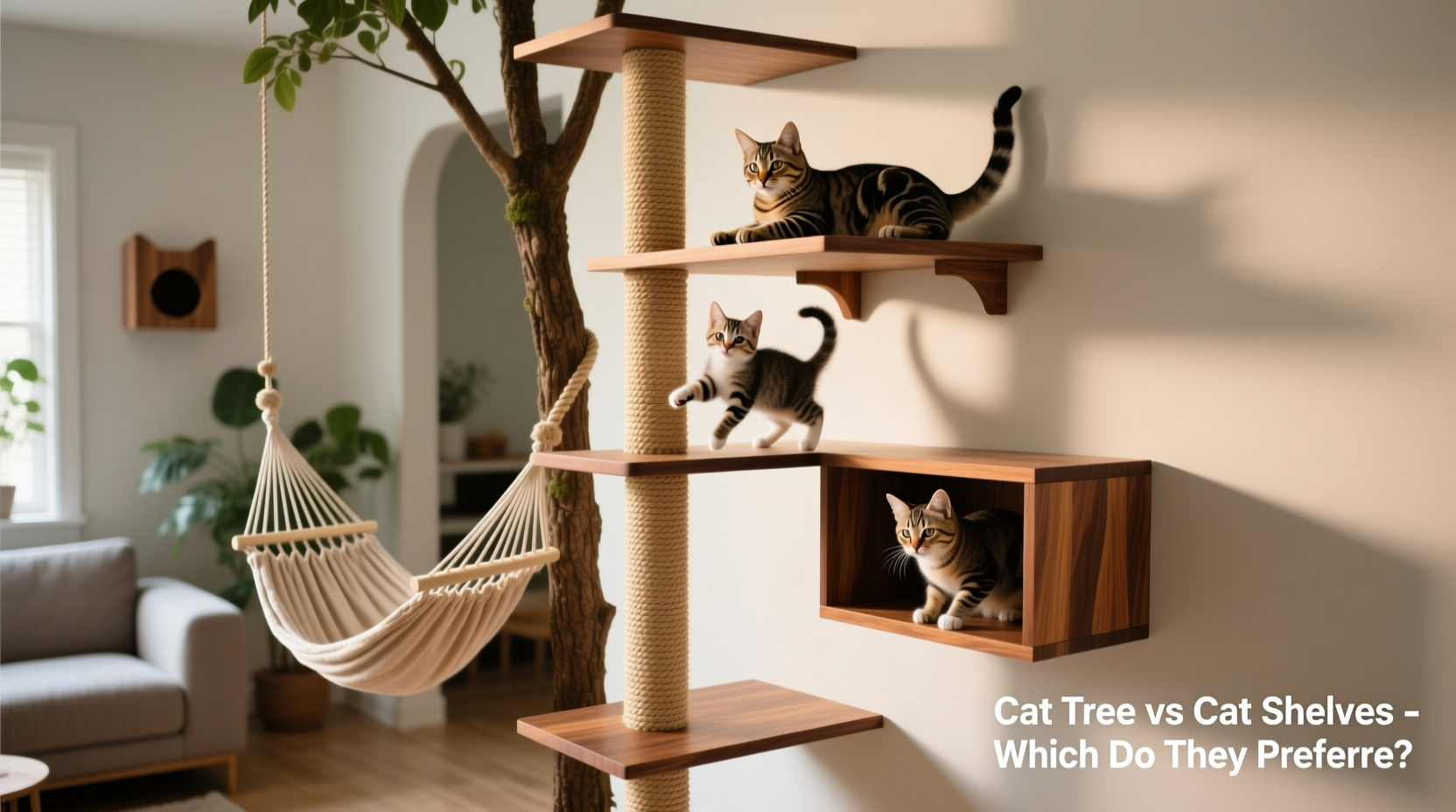
Cats are ambush predators with a need for surveillance. Elevated perches give them a strategic vantage point to monitor their surroundings, detect potential threats, and observe household activity—all while feeling secure. This instinctual behavior is known as \"perch-and-observe,\" and it plays a crucial role in reducing anxiety, especially in multi-cat homes or environments with frequent changes.
According to Dr. Sarah Ellis, a feline behavior researcher at the University of Lincoln, “Vertical space allows cats to exert control over their environment. When they can retreat upward, they feel less vulnerable, which directly impacts their emotional state.” This sense of security translates into fewer stress-related behaviors such as over-grooming, inappropriate elimination, or aggression.
“Cats don’t just climb for fun—they climb for survival. Even in safe homes, that wiring remains active.” — Dr. Mikel Delgado, Certified Cat Behavior Consultant
Studies show that cats in enriched environments with access to vertical territory exhibit lower cortisol levels (a stress hormone) and higher engagement in natural behaviors like stretching, scratching, and play. Whether that space comes from a freestanding tower or a series of floating platforms, the key is accessibility, stability, and placement near points of interest—like windows, doorways, or feeding areas.
Understanding Cat Trees: Pros and Cons
Cat trees—also called cat condos or towers—are self-contained structures made of posts wrapped in sisal, platforms, hideaways, and sometimes toys or hammocks. They range from compact 24-inch models to floor-to-ceiling units over six feet tall.
Advantages of Cat Trees:
- All-in-one design: Combines scratching surfaces, lounging spots, hiding places, and play elements.
- Stability: Freestanding weight provides resistance when cats leap or scratch vigorously.
- Immediate setup: No installation required—place and let your cat explore.
- Ideal for kittens and active cats: Encourages jumping, batting, and climbing games.
Drawbacks of Cat Trees:
- Bulkiness: Takes up significant floor space, which can be problematic in small apartments.
- Limited placement options: Must be positioned against a wall for safety, reducing flexibility.
- Aesthetic mismatch: Many models clash with modern decor despite functional benefits.
- Wear and tear: Over time, fabric frays, stuffing protrudes, and base wobbles, requiring replacement.
Exploring Cat Shelves: Pros and Cons
Cat shelves—also known as catwalks or floating shelves—are mounted directly to walls, creating a custom pathway system across rooms. Typically made of wood or engineered materials, they come in various shapes (rectangular, L-shaped, circular) and can be arranged vertically or horizontally.
Advantages of Cat Shelves:
- Space-saving: Uses vertical wall space instead of floor area, ideal for studios or minimalist homes.
- Customizable layouts: Can be arranged to suit room dimensions, cat mobility, and visual preferences.
- Modern aesthetics: Blends with interior decor when designed thoughtfully—some resemble art installations.
- Promotes exploration: Creates a circuit-like route encouraging sustained movement and mental stimulation.
Drawbacks of Cat Shelves:
- Installation complexity: Requires drilling into studs for safety; improper mounting risks collapse.
- No built-in scratching: Most shelves lack sisal-wrapped posts, so separate scratching solutions are needed.
- Less sheltered: Open design doesn’t offer enclosed hiding spots unless paired with cubbies.
- Not ideal for older or arthritic cats: Gaps between shelves may be too wide for less agile felines.
One major benefit often overlooked is the psychological impact of continuity. A well-designed shelf system mimics the branching pathways of natural terrain, allowing cats to move through their territory without descending to “predator level” (the floor). This uninterrupted access reinforces confidence and territorial ownership.
Comparative Overview: Cat Tree vs Cat Shelves
| Feature | Cat Tree | Cat Shelves |
|---|---|---|
| Floor Space Used | High – requires dedicated footprint | Low – uses wall space only |
| Installation Effort | None – ready to place | Moderate to high – requires secure wall mounting |
| Scratching Integration | Yes – standard on most models | No – must be added separately |
| Customization | Limited – fixed structure | High – modular and reconfigurable |
| Aesthetic Flexibility | Low – often bulky and toy-like | High – can match home decor |
| Best For | Active cats, kittens, homes with open space | Small spaces, multi-level routes, design-conscious owners |
Real-World Example: A Multi-Cat Apartment Setup
In a 750-square-foot apartment in Portland, Oregon, resident Lena adopted two rescue cats—Miso, a bold three-year-old tabby, and Tofu, a shy seven-year-old tuxedo. Initially, both cats competed for the same sunny windowsill, leading to tension and avoidance behaviors.
Lena installed a combination system: a mid-sized cat tree beside the living room window provided immediate relief with multiple levels and a covered condo, while she added three wooden cat shelves along an adjacent wall, forming a U-shape route connecting the bedroom to the kitchen.
Within days, Miso claimed the top perch of the cat tree for daytime napping, while Tofu used the higher, quieter shelves to observe without direct exposure. The separation reduced conflict, and both cats began using different parts of the vertical network based on mood and time of day.
This hybrid approach highlights a key insight: cats don’t always prefer one type of vertical space over another—they use different zones for different purposes. The tree offered comfort and enclosure; the shelves offered escape and exploration.
How to Choose Based on Your Cat’s Personality
There is no universal preference—cats vary widely in temperament, age, and physical ability. Consider these guidelines when deciding:
- Confident, playful cats: Often gravitate toward cat trees with interactive features like dangling toys or tunnels.
- Shy or anxious cats: May prefer elevated shelves that allow quick retreat and panoramic views without being seen.
- Senior or mobility-impaired cats: Benefit from low-rise, closely spaced shelves with non-slip surfaces and easy access.
- Kittens: Thrive with cat trees that encourage climbing, scratching, and pouncing.
Step-by-Step Guide to Building a Feline-Friendly Vertical Environment
- Assess your cat’s habits: Note where they already climb or rest—windowsills, bookshelves, backs of sofas.
- Map your available space: Identify wall areas suitable for mounting shelves or floor zones for a cat tree.
- Determine your priorities: Is saving floor space critical? Do you want scratching integration? Are aesthetics important?
- Select your primary system: Start with either a sturdy cat tree or a basic shelf set (3–4 units).
- Install securely: For shelves, anchor into wall studs using appropriate hardware. Test stability before use.
- Encourage use: Place soft bedding, treats, or cat-safe plants on platforms to draw interest.
- Monitor and adjust: Observe which areas your cat uses most and modify placement or add connections as needed.
- Combine systems if desired: Anchor a cat tree beneath a shelf line to create a continuous pathway.
Frequently Asked Questions
Do cats really need vertical space?
Yes. Vertical space satisfies instinctual needs for observation, security, and territory control. It’s especially important in homes with limited floor space or multiple pets. Without it, cats may develop stress-related behaviors or become overly territorial on ground level.
Can I install cat shelves on drywall without studs?
No. Drywall alone cannot support a cat’s weight during dynamic movements like jumping or landing. Always mount shelves into wooden studs using lag screws rated for at least 50 pounds per bracket. If studs aren’t aligned, use toggle bolts designed for heavy loads—but consult a professional if unsure.
Which is better for small apartments—cat trees or shelves?
Cat shelves are generally better for small spaces because they free up floor area. However, compact cat trees (under 3 feet tall) can work if placed in corners. Prioritize vertical reach over footprint, and consider wall-mounted systems for maximum efficiency.
Checklist: Choosing the Right Vertical Solution
- ☐ Measure available floor and wall space
- ☐ Observe your cat’s current climbing preferences
- ☐ Decide whether scratching surfaces are needed
- ☐ Confirm wall type (drywall, plaster, brick) for mounting feasibility
- ☐ Choose materials that match your decor and durability needs
- ☐ Ensure all edges are smooth and platforms are slip-resistant
- ☐ Plan for future expansion (modular systems allow this)
- ☐ Introduce the structure slowly with positive reinforcement
Conclusion: It’s Not Either/Or—It’s About Harmony
The question isn’t necessarily whether cats prefer cat trees or cat shelves—it’s how to provide a layered, thoughtful vertical landscape that meets their behavioral needs. Some cats will favor the cozy enclosure of a cat tree; others will patrol the high ledges of a shelf circuit like silent sentinels. Many thrive when given both.
Rather than viewing these options as competing, consider them complementary tools in environmental enrichment. A cat tree can serve as a central hub—a base camp—while shelves extend the territory into overlooked areas like above doorways or along hallways. Together, they create a three-dimensional home that respects your cat’s instincts and enhances their quality of life.
💬 Have you tried cat trees, shelves, or a mix of both? Share your experience and what your cat prefers in the comments below!








