
For decades, the idea of training a cat to perform on command—like sitting, shaking paws, or coming when called—has been met with skepticism. Dogs, after all, are social pack animals bred for obedience. Cats? Independent, aloof, and seemingly indifferent. But modern behavioral science is challenging this long-held assumption. While cats may not be miniature dogs, research in animal cognition and operant conditioning shows they can learn complex behaviors—just differently.
The key lies not in forcing feline nature into a canine mold, but in understanding what motivates cats, how they process learning, and why their behavior has evolved the way it has. With patience, consistency, and the right techniques, many cat owners have successfully taught their pets tricks once thought impossible.
The Science Behind Feline Learning
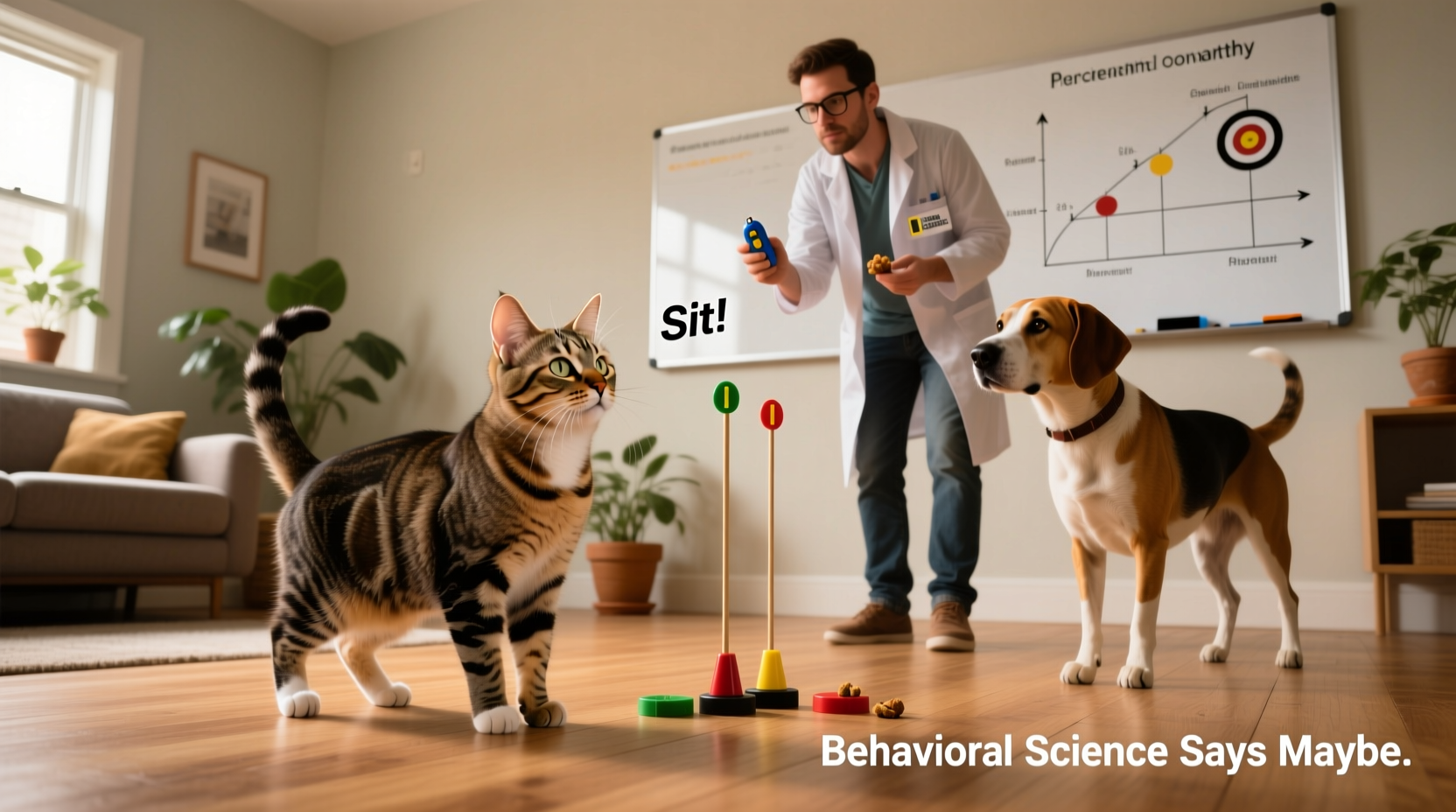
Cats are not untrainable—they’re selectively trainable. Unlike dogs, which evolved as cooperative hunters in social groups, cats are solitary predators. Their survival depended on independence, stealth, and quick decision-making. This evolutionary path shaped a brain wired for efficiency, not compliance.
However, neuroscience and ethology confirm that cats possess the cognitive capacity for associative learning. In fact, studies from the University of Tokyo and the University of Lincoln show that cats can recognize their names, distinguish human voices, and respond to cues when properly reinforced. The difference isn’t ability—it’s motivation.
Dogs often work for praise or the joy of pleasing their owner. Cats, by contrast, respond best to immediate, tangible rewards—typically food. This doesn’t make them less intelligent; it makes them more pragmatic. As Dr. John Bradshaw, anthrozoologist and author of *Cat Sense*, explains:
“Cats aren’t stubborn or unaffectionate. They simply don’t operate on the same social currency as dogs. To train a cat, you must speak their language: consequences and rewards.” — Dr. John Bradshaw, Anthrozoologist
Operant conditioning—the principle behind most animal training—is just as effective with cats as with dogs. When a behavior leads to a positive outcome (like a treat), it’s more likely to be repeated. Negative outcomes (like being ignored) reduce unwanted behaviors. The challenge is aligning the cat’s natural inclinations with the desired action.
What Training Is Possible—and What Isn’t
Not every dog-like behavior translates neatly to cats. However, many core commands and tricks are achievable with proper technique. Below is a comparison of common training goals and their feasibility in cats.
| Behavior | Feasibility in Cats | Notes |
|---|---|---|
| Sit on command | High | Most cats learn this quickly with food luring. |
| Come when called | Moderate | Requires strong association with reward; inconsistent due to independence. |
| High-five / Shake paw | High | Popular trick; uses natural paw-lifting motion. |
| Roll over | Moderate | Takes longer; depends on cat’s flexibility and trust. |
| Walk on leash | Variable | Possible with early exposure; some cats adapt well, others resist. |
| Fetch | Low to Moderate | Rare, but some cats—especially Bengals or kittens—enjoy retrieving. |
| Stay in place | Low | Cats are naturally mobile; “stay” contradicts instinct. |
The table reveals a pattern: cats excel at discrete, reward-based actions but struggle with prolonged compliance. This isn’t a failure of training—it’s a reflection of their ecological niche. A wild cat that “stays” too long risks missing prey or becoming prey itself.
Tip: Start training during your cat’s natural active periods—usually dawn or dusk—for maximum engagement.A Step-by-Step Guide to Training Your Cat
Training a cat requires breaking down behaviors into small, manageable steps. Here’s a proven five-phase method based on clicker training and positive reinforcement.
- Choose the Right Reward
Select a high-value treat your cat rarely gets—such as freeze-dried chicken, tuna flakes, or commercial cat treats. Avoid using kibble unless it’s highly motivating. - Introduce the Clicker or Marker Word
Use a clicker or a consistent word like “yes” to mark the exact moment your cat performs the desired behavior. Pair the sound with an immediate treat so the cat learns it predicts a reward. - Lure the Behavior
Hold the treat near your cat’s nose and guide their head up slightly. As their head lifts, their bottom naturally lowers into a sit. The instant they sit, click and treat. - Add the Cue
Once your cat consistently sits in response to the lure, say “sit” just before presenting the treat. Over time, they’ll associate the word with the action. - Phase Out the Lure
Gradually stop moving the treat. Use only the verbal cue. Reinforce correct responses intermittently to maintain the behavior without dependency on constant treats.
This process works for other behaviors too. For example, to teach “high-five,” gently touch your cat’s paw while saying the cue. When they lift it—even slightly—click and reward. Shape the behavior incrementally until they offer the paw on command.
Real Example: How One Owner Trained Her Cat to Come When Called
Maria, a veterinarian technician from Portland, adopted Luna, a shy tabby, at six months old. Initially, Luna would hide whenever visitors came over and never responded to her name. Determined to improve their bond, Maria began a daily training routine.
She started by saying “Luna” in a cheerful tone just before mealtime. Every time Luna looked up or approached, she clicked and gave a treat. After two weeks, Luna began running to the kitchen when called. By week six, Maria could call her from another room—even during nap time.
“I didn’t expect much,” Maria said. “But I realized she wasn’t ignoring me—she just didn’t know it was worth her attention. Once she made the connection, everything changed.”
Today, Luna comes when called 80% of the time and even performs a “spin” trick for guests. Maria credits success to timing, consistency, and respecting Luna’s limits. “Some days she just doesn’t want to play. And that’s okay. I’ve learned to read her mood.”
Common Mistakes That Sabotage Cat Training
Even with the right tools, many owners unintentionally undermine progress. These pitfalls are common but avoidable:
- Expecting dog-level obedience: Cats won’t perform on demand every time. Their cooperation is conditional, not contractual.
- Using punishment: Yelling, spraying water, or physical corrections damage trust and increase anxiety. They do not teach alternative behaviors.
- Training for too long: Cats have short attention spans. Sessions should last 3–5 minutes, 2–3 times a day.
- Inconsistent cues: Saying “come,” “here,” and “过来” interchangeably confuses the cat. Pick one word and stick to it.
- Neglecting environmental triggers: Loud noises, other pets, or stress can override training. Choose calm moments for practice.
Checklist: Getting Started with Cat Training
Before you begin, ensure you have the right setup. Use this checklist to prepare:
- ✅ High-value treats (small, soft, and strongly scented)
- ✅ Clicker or consistent marker word (“yes,” “good”)
- ✅ Quiet, distraction-free space
- ✅ 3–5 minute blocks of time, twice daily
- ✅ Patience and realistic expectations
- ✅ Notebook to track progress (optional but helpful)
- ✅ Leash and harness (if planning outdoor walks)
FAQ: Common Questions About Training Cats
Can older cats be trained?
Yes. While kittens learn faster due to neuroplasticity, adult and even senior cats can acquire new behaviors. The process may take longer, and motivation must be higher, but age alone is not a barrier.
Do I need a clicker, or can I use my voice?
A clicker provides a precise, consistent sound that marks the exact moment of success. However, a distinct word like “yes” or “got it” can work if used consistently. Avoid emotional tones—keep it neutral and immediate.
My cat ignores me. Does that mean they can’t be trained?
Not necessarily. Ignoring you often means the current reward isn’t valuable enough or the environment is too distracting. Try training during feeding times when your cat is hungrier, or switch to a more enticing treat.
Why This Matters Beyond Tricks
Training isn’t just about entertainment. It strengthens the human-cat bond, reduces stress, and improves welfare. A trained cat is easier to manage during vet visits, grooming, and emergencies.
For example, teaching your cat to enter a carrier voluntarily eliminates stressful chases. Using positive reinforcement, you can condition them to see the carrier as a safe space associated with good things. The same principles apply to nail trims, medication administration, and handling.
Dr. Sarah Ellis, co-author of *The Trainable Cat*, emphasizes this practical benefit:
“Training isn’t about control. It’s about communication. When we understand how cats learn, we give them more choice, reduce fear, and build mutual respect.” — Dr. Sarah Ellis, Feline Behavior Researcher
Conclusion: Rethinking the Cat-Dog Divide
The question isn’t whether cats can be trained like dogs—but whether we’re willing to adapt our methods to their nature. Behavioral science confirms that cats are capable learners, but they operate on their own terms. Success comes not from demanding dog-like loyalty, but from respecting feline psychology.
With the right mindset, tools, and timing, you can teach your cat to sit, come, shake, and even walk on a leash. More importantly, you deepen your relationship through shared understanding. The goal isn’t to turn your cat into a dog, but to unlock their potential on their own terms.
💬 Have you trained your cat? Share your story, tips, or challenges in the comments. Let’s celebrate the clever, quirky minds of our feline companions.








