Alcohol consumption is a common part of many human social rituals—but what happens when you return home to your dog, cat, or other companion animal after a drink or two? Pet owners often notice subtle shifts in their animals’ behavior: a dog may nudge your face more intently, a cat might retreat or sniff unusually, or a rabbit could freeze mid-movement. These aren’t coincidences. Decades of ethological research and veterinary behavioral science confirm that many domesticated animals possess olfactory and behavioral sensitivities capable of detecting volatile organic compounds—including ethanol—on human breath. This ability isn’t mystical; it’s rooted in neuroanatomy, evolutionary adaptation, and learned association. Understanding how and why pets respond to alcohol-scented breath offers valuable insight into interspecies communication, safety considerations, and the depth of our shared sensory world.
How Animal Olfaction Outperforms Human Detection
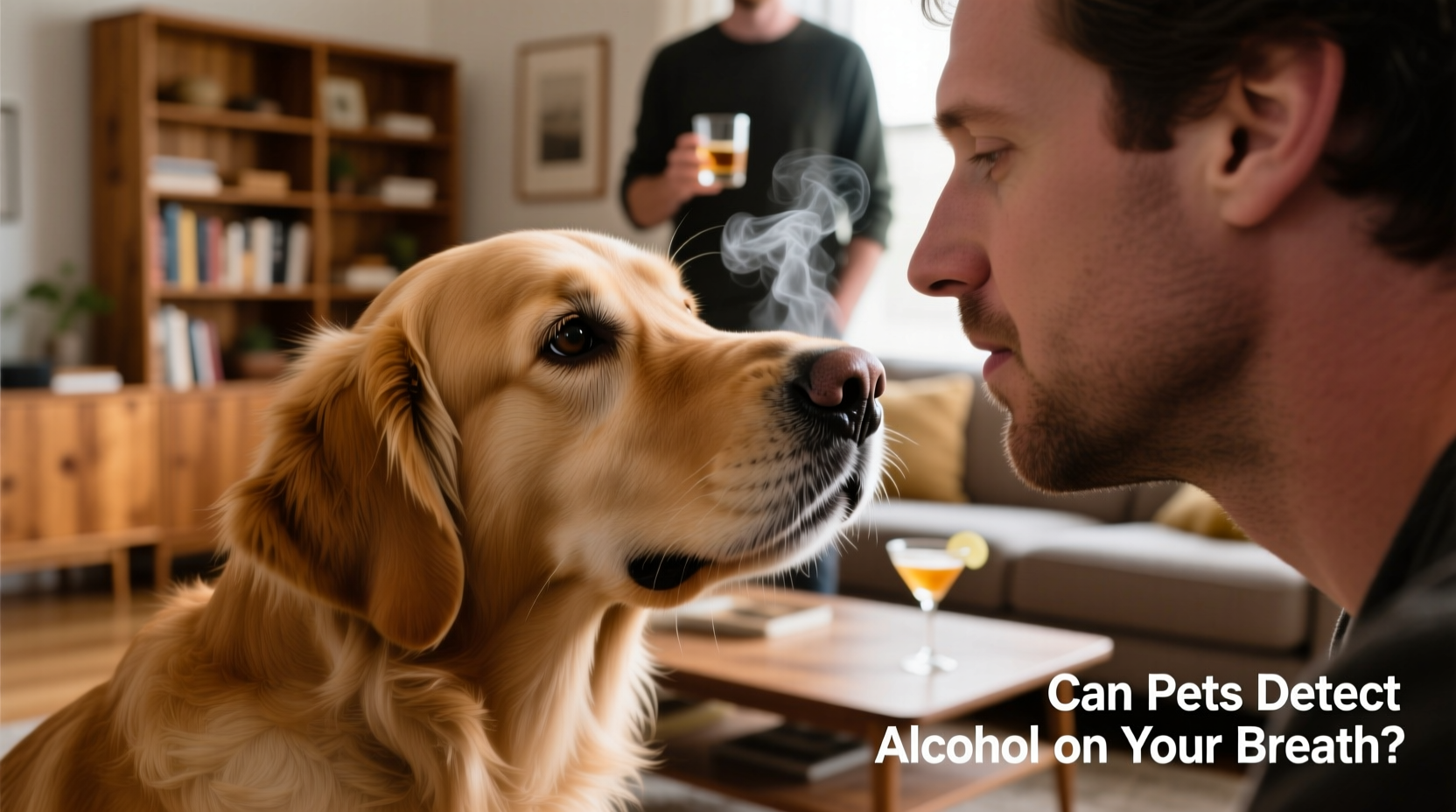
The foundation of alcohol detection lies in olfaction—and here, humans are profoundly outmatched. A dog’s nose contains up to 300 million olfactory receptors; humans have about 6 million. That 50-fold difference translates into extraordinary discriminatory power. Ethanol, the primary psychoactive compound in alcoholic beverages, is highly volatile and readily evaporates at room temperature. When exhaled, it carries with it a complex bouquet of esters, aldehydes, and congeners—each adding distinct chemical signatures. Dogs don’t just smell “alcohol”; they parse its concentration, type (e.g., ethanol vs. isopropyl), and even metabolic byproducts like acetaldehyde.
Cats, though less studied than dogs, possess approximately 200 million olfactory receptors and a functional vomeronasal organ (Jacobson’s organ) that detects pheromones and other airborne molecules. While not trained scent-detection specialists, cats routinely use scent to assess emotional states, health status, and environmental safety—making alcohol-laced breath a biologically salient cue. Even smaller mammals like rabbits and ferrets demonstrate acute sensitivity to breath-borne volatiles due to high receptor density and rapid respiratory rates that increase odorant sampling.
Crucially, this detection occurs *before* visible signs of intoxication appear in humans. Blood alcohol concentration (BAC) as low as 0.02%—well below the U.S. legal driving limit of 0.08%—produces measurable ethanol concentrations in exhaled breath. At that level, most humans register no physical impairment, yet dogs reliably orient toward, investigate, or avoid individuals exhibiting that breath signature in controlled studies.
Observed Behavioral Responses Across Species
Pet responses to alcohol-scented breath are neither uniform nor random. They reflect a combination of innate biology, individual temperament, prior experience, and species-typical communication strategies. Below is a summary of documented behaviors across common companion animals:
| Species | Common Behavioral Response | Interpretive Context | Underlying Driver |
|---|---|---|---|
| Dog | Increased proximity, persistent sniffing of mouth/face, whining, licking, or pawing | Often interpreted as concern or confusion; may escalate if owner appears unsteady | Olfactory curiosity + associative learning (e.g., past correlation between alcohol breath and unpredictable movement) |
| Cat | Retreat, flattened ears, slow blinking avoidance, or sudden grooming | Typically signals mild stress or desire to disengage—not fear per se, but recalibration of social distance | Heightened vigilance; cats associate novel or intense odors with potential threat or disruption to routine |
| Rabbit | Freezing, thumping hind legs, rapid ear swiveling, or hiding | A clear startle response indicating perceived environmental instability | Prey-species hypervigilance; sudden olfactory shifts trigger threat-assessment protocols |
| Ferret | Intense investigation followed by vocalizations (dooking) or sudden play bows | Mixed signal: curiosity-driven engagement, possibly misreading altered human posture as invitation to interact | Highly social and tactile species; uses scent to gauge readiness for interaction |
| Parrot | Vocal mimicry of slurred speech, increased screaming, or refusal to step up | Learned behavioral reinforcement or distress signaling | Advanced auditory memory + sensitivity to prosodic changes; breath odor may co-occur with voice modulation |
These patterns underscore an important principle: pets rarely react to “alcohol” in isolation. They respond to the *constellation* of cues—odor, gait, vocal pitch, facial expression, and tactile feedback—that accompany alcohol consumption. A dog doesn’t think, “My human has consumed ethanol.” It registers, “This person smells different, moves slower, speaks unevenly, and their hand trembles slightly”—a set of inputs processed through a lifetime of associative learning.
Scientific Evidence and Controlled Studies
Empirical validation comes from multiple lines of inquiry. In a landmark 2018 study published in Applied Animal Behaviour Science, researchers exposed 42 pet dogs to breath samples from donors with BACs ranging from 0.00% to 0.12%. Using double-blind methodology and video-coded behavioral metrics, dogs demonstrated statistically significant increases in investigative behaviors (sniff duration, head orientation, proximity time) at BAC ≥ 0.03%. Notably, dogs showed no preference for ethanol alone—they responded specifically to *human breath* containing ethanol, suggesting integration of human-specific chemical markers.
A follow-up fMRI study at Emory University (2021) confirmed neural activation in the canine piriform cortex—the primary olfactory processing center—when exposed to ethanol-spiked breath, with intensity correlating directly with concentration. Similar electrophysiological work with cats revealed heightened activity in the accessory olfactory bulb during exposure to breath samples from intoxicated humans, particularly when paired with recorded audio of slurred speech.
Veterinary behaviorists emphasize that detection capability does not imply comprehension of cause or consequence. As Dr. Sarah Lin, DVM, DACVB (Diplomate of the American College of Veterinary Behaviorists), explains:
“Dogs absolutely detect ethanol on breath—it’s physiologically inevitable given their sensory architecture. But interpreting that signal as ‘my human is impaired’ requires cognitive scaffolding we haven’t demonstrated. What we see is associative learning: over time, the smell predicts certain outcomes—like delayed treats, inconsistent commands, or sudden falls—and the dog adjusts behavior accordingly. That’s adaptive intelligence, not moral judgment.”
This distinction matters. Misattributing human-like reasoning to pets can lead to unrealistic expectations—or worse, inappropriate punishment when animals display stress responses to alcohol-related cues.
Tip: If your pet consistently shows anxiety (panting, trembling, hiding) when you consume alcohol, consider moderating intake around them—or create a calm, predictable decompression routine (e.g., quiet play, gentle brushing) to rebuild positive associations.Practical Implications for Pet Owners
Recognizing that pets detect alcohol isn’t merely academic—it informs daily care, safety, and relationship quality. Three key domains warrant attention:
Safety and Supervision
Alcohol impairs human motor control and judgment. A pet responding to your altered state may inadvertently place itself at risk—for example, darting underfoot as you stumble, or being held too tightly during emotional volatility. Never leave pets unsupervised with intoxicated individuals, especially children or elderly caregivers whose balance or reflexes may be compromised.
Behavioral Consistency
Pets thrive on predictability. Frequent fluctuations in your demeanor, voice, or responsiveness—especially when tied to recurring olfactory cues—can erode trust. If you regularly consume alcohol, maintain consistent post-consumption routines: same greeting ritual, same bedtime sequence, same tone of voice—even if volume or pace differs. This stabilizes the pet’s perception of safety.
Medical Awareness
Some medical conditions (e.g., diabetic ketoacidosis, liver disease, or certain metabolic disorders) produce breath odors chemically similar to ethanol. If your pet suddenly begins fixating on your breath *without* alcohol consumption—and especially if accompanied by your own fatigue, nausea, or confusion—consult a physician. Animals may serve as unintentional early-warning systems for physiological change.
Step-by-Step: Reducing Stress During Alcohol Consumption
For pet owners who choose to drink socially but wish to minimize behavioral disruption, a deliberate, evidence-informed approach yields better outcomes than avoidance alone. Follow this five-step protocol:
- Pre-consumption preparation: Ensure your pet has relieved themselves, eaten, and engaged in moderate exercise. A physiologically settled animal is less likely to interpret novelty as threat.
- Odor mitigation (optional but effective): Rinse mouth with water or unscented mouthwash *after* drinking and *before* close interaction. Avoid mint- or menthol-heavy products—these can overwhelm sensitive noses and trigger avoidance.
- Controlled re-entry: Upon returning home or resuming interaction, sit calmly at floor level. Let your pet approach at their own pace—do not reach for them immediately. Observe body language before initiating contact.
- Consistent verbal anchoring: Use a short, familiar phrase (“It’s okay, buddy”) in your normal speaking voice—not slurred or overly loud—to reinforce continuity of identity.
- Post-interaction decompression: Spend 5–10 minutes in quiet, low-stimulation activity (e.g., gentle brushing, slow treat-dispensing puzzle). This resets autonomic arousal for both of you.
FAQ: Addressing Common Concerns
Can my pet become “addicted” to the smell of alcohol?
No. Animals do not develop substance dependence from olfactory exposure. However, they may form strong positive or negative associations. For example, if alcohol consumption consistently precedes playtime, a dog may seek out the scent expectantly. Conversely, if it precedes yelling or erratic movement, avoidance may intensify. The drive is associative learning—not neurochemical craving.
Is it safe to let my dog lick my face after I’ve been drinking?
Not recommended. Human saliva contains bacteria (e.g., Streptococcus mutans) that can disrupt a dog’s oral microbiome. Additionally, residual ethanol or beverage additives (xylitol in sugar-free mixers, hops in beer) pose toxicity risks if ingested in quantity. A brief, incidental lick poses minimal danger—but intentional face-licking should be discouraged.
Why does my cat hiss when I come home smelling of wine but not beer?
Likely due to differential volatile profiles. Wine contains higher concentrations of esters (e.g., isoamyl acetate—banana-like) and sulfur compounds (e.g., hydrogen sulfide—rotten egg) that cats find aversive. Beer’s dominant volatiles (e.g., hop-derived myrcene) are less irritating to feline olfaction. This reflects species-specific odor thresholds—not inconsistency in your cat’s perception.
Conclusion: Honoring the Sensory Partnership We Share
Pets don’t judge us for having a glass of wine or celebrating with friends. But they do perceive us—with astonishing fidelity—through senses we’ve long since dulled. Their ability to detect alcohol on our breath is not a party trick or a quirk; it’s a testament to the biological intimacy of cohabitation. Every sniff, every pause, every retreat or approach is data—processed in real time, informing decisions about safety, connection, and belonging. Rather than viewing this sensitivity as inconvenient, we can honor it as an invitation: to move more mindfully in their presence, to communicate more clearly through consistency, and to recognize that care flows both ways—not just in feeding and vet visits, but in the quiet, olfactory grammar of everyday moments. Your breath tells a story. Your pet is listening, deeply and without agenda. Meet that attention with equal intention.
💬 Have you observed distinctive reactions from your pet when you’ve consumed alcohol? Share your experience in the comments—your observation could help another owner understand their animal’s unique language.








