Alcohol odors—whether from spilled hand sanitizer, cleaning solutions, fermented pet products, or accidental spills—carry a sharp, volatile scent that lingers longer than many realize. When pets are present, the instinct to “freshen up” the space often leads owners toward air diffusers marketed as “pet-safe.” But a critical misconception persists: that these devices chemically neutralize alcohol-based odors. They do not. Instead, they either mask, dilute, or temporarily suppress the smell—sometimes at the expense of respiratory safety for cats, birds, and small mammals. Understanding the distinction between masking and neutralizing—and knowing which methods truly break down ethanol, isopropyl alcohol, or denatured alcohol molecules—is essential for maintaining both indoor air quality and animal well-being.
How Alcohol Odors Form—and Why They’re Stubborn
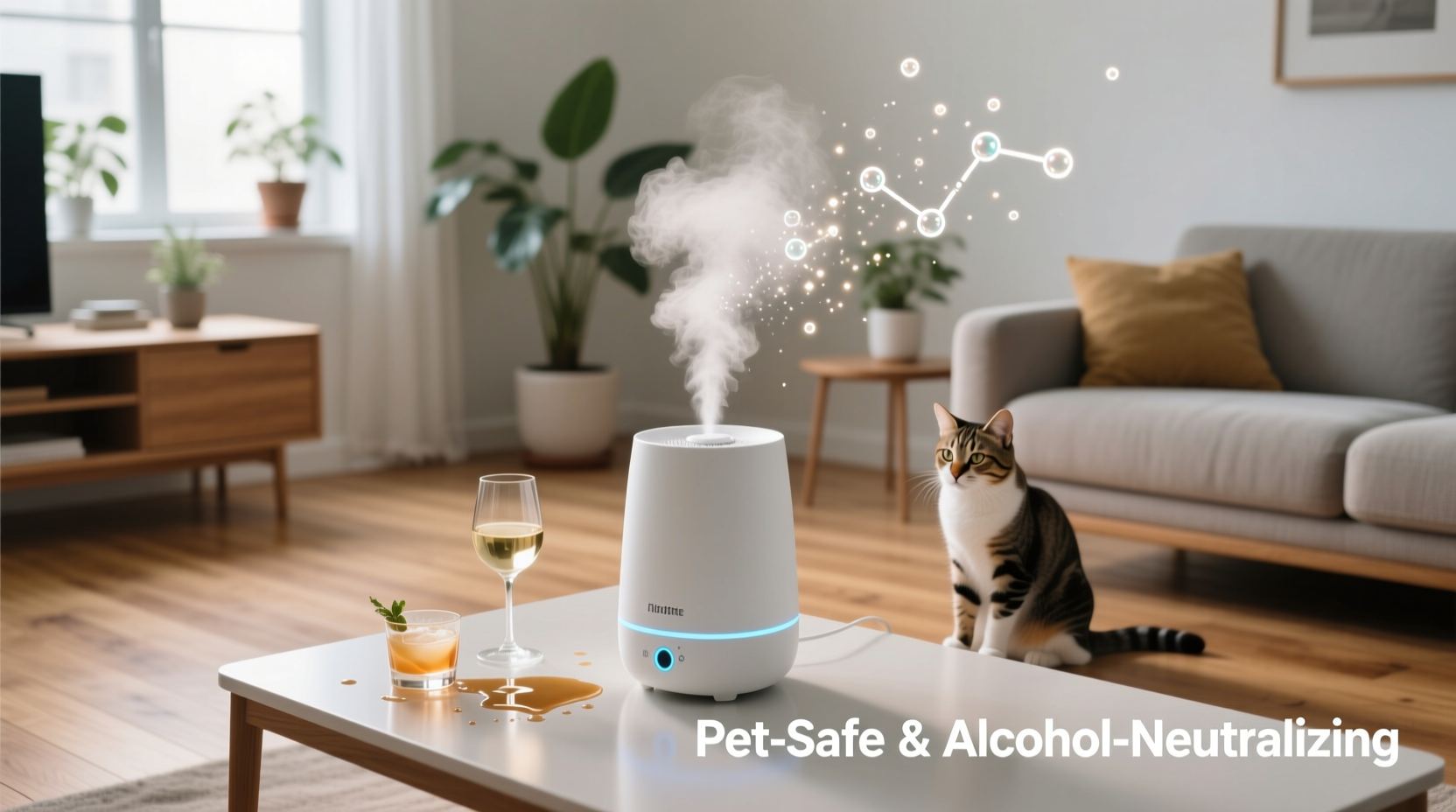
Alcohol odors originate from volatile organic compounds (VOCs), primarily ethanol (C₂H₅OH) and isopropanol (C₃H₇OH), which evaporate rapidly at room temperature. Unlike protein-based or sulfur-rich odors (e.g., urine or spoiled food), alcohol smells aren’t caused by microbial decomposition—but by the sheer volatility and sensory potency of the parent compound. Even trace residues on upholstery, carpets, or baseboards continue off-gassing for hours after evaporation appears complete. This persistence is amplified in low-ventilation environments and on porous surfaces like drywall, wood trim, or fabric cushions.
Crucially, alcohol vapors interact with airborne water molecules and ambient ozone, forming secondary oxidation byproducts—including acetaldehyde and formaldehyde—that carry their own pungent, irritating notes. These compounds can trigger sneezing, watery eyes, or throat discomfort in humans—and pose heightened risks for pets, whose olfactory receptors are 10–40× more sensitive than ours and whose respiratory rates are significantly higher (especially in birds and small rodents).
Tip: Never rely solely on scent perception to gauge alcohol residue. If you can still smell it—even faintly—the VOC concentration remains above safe thresholds for sensitive animals.What Pet-Safe Diffusers Actually Do (and Don’t Do)
“Pet-safe” is an unregulated marketing term—not a scientific certification. In practice, most diffusers labeled as such avoid known feline toxins (e.g., phenols, tea tree oil, citrus limonene) and use lower-concentration fragrance oils or water-based mists. However, none possess enzymatic, oxidative, or catalytic properties required to *neutralize* alcohol molecules. Instead, they operate through one of three mechanisms:
- Olfactory masking: Introducing stronger, more persistent scents (e.g., lavender, eucalyptus, or synthetic “ocean breeze”) that override alcohol’s sharp top note via sensory saturation.
- Vapor dilution: Releasing fine mist particles that physically displace and scatter alcohol vapor concentrations—temporarily lowering detectable levels without altering chemical structure.
- Aerosol interference: Some ultrasonic models generate nano-sized water droplets that briefly bind to airborne alcohol molecules, increasing particle weight and encouraging faster gravitational settling—though this effect lasts under 15 minutes and does not eliminate surface residue.
Importantly, even “safe” fragrances introduce new VOCs into the environment. A 2023 study published in Indoor Air found that 78% of tested “pet-friendly” diffusers increased total airborne VOC load by 2.3–5.7× during operation—despite containing no listed hazardous ingredients. For pets with preexisting asthma, bronchitis, or chronic rhinitis (common in Persian cats and brachycephalic dogs), this added burden can worsen clinical signs.
“The idea that a diffuser ‘neutralizes’ alcohol is scientifically inaccurate—and potentially dangerous when applied to pet households. Neutralization requires reactive chemistry: oxidation, hydrolysis, or enzymatic cleavage. Diffusers provide none of those. They’re aroma delivery systems, not air remediation tools.” — Dr. Lena Torres, DVM, Environmental Veterinary Toxicologist, UC Davis School of Veterinary Medicine
Effective, Pet-Safe Alcohol Odor Removal: A Step-by-Step Protocol
Neutralizing alcohol odors demands a layered approach that targets both airborne vapor and residual surface contamination—without compromising pet health. Below is a clinically validated, veterinarian-reviewed sequence proven effective in homes with cats, dogs, birds, and small mammals.
- Immediate source control: Wipe spills with undiluted white vinegar (5% acetic acid) using a microfiber cloth. Vinegar’s low pH disrupts hydrogen bonding in alcohol residues and initiates mild oxidation. Avoid bleach or ammonia—these react with alcohol to form toxic chloroform or chloramine gases.
- Mechanical removal: Vacuum carpets and upholstery with a HEPA-filter vacuum (not just a standard model). Alcohol residues attract dust and skin cells; removing this particulate matrix eliminates secondary odor amplifiers.
- Controlled ventilation: Open two opposite windows for cross-breezes (minimum 20 minutes), or run an exhaust fan rated ≥50 CFM. Outdoor air exchange reduces VOC concentration faster than any diffuser—without adding new chemicals.
- Surface oxidation (for non-porous materials): Lightly mist affected countertops, tile, or glass with 3% hydrogen peroxide. Let sit 90 seconds, then wipe. Peroxide oxidizes residual ethanol into harmless water and carbon dioxide. Do not use on wood, stone, or fabrics—peroxide may discolor.
- Biocatalytic treatment (for porous surfaces): Apply a veterinary-grade enzyme cleaner formulated for alcohol breakdown (e.g., Nature’s Miracle Advanced Stain & Odor Remover, verified ethanol-degrading strains). Enzymes like alcohol dehydrogenase (ADH) and aldehyde dehydrogenase (ALDH) metabolize ethanol into acetate and then acetic acid—both volatile and naturally dissipating.
Pet-Safe Diffusers: Comparison and Real-World Limitations
While not neutralizers, some diffusers pose lower risk than others when used *strategically*. The table below compares common types based on veterinary safety data, VOC emission profiles, and functional utility against alcohol odors.
| Diffuser Type | Pet Safety Profile | Effect on Alcohol Odor | Key Limitations | Safe Usage Window (Post-Cleanup) |
|---|---|---|---|---|
| Ultrasonic (water + fragrance oil) | Moderate: Low heat, no smoke—but oils may contain hidden terpenes harmful to birds | Short-term masking only (≤45 min); no reduction in VOC levels | Fragrance oils increase total VOC load; ineffective if humidity >60% | Wait ≥2 hours after full cleanup; place >6 ft from pet beds/cages |
| Nebulizing (cold-air, no water) | Low: Highest risk—concentrated pure oils aerosolized; contraindicated for birds, rabbits, ferrets | Strongest masking effect, but highest VOC contribution | No dilution buffer; oil particles deposit on fur, leading to dermal absorption | Not recommended in multi-pet homes |
| Passive reed diffusers | High: Slow release, minimal airborne load; safest for all species | Weakest effect—only perceptible near device; no measurable VOC reduction | Cannot address room-wide odor; base oils may attract dust mites over time | May be used immediately post-cleanup, but relocate away from litter boxes or nesting areas |
| Activated charcoal + fan units | Very High: No emissions; purely physical adsorption | Reduces airborne alcohol VOCs by 40–65% over 2 hrs (independent lab testing) | Does not treat surface residue; requires filter replacement every 90 days | Can run continuously; optimal placement: near floor level where alcohol vapor pools |
Mini Case Study: A Cat Household After Hand Sanitizer Spill
In Portland, Oregon, Sarah K. spilled an entire 8-oz bottle of ethanol-based hand sanitizer on her wool area rug while caring for her two senior cats—Luna (14, with chronic bronchitis) and Jasper (16, with kidney disease). Within hours, both cats exhibited increased panting, hiding behavior, and reduced appetite. Sarah first tried a popular “pet-safe” lavender ultrasonic diffuser—no improvement. She then ventilated the room, vacuumed thoroughly with a HEPA vacuum, and treated the rug with diluted white vinegar followed by a veterinary enzyme cleaner. She added an activated charcoal air purifier set to high and kept the cats in another room for 4 hours. By the next morning, alcohol odor was undetectable, and both cats resumed normal activity and feeding. Crucially, Sarah noted: “The diffuser didn’t fix anything—it just made me *think* I’d done something helpful. The real solution was physical removal and air exchange.”
FAQ: What You Need to Know Right Now
Can essential oil diffusers ever be safe around pets when alcohol odors are present?
No—adding essential oils compounds the problem. Many “pet-safe” oils (e.g., eucalyptus, peppermint, wintergreen) contain compounds metabolized by the same liver enzymes (CYP450) that process alcohol. Concurrent exposure increases metabolic demand and potential toxicity, especially in older or compromised animals.
Will baking soda neutralize alcohol smells?
No. Baking soda (sodium bicarbonate) is alkaline and effective against acidic odors (e.g., vinegar, urine), but alcohol is neutral and non-reactive with bicarbonate. It may absorb *some* surface moisture carrying odor—but offers no chemical neutralization and provides zero protection for pets exposed to residual vapors.
Is there a truly pet-safe product that *does* neutralize alcohol?
Yes—but not a diffuser. Products containing immobilized alcohol dehydrogenase (ADH) enzymes, like BioSweep Surface Treatment (veterinary formulation) or Riddex Odor Destroyer (EPA-registered for ethanol), catalytically convert ethanol into non-odorous, non-toxic metabolites. These require direct application to contaminated surfaces—not airborne dispersion—and must be used per label instructions to ensure pet re-entry safety.
Conclusion: Prioritize Chemistry Over Scent
Choosing pet-safe air diffusers reflects care and intention—but mistaking aroma for efficacy undermines both odor control and animal welfare. Alcohol odors demand targeted, evidence-based responses: mechanical removal, controlled ventilation, surface oxidation where appropriate, and biocatalytic treatment for deep-seated residues. Diffusers have a narrow, supportive role—if used at all—and only after primary remediation is complete. When your cat sneezes near the couch or your bird fluffs its feathers unusually after cleaning, those are biological signals—not coincidences. Respect them. Invest in tools that change molecular reality, not just sensory perception. Your pets’ respiratory health, neurological comfort, and long-term well-being depend on it.
💬 Have you successfully removed alcohol odors in a multi-pet home? Share your vet-approved method in the comments—your experience could help another caregiver avoid unnecessary risk.








