Dogs don’t just notice when you’ve had a drink—they often react before you’ve taken the first sip. A sudden nudge at your hand, an intense stare while you’re sipping wine, or persistent sniffing near your breath or skin can feel uncanny. But is this behavior rooted in biological capability, or is it learned association? The question isn’t merely academic: it touches on veterinary safety, responsible pet ownership, forensic reliability, and even workplace policies involving service or detection animals. To separate myth from mechanism, we must examine canine olfaction not as folklore, but as physiology—grounded in receptor density, metabolic pathways, and behavioral context.
How Dogs Smell: The Biology Behind the Sniff
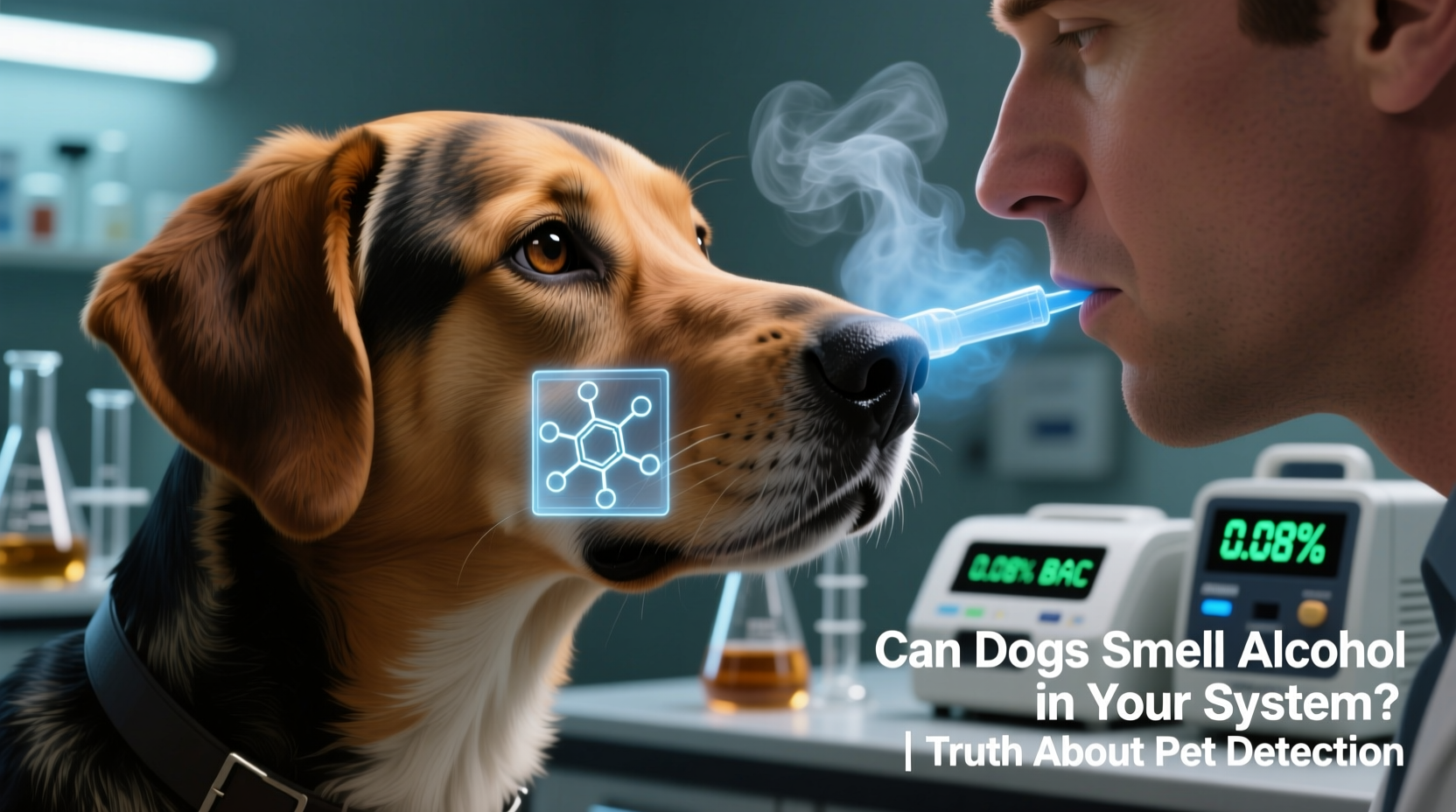
A dog’s nose contains roughly 220–300 million olfactory receptors—compared to about 5–6 million in humans. That’s not just a quantitative difference; it’s a qualitative one. Their olfactory bulb, the brain region dedicated to processing scent, is proportionally 40 times larger than ours. When airborne molecules enter a dog’s nasal cavity, they bind to specialized receptors that trigger neural signals directly to the olfactory cortex—bypassing the thalamus, which means scent perception is faster and more emotionally charged for dogs than for us.
Crucially, dogs exhale through slits in the sides of their nostrils while inhaling—a design that creates continuous air circulation. This allows them to sample new odors without disrupting ongoing analysis. In controlled studies, detection dogs have identified target compounds at concentrations as low as one part per *trillion*. For reference, that’s equivalent to detecting a single drop of liquid in 20 Olympic-sized swimming pools.
But here’s the key nuance: dogs don’t “smell alcohol” as a singular concept. Ethanol—the primary psychoactive compound in alcoholic beverages—is metabolized rapidly in the human body into acetaldehyde and then acetate. What dogs detect are volatile organic compounds (VOCs) released during that process—not ethanol itself in blood or tissue, but its gaseous byproducts exhaled in breath, secreted in sweat, or present in saliva residue.
What Alcohol-Related Compounds Can Dogs Actually Detect?
Research confirms dogs respond consistently to three main categories of alcohol-related VOCs:
- Exhaled ethanol vapor: Present in breath within minutes of ingestion, peaking around 30–60 minutes post-consumption. Detection threshold in trained dogs: ~0.02% BAC (well below the U.S. legal driving limit of 0.08%).
- Acetaldehyde: A pungent, fruity-smelling intermediate metabolite. Highly volatile and easily detected—even at trace levels in sweat and breath.
- Ethyl glucuronide (EtG) and ethyl sulfate (EtS): Non-volatile metabolites found in urine—but not airborne. Unlikely to be detected by dogs unless urine is freshly deposited and evaporating.
Importantly, dogs cannot determine blood alcohol concentration (BAC) with clinical precision. They signal presence—not quantity. A dog may alert to someone who drank one beer two hours ago or someone who consumed four shots 15 minutes prior with equal intensity. Contextual cues—body language, gait, vocal tone—often amplify or modulate the response.
Tip: If your dog becomes unusually attentive or anxious after you drink, observe whether the behavior correlates with breath proximity, hand contact, or clothing. This helps distinguish true scent detection from conditioned responses.Real-World Detection: From K-9 Units to Living Rooms
In 2021, the U.S. Customs and Border Protection deployed a pilot program using dual-purpose detection dogs trained to identify both narcotics and ethanol vapors in vehicle checkpoints. Over six months, 17 dogs achieved 92% accuracy in identifying drivers with BAC ≥ 0.05%, confirmed by breathalyzer. Notably, false positives occurred almost exclusively when handlers were unaware the subject had used mouthwash containing 27% ethanol—or consumed ripe fruit like overripe bananas, which naturally produce ethanol during fermentation.
A more relatable scenario unfolded in Portland, Oregon: Sarah M., a licensed addiction counselor, noticed her rescue Labrador, Jasper, began nudging her wrist and licking her palms every evening around 6:15 p.m.—consistently, for three weeks. She kept a log: no alcohol was consumed that day, but she *had* applied hand sanitizer (62% ethanol) before leaving work. When she switched to an alcohol-free formula, Jasper’s behavior ceased. This wasn’t detection of systemic alcohol—it was detection of residual topical ethanol, demonstrating how environmental contamination skews interpretation.
“Dogs don’t discriminate between ‘intoxicated’ and ‘contaminated.’ Their noses report chemistry—not context. A handler’s job is to rule out confounding variables before drawing conclusions.” — Dr. Lisa Chen, Veterinary Neuroethologist and Lead Researcher, UC Davis Canine Olfaction Lab
Limitations and Misconceptions: What Dogs *Cannot* Do
Despite their extraordinary sensitivity, dogs face hard physiological boundaries. A well-documented limitation is temporal resolution: dogs cannot detect alcohol *after* it has been fully metabolized and cleared from breath and skin—typically within 3–5 hours for moderate consumption in healthy adults. They also cannot detect alcohol in sealed containers (e.g., unopened bottles), inside the bloodstream, or through clothing unless ethanol has permeated fabric fibers via sweat or spillage.
More critically, dogs lack the capacity to interpret intent, impairment, or legality. Alerting to ethanol does not equate to assessing cognitive function, coordination, or risk level. A dog may alert to a recovering alcoholic taking prescribed benzodiazepines (which sometimes contain ethanol as a solvent), or to a diabetic in ketoacidosis (producing acetone, chemically similar to ethanol).
| Capability | Supported by Evidence? | Key Constraint |
|---|---|---|
| Detect ethanol in human breath within 10 minutes of ingestion | ✅ Yes (peer-reviewed field trials) | Requires active exhalation; ineffective if subject holds breath or wears mask |
| Distinguish between beer, wine, and spirits by scent alone | ❌ No | They detect shared VOCs—not beverage-specific esters or congeners |
| Identify intoxication level (e.g., “mildly impaired” vs. “severely impaired”) | ❌ No | No correlation between alert intensity and BAC or motor performance |
| Detect alcohol in urine or blood samples without direct exposure | ❌ No | Requires volatilization—non-volatile metabolites like EtG aren’t airborne |
| Alert reliably across all human demographics (age, metabolism, health status) | ⚠️ Partially | Older adults and those with liver disease metabolize ethanol slower—prolonging detectable window |
Practical Implications for Pet Owners and Professionals
Understanding what dogs *can* and *cannot* do transforms how we interact with them—and how we interpret their behavior. For pet owners, this knowledge prevents mislabeling normal curiosity as “judgmental” behavior. For employers considering canine screening in safety-sensitive roles, it underscores why dogs should never replace objective testing. And for veterinarians, it informs counseling on household hazards: ethanol-containing products—from hand sanitizers to fermented foods to certain medications—are far more accessible scent triggers than systemic alcohol.
Step-by-Step: Assessing Whether Your Dog Is Responding to Alcohol
- Rule out immediate sources: Check for recent use of hand sanitizer, mouthwash, cooking wine, or cleaning products containing ethanol.
- Observe timing: Does the behavior occur only within 2 hours of your drinking—or persist overnight? True metabolic detection rarely lasts beyond 4 hours.
- Test consistency: Repeat the scenario twice with identical conditions (same drink, same time, same environment). Does the response recur? Random or stress-induced behaviors rarely replicate precisely.
- Eliminate confounders: Ask another person (who hasn’t consumed alcohol) to wear your clothing or hold your glass. Does your dog respond similarly? If yes, scent is likely environmental—not physiological.
- Consult a professional: A certified canine behaviorist can conduct controlled scent discrimination exercises to determine baseline reactivity.
FAQ: Addressing Common Concerns
Can my dog tell if I’m hungover?
No—not directly. Hangover symptoms (fatigue, headache, nausea) stem from dehydration, inflammation, and acetaldehyde accumulation—but acetaldehyde clears from breath and sweat within 2–3 hours. What dogs may detect is residual ethanol from late-night snacking (e.g., fermented breads), poor oral hygiene, or topical products used during recovery. Persistent attention is more likely tied to your altered routine or stress signals than biochemical traces.
Is it dangerous for dogs to smell alcohol on humans?
Not inherently—but repeated exposure to high-concentration ethanol vapors (e.g., frequent close contact with someone heavily intoxicated) may irritate nasal mucosa over time. More concerning is secondary exposure: dogs ingesting spilled drinks, licking ethanol-soaked skin, or chewing alcohol-based products. Even small amounts of ethanol can cause vomiting, ataxia, or respiratory depression in dogs. Keep hand sanitizers, cocktails, and fermenting foods securely out of reach.
Do service dogs detect alcohol for people with alcohol use disorder?
Not as a standard task—and for good reason. While some assistance dogs are trained to interrupt harmful behaviors (e.g., retrieving medication or calling for help), detecting alcohol in a handler’s system would create ethical conflicts: it could undermine autonomy, trigger shame, or incentivize concealment. Reputable service dog organizations explicitly exclude substance detection from training protocols. Instead, they focus on crisis response, medication reminders, and grounding techniques during cravings.
Conclusion: Respecting the Nose Without Mystifying It
Dogs can smell alcohol—not as a mystical sixth sense, but as a consequence of evolutionary specialization honed over millennia. Their ability to detect ethanol metabolites is real, measurable, and useful in specific contexts. Yet that power is bounded: by chemistry, by time, by environment, and by biology. Recognizing those boundaries doesn’t diminish their brilliance—it deepens our respect for it. It shifts us from wondering *if* they smell alcohol to understanding *what exactly* they smell, *when*, and *why it matters*.
If you’ve ever caught your dog staring intently as you raised a glass, take it as a quiet reminder: you’re sharing space with a creature whose world is built on scent—a world where a molecule of ethanol carries more information than a thousand words. Observe closely. Question assumptions. Prioritize evidence over anecdote. And next time your dog sniffs your wrist, ask not “What do you know?” but “What are you telling me—and how can I listen better?”
💬 Have you observed your dog responding to alcohol—or other subtle human physiological changes? Share your experience in the comments. Real stories help scientists, trainers, and fellow pet owners refine our understanding—one sniff at a time.








