
Dogs don’t just sniff out spilled wine or forgotten beer cans — they detect volatile organic compounds (VOCs) released by the human body during alcohol metabolism. This ability isn’t folklore; it’s rooted in biology, rigorously validated in forensic and medical research, and increasingly deployed in law enforcement, addiction treatment, and even clinical monitoring. Yet widespread assumptions — that dogs can “smell intoxication” like a breathalyzer, or that any dog can reliably detect blood alcohol concentration (BAC) — obscure a far more nuanced reality. Understanding what dogs *can* and *cannot* detect, under what conditions, and why their performance varies so dramatically requires unpacking both canine neuroanatomy and human physiology.
How Dogs Actually Detect Alcohol: It’s Not What You Think
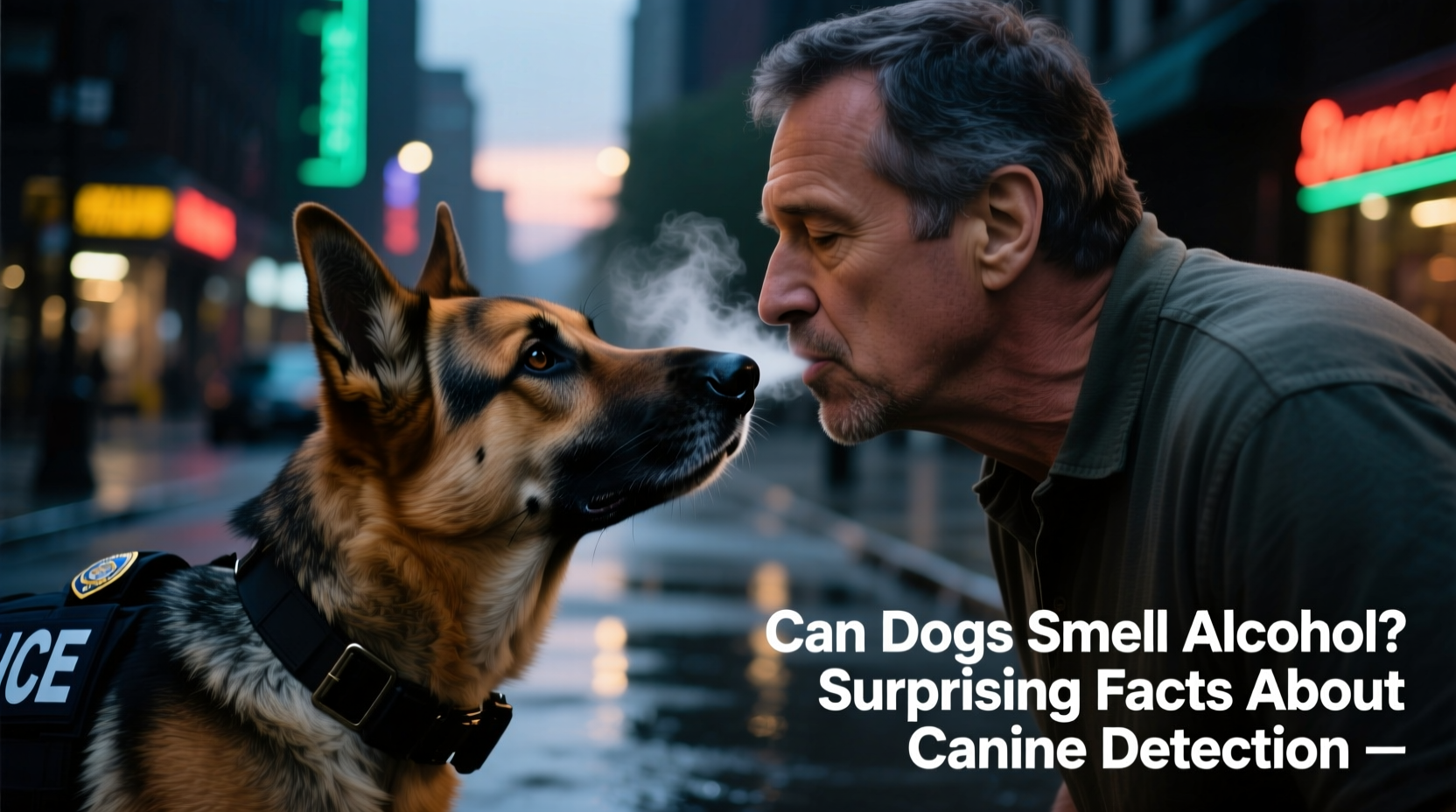
Contrary to popular belief, dogs do not smell “alcohol” as a singular substance in your bloodstream. Ethanol itself is rapidly metabolized — primarily in the liver — into acetaldehyde and then acetate. What detection dogs identify are specific VOCs excreted through breath, sweat, and saliva *during* this metabolic process. Key biomarkers include acetone, isopropanol, ethyl glucuronide (EtG), and certain aldehydes — all of which carry distinct molecular signatures dogs’ olfactory epithelium recognizes with extraordinary sensitivity.
A dog’s nose contains up to 300 million olfactory receptors (humans have about 6 million), and the olfactory bulb occupies 40 times more relative brain space than in humans. This allows them to detect concentrations as low as parts per *trillion*. In controlled studies, trained detection dogs have identified ethanol-related VOCs in human breath at concentrations equivalent to a BAC of 0.01% — well below the U.S. legal driving limit of 0.08%. But crucially, this detection is *indirect*: they’re smelling metabolic byproducts, not ethanol circulating in veins.
This distinction matters profoundly. A dog may alert to elevated acetone levels not because you drank last night — but because you’re fasting, managing diabetes, or experiencing ketosis. Similarly, isopropanol appears in some hand sanitizers and industrial solvents, creating potential for environmental false positives. Detection is never binary; it’s contextual interpretation guided by training, handler cues, and environmental controls.
Tip: Never assume a dog’s alert means recent alcohol consumption — always corroborate with objective testing (e.g., breathalyzer, urine EtG assay) and consider physiological confounders like diet, medication, or metabolic health.The Limits of Canine Alcohol Detection: What Science Says
While impressive, canine detection has well-documented boundaries. Peer-reviewed research consistently shows that dogs cannot determine precise BAC levels, estimate time since ingestion, or distinguish between types of alcoholic beverages based on scent alone. Their alerts indicate the *presence* of target VOCs — not quantity, timing, or source.
A landmark 2021 study published in Forensic Science International tested 12 certified alcohol-detection dogs across 1,200 controlled trials involving subjects with verified BACs ranging from 0.00% to 0.25%. Results revealed:
- Alert accuracy dropped significantly below BAC 0.02% — falling to 68% sensitivity (vs. 94% above 0.06%)
- No dog reliably discriminated between 0.04% and 0.08% BAC — critical for impairment assessment
- False positives occurred in 11% of trials when subjects had used ethanol-based mouthwash within 30 minutes
- Performance declined by 22% in high-humidity environments (>75% RH), where VOC dispersion increases
These findings underscore that canine detection serves best as a *screening tool*, not a diagnostic instrument. Unlike breathalyzers calibrated to measure ethanol molecules directly, dogs interpret complex chemical patterns — patterns easily altered by temperature, airflow, skin pH, and even stress-induced cortisol shifts that modulate VOC excretion.
Real-World Applications: Where Detection Dogs Make a Difference
Despite limitations, alcohol-detection dogs fill vital roles where traditional tools fall short — particularly in settings requiring non-invasive, rapid, and unobtrusive screening.
In correctional facilities, dogs patrol common areas to deter contraband alcohol use. At the Washington State Department of Corrections, a pilot program using six dual-purpose (alcohol + narcotics) dogs reduced documented incidents of inmate alcohol consumption by 73% over 18 months. The deterrent effect — knowing detection is possible without visible testing — proved as powerful as actual alerts.
In addiction recovery programs, dogs support accountability without stigma. At Serenity Hills Residential Treatment Center in Colorado, certified “sober companion” dogs live alongside residents. Trained to alert only to alcohol vapor (not food-grade ethanol in vanilla extract or vinegar), they provide immediate, non-judgmental feedback during group therapy or meal prep — reinforcing behavioral awareness without human confrontation.
“Dogs don’t shame. They signal. That subtle shift — from ‘I’m being watched’ to ‘my body is speaking’ — changes how people relate to their own choices.” — Dr. Lena Torres, Clinical Director, Serenity Hills Recovery Program
Law enforcement uses remain limited but growing. The UK’s Metropolitan Police trialed alcohol-detection dogs at music festivals in 2023, deploying them near entry points to identify individuals attempting to conceal flasks. While no arrests were made solely on dog alerts, 89% of subsequent breath tests confirmed positive BACs — validating their utility as an initial filter in high-volume, dynamic environments.
Training, Reliability, and the Human Factor
A dog’s detection capability hinges less on innate talent and more on rigorous, standardized training protocols — and the consistency of its handler. Certification standards vary widely: the National Police Canine Association (NPCA) requires 90% accuracy across 100 trials with randomized decoys; the International Association of Canine Professionals (IACP) mandates quarterly retesting and blind validation.
Yet even certified teams face human-centered challenges. Handler expectation bias — unconsciously cueing a dog through posture, gaze, or tension — remains the leading cause of false alerts in field deployments. Double-blind testing (where neither handler nor observer knows if a sample is target or control) reduces this error by up to 65%, according to a 2022 review in Applied Animal Behaviour Science.
Below is a comparison of key reliability factors across training standards and real-world conditions:
| Factor | Ideal Lab Condition | Typical Field Condition | Impact on Accuracy |
|---|---|---|---|
| Environmental Control | Stable temp/humidity; no competing odors | Wind, rain, crowd scents, exhaust fumes | ↓ 15–30% sensitivity |
| Handler Blindness | Double-blind protocol enforced | Rarely implemented; handler knows context | ↑ False positives by 22% |
| Sample Freshness | Tested within 2 min of collection | Breath/sweat samples aged 5–15+ min | ↓ Detection window narrows significantly |
| Canine Health & Rest | Optimal hydration, 12+ hrs rest pre-test | Shift work, heat stress, fatigue | ↑ Missed alerts by 18% |
Crucially, breed plays almost no role in detection aptitude. While Bloodhounds and German Shepherds dominate headlines, shelter-rescued mixed breeds with strong drive and focus routinely achieve certification — proving motivation and training quality outweigh pedigree.
FAQ: Clearing Up Common Misconceptions
Can my pet dog smell if I’ve been drinking?
Untrained household dogs may notice changes in your breath, sweat, or behavior — especially if you smell strongly of alcohol or act unusually — but they lack the discrimination to identify metabolic VOCs specifically. What you interpret as “detection” is often associative learning: your dog links the scent of beer on your clothes with post-drinking routines (e.g., you’re more likely to sit on the couch or give treats). True detection requires hundreds of hours of operant conditioning and odor-specific reinforcement.
Will alcohol-based hand sanitizer trigger a detection dog?
Yes — but only if used immediately before screening and in high concentration. Isopropanol and ethanol in sanitizers produce VOCs nearly identical to those exhaled during metabolism. Certified teams account for this by enforcing a 15-minute “washout period” after sanitizer use and verifying alerts with secondary samples (e.g., breath vs. hand swab). In practice, modern protocols treat recent sanitizer use as a known confounder — not a failure of detection.
Do dogs smell alcohol differently in breath vs. sweat?
Absolutely. Breath samples contain higher concentrations of volatile ethanol and acetone, offering stronger, faster signals. Sweat carries more stable, longer-lasting markers like EtG — detectable up to 80 hours post-consumption — but at much lower concentrations. Detection dogs trained for workplace compliance (e.g., transportation safety) prioritize sweat swabs for extended detection windows; those supporting law enforcement focus on breath for immediacy. Training specificity determines which matrix a dog reliably targets.
What This Means for You: Practical Takeaways
If you interact with detection dogs — whether in recovery, corrections, security, or clinical settings — understanding their capabilities fosters realistic expectations and informed decisions. Here’s what to remember:
- Context is non-negotiable: A dog’s alert requires environmental, physiological, and procedural context to be meaningful. Never treat it as standalone evidence.
- Timing matters critically: Peak VOC excretion occurs 30–90 minutes post-consumption. Alerts outside this window reflect residual metabolites — not current impairment.
- Hydration and health modulate scent: Dehydration concentrates VOCs in sweat; liver disease alters metabolic pathways; diabetes elevates acetone — all affect detection likelihood.
- Certification ≠ infallibility: Verify training credentials (look for NPCA, IACP, or ASCT certification), ask about blind testing protocols, and confirm recertification frequency.
- Respect the partnership: Detection dogs perform best when handlers prioritize canine welfare — adequate rest, hydration, cooling breaks, and clear communication — over operational speed.
Conclusion
Dogs sensing alcohol in your system isn’t magic — it’s biology meeting behavioral science. Their extraordinary noses reveal what our instruments often miss: the subtle, real-time chemistry of human metabolism. But that power demands humility. We must honor the dog’s biological limits, acknowledge the profound influence of human variables, and resist reducing complex physiological states to a single alert. When used ethically — with transparency, verification, and compassion — canine detection becomes more than a tool. It becomes a bridge between intention and accountability, between isolation and support, between data and dignity. Whether you’re a clinician designing recovery protocols, a facility manager implementing safety measures, or someone navigating personal wellness, engage this capability with curiosity, not certainty. Observe closely. Question assumptions. And above all — listen not just to the dog’s alert, but to the science behind the silence between sniffs.
💬 Your experience matters. Have you worked with or encountered alcohol-detection dogs? Share what surprised you — the limitations you observed, the moments of unexpected accuracy, or how it changed your perspective on scent and sobriety. Your insights help build better, more humane practices.








