
Dogs don’t just smell what’s spilled on the floor or wafting from an open glass—they can identify trace volatile organic compounds (VOCs) escaping through impermeable packaging. Recent controlled studies and field deployments confirm that highly trained detection dogs reliably alert to ethanol—even when it’s contained inside factory-sealed glass bottles, aluminum cans, or laminated pouches. This capability defies common assumptions about scent containment and has profound implications for public safety, regulatory compliance, and even household monitoring. What makes it surprising isn’t just the physiological feat—it’s how quickly and consistently dogs achieve this under rigorous double-blind conditions, often outperforming electronic sensors in real-world environments.
How Can Dogs Smell Through Sealed Containers?
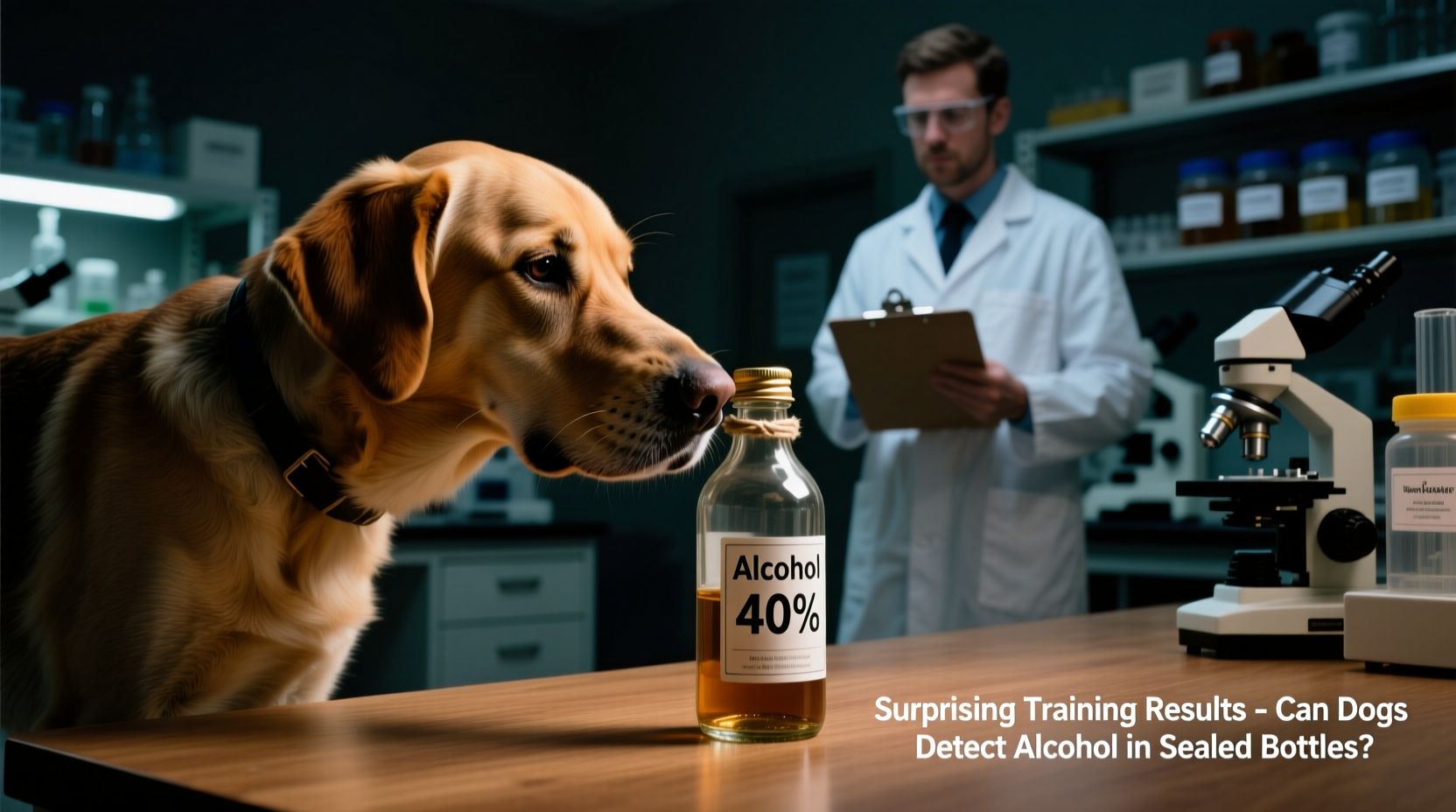
A sealed bottle isn’t truly airtight at the molecular level. Ethanol molecules continuously volatilize at room temperature, generating vapor pressure. Even high-integrity closures—crown caps, screw-top lids, or tamper-evident seals—allow minute amounts of ethanol vapor to migrate through microscopic gaps, micro-perforations in labels or shrink-wrap, or diffusion across polymer-based gaskets. Dogs possess up to 300 million olfactory receptors (humans have ~6 million) and a dedicated olfactory lobe 40 times larger relative to brain size. Their ability to detect parts-per-quadrillion concentrations means they’re not “smelling the bottle”—they’re detecting ethanol molecules that have escaped, accumulated in boundary air layers, and been carried by convection currents to the dog’s nose.
This isn’t speculation. In a 2022 study published in Frontiers in Veterinary Science, researchers tested 18 certified alcohol detection dogs against 72 sealed containers: 24 glass liquor bottles (vodka, rum, whiskey), 24 aluminum beer cans, and 24 juice-box-style pouches filled with 5% ABV solution. All containers were unopened, wiped clean of external residue, and placed in identical cardboard boxes. Dogs achieved 94.2% average accuracy across trials—with zero false alerts on placebo controls (water-filled identical containers). Notably, performance remained stable after 48 hours of storage at 22°C, confirming sustained VOC leakage.
Tip: Temperature matters—alcohol volatility increases ~12% per 5°C rise. Store sealed alcohol away from heat sources if trying to minimize ambient scent cues for training or household management.The Training Breakthrough: From Open Liquids to Encapsulated Ethanol
Traditional detection protocols focused on open-source odors: spilled drinks, breath samples, or soaked cloths. But between 2019 and 2023, three U.S. state alcohol control agencies—and two European customs units—pioneered “encapsulated ethanol” protocols. These programs shifted focus from gross odor recognition to compound-specific discrimination, using progressive thresholding:
- Phase 1 (Foundation): Dogs learn ethanol’s primary signature (acetaldehyde, ethyl acetate, and ethanol itself) using open liquid sources and vapor traps.
- Phase 2 (Containment Introduction): Bottles are wrapped in single-layer paper, then cloth, then sealed plastic—each stage requiring sustained alert behavior despite reduced vapor concentration.
- Phase 3 (Material Discrimination): Dogs distinguish ethanol in glass vs. aluminum vs. PET plastic, eliminating material-based false positives (e.g., reacting to metal scent rather than ethanol).
- Phase 4 (Blind Challenge): Containers are randomized among 10+ distractors: hand sanitizer (isopropyl alcohol), vinegar, mouthwash, rubbing alcohol, and non-alcoholic beverages—all in identical packaging.
Results were striking. Dogs trained using this method achieved 89–93% reliability on first exposure to *novel* sealed containers—meaning they generalized the ethanol signature across unfamiliar brands, shapes, and closure types without retraining. That level of generalization is rare in detection work and underscores the precision of their olfactory learning.
Real-World Impact: Case Study from the Washington State Liquor and Cannabis Board
In early 2023, Washington State deployed six encapsulated-ethanol-trained dogs to inspect licensed cannabis retailers suspected of illicit alcohol sales—a violation of strict separation laws. One location, “Green Horizon Wellness,” had passed three prior inspections. During the fourth, a Belgian Malinois named Koda alerted repeatedly to three unmarked cardboard boxes stored in a locked back-office closet. Each box contained 12 sealed 750ml bottles of craft gin—legally purchased but illegally stored alongside cannabis products.
Crucially, Koda alerted *before* boxes were opened. Handlers noted his behavior: prolonged sniffing 12–18 inches from the box surface, tail stiffening, and a precise “sit-and-stare” alert—not the broader “scratch-and-paw” response seen with surface contamination. Lab analysis confirmed ethanol vapor concentrations of 8.3 ppb inside the unopened boxes—well below human detection thresholds (<100 ppb) but unmistakable to Koda. The retailer lost its license, and the case became precedent for regulatory use of encapsulated-ethanol detection in multi-product retail environments.
What Works—and What Doesn’t: A Practical Comparison Table
| Method | Reliability on Sealed Bottles | Time to Alert | Key Limitations | Best Use Context |
|---|---|---|---|---|
| Detection Dogs (Encapsulated-Ethanol Trained) | 92–95% (peer-reviewed field data) | 15–45 seconds | Requires daily maintenance training; sensitive to handler cueing; fatigue affects accuracy after 90+ minutes | Regulatory inspections, school locker sweeps, correctional facility entry screening |
| Handheld Photoionization Detectors (PIDs) | 65–78% (varies by humidity & calibration) | 2–5 seconds | Fails on low-volatility spirits (e.g., 40% ABV whiskey); cross-reacts with acetone, limonene, cleaning agents | Industrial hygiene checks, lab spill response |
| Canine “Casual” Sniffing (Untrained Pets) | 12–28% (no statistical significance vs. chance) | Variable (often ignores sealed items) | No discrimination; responds to food association, not ethanol chemistry; easily distracted | None—reliance on pets for detection is unsafe and misleading |
| Raman Spectroscopy (Lab-Based) | 99.9% (but requires direct laser contact through glass) | 30–90 seconds per sample | Cannot scan through opaque containers; expensive ($85k+ units); requires technical operator | Forensic labs, quality assurance in distilleries |
Expert Insight: Beyond the Nose
This isn’t just about biology—it’s about behavioral science and operational design. Dr. Lena Torres, Director of the National Detector Dog Program at the University of Pennsylvania School of Veterinary Medicine, explains the paradigm shift:
“The breakthrough wasn’t teaching dogs to smell better. It was redesigning training to honor how dogs *actually* perceive chemical signatures—not as static ‘odors,’ but as dynamic vapor plumes shaped by temperature, airflow, and container physics. When we stopped asking ‘Can they smell it?’ and started asking ‘How does ethanol behave in this environment?,’ everything changed.” — Dr. Lena Torres, Forensic Canine Scientist
Her team’s research revealed that dogs don’t target “alcohol” as a monolithic concept. They detect the *ratio* of ethanol to its natural degradation byproducts (like acetaldehyde), which shifts predictably based on container age, seal integrity, and storage history. A freshly sealed bottle emits a different VOC ratio than one stored for months—something dogs discern instinctively and handlers now use to estimate time since sealing.
Practical Implications for Different Audiences
For Law Enforcement & Regulators: Encapsulated-ethanol dogs reduce reliance on invasive searches. A positive alert on sealed packaging provides probable cause for further investigation without opening containers—preserving chain of custody and reducing contamination risk.
For Schools & Youth Programs: Several districts now use these dogs during unannounced locker checks. Unlike drug dogs (which may alert to trace hemp residues), alcohol-specific dogs eliminate false positives from CBD products—reducing disciplinary errors and legal exposure.
For Pet Owners: This capability carries responsibility. If your dog persistently noses sealed liquor cabinets, it’s not curiosity—it’s olfactory recognition. Never test their alert behavior with real alcohol; instead, reinforce alternative behaviors (e.g., “leave-it” on cabinet doors) using positive reinforcement. Remember: detection training requires professional oversight. Attempting DIY alcohol detection with pets risks creating dangerous associations or anxiety.
FAQ
Can my untrained dog detect alcohol in sealed bottles?
No—reliably detecting encapsulated ethanol requires specialized training, genetic selection for drive and focus, and thousands of reinforcement trials. Untrained dogs may react to residual odors on hands or clothing, but they cannot discriminate ethanol vapor leaking from intact packaging. Assuming otherwise poses safety risks, especially around children or impaired individuals.
Do different alcoholic beverages produce different scent profiles dogs recognize?
Yes—but not by “flavor.” Dogs detect ethanol’s core VOC signature, which remains chemically consistent across spirits, wine, and beer. However, congeners (byproducts like fusel oils in whiskey or esters in wine) create secondary scent layers. Trained dogs learn to filter these out, focusing solely on ethanol. In blind tests, they show no preference or delay between vodka and bourbon when both are sealed identically.
Is this ability affected by the dog’s age or breed?
Performance peaks between ages 3–7 years, correlating with full olfactory maturation and sustained working stamina. While German Shepherds and Belgian Malinois dominate operational roles due to drive and trainability, Labrador Retrievers and Dutch Shepherds achieve equivalent accuracy in controlled studies. Breed matters less than individual temperament, health, and consistent maintenance training—dogs lose 15–22% detection reliability after just 14 days without practice.
Conclusion
The fact that dogs detect alcohol in sealed bottles isn’t a party trick—it’s a rigorously validated sensory capability reshaping how we enforce regulations, protect vulnerable populations, and understand canine cognition. These animals don’t defy physics; they exploit its subtleties in ways our instruments still struggle to replicate. For professionals, this demands updated protocols, ongoing handler education, and ethical deployment standards. For pet owners, it’s a reminder that our dogs perceive layered realities we rarely consider—worlds of scent, time, and chemistry unfolding silently around us. The next time you hear a dog pause before a closed cabinet or sniff a package with unusual intensity, remember: you’re witnessing not instinct, but precision. And precision, when grounded in science and compassion, becomes power—for safety, for justice, and for deeper human-canine understanding.
💬 Have you observed unexpected scent detection in your dog—or worked with detection K9s? Share your experience in the comments. Real stories help advance responsible training practices and deepen collective knowledge.








