For anyone with thick, dense, or long hair, finding a reliable way to keep it securely off the face without sacrificing comfort or style is a daily challenge. Two popular options—big bow claw clips and hair sticks—have gained cult followings in recent years. Both promise quick styling and all-day hold, but when it comes to managing heavy, voluminous hair, which one truly performs better? The answer isn’t as simple as brand preference or aesthetics—it depends on mechanics, technique, and hair type.
This guide dives deep into the structural differences, holding power, and real-life usability of big bow claw clips and hair sticks, backed by practical insights from stylists and users with thick hair. Whether you’re heading to work, working out, or just want a no-fuss updo, understanding the strengths and limitations of each tool can help you make a smarter choice.
How Claw Clips Work: Mechanics of the Hold
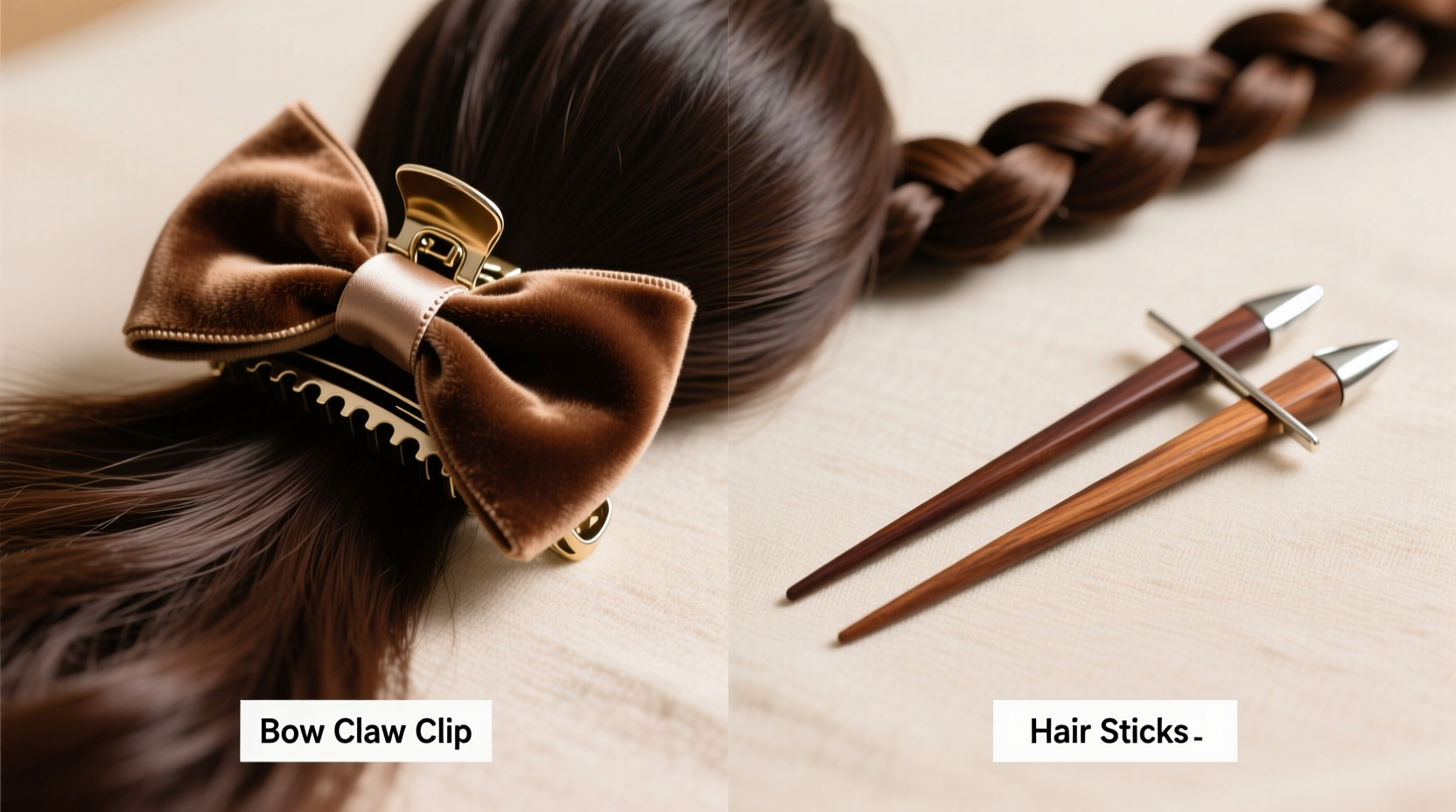
Claw clips operate on a spring-loaded hinge mechanism. When opened, tension builds in the internal spring; when released, the clip snaps shut, gripping hair between two interlocking teeth. Big bow claw clips—often 3 to 4 inches wide—are designed specifically for volume. Their wider jaw span allows them to accommodate more hair at once, while the curved interior helps distribute pressure evenly.
The effectiveness of a claw clip hinges on three factors:
- Grip strength: Determined by the quality of the spring and the tooth design.
- Jaw width: Wider jaws handle thicker sections without overloading.
- Material: High-grade acetate or reinforced resin resists snapping under tension.
For thick hair, a well-designed claw clip can secure a full top knot or half-up style with minimal slippage—provided the hair is sectioned properly and the clip is aligned with the natural fall of the hair.
Tip: Always twist or braid hair slightly before inserting into a claw clip—this reduces bulk and improves grip.The Role of Hair Sticks: Simplicity Meets Strength
Hair sticks, also known as hair pins or dowels, are long, straight rods typically made of wood, metal, or acrylic. They rely not on mechanical tension but on friction and strategic placement within a twisted or coiled hairstyle. To use a hair stick, you gather your hair into a bun or chignon, twist it around itself, and slide the stick through the base to lock it in place.
Unlike claw clips, hair sticks don’t clamp down. Instead, they act as an anchor, using the weight and coil of the hair to create resistance against slipping. This makes them especially effective for very long or coarse textures, where density adds to the stability of the twist.
Stylists often favor hair sticks for formal updos because they offer a sleeker finish and allow for more customization in shaping. However, their success depends heavily on user technique—improper twisting or poor stick placement can lead to sudden unraveling.
“Hair sticks are underrated for thick hair. When used correctly, they provide a more secure, low-profile hold than most clips.” — Lila Nguyen, Professional Stylist & Texture Specialist
Direct Comparison: Claw Clips vs Hair Sticks
| Feature | Big Bow Claw Clip | Hair Stick |
|---|---|---|
| Hold Strength (Thick Hair) | High – excellent for mid-weight to heavy loads if properly sized | Very High – superior when hair is long and tightly twisted |
| Speed of Use | Fast – one-motion closure | Moderate – requires twisting and positioning |
| Comfort Over Time | Good – may press on scalp if worn too tightly | Excellent – distributes pressure evenly |
| Style Versatility | Moderate – best for half-ups, ponytail holders, and messy buns | High – ideal for buns, knots, and intricate twists |
| Durability | Varies – cheaper models can snap under strain | High – solid materials rarely break |
| Slip Resistance | Medium – can loosen with movement or fine layers escaping | High – once locked, stays unless pulled directly |
Real-World Test: A Day with Thick, Wavy Hair
To evaluate both tools under realistic conditions, we followed Maya, a 29-year-old with shoulder-length, wavy, high-density hair (Type 2C–3A), through a typical day. She tested both a 3.5-inch matte black acetate claw clip and a pair of 6-inch bamboo hair sticks during a commute, office work, and a lunchtime walk outdoors.
In the morning, she used the claw clip for a half-up style. It held firmly for about four hours but began to sag after head movements and wind exposure. One side eventually gave way when she bent forward. Later, she switched to a low twisted bun secured with two crossed hair sticks. Despite active movement and brushing her hair against a coat collar, the style remained intact for eight hours with no adjustments.
Maya noted that while the claw clip was faster to apply, the hair sticks felt more secure and caused less tension on her scalp. “I don’t worry about the sticks falling out,” she said. “With the clip, I’m always checking if it’s still there.”
When to Choose Each Tool: A Practical Guide
Neither tool is universally better—the best choice depends on your hair goals, lifestyle, and styling preferences. Here’s how to decide:
Choose a Big Bow Claw Clip If:
- You need a quick, one-step solution for school, gym, or errands.
- Your hair is thick but not extremely long (below shoulder length).
- You prefer visible, trendy accessories that double as fashion statements.
- You’re creating loose, textured styles like messy buns or clipped-back layers.
Choose Hair Sticks If:
- You have long, thick, or coarse hair that can be twisted into a compact coil.
- You want a secure hold for extended wear or physical activity.
- You prefer a minimalist, nearly invisible updo for professional or formal settings.
- You’re willing to spend a few extra seconds perfecting placement.
Step-by-Step: How to Maximize Hold for Thick Hair
Regardless of which tool you choose, proper technique makes all the difference. Follow these steps to ensure your style lasts:
- Prep your hair: Lightly tease the roots or apply texturizing spray for added grip—especially helpful for slippery, fine-thick textures.
- Section strategically: Divide thick hair into two or more sections. Secure each separately rather than overloading one clip or stick.
- Twist before clipping: Even with claw clips, a small twist reduces bulk and creates internal friction that prevents slippage.
- Align with hair growth: Place claw clips parallel to your hairline, opening them against the direction of hair flow for tighter grip.
- Anchor, don’t force: With hair sticks, let the twist do the work. Slide the stick through the base of the bun, not the top, to lock it beneath the weight of the hair.
- Secure flyaways: Use bobby pins discreetly to tame ends, especially with claw clips that expose loose strands.
FAQ
Can hair sticks hold curly, frizzy hair securely?
Yes—curly and frizzy textures often provide more natural grip due to their texture and volume. Twisting damp (not wet) hair can help set the shape, and using two sticks in a cross formation enhances hold.
Why does my claw clip keep popping open?
This usually happens when the clip is overloaded or the wrong size. Use a larger clip (at least 3 inches), avoid placing it on clean, silky hair without texture, and never force it closed on too much hair at once.
Are metal hair sticks better than wooden ones?
Not necessarily. Metal sticks are smoother and more durable, but can be slippery. Wooden sticks offer more friction and a vintage look, though they may splinter over time. Choose based on your hair texture and desired grip level.
Conclusion
When it comes to holding thick hair, hair sticks generally outperform big bow claw clips in terms of longevity, security, and comfort—especially for longer styles and active days. However, claw clips win on convenience, speed, and aesthetic versatility. The smart approach isn’t to pick one over the other, but to use both as part of a broader toolkit.
For rushed mornings, reach for the claw clip. For all-day events or workouts, trust the hair stick. And remember: the right technique matters more than the tool itself. Master the twist, respect your hair’s volume, and choose quality over trends.
💬 Have a favorite trick for securing thick hair? Share your go-to method in the comments—your tip might help someone finally conquer their flyaways.








