
Choosing the right feeding system for your pet isn't just about convenience—it directly impacts food quality, hygiene, and household safety. Two of the most common options—automatic pet feeders and gravity feeders—serve very different purposes and come with distinct advantages and drawbacks. One excels in portion control and scheduling; the other offers constant access with minimal maintenance. But when it comes to preserving food freshness and keeping pests at bay, one clearly outperforms the other. Understanding these differences helps pet owners make informed decisions that benefit both their pets and homes.
How Each Feeder Works: Core Mechanics
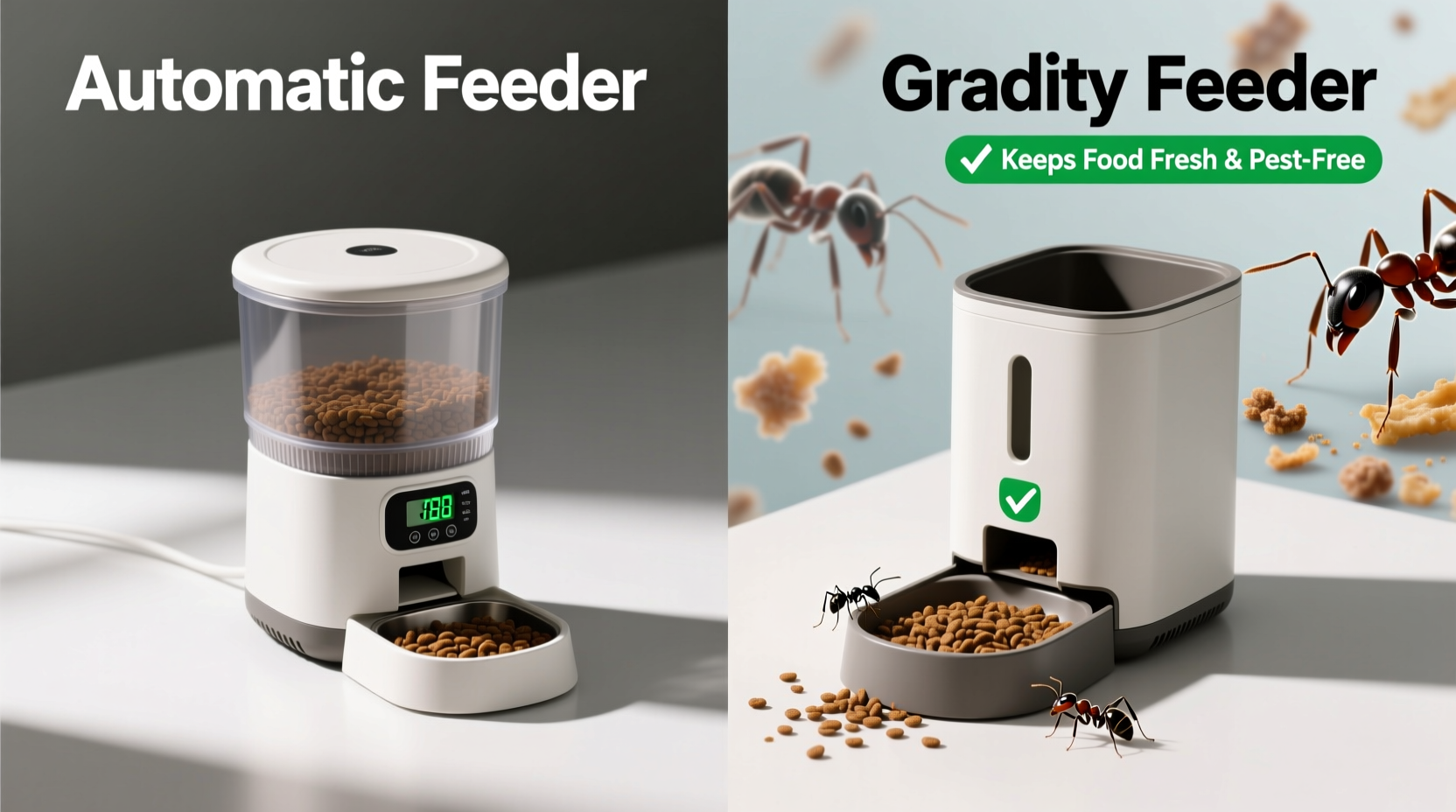
An automatic pet feeder operates on a timer or smart schedule, dispensing pre-measured portions of dry food at set times. Most models use a rotating tray or auger system to release food from sealed compartments. These feeders are often Wi-Fi enabled, allowing remote monitoring and adjustment via smartphone apps. Some advanced units even include cameras and two-way audio to interact with pets during feeding.
In contrast, a gravity feeder relies on simple physics. It consists of an elevated hopper connected to a bowl. As the pet eats, gravity pulls more kibble down to refill the bowl automatically. These systems require no electricity and function continuously as long as food is loaded into the reservoir.
The fundamental difference lies in exposure: automatic feeders keep food sealed until dispensing, while gravity feeders leave kibble exposed to air—and potential contaminants—for hours or days at a time.
Tip: If you live in a humid climate, avoid leaving dry pet food exposed for more than 4–6 hours to prevent moisture absorption and mold growth.Food Freshness: Sealed vs. Continuous Exposure
Freshness begins to degrade the moment dry pet food is exposed to oxygen, light, and humidity. Oxidation causes fats in kibble to go rancid, reducing palatability and nutritional value. Over time, vitamins break down, and essential fatty acids deteriorate. This process accelerates in warm or damp environments.
Automatic feeders maintain freshness by storing food in enclosed, often airtight compartments. Food is only dispensed when needed, minimizing its time outside the bag. Many high-end models include desiccant-lined lids or vacuum seals to further reduce moisture and oxidation.
Gravity feeders, however, expose food continuously. Even if the hopper has a cover, the bowl remains open, and kibble sits in ambient conditions. After just a few hours, surface oils begin to oxidize. In homes with high humidity or temperature fluctuations, this degradation happens faster. Pet owners may not notice the change in smell or taste, but pets often do—leading to picky eating or reduced appetite.
“Dry pet food starts losing nutrient integrity within 8 hours of exposure to air. For optimal health, minimize open-air storage.” — Dr. Laura Simmons, Veterinary Nutritionist
Pest Prevention: Why Exposure Matters
Pests such as ants, cockroaches, mice, and even raccoons are attracted to accessible food sources. A gravity feeder, especially one left outdoors or near a garage or basement entrance, can become a beacon for unwanted visitors.
Ants are particularly drawn to residual kibble crumbs around the base of the bowl. Once they locate a reliable source, they establish trails and return in increasing numbers. Rodents, meanwhile, are capable of climbing into hoppers or gnawing through plastic to reach stored food.
Automatic feeders significantly reduce this risk. Because food is dispensed in controlled amounts and only at specific times, there’s little residue left behind. Many models also feature raised bases and smooth surfaces that deter crawling insects. Smart feeders with app alerts can notify owners if the unit has been tampered with—possibly indicating rodent activity.
That said, poor placement or infrequent cleaning can undermine even the best automatic feeder. Crumbs accumulating under or around any feeder create attractants. Regular sweeping and wiping are essential regardless of the system used.
Comparative Analysis: Key Differences at a Glance
| Feature | Automatic Feeder | Gravity Feeder |
|---|---|---|
| Food Exposure Time | Minutes per meal (sealed between meals) | Hours to days (constant exposure) |
| Freshness Retention | High (protected storage) | Low to moderate |
| Pest Attraction Risk | Low (when cleaned regularly) | High (especially outdoors) |
| Portion Control | Precise, programmable | None (free-feed only) |
| Power Required | Yes (battery or plug-in) | No |
| Ideal For | Scheduled feeding, weight management, travel | Multipet households, free-feeding setups |
Real-World Scenario: The Urban Apartment Dilemma
Consider Maria, a pet owner living in a third-floor apartment with her cat, Milo. She initially used a gravity feeder on her balcony, thinking it would give Milo freedom to eat whenever he wanted. Within two weeks, she noticed small black ants swarming the bowl every afternoon. Despite daily cleaning, the problem persisted. She also observed Milo becoming less interested in his food.
After consulting her vet, Maria switched to a Wi-Fi-enabled automatic feeder placed indoors. She programmed two meals per day and stored the device on a wipeable mat. The ant problem disappeared immediately. More importantly, Milo began eating more consistently—likely because his food was fresher and not contaminated by environmental odors or insect traces.
This case illustrates how environment and feeder type interact. Outdoor or semi-outdoor placements dramatically increase pest risks, making gravity feeders impractical in many urban or suburban settings.
Best Practices for Maximizing Freshness and Safety
Regardless of the feeder type, certain habits improve outcomes. Here’s a step-by-step guide to maintaining food quality and minimizing pest issues:
- Use original packaging inside feeders: Transfer kibble to the feeder from its original bag, which contains protective lining. Avoid storing bulk food directly in plastic hoppers.
- Clean feeders weekly: Disassemble and wash all components with mild soap and water. Residual oils promote bacterial growth and attract pests.
- Elevate and isolate: Place feeders on trays or mats that can be easily wiped. Keep them away from walls and corners where pests hide.
- Monitor humidity: In damp climates, consider using silica gel packs inside storage compartments (not in contact with food).
- Limit outdoor use: If feeding outside, opt for scheduled automatic dispensing rather than continuous gravity flow. Remove uneaten food after 30 minutes.
When to Choose Which Feeder: Decision Checklist
Use this checklist to determine the best option for your situation:
- ✅ Do you need strict portion control? → Automatic feeder
- ✅ Is your pet prone to overeating or weight gain? → Automatic feeder
- ✅ Are you frequently away from home? → Automatic feeder
- ✅ Do you have multiple pets with different diets? → Automatic feeder
- ✅ Are ants or rodents a known issue in your area? → Automatic feeder
- ✅ Do you prefer a low-tech, no-power solution? → Gravity feeder
- ✅ Are you feeding outdoor cats in a secure location? → Gravity feeder (with precautions)
- ✅ Is constant access important for medical or behavioral reasons? → Gravity feeder
Note: Even if a gravity feeder suits your lifestyle, place it in a clean, sheltered area and refill it daily to limit stale food buildup.
Frequently Asked Questions
Can I use an automatic feeder for wet food?
No, most automatic feeders are designed for dry kibble only. Wet food spoils quickly at room temperature and can clog mechanisms. Specialized refrigerated feeders exist but are rare and expensive.
Do gravity feeders cause obesity in pets?
They can contribute to overeating, especially in breeds predisposed to weight gain. Free-feeding without portion limits makes it difficult to monitor intake. Pairing a gravity feeder with daily rationing (refilling only a set amount each morning) can help mitigate this.
How often should I replace my feeder?
Plastic feeders should be replaced every 1–2 years due to micro-scratches that harbor bacteria. Stainless steel bowls and hoppers last longer and are easier to sanitize. Mechanical parts in automatic feeders may wear out after 3–5 years depending on usage.
Final Recommendation: Prioritize Freshness and Pest Control
When the primary goals are preserving food freshness and preventing pest infestations, the automatic pet feeder is the superior choice. Its ability to seal food between meals drastically reduces oxidation, moisture absorption, and odor dispersion—all of which attract insects and rodents. While gravity feeders offer simplicity and uninterrupted access, their design inherently compromises food quality and increases household risks.
For pet owners in apartments, humid regions, or areas with known pest activity, switching to an automatic system is a proactive step toward better pet health and home hygiene. Even in rural or outdoor settings, combining scheduled feeding with secure storage yields better results than relying solely on gravity-based access.
Ultimately, the right feeder aligns with your pet’s dietary needs, your lifestyle, and your environment. But if freshness and cleanliness are priorities, automation provides a measurable advantage—one that supports long-term wellness for both pets and their people.
🚀 Ready to upgrade your pet’s feeding routine? Evaluate your current setup today—clean your feeder, check for pests, and consider transitioning to a timed system for fresher food and a safer home.








