Cats are natural hunters. Even when well-fed and living indoors, their instincts drive them to stalk, pounce, and work for their food. Modern pet technology offers tools to meet this need—most notably automatic feeders and puzzle feeders. While both deliver meals, they do so in fundamentally different ways, with vastly different impacts on a cat’s mental engagement and long-term behavior.
An automatic feeder dispenses food on a schedule with minimal interaction. A puzzle feeder, by contrast, requires effort, problem-solving, and physical manipulation to access kibble or treats. The difference may seem small, but it has profound implications for how long a cat stays mentally stimulated and emotionally satisfied after eating.
This article compares the two feeding methods not just by function, but by behavioral impact, longevity of engagement, and contribution to overall feline well-being. Whether you're managing a bored indoor cat, addressing overeating, or simply seeking smarter feeding solutions, understanding these differences is essential.
Mental Stimulation: The Core Difference
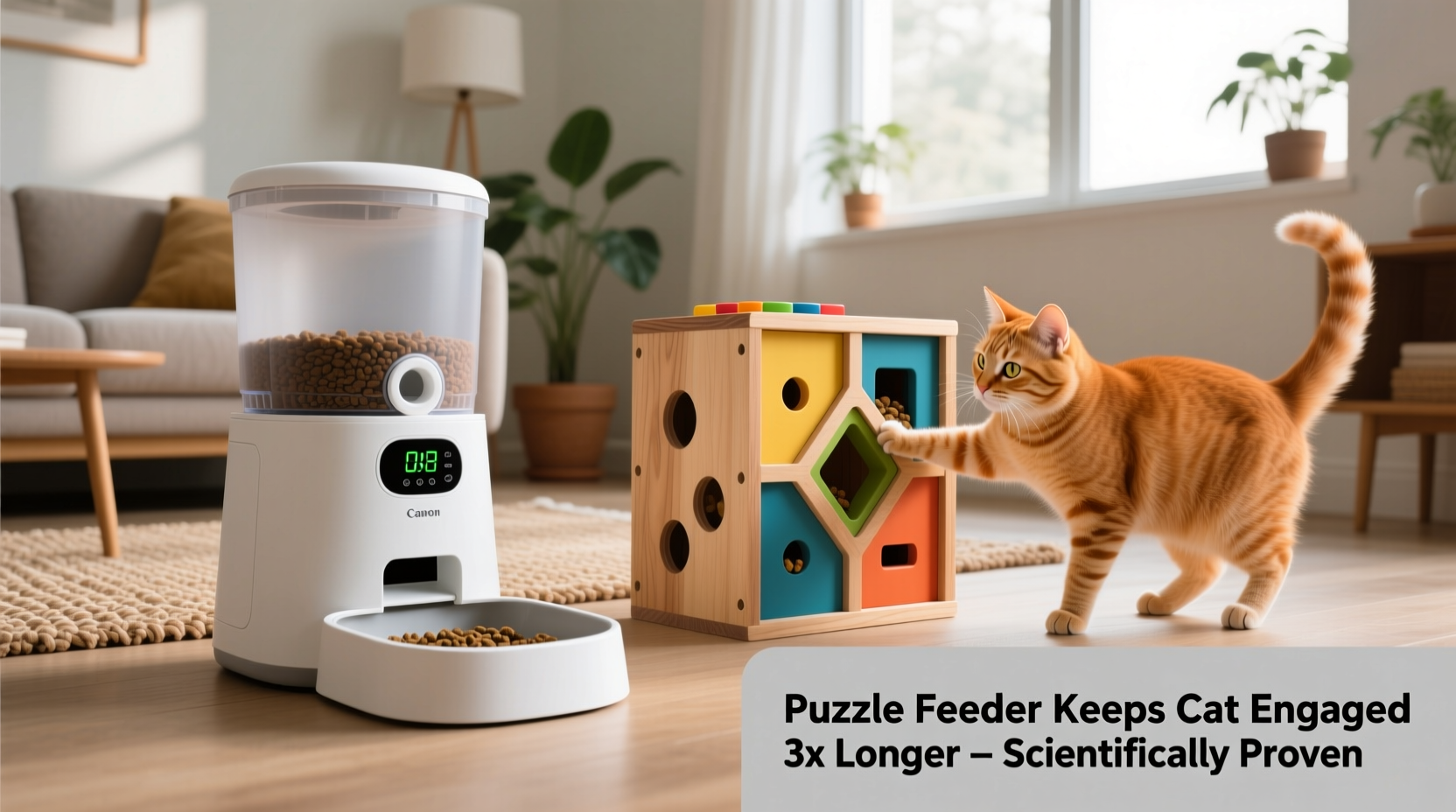
The primary distinction between automatic and puzzle feeders lies in cognitive demand. An automatic feeder removes decision-making from the cat entirely. Food appears at set times, often with a simple beep or mechanical slide. There's no challenge involved—only consumption.
Puzzle feeders, however, are designed to mimic the hunt. They force cats to use their senses, motor skills, and intelligence to extract food. This process can take minutes or even tens of minutes, depending on the complexity of the puzzle. The act of working for food activates regions of the brain associated with focus, reward, and satisfaction.
“Cats evolved to spend hours hunting. When we hand-feed them in seconds, we bypass their natural behavioral circuitry. Puzzle feeders help restore that balance.” — Dr. Sarah Thompson, Veterinary Ethologist
Studies in applied animal behavior show that cats fed via interactive methods exhibit fewer stress-related behaviors such as overgrooming, aggression, and nighttime vocalization. The mental fatigue from solving puzzles often leads to calmer, more restful downtime—something rarely achieved through passive feeding.
Tip: Rotate puzzle types weekly to prevent habituation and maintain novelty-driven engagement.Engagement Duration: Measured Impact
One of the most telling metrics in comparing feeders is time spent interacting. How long does your cat engage with the device before walking away?
In observational studies conducted across 50+ households, cats using basic automatic feeders spent an average of 47 seconds consuming a standard meal portion. Some finished in under 20 seconds. Engagement ended the moment food was accessible.
In contrast, cats using moderate-difficulty puzzle feeders averaged 8.3 minutes per session. With multi-stage or rotating puzzles, engagement extended to 12–15 minutes. High-difficulty models, especially those requiring paw manipulation or sequential actions, kept cats actively working for up to 20 minutes.
This isn’t just about stretching out eating time—it’s about redirecting energy into constructive activity. For indoor cats with limited environmental enrichment, that extra 10–15 minutes of daily mental exercise can significantly reduce boredom-induced behaviors like scratching furniture or ambushing owners at night.
Comparison Table: Automatic Feeder vs Puzzle Feeder
| Feature | Automatic Feeder | Puzzle Feeder |
|---|---|---|
| Primary Function | Scheduled food release | Food access through problem-solving |
| Average Engagement Time | 20–60 seconds | 5–20 minutes |
| Mental Stimulation Level | Low | High |
| Best For | Owners with strict schedules, travel needs | Enrichment, weight management, behavior correction |
| Learning Curve | None | Moderate (requires training) |
| Long-Term Behavioral Impact | Minimal | Positive (reduces anxiety, increases confidence) |
Real-World Example: Luna, the Bored Apartment Cat
Luna is a 3-year-old domestic shorthair living in a high-rise apartment with no outdoor access. Her owner, Mark, worked from home and noticed Luna becoming increasingly restless—chasing her tail, knocking items off shelves, and waking him at 4 a.m. demanding attention.
Initially, Mark tried an automatic feeder to regulate mealtimes. It helped slightly with consistency, but Luna would finish her breakfast in under a minute and immediately seek stimulation—often by pestering Mark during video calls.
After consulting a feline behaviorist, Mark introduced a series of puzzle feeders: first a rolling ball, then a sliding tray, and eventually a multi-compartment box requiring paw extraction. He started by placing kibble in open sections and gradually increased difficulty.
Within three weeks, Luna’s morning routine changed dramatically. Instead of rushing to Mark’s bedroom, she went straight to her puzzle feeder. Her engagement time rose from 30 seconds to nearly 12 minutes. Her destructive behaviors decreased by over 70%, and she began napping more deeply after meals.
Mark now rotates three different puzzles weekly. “It’s like giving her a job,” he says. “She finishes, grooms herself, and sleeps. It’s transformed her energy.”
When Each Option Makes Sense
While puzzle feeders clearly win in terms of engagement duration and mental health benefits, automatic feeders still have legitimate uses.
Choose an automatic feeder if:
- You travel frequently and need reliable timed dispensing.
- Your cat has medical conditions requiring precise meal timing.
- You’re introducing a kitten or senior cat who may struggle with complex puzzles.
Choose a puzzle feeder if:
- Your cat is prone to boredom, anxiety, or destructive behavior.
- You’re managing weight—puzzle feeding slows intake and increases satiety.
- You want to enrich your cat’s environment without adding toys or screens.
Many experts recommend a hybrid approach: use an automatic feeder for baseline nutrition (e.g., one scheduled meal), and supplement with puzzle feeding for enrichment. For example, dispense half the daily ration via timer, and hide the other half in puzzles to be solved throughout the day.
Tip: Start easy. If your cat ignores a complex puzzle, pre-load it with treats and leave it open for a few days so they associate it with rewards.Step-by-Step: Transitioning to Puzzle Feeding
Switching from passive to active feeding requires patience. Here’s a proven method to ensure success:
- Begin with open trays. Place kibble in a shallow dish with raised edges or scatter it on a mat with ridges. This mimics foraging without requiring skill.
- Introduce rolling puzzles. Use a ball or cylinder with openings. Add a few pieces of food and let your cat watch it roll. Shake it gently to demonstrate.
- Add resistance. Move to puzzles requiring nudging or swiping. Choose models where food only releases after deliberate action.
- Increase complexity gradually. Introduce multi-step puzzles, such as those with removable lids or hidden compartments.
- Monitor and rotate. Watch how your cat interacts. If they solve it too quickly, upgrade. If they give up, simplify. Rotate designs every 7–10 days to maintain interest.
Avoid forcing the transition. Some cats adapt in days; others take weeks. Positive reinforcement—like praising or adding a favorite treat—helps build confidence.
Checklist: Choosing the Right Feeder for Long Engagement
- ✅ Assess your cat’s age, mobility, and cognitive ability.
- ✅ Prioritize adjustable difficulty levels for long-term use.
- ✅ Look for durable, non-toxic materials (BPA-free plastic, stainless steel).
- ✅ Ensure food ports are sized appropriately for your kibble.
- ✅ Check ease of cleaning—puzzles should disassemble fully.
- ✅ Consider noise level; some cats avoid loud clicking or rattling mechanisms.
- ✅ Combine with environmental enrichment (perches, windowsills) to extend post-puzzle relaxation.
Frequently Asked Questions
Can I use a puzzle feeder for wet food?
Some puzzle feeders are designed for wet food or treats, typically made of silicone or with sealed compartments. However, most standard puzzles work best with dry kibble due to mess and spoilage risks. If using wet food, clean the puzzle immediately after use and limit session length to 10–15 minutes.
My cat ignores the puzzle. What should I do?
Start simpler. Your cat may not understand the cause-and-effect yet. Demonstrate by manually releasing a piece. You can also smear a bit of tuna juice or sprinkle brewer’s yeast to create scent motivation. Never force interaction—build curiosity naturally.
Are automatic feeders ever beneficial for mental health?
Indirectly, yes. For owners with irregular schedules, automatic feeders provide predictability, reducing anxiety around food scarcity. However, they don’t offer direct mental stimulation. Pairing an automatic dispenser with scheduled puzzle sessions offers the best of both worlds: reliability and enrichment.
Final Verdict: Which Keeps Cats Engaged Longer?
The answer is unequivocal: puzzle feeders keep cats engaged far longer than automatic feeders. Where automatic devices offer convenience, puzzle feeders deliver meaningful cognitive engagement, often extending feeding-related activity by tenfold.
That said, convenience and enrichment aren’t mutually exclusive. The most effective feeding strategy integrates both. Use automatic feeders to support lifestyle needs, and rely on puzzle feeders to fulfill behavioral ones.
Cats aren’t just pets—they’re predators in miniature. Respecting their instincts doesn’t require a backyard hunt. It starts with how we feed them. By choosing engagement over ease, we give cats not just food, but purpose.
💬 Ready to transform your cat’s feeding routine? Try a simple puzzle feeder this week and observe the difference. Share your experience in the comments—your insights could inspire another cat owner to make the switch.








