
Every cat owner knows the ritual: 5:30 a.m., the soft paws on the bed, the insistent meowing, the gentle paw to the face. Your cat wants breakfast — now. No amount of groggy protest matters. You’re awake. This daily interruption isn’t just annoying; it chips away at your sleep quality, mood, and productivity. Many pet owners turn to feeding solutions like automatic or gravity feeders hoping to reclaim their mornings. But do they actually work? And more importantly, will your cat stop waking you up?
The short answer: sometimes. The long answer depends on your cat’s personality, feeding habits, and which type of feeder you choose. Let’s break down the two most common options — automatic and gravity feeders — and explore whether either can truly silence those pre-dawn wake-up calls.
How Automatic Feeders Work — And Why They Might Help
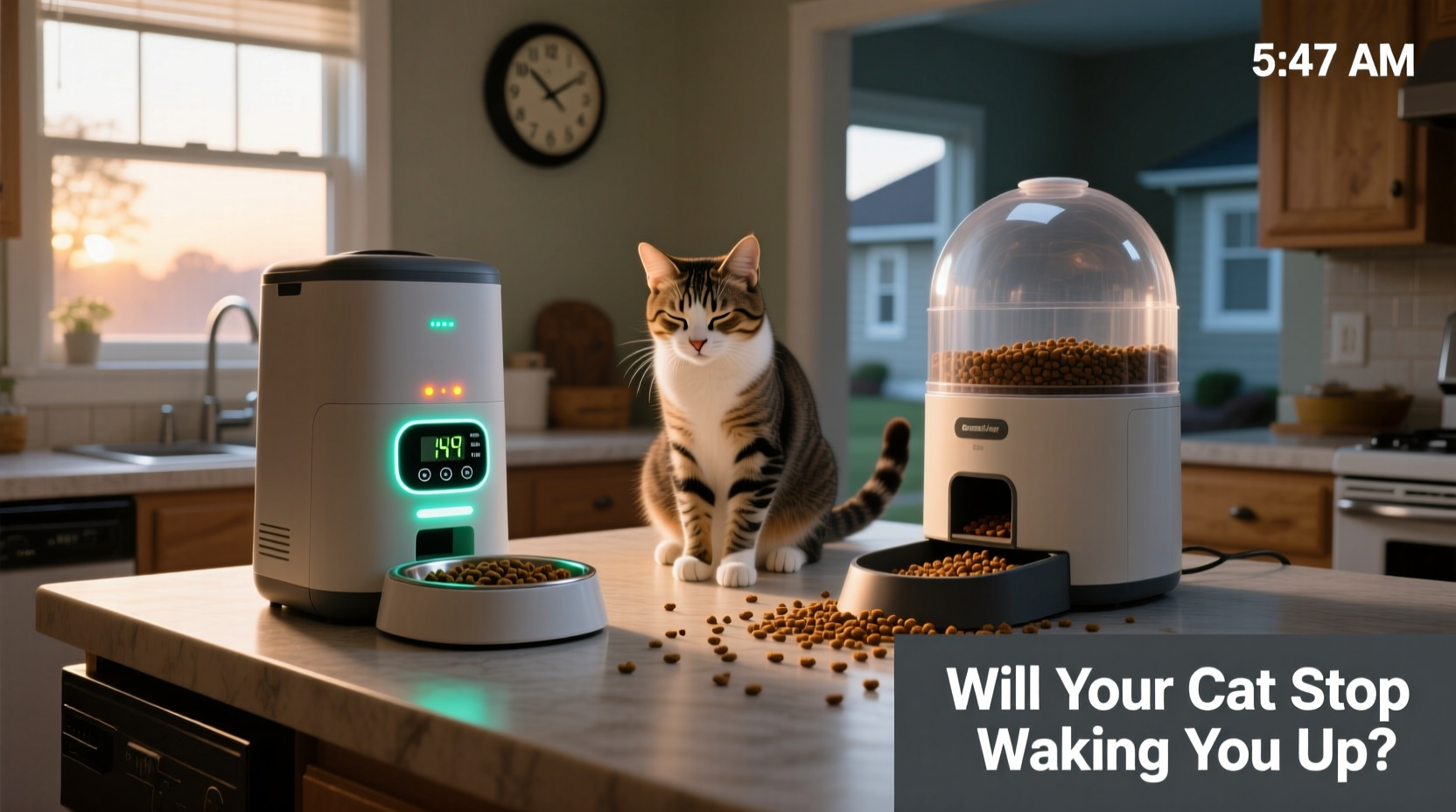
An automatic cat feeder is an electronic device that dispenses food at scheduled times. Most models allow you to set multiple meals per day, portion sizes, and even include voice recording features to call your cat to eat. Some advanced versions connect to Wi-Fi, letting you control them remotely via smartphone apps.
These feeders are designed for precision. If your cat expects food at 6 a.m. and you’ve programmed the feeder to open at exactly 6:15 a.m., it may eventually adjust its behavior — assuming it learns that no amount of yowling will speed things up.
The key benefit of automatic feeders lies in consistency. Unlike humans who might sleep through an alarm or delay breakfast during a lazy weekend, these devices operate with robotic reliability. Over time, this predictability can retrain your cat’s expectations.
Tip: Start by setting the first meal 15–30 minutes later than your cat’s usual wake-up time. Gradually shift it later by 10-minute increments every few days to avoid resistance.The Reality of Gravity Feeders — Always Full, Never Quiet
A gravity feeder relies on simple physics: as your cat eats from a bowl, more food flows down from a hopper above. There’s no timer, no motor, no schedule — just continuous access to dry kibble. These feeders are low-tech, inexpensive, and require minimal maintenance.
On paper, they seem like the ultimate solution: your cat eats whenever it wants, so why would it bother you?
Here’s the catch: cats aren’t just driven by hunger. Their early-morning antics are often rooted in attention-seeking, routine reinforcement, or instinctual hunting patterns (dawn and dusk being natural peak activity times). A full bowl doesn’t eliminate these behaviors. In fact, some cats become *more* demanding when they have constant access to food because they associate your presence with interaction, not just meals.
Worse, gravity feeders can encourage overeating and reduce the mental stimulation that comes from scheduled feeding. Without structure, your cat may graze all night — increasing the chance it’ll be active (and loud) when you’re trying to sleep.
“Cats thrive on routine. Removing all structure from feeding can increase anxiety and unwanted behaviors, including nighttime vocalization.” — Dr. Lena Patel, Feline Behavior Specialist
Automatic vs Gravity Feeder: A Direct Comparison
| Feature | Automatic Feeder | Gravity Feeder |
|---|---|---|
| Scheduled Meals | Yes — programmable timing | No — free-feeding only |
| Portion Control | Precise portions per meal | No control — continuous flow |
| Reduces Early Wake-Ups | High potential if used correctly | Limited to none |
| Overeating Risk | Low | High — especially in sedentary cats |
| Cost | $40–$120+ | $15–$30 |
| Maintenance | Requires battery or power; regular cleaning | Simple — occasional refill and wash |
| Best For | Cats needing routine, portion control, or training | Healthy, active cats with self-control |
Can Either Feeder Actually Stop the Wake-Up Calls?
The answer hinges on understanding your cat’s motivation. Is your cat waking you because it’s genuinely hungry? Or is it seeking attention, play, or simply following a learned pattern?
If your cat has learned that meowing at 5 a.m. results in food, affection, or even just eye contact, it will keep doing it — regardless of available food. This is operant conditioning: your response reinforces the behavior.
Automatic feeders have a real advantage here. When paired with behavioral training, they can decouple your presence from feeding time. Once your cat realizes that food appears without you lifting a finger, the incentive to wake you diminishes.
Gravity feeders, however, don’t change the cause-and-effect relationship. Your cat still sees you as part of the morning ritual — perhaps even more so, since it may come to you after eating, expecting play or petting.
Tip: Combine an automatic feeder with environmental enrichment — like puzzle feeders or timed toys — to redirect your cat’s dawn energy into independent activities.Real Example: How Sarah Regained Her Sleep
Sarah, a graphic designer from Portland, struggled for years with her tabby, Milo, who started yowling at 5:15 a.m. every day. She tried ignoring him, but he’d escalate to jumping on the bed and pawing at her face. She assumed he was hungry, so she bought a gravity feeder. “I thought, ‘Great, he can eat whenever he wants.’ But he didn’t stop. He’d eat, then come wake me up anyway.”
Frustrated, Sarah switched to a Wi-Fi-connected automatic feeder. She programmed it to release food at 6:30 a.m. and committed to not interacting with Milo before then — no talking, no eye contact, no pushing him away (which still counts as attention).
For the first week, Milo intensified his efforts. But by day ten, he began lingering near the feeder as 6:30 approached. By the third week, he rarely came to the bedroom. “Now he hears the beep, trots off to eat, and I don’t see him for another hour,” Sarah says. “It wasn’t the food he needed — it was the routine.”
Step-by-Step: Training Your Cat to Sleep In
- Assess your cat’s current routine. Note when it wakes you, how it behaves, and what you typically do in response.
- Choose the right feeder. Opt for an automatic model with reliable timing and portion control.
- Set the first meal 15–30 minutes after your desired wake-up time. Don’t try to jump to 7 a.m. immediately if your cat wakes at 5.
- Remove all other food sources. Stop free-feeding and hide any accessible kibble.
- Be consistent — no exceptions. Do not feed, talk to, or acknowledge your cat before the feeder releases food.
- Add a second meal before bedtime. A late dinner around 10–11 p.m. can help your cat sleep through the night.
- Introduce enrichment. Use timed treat dispensers or motion-activated toys to keep your cat engaged in the morning without your involvement.
- Adjust gradually. Move feeding times later in 10-minute increments until you reach your ideal schedule.
Checklist: Choosing the Right Feeder for Peaceful Mornings
- ✅ Does your cat beg for food at specific times? → Automatic feeder recommended
- ✅ Is your cat prone to overeating or weight gain? → Avoid gravity feeders
- ✅ Do you travel or have an irregular schedule? → Automatic feeder with backup battery
- ✅ Is your cat tech-savvy (adapts easily to new objects)? → Wi-Fi model with app control
- ✅ Are you willing to commit to a no-interaction rule for 2–3 weeks? → Essential for success
- ✅ Do you have multiple pets? → Ensure the feeder has portion locks or access control
Frequently Asked Questions
Can a gravity feeder cause health problems?
Yes, for some cats. Continuous access to food can lead to obesity, especially in indoor, less active cats. It may also contribute to dental issues and reduced interest in wet food, which is important for hydration. Cats with diabetes or metabolic conditions should never be free-fed.
Will my cat starve if I ignore its morning meowing?
No. If your cat is healthy and gets adequate food during scheduled meals, it won’t go hungry. Short-term behavioral persistence (increased meowing) is normal during training. As long as food is provided reliably at set times, your cat will adapt.
Are automatic feeders reliable enough to use long-term?
Most high-quality models are very reliable. Look for ones with customer reviews highlighting durability, accurate portioning, and battery backup. Always test the feeder for a few days while you’re home before relying on it exclusively.
Final Verdict: What Really Stops the Wake-Up Calls?
The feeder itself isn’t the magic solution — it’s the system around it. An automatic feeder gives you the tools to create structure, but success depends on consistency, patience, and understanding your cat’s psychology.
Gravity feeders offer convenience but rarely solve behavioral wake-up issues. They may even make them worse by enabling round-the-clock grazing without addressing the root cause: your cat’s expectation of interaction.
If your goal is uninterrupted sleep, invest in an automatic feeder and pair it with a clear training plan. Remove reinforcement, establish predictable mealtimes, and enrich your cat’s environment. It may take two to three weeks, but many owners report dramatic improvements — and for the first time in years, actual rest.
“The most effective feeding strategy isn’t about technology or design — it’s about aligning with your cat’s natural rhythms while setting healthy boundaries.” — Dr. Marcus Tran, Veterinary Ethologist
Take Back Your Mornings
You don’t have to accept early wake-ups as an inevitable part of cat ownership. With the right approach, your cat can learn to wait for breakfast — quietly. An automatic feeder isn’t a quick fix, but it’s a powerful tool when used correctly. Combine it with behavioral awareness and consistency, and you’ll likely find your cat adapting faster than expected.
💬 Have you tried an automatic or gravity feeder? Did it stop the morning meowing? Share your experience in the comments — your story could help another sleep-deprived cat owner finally get some rest.








