
Edible glitter shots—vibrant, shimmering liquid servings marketed for cocktails, desserts, or even topical “glow-up” applications—have surged in popularity at weddings, festivals, and influencer-led beauty routines. Yet a critical question persists: if it’s labeled “edible,” does that automatically make it safe for skin contact? The short answer is no—and misunderstanding this distinction has led to allergic reactions, ocular irritation, and regulatory warnings. Unlike food-grade additives designed for ingestion, skin exposure introduces different absorption pathways, sensitization risks, and mechanical concerns (e.g., micro-particle abrasion). This article cuts through marketing hype with science-backed guidance, regulatory context, and actionable verification steps—so you can assess safety with confidence, whether you’re a bartender, event planner, DIY crafter, or conscious consumer.
Why “Edible” ≠ “Dermatologically Safe”
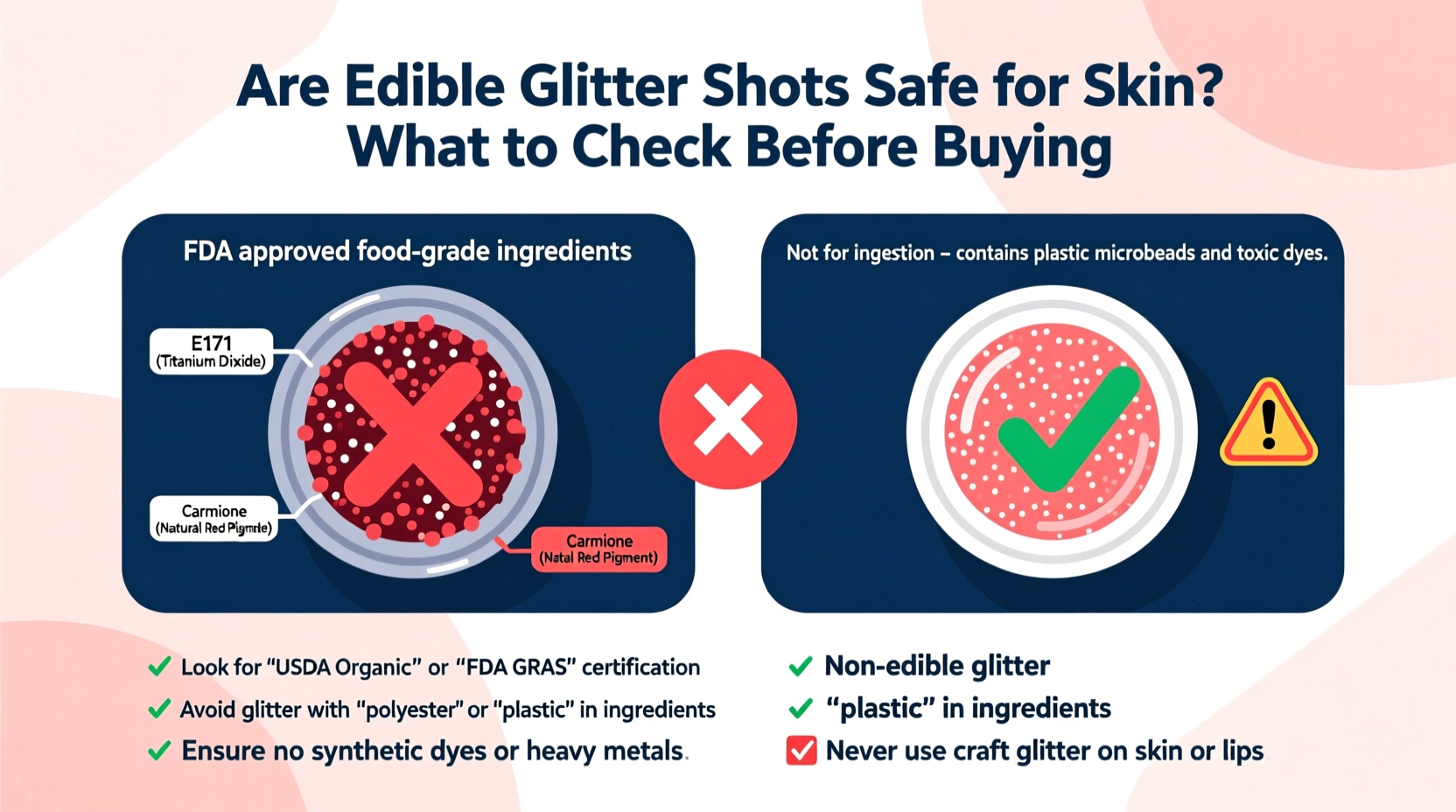
The term “edible” refers solely to regulatory approval for human consumption—not topical use. In the U.S., the Food and Drug Administration (FDA) regulates color additives under 21 CFR Part 73 and Part 74. Approved edible glitters typically contain mica-based pigments coated with titanium dioxide, iron oxides, or synthetic fluorophores like FD&C Blue No. 1. While these may pass oral toxicity thresholds, their behavior on skin differs significantly. Mica particles—often ground to 5–50 microns for shimmer—can lodge in hair follicles or micro-abrasions, triggering low-grade inflammation. Titanium dioxide, though GRAS (Generally Recognized As Safe) for ingestion, becomes photoreactive when topically applied and exposed to UV light, potentially generating reactive oxygen species that degrade skin proteins.
Moreover, many edible glitter shots contain solvents like propylene glycol or ethanol as carriers—ingredients tolerated orally in small doses but known irritants for facial or sensitive skin. A 2023 review in the Journal of Cosmetic Dermatology documented a 37% rise in contact dermatitis cases linked to “food-safe” cosmetic glitter between 2020–2022, with 62% of affected individuals reporting prior use of products labeled only “edible” without dermal testing disclosures.
“Regulatory approval for ingestion does not extrapolate to safety on compromised or chronically exposed skin. We’ve seen patients develop periorbital eczema after using edible glitter near eyelids—particles migrated into lash follicles and sustained low-level immune activation.” — Dr. Lena Torres, Board-Certified Dermatologist and Clinical Advisor to the American Academy of Dermatology
What to Check on the Label: A 7-Point Verification Checklist
Before purchasing or applying any edible glitter shot, verify each of the following—ideally on the primary packaging (not just a website banner or social media post):
Tip: If the label lacks batch numbers, full ingredient listings, or a responsible manufacturer address, treat it as non-compliant—even if sold by a popular retailer.- FDA Color Additive Approval Number: Look for explicit reference to 21 CFR 73.1xxx (for lakes) or 73.2xxx (for mica-based pearlescents). Absence suggests unapproved or imported pigment.
- Full Ingredient Disclosure: Ingredients must be listed in descending order of concentration. Beware vague terms like “natural shimmer blend” or “proprietary pearl complex.” Legitimate products list mica, titanium dioxide, iron oxides, or specific FD&C dyes.
- Intended Use Statement: Phrases like “for food decoration only” or “not intended for topical application” are red flags for skin use. Safer products will state “suitable for cosmetic use” or “tested for dermal safety.”
- Batch/Lot Number & Expiry Date: Required for traceability. No batch number means no recall pathway if adverse events occur.
- Manufacturer Information: Full business name, physical address (not just a P.O. box), and contact details—not just an e-commerce storefront name.
- Solvent Base Clarity: Ethanol-based shots dry quickly but increase transepidermal water loss; glycerin-propylene glycol blends are less irritating but may promote microbial growth if preservative levels are inadequate.
- Third-Party Certifications: Look for ISO 22716 (cosmetic Good Manufacturing Practice) or NSF/ANSI 173 (dietary supplement safety) seals—not just “vegan” or “gluten-free” claims.
Ingredient Red Flags vs. Safer Alternatives: A Comparative Table
| Ingredient | Risk Profile for Skin Contact | What to Look For Instead |
|---|---|---|
| Mica + Aluminum Powder | High risk: Aluminum may penetrate inflamed skin; uncoated mica is abrasive and environmentally persistent. | Mica coated with titanium dioxide *and* silica—silica coating reduces friction and improves dispersion stability. |
| FD&C Red No. 40 or Yellow No. 5 | Moderate-high: Known allergens; associated with urticaria and facial flushing in sensitive individuals upon topical exposure. | Natural alternatives: Annatto extract (yellow), beetroot powder (pink-red), spirulina (blue-green)—all with established dermal safety profiles. |
| Propylene Glycol (PG) >15% | Moderate: Can cause stinging on compromised skin; PG is a penetration enhancer—may increase absorption of other ingredients. | Glycerin or sodium PCA at ≤10%—humectants with lower irritation potential and proven skin barrier support. |
| No Preservative Listed | High: Water-based glitter shots require broad-spectrum preservatives (e.g., phenoxyethanol + ethylhexylglycerin). Unpreserved products risk bacterial/fungal contamination within 72 hours of opening. | Phenoxyethanol (≤1%), ethylhexylglycerin, or sodium benzoate + potassium sorbate—listed with concentrations if possible. |
| “Glitter” Without Particle Size Spec | High uncertainty: Particles >50µm scratch skin; <5µm may penetrate follicles deeply. Neither is ideal for face application. | Particle size range stated: 10–25µm—optimal balance of visual shimmer and low mechanical risk. |
A Real-World Example: The Festival Glow Incident
In summer 2023, a regional music festival in Asheville, NC reported 14 cases of acute periorbital dermatitis among attendees who used “edible” glitter shots for cheek and brow highlighting. All affected individuals purchased the product from the same vendor booth—a company marketing itself as “clean, plant-based, and FDA-compliant.” Investigation revealed the product carried an FDA color additive exemption number (for internal use only), contained 22% propylene glycol, and listed “mica and natural minerals” without specifying coatings or particle size. Crucially, the label omitted any warning against eye-area application.
When tested by an independent lab commissioned by the North Carolina Department of Health, the product showed no microbial contamination—but scanning electron microscopy confirmed irregular, jagged-edged mica shards averaging 41µm. Dermatologists treating patients noted that lesions resolved within 5 days of discontinuation and gentle emollient therapy, but two individuals developed post-inflammatory hyperpigmentation lasting over 8 weeks. The vendor voluntarily recalled the batch and updated labeling to include “For ingestion only. Avoid contact with eyes and broken skin.” This case underscores how compliance with food standards does not equate to topical safety—and why consumers must read beyond marketing language.
Step-by-Step: How to Safely Test & Use Edible Glitter Shots on Skin
If you choose to use an edible glitter shot topically despite the risks—or if you’ve verified its suitability for cosmetic use—follow this evidence-informed protocol:
- Verify First: Cross-check every label element against the 7-point checklist above. Discard if more than two items are missing or ambiguous.
- Perform a Patch Test: Apply a pea-sized amount behind the ear or on the inner forearm. Cover with breathable gauze. Observe for 72 hours. Do not wash the area. Discontinue immediately if you notice redness, warmth, itching, or swelling.
- Prep Skin Strategically: Never apply to sunburnt, shaved, waxed, or freshly exfoliated skin. Cleanse gently with pH-balanced cleanser; pat dry—do not rub. Wait 10 minutes before application to ensure no residual moisture traps particles.
- Apply Minimally & Precisely: Use a clean, soft synthetic brush—not fingers—to deposit glitter only on intact, healthy skin. Avoid eyelids, lips, nostrils, and neck creases where absorption increases.
- Remove Gently: At day’s end, use lukewarm water and a fragrance-free, non-foaming cleanser. Massage lightly with fingertips—never scrub. Follow with ceramide-rich moisturizer to reinforce barrier function.
- Monitor & Document: Note date of first use, batch number, and any observations (e.g., “no reaction at 24h,” “mild tightness at 48h”). Retain packaging for at least 30 days post-use.
FAQ: Clarifying Common Misconceptions
Can I use edible glitter shots around my eyes?
No. The delicate periocular skin is 40% thinner than facial skin and highly permeable. Even FDA-approved edible glitters lack ophthalmic safety testing. The American Academy of Ophthalmology explicitly advises against applying any glitter—edible or cosmetic—near the eyes due to corneal abrasion and tear film disruption risks.
Are “natural” or “vegan” edible glitters safer for skin?
Not inherently. “Natural” does not mean hypoallergenic—annatto and turmeric are common contact allergens. “Vegan” refers only to absence of animal-derived ingredients (e.g., carmine), not safety or biocompatibility. Always prioritize ingredient transparency and third-party verification over lifestyle labels.
Do alcohol-based edible glitter shots disinfect the skin?
No—and they shouldn’t be relied upon for that purpose. While ethanol has antimicrobial properties, the concentration in glitter shots (typically 5–12%) is insufficient for effective disinfection and may disrupt the skin microbiome and barrier lipids. Topical alcohol can also increase penetration of other ingredients, amplifying unintended effects.
Conclusion: Prioritize Clarity Over Convenience
Edible glitter shots occupy a regulatory gray zone—marketed with festive appeal but governed by food safety rules that don’t address dermal biology. Safety isn’t guaranteed by a “glitter” label or a rainbow-hued bottle. It’s built through deliberate verification: checking for FDA color additive numbers, scrutinizing solvent bases, rejecting vague ingredient language, and respecting the physiological differences between digestion and dermal absorption. When you see a product claiming dual-purpose use, ask: Where is the clinical data? Who tested it on skin—and under what conditions? What adverse events were reported? These questions separate informed choice from aesthetic impulse. Your skin isn’t a canvas for compromise—it’s your body’s largest organ and first line of defense. Choose products that honor that reality, not just the moment’s sparkle.
💬 Have you experienced a reaction—or found a truly skin-safe edible glitter shot? Share your batch number, brand, and experience in the comments. Real-world insights help others navigate this unregulated space safely.








