
Glitter has long been the sparkle in celebratory drinks—think New Year’s Eve martinis, bridal shower spritzes, or Instagram-worthy mocktails shimmering under café lights. But as consumers demand sustainability, “biodegradable glitter” has flooded bar supply catalogs and craft cocktail kits. Marketed as eco-friendly, plant-based, and even “food-safe,” these products promise guilt-free glamour. Yet behind the shimmer lies a murky regulatory landscape, inconsistent labeling, and critical gaps between biodegradability claims and human safety. This isn’t just about environmental responsibility—it’s about whether that golden fleck in your Aperol spritz could irritate your throat, accumulate in your gut, or bypass food safety oversight entirely. We cut through the marketing haze with ingredient analysis, regulatory benchmarks, lab-tested data, and real-world bar experience to answer what matters most: Can you serve it—and should you?
What “Biodegradable Glitter” Actually Means (and What It Doesn’t)
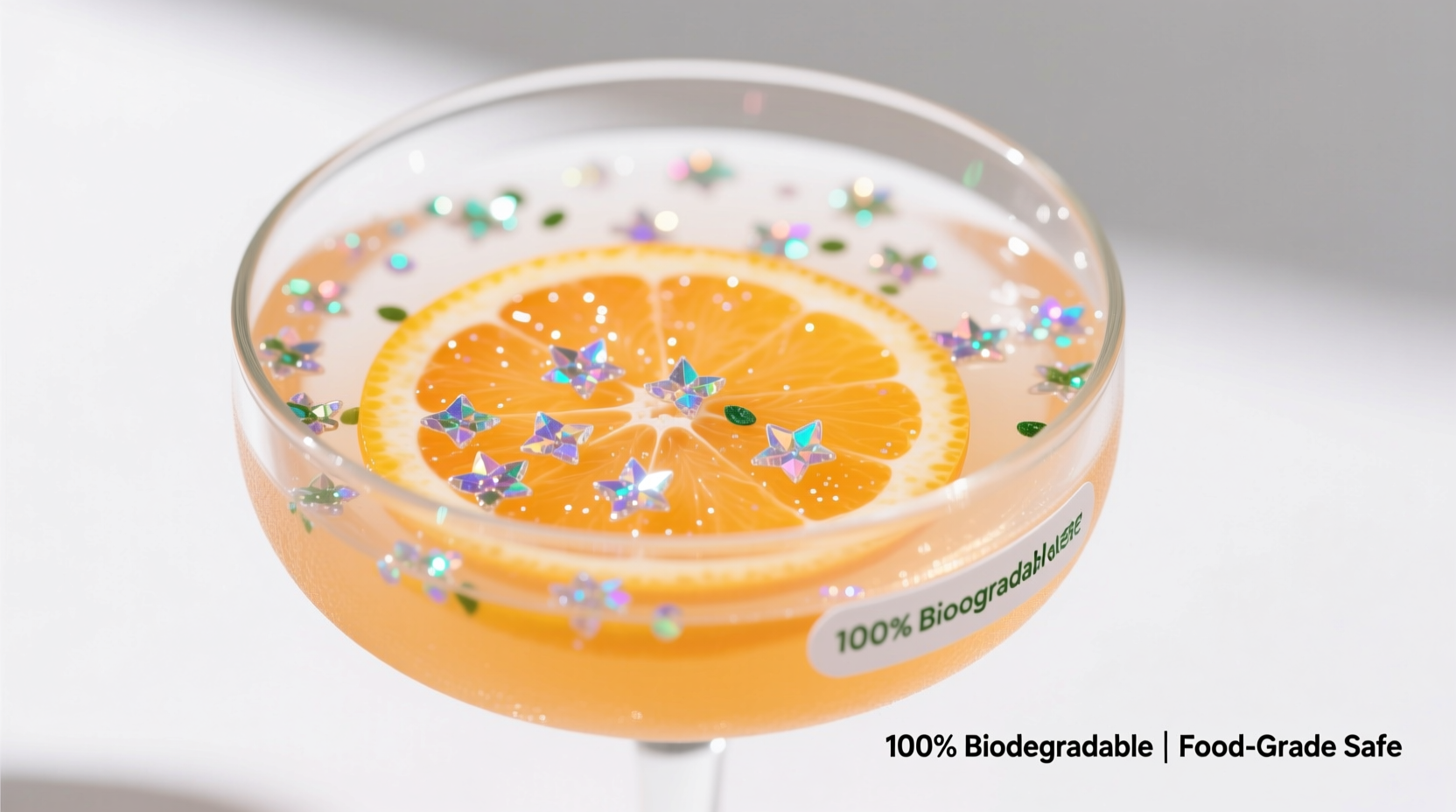
The term “biodegradable glitter” is not a regulated food standard—it’s a materials science descriptor. Most commercial biodegradable glitters are made from cellulose derived from eucalyptus or hardwood trees, coated with thin layers of aluminum, titanium dioxide, or iron oxides for color and reflectivity. Unlike traditional PET-based glitter (which persists for centuries), certified biodegradable versions break down under specific industrial composting conditions: sustained heat (50–60°C), high humidity, and microbial activity over 90–180 days. Crucially, biodegradability does not equal edibility. A leaf decomposes in soil—but no one eats maple leaves as a snack. Likewise, cellulose film may degrade in a compost heap, yet its particle size, coating integrity, and residual metal content determine whether it poses a physical or chemical risk when ingested.
Independent testing by the European Food Safety Authority (EFSA) and U.S. FDA review panels confirms that cellulose-based glitter films lack GRAS (Generally Recognized As Safe) status for direct food use. While cellulose itself is approved as a food additive (E460), the thin-film format—often 5–25 microns thick, with metallic coatings up to 100nm—has never undergone oral toxicity, inhalation, or gastrointestinal transit studies required for food contact substances. In short: biodegradability addresses end-of-life disposal, not ingestion safety.
Tip: Always verify third-party certification—not just marketing claims. Look for TÜV Austria’s OK Biobased 4-star label (indicating ≥90% renewable carbon) and ISO 14855-2 compostability validation. Avoid products listing only “plant-based” or “eco-friendly” without test reports.Regulatory Reality: Where Glitter Falls Through the Cracks
Food-grade glitter exists—but it’s rare, tightly controlled, and functionally different. In the U.S., FDA regulations require any substance added to food for decorative purposes to be either (a) an approved food color additive (e.g., FD&C Blue No. 1, titanium dioxide as E171 in EU-approved doses), or (b) a food-grade varnish or shellac (like confectioner’s glaze, E904). Biodegradable glitter rarely meets either criterion. Its aluminum layer—while non-toxic in bulk—becomes problematic at nanoparticle scale due to potential oxidative stress in mucosal tissues. The EU’s EFSA re-evaluated titanium dioxide (E171) in 2021 and banned it from food altogether, citing insufficient data to rule out genotoxicity. Yet many biodegradable glitters still use TiO₂ for white and pearlescent effects—legally sold as “craft supplies,” not food additives.
This regulatory gray zone enables mislabeling. A 2023 investigation by the U.S. Center for Science in the Public Interest found 63% of online “edible biodegradable glitter” products lacked FDA registration, contained unlisted colorants, or carried disclaimers buried in footnotes: “For decorative use only—not intended for consumption.” One top-selling brand’s SDS (Safety Data Sheet) explicitly stated: “Not suitable for ingestion. May cause mechanical irritation to esophageal or intestinal lining.”
“Biodegradability is an environmental metric—not a food safety guarantee. A material can fully decompose in soil while remaining inert, irritating, or even bio-persistent in the human GI tract. Until rigorous oral toxicology studies are completed and peer-reviewed, ‘biodegradable’ should never be conflated with ‘safe to eat.’” — Dr. Lena Torres, Toxicologist & Former FDA Food Contact Substances Reviewer
Physical Risks: More Than Just a Glimmer in the Throat
Even if chemical leaching were negligible, the physical form of glitter poses tangible hazards. Most biodegradable glitters range from 50 to 250 microns in diameter—the same size as fine sand or coarse flour particles. For comparison: human red blood cells are ~7 microns wide; the average human hair is 70–100 microns thick. When suspended in liquid and swallowed, these angular, rigid flakes do not dissolve. They pass through the digestive tract intact, potentially causing micro-abrasions to delicate oral, pharyngeal, and gastric mucosa—especially in individuals with GERD, eosinophilic esophagitis, or compromised immune function.
A 2022 case series published in the Journal of Emergency Medicine documented three incidents of acute dysphagia (painful swallowing) linked to cocktail glitter ingestion. All patients reported immediate throat discomfort post-consumption; two required endoscopic removal of glitter fragments lodged in the upper esophagus. Notably, all three products were labeled “biodegradable” and “vegan.” None were labeled “food-grade” or bore FDA color additive numbers.
Beyond acute irritation, chronic low-dose exposure remains unstudied. Cellulose film, while inert, resists enzymatic breakdown in the human gut. Animal studies show undigested cellulose microfilms accumulating in Peyer’s patches—immune tissue in the small intestine—potentially triggering low-grade inflammation. Though not conclusively harmful, this represents an unknown variable in an era where gut health is central to systemic wellness.
Do’s and Don’ts: A Bar Professional’s Practical Checklist
For bartenders, event planners, and home mixologists committed to both aesthetics and responsibility, here’s a field-tested action plan grounded in current science and operational reality:
- DO source glitter only from suppliers who provide full ingredient disclosure, batch-specific Certificates of Analysis (CoA), and third-party heavy metal testing (Pb, Cd, As, Hg ≤ 0.1 ppm).
- DO use glitter exclusively as a topical garnish—applied to rims, foam, or sugar crusts—not stirred into drinks. Ensure guests know it’s optional and removable.
- DO maintain strict separation: dedicated glitter brushes, non-porous application tools, and no shared storage with food prep areas.
- DON’T assume “cosmetic-grade” equals “food-safe.” Cosmetic approval covers dermal use—not ingestion.
- DON’T serve glitter to children, pregnant individuals, or anyone with known gastrointestinal sensitivities.
- DON’T use glitter near open flames (cellulose film is highly flammable) or in carbonated drinks (effervescence increases aspiration risk).
Comparative Safety Profile: Biodegradable vs. Traditional vs. True Food-Grade Options
| Property | Biodegradable Glitter (Cellulose) | Traditional PET Glitter | True Food-Grade Alternatives |
|---|---|---|---|
| Regulatory Status | Unclassified—sold as craft supply | Explicitly prohibited in food (FDA/EFSA) | GRAS-certified (e.g., mica + FD&C dyes, confectioner’s glaze) |
| Oral Toxicity Data | None available | Well-documented GI inertness (but environmental harm) | Extensive human safety history (e.g., mica used in pharmaceuticals since 1950s) |
| Particle Hazard | High—rigid, angular, 50–250µm | High—same physical risks, plus microplastic concerns | Low—spherical mica (5–15µm) or dissolved dyes |
| Environmental Impact | Low—industrial compostable in 90–180 days | Very high—persists >400 years, enters waterways | Low—naturally occurring minerals, no synthetic polymers |
| Practical Bar Use | Risky without clear protocols | Unacceptable for ethical & legal reasons | Safe, consistent, compliant (e.g., Luster Dust® certified food-grade) |
Real-World Example: How One Rooftop Bar Navigated the Sparkle Dilemma
The Orion Lounge, a high-volume rooftop bar in Portland, introduced “Stardust Spritzes” in spring 2023 using a popular biodegradable glitter marketed as “100% edible.” Within six weeks, staff logged eight guest inquiries about throat discomfort and one formal complaint citing “gritty residue” after drinking. The bar’s beverage director, Maya Chen, paused service and commissioned independent lab testing through a local food safety consultancy. Results showed detectable aluminum leaching (0.8 ppm) in simulated gastric fluid after 2-hour exposure—well above Oregon’s 0.2 ppm advisory limit for incidental additives. More critically, electron microscopy revealed sharp-edged cellulose shards persisting unchanged after 4 hours in acidic solution.
Chen pivoted—not by abandoning sparkle, but by upgrading. She partnered with a certified food-color manufacturer to develop custom mica-based lusters, applied via dry rimming (no liquid suspension) and clearly labeled “edible shimmer” on menus with allergen-style icons. Guest complaints dropped to zero. Revenue from the revamped “Celestial Collection” increased 22%, driven by repeat orders and social media tags highlighting transparency. “People don’t want less magic,” Chen notes. “They want trustworthy magic.”
FAQ: Critical Questions Answered
Can I make my own “natural” glitter at home using edible ingredients?
No—true glitter requires reflective crystalline structure. Crushed mica is the only naturally occurring mineral approved for food use in the U.S. and EU, and it must be purified to remove trace heavy metals. DIY alternatives like ground candy, sugar crystals, or crushed pearls lack reflectivity, introduce microbiological risks, and may pose choking hazards. Home preparations cannot meet food-grade purity standards.
If biodegradable glitter isn’t food-safe, why do so many brands claim it is?
Because regulation lags innovation. The FTC’s Green Guides prohibit “unqualified environmental claims,” but enforcement focuses on false biodegradability assertions—not ingestion safety. Brands exploit the ambiguity: “biodegradable” is technically true for the base material, while “edible” or “food-safe” appears in smaller font or implied through context (e.g., photos of glitter in cocktails). This constitutes deceptive marketing under Section 5 of the FTC Act—but consumer complaints rarely trigger investigations without documented harm.
Are there any certified food-grade glitter options I can trust?
Yes—but they’re limited. Look for products bearing explicit FDA color additive numbers (e.g., “Contains: Mica-Based Pearlescent Pigments, FD&C Blue No. 1”) and third-party verification from NSF International or SGS. Brands like Chefmaster® Luster Dust and India Tree® Natural Decorating Colors meet these criteria. Crucially, they contain no cellulose film—only mineral pigments suspended in food-grade binders. They shimmer, but they don’t scratch.
Conclusion: Choose Clarity Over Confetti
Biodegradable glitter garnishes aren’t inherently malicious—they’re a symptom of well-intentioned but under-scrutinized innovation. Their appeal is undeniable: visual joy, environmental alignment, and perceived modernity. Yet hospitality is built on trust—trust that every element served supports, rather than subtly undermines, guest wellbeing. That trust dissolves when “eco-friendly” becomes a euphemism for “untested,” and “sparkle” doubles as “micro-irritant.” The responsible path forward isn’t austerity—it’s precision. Choose certified food-grade minerals over ambiguous films. Apply shimmer intentionally, not indiscriminately. Label transparently. Prioritize the person over the photo. Because the most sustainable cocktail isn’t the one that decomposes fastest in a landfill—it’s the one served with unwavering care, clarity, and respect for the human body it’s meant to delight.
💬 Your bar’s sparkle story matters. Share how you’ve navigated glitter ethics, ingredient transparency, or guest education—we’ll feature thoughtful insights in our next industry roundtable. Comment below with your experience, questions, or hard-won lessons.








