For busy pet owners, automatic pet feeders promise peace of mind—delivering meals on schedule whether you're at work, traveling, or simply running late. But when the lights go out and the power fails, does that promise hold up? Many assume these devices are foolproof, only to discover too late that their pet’s next meal won’t dispense without electricity. The truth is, not all automatic feeders are created equal. Some are genuinely reliable in emergencies; others are little more than high-tech novelties with no backup plan. This article examines how automatic feeders perform during power outages, what features actually matter, and whether they’re worth relying on when it counts.
How Automatic Feeders Work—and Where They Fall Short
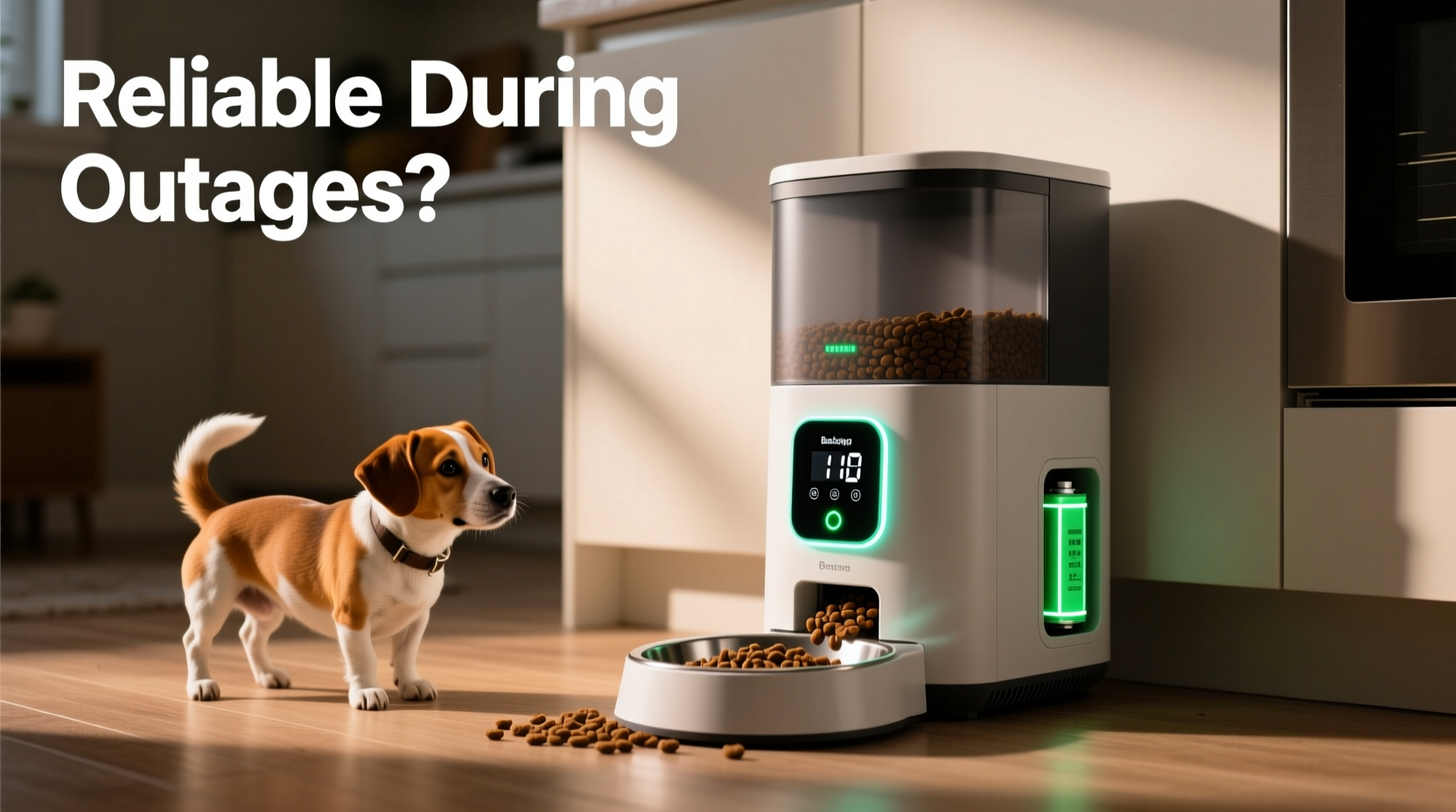
Most automatic pet feeders operate using a small motorized mechanism that rotates a portioned tray or opens a hopper lid at preset times. These units typically plug into a wall outlet and rely on internal clocks synchronized via digital timers or smartphone apps. While convenient under normal conditions, this setup becomes problematic during extended power failures.
The core issue lies in energy dependency. Without a built-in battery or alternative power source, most standard models shut down completely once the electricity cuts off. Even if the device has a clock memory function, the motor that dispenses food still needs power to operate. That means your pet could miss one, two, or even multiple meals depending on how long the outage lasts.
Some manufacturers advertise “battery backup” as a standard feature, but this claim can be misleading. In reality, many units only use batteries to maintain time settings—not to power the dispensing mechanism. So while the feeder might remember the correct schedule after power returns, it won’t have fed your pet during the blackout.
Tip: Always verify whether a feeder's battery supports full operation during outages, not just timekeeping.What Makes a Feeder Truly Reliable During Power Outages?
A truly dependable automatic feeder must meet three key criteria: sustained power autonomy, mechanical reliability, and fail-safe design. Let’s examine each in detail.
1. Battery Backup for Full Operation
The most critical factor is whether the feeder runs entirely on batteries during an outage. Units equipped with 6 AA or C-cell batteries (or rechargeable lithium packs) that power both the timer and the dispensing motor offer real resilience. Look for models explicitly stating “dispensing continues during power loss.” Avoid those that say only “time memory retained.”
2. Low-Power Design
Energy efficiency matters. Some advanced feeders use low-voltage DC motors and optimized circuitry to extend battery life. A well-designed unit should run for 24–72 hours on batteries alone—even longer if feeding only twice daily. Check product specs for estimated battery runtime under normal usage.
3. Mechanical Simplicity
Complex mechanisms with multiple moving parts are more prone to jamming, especially when powered intermittently. Simpler rotary trays or gravity-fed designs with minimal electronics tend to be more dependable over time. Fewer components mean fewer failure points when operating off-grid.
“During hurricane season, we’ve seen dozens of cases where pets went unfed because owners assumed their smart feeder had backup power. It didn’t.” — Dr. Lena Torres, DVM, Emergency Veterinary Services
Comparison: Reliable vs. Gimmicky Feeders
| Feature | Reliable Feeder | Gimmicky Feeder |
|---|---|---|
| Battery Function | Power entire system including motor | Only retains time settings |
| Runtime on Batteries | 48+ hours typical | Not applicable – no dispensing |
| Motor Type | Low-power DC with torque control | AC-dependent, high-draw motor |
| Connectivity | Wi-Fi optional; works offline | Requires constant app connection |
| Jam Resistance | Wide chute, anti-jam sensors | Frequent blockages reported |
| Price Range | $80–$150 | $30–$60 |
This table highlights a common pattern: budget-friendly models often lack true redundancy, while higher-end feeders invest in robust engineering. Price isn’t always indicative of quality, but in this category, spending more usually buys better reliability.
Real-World Example: A Storm Test in Florida
In 2023, Hurricane Idalia caused widespread blackouts across coastal Florida. Among affected residents was Maria Chen, a cat owner in Sarasota who relied on an automatic feeder for her two indoor cats. She owned a mid-tier model advertised with “battery backup.” When the storm hit and power failed for 36 hours, she assumed her pets were fine.
She returned home to find both cats hungry and meowing persistently. The feeder had kept accurate time—but hadn't dispensed any food. Upon checking the manual, she discovered the four AA batteries were only meant to preserve settings, not drive the motor. The unit required AC power to dispense meals.
Maria switched to a premium model with full battery operation and added a portable power bank as secondary backup. “I learned the hard way,” she said. “Now I treat my feeder like emergency equipment—not a gadget.”
Choosing the Right Feeder: A Practical Checklist
To avoid falling into the same trap, follow this checklist before purchasing any automatic pet feeder:
- ✅ Does it dispense food using batteries during a power outage?
- ✅ Is the battery runtime sufficient for expected outage durations?
- ✅ Can it operate independently of Wi-Fi or a smartphone app?
- ✅ Does it have physical controls in case connectivity fails?
- ✅ Is there a manual override option to release food instantly?
- ✅ Are customer reviews consistent about reliability during blackouts?
- ✅ Does the brand offer firmware updates to improve stability?
Additionally, consider pairing your feeder with a UPS (Uninterruptible Power Supply), especially if you live in an area prone to frequent or prolonged outages. A small UPS can keep a low-wattage feeder running for days.
Step-by-Step: Preparing Your Feeder for Power Emergencies
Even the best feeder requires proper setup to function reliably during crises. Follow this timeline to ensure readiness:
- Week 1: Research & Purchase
Select a feeder confirmed to operate fully on battery. Read third-party reviews and check forums like Reddit’s r/PetTech for real-user experiences. - Day of Setup: Install Fresh Batteries
Use high-quality alkaline or rechargeable batteries. Avoid cheap zinc-carbon cells, which drain quickly under load. - After Setup: Run a Simulation Test
Unplug the feeder during a scheduled feeding time. Observe whether food dispenses correctly. Repeat after changing batteries. - Monthly: Maintenance Check
Clean the food tray, inspect for jams, and test battery voltage. Replace batteries every 6 months even if not depleted. - Before Storm Season or Travel: Double-Check Supplies
Ensure extra batteries are on hand. Confirm the feeder is positioned away from water sources or flooding risks.
When Technology Isn’t Enough: The Case for Redundancy
No electronic device is 100% fail-proof. Motors stall, sensors glitch, and batteries die unexpectedly. For maximum safety, treat your automatic feeder as one layer of a broader feeding strategy.
Veterinarians and animal behaviorists recommend combining automated systems with low-tech backups. For example:
- Keep a portion of daily food in a sealed container labeled with feeding instructions, accessible to neighbors or family.
- Arrange a check-in system with a trusted friend who can drop by during extended outages.
- Use feeders with camera integration so you can visually confirm meals were dispensed.
As Dr. Alan Prescott, a veterinary advisor with the American Pet Safety Council, notes: “Automation should enhance care—not replace human responsibility. Think of it like a smoke detector: useful, but not a substitute for having a fire escape plan.”
Frequently Asked Questions
Can I use a power bank to run my pet feeder during an outage?
Yes—if the feeder supports USB power input. Some modern models include micro-USB or USB-C ports for external battery packs. A standard 10,000mAh power bank can power compatible feeders for several days. Always verify voltage compatibility first.
Do Wi-Fi feeders stop working if my internet goes down?
It depends. High-quality models continue scheduled feedings even without internet. However, app-based commands (like remote feeding) will fail. Avoid feeders that require constant connectivity to function.
How long do batteries last in a backup-ready feeder?
Under normal use, expect 3–6 months from alkaline batteries if the unit primarily runs on AC power. If operating entirely off-grid, runtime drops to 24–72 hours depending on feeding frequency and motor efficiency.
Conclusion: Beyond the Hype—Building Trust in Automation
Automatic pet feeders aren’t inherently unreliable—but treating them as magic boxes without understanding their limitations is a mistake. The ones that perform well during power outages are thoughtfully engineered, transparent about capabilities, and designed with pet welfare as the priority. Others are little more than convenience gadgets dressed up with apps and notifications.
The difference lies in preparation. By selecting a truly resilient model, testing it under simulated blackouts, and maintaining a backup plan, you can confidently rely on automation without putting your pet at risk. Technology should serve your pet’s needs, not complicate them.
🚀 Ready to upgrade your pet’s feeding system? Audit your current feeder today—test its battery mode, read the manual closely, and share your experience to help other pet owners make smarter choices.








