Clear, sparkling water is one of the most visible signs of a healthy aquarium. While many factors contribute to water quality—such as feeding habits, stocking levels, and lighting—the filtration system plays the central role in maintaining clarity over time. Not all filters are created equal when it comes to keeping water clean and clear for extended periods. Some excel at mechanical removal of debris, others specialize in biological processing, and a few combine both with chemical refinement to deliver long-lasting transparency.
Choosing the right filter isn’t just about matching tank size—it’s about understanding how each type handles particulate matter, dissolved organics, and microbial balance. This guide explores the most effective aquarium filter types for sustained water clarity, backed by performance data, expert recommendations, and real-world usage patterns. Whether you're managing a high-bioload cichlid tank or a delicate planted nano aquarium, knowing which filter works best can save you hours of maintenance and prevent recurring algae blooms.
Understanding Filtration: The Three Pillars of Water Clarity
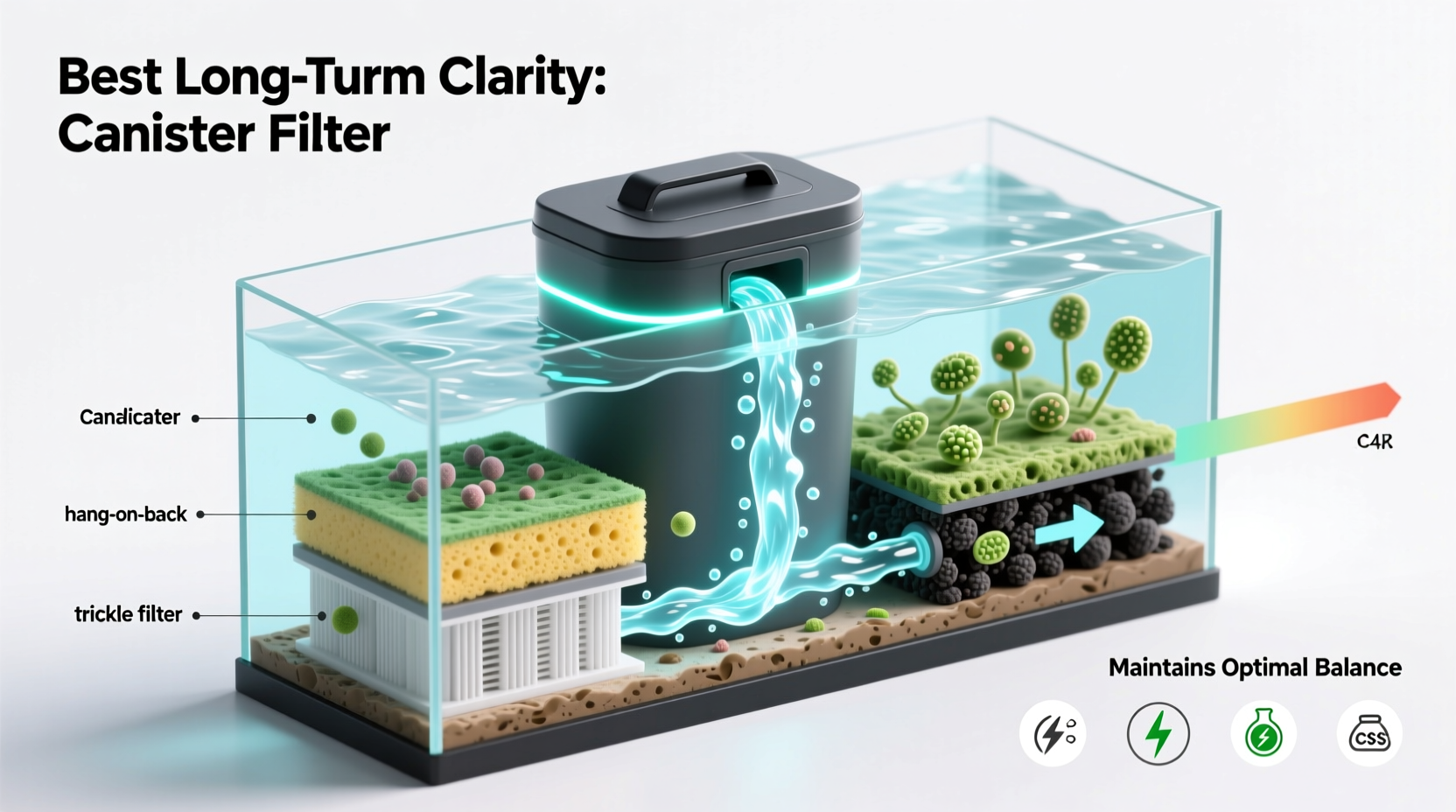
Filtration in aquariums operates on three core principles: mechanical, biological, and chemical. Each contributes uniquely to water clarity, but only systems that integrate all three effectively can maintain consistently clear water over weeks and months.
- Mechanical filtration physically traps particles like fish waste, uneaten food, and plant debris. This prevents cloudiness caused by suspended solids.
- Biological filtration supports beneficial bacteria that convert toxic ammonia into nitrite and then into less harmful nitrate. Without this process, organic buildup leads to bacterial blooms and hazy water.
- Chemical filtration uses media such as activated carbon or phosphate removers to eliminate dissolved pollutants, tannins, and discolorations that mechanical filters miss.
A filter may perform well in one category but fall short in another. For long-term clarity, all three must work in harmony. A canister filter loaded with sponges, biomedia, and carbon will outperform a basic hang-on-back (HOB) unit relying solely on a disposable cartridge.
Tip: Rinse mechanical filter media in dechlorinated tank water—not tap water—to preserve beneficial bacteria colonies.Top Filter Types Ranked for Long-Term Water Clarity
Different filter designs offer varying degrees of efficiency, capacity, and maintenance frequency. Below is a breakdown of the most common aquarium filter types, evaluated specifically for their ability to keep water clear over extended periods.
| Filter Type | Clarity Duration | Maintenance Frequency | Best For |
|---|---|---|---|
| Canister Filter | ★★★★★ (4–6 weeks) | Monthly | Medium to large tanks, planted setups, reef tanks |
| Sump Filter | ★★★★★ (5+ weeks) | Every 4–6 weeks | Advanced hobbyists, marine tanks, high bioload systems |
| HOB (Hang-On-Back) | ★★★☆☆ (2–3 weeks) | Every 2–3 weeks | Beginner freshwater tanks under 50 gallons |
| Sponge Filter | ★★☆☆☆ (1–2 weeks) | Bi-weekly | Breeding tanks, quarantine, low-flow environments |
| Internal Power Filter | ★★★☆☆ (2–3 weeks) | Every 2–3 weeks | Small tanks, temporary setups |
The table shows that canister and sump filters lead in sustained clarity due to superior media capacity, multi-stage filtration, and consistent flow rates. These systems allow customization with specialized media like fine polishing pads, denitrifying resins, or UV sterilizers—features rarely found in entry-level models.
Why Canister Filters Excel in Clarity Retention
Canister filters sit below the tank and use powerful pumps to draw water through multiple chambers filled with customizable media. Their sealed design prevents air leaks and maintains strong flow even as media loads with debris. Because they support layered filtration—coarse sponge first, then fine floss, followed by ceramic rings and carbon—they remove both large particles and microscopic contaminants.
High-end models like the Eheim Pro III or Fluval FX series include pre-filters and self-priming mechanisms that reduce clogging and downtime. With proper maintenance, these units can keep water visibly clear for over a month, even in heavily stocked tanks.
“Canister filters remain the gold standard for clarity because they combine high flow with massive media volume. It’s not just about power—it’s about retention.” — Dr. Alan Reyes, Aquatic Systems Biologist
How Sump Filters Achieve Superior Longevity in Clarity
Sump filters, typically used in larger or saltwater systems, are external reservoirs located beneath or beside the main tank. Water flows into the sump via an overflow box, passes through various compartments, and returns via a return pump. This setup allows for extensive customization and unparalleled surface area for biological and chemical filtration.
What sets sumps apart is their ability to incorporate additional clarity-enhancing components:
- Protein skimmers (in marine tanks) remove organic compounds before they break down.
- Refugiums grow macroalgae that absorb nitrates and outcompete nuisance algae.
- UV sterilizers kill free-floating algae and pathogens, preventing green water outbreaks.
- Mechanical foam fractionators trap ultrafine particles that standard filters miss.
Because sumps operate outside the display tank, they avoid visual clutter and allow for larger media volumes than any internal or HOB system. As a result, water clarity often remains pristine for five weeks or longer without noticeable degradation—provided nutrient inputs are controlled.
Tip: Install a pre-filter sock in your sump and change it weekly to extend the interval between deep cleanings of bio-media.Step-by-Step Guide to Maximizing Filter Efficiency for Clear Water
Even the best filter won’t maintain clarity if not properly maintained or configured. Follow this sequence to ensure your filtration system performs optimally over time.
- Choose the right filter for your tank size: Select a unit rated for at least 1.5x your tank’s volume. For example, a 50-gallon tank should have a filter rated for 75+ gallons.
- Layer your media strategically: Place coarse sponge first to catch large debris, followed by fine filter floss, then biological media (ceramic rings, bio-balls), and finally chemical media like activated carbon or Purigen.
- Prime and install correctly: Ensure no air pockets in canisters; align intake tubes precisely in sumps to avoid gurgling or reduced flow.
- Establish biological maturity: Run the filter continuously for 4–6 weeks before adding sensitive livestock to allow bacterial colonization.
- Schedule routine maintenance: Clean mechanical media every 2 weeks using old tank water; replace chemical media monthly; inspect impellers quarterly.
- Monitor flow rate: A drop in output indicates clogging—clean intake strainers and check for blockages.
- Add supplemental clarity tools: Consider a UV clarifier if green water persists despite good filtration.
This protocol ensures that your filter operates at peak efficiency, minimizing the accumulation of fine particulates that degrade water appearance over time.
Real Example: A Planted Tank Transformed by Upgrading Filtration
Mark T., an aquascaper from Portland, struggled for months with recurring haze in his 72-gallon planted tank. Despite regular water changes and low fish density, the water would begin to dull within 10 days after cleaning. His original setup used a mid-tier HOB filter, which he cleaned every two weeks.
After consulting with a local aquarium club, Mark upgraded to a pressurized canister filter and reconfigured his media: pre-filter sponge, dual layers of fine floss, Seachem Matrix for biological support, and a mesh bag of Purigen for chemical polishing. He also added a small inline UV sterilizer.
The results were dramatic. Within three weeks, the water achieved a glass-like clarity that lasted over five weeks. Algae growth slowed significantly, and plant vibrancy improved. “I didn’t realize how much dissolved organics were affecting my tank,” Mark said. “The new filter doesn’t just clean the water—it keeps it clean.”
Checklist: Ensuring Your Filter Delivers Lasting Clarity
Use this checklist monthly to verify your filtration system is optimized for maximum water transparency:
- ☐ Flow rate is strong and consistent
- ☐ Mechanical media is free of compacted debris
- ☐ Chemical media (carbon, Purigen) has been replaced within the last 30 days
- ☐ Biological media shows no signs of channeling or decay
- ☐ Intake tube and impeller are clean and unobstructed
- ☐ No air leaks in hoses or connections (for canisters/sumps)
- ☐ Supplemental devices (UV, skimmer) are functioning
- ☐ Pre-filter socks or sponges are rinsed or replaced
Performing these checks helps prevent gradual declines in performance that often go unnoticed until water clarity suffers.
FAQ: Common Questions About Filter Performance and Clarity
Do more expensive filters really keep water clearer longer?
Yes, generally. Higher-end filters use better pumps, larger media chambers, and higher-quality materials that resist clogging and maintain flow. They also support modular media arrangements, allowing precise tuning for clarity. While budget filters work for basic needs, premium units deliver superior long-term results.
Can I rely solely on water changes instead of upgrading my filter?
Water changes help dilute pollutants but don’t address root causes of cloudiness. Without adequate mechanical and biological filtration, particulates and dissolved organics rebuild quickly after each change. A robust filter reduces reliance on frequent water exchanges while providing continuous cleaning.
Why does my water turn cloudy shortly after cleaning the filter?
This is usually due to disrupting established bacterial colonies or releasing trapped debris back into the tank. Always rinse biological media gently in old tank water, never under tap water (chlorine kills bacteria). Also, consider cleaning only half the media at a time to preserve microbial balance.
Conclusion: Invest in Filtration for Effortless, Long-Lasting Clarity
Crystal-clear aquarium water shouldn’t require constant intervention. The key lies in selecting and maintaining a filtration system capable of handling mechanical, biological, and chemical demands simultaneously. Canister and sump filters stand out as the most reliable solutions for extended clarity, thanks to their capacity, versatility, and integration potential with advanced add-ons like UV sterilization.
While initial costs may be higher, the long-term benefits—less maintenance, healthier livestock, and stunning visual appeal—make them worthwhile investments. Combine the right filter with disciplined care, and your aquarium can remain brilliantly clear for weeks at a time, showcasing its inhabitants in their best light.
💬 Have you upgraded your filter for better clarity? Share your experience or ask questions in the comments—your insight could help another hobbyist achieve pristine water!








