
In 1930, a tiny speck of light captured on photographic plates at Lowell Observatory changed our understanding of the solar system. That speck turned out to be Pluto—a world so distant and mysterious that its very name carries a story spanning continents, schoolchildren, and mythological realms. Though no longer classified as a full-fledged planet, Pluto remains one of the most beloved celestial bodies in the public imagination. But why is it called Pluto? The answer weaves together science, serendipity, and a remarkable 11-year-old girl from England.
The Discovery of Pluto
For decades before its official discovery, astronomers suspected the existence of a \"Planet X\" beyond Neptune. Percival Lowell, founder of the Lowell Observatory in Flagstaff, Arizona, was among the first to mathematically predict such a body based on irregularities in Uranus’ orbit. Though Lowell died in 1916 without finding it, his observatory continued the search.
It wasn’t until 1930 that Clyde Tombaugh, a young farm boy from Kansas working at the observatory, identified the moving object on photographic plates taken weeks apart. After confirming the motion, the team realized they had found the ninth planet—provisionally named Planet X. Now came the crucial question: what should it be called?
How Pluto Got Its Name
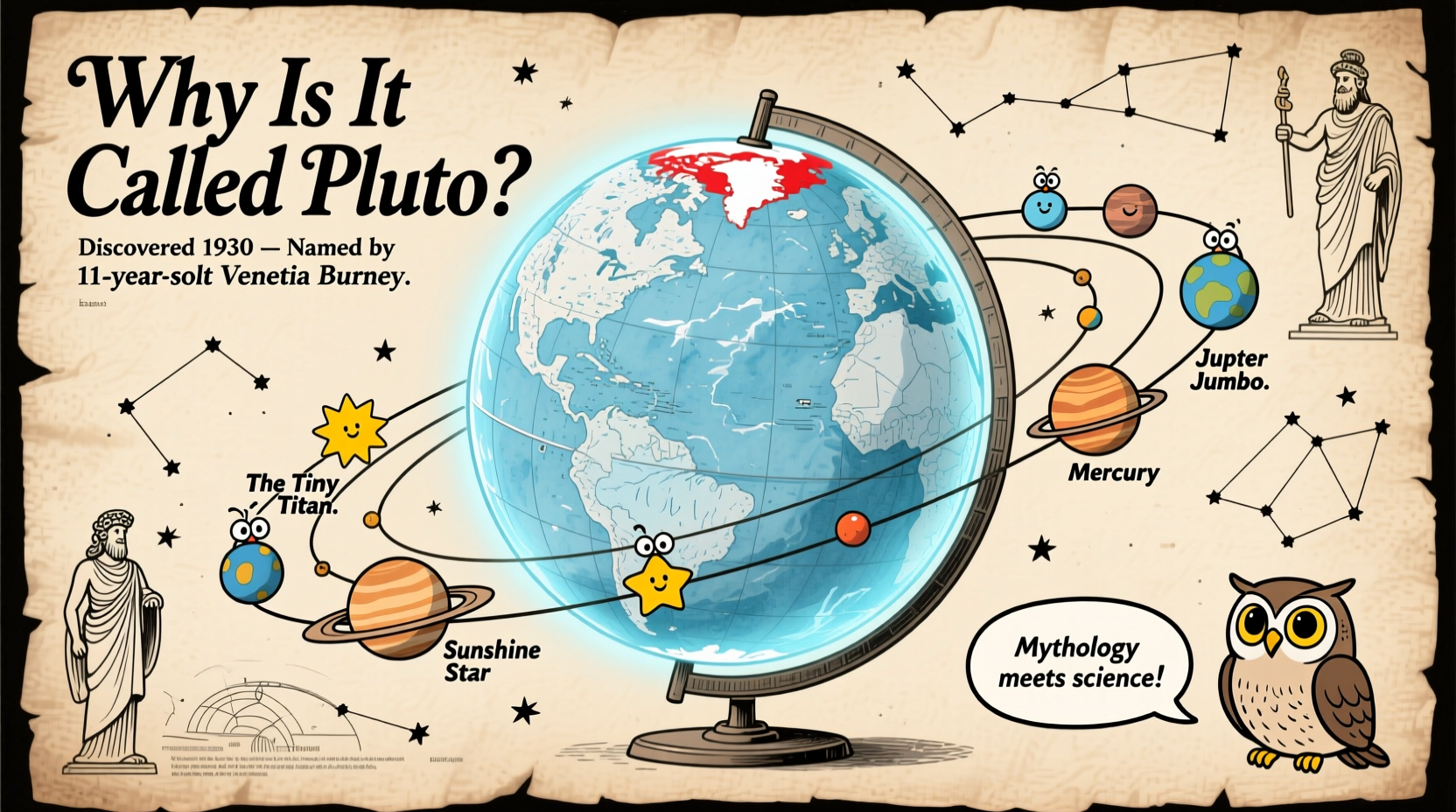
The honor of naming the new planet was given to the discoverers, but the final choice emerged from an unexpected source. In Oxford, England, 11-year-old Venetia Burney sat at breakfast with her grandfather, Falconer Madan, a retired librarian at the University of Oxford. As he read the morning paper announcing the discovery, he mused aloud about what the new planet might be called.
Venetia suggested “Pluto,” the Roman god of the underworld—a fitting name for a dark, distant world shrouded in cold and shadow. She also noted that it preserved the tradition of naming planets after mythological figures. Her grandfather was impressed. He passed the idea to astronomer Herbert Hall Turner, who telegraphed it to colleagues at Lowell Observatory.
The name resonated instantly. Not only did it fit mythologically, but the first two letters—“P” and “L”—honored Percival Lowell, whose calculations had inspired the search. On May 1, 1930, the name Pluto was officially adopted.
Tip: When teaching kids about space, use stories like Venetia’s to show how curiosity and creativity can contribute to real scientific milestones.Fun Facts About Pluto’s Name and Legacy
- Pluto is not pronounced “PLUT-oh” everywhere: In British English, it's often pronounced “PLUT-oh,” while American English typically says “PLOO-toe.”
- The Disney dog connection: Walt Disney introduced a character named Pluto the Pup in 1930, just months after the planet’s naming. Though likely coincidental, the shared name sparked playful speculation.
- Only one spacecraft has visited Pluto: NASA’s New Horizons mission flew by in July 2015, sending back stunning images and data that revolutionized our understanding of this icy world.
- Pluto has five known moons: Charon, Styx, Nix, Kerberos, and Hydra—all named after figures associated with the underworld in Greek and Roman mythology.
- Pluto’s symbol is ⯓: A monogram of the letters “P” and “L,” both honoring Percival Lowell and the planet’s name.
“The fact that a child could influence something as grand as planetary nomenclature reminds us that science belongs to everyone.” — Dr. Emily Rice, Astrophysicist and Science Communicator
A Timeline of Pluto’s Naming and Classification
The journey from discovery to reclassification spans nearly a century. Here’s a concise timeline highlighting key moments:
- 1930: Clyde Tombaugh discovers Pluto; Venetia Burney suggests the name.
- 1930 (May 1): The name Pluto is formally adopted by the astronomical community.
- 1978: Astronomers discover Charon, Pluto’s largest moon, allowing more accurate mass measurements.
- 1992–2006: Dozens of icy bodies similar to Pluto are discovered in the Kuiper Belt.
- 2006: The International Astronomical Union (IAU) redefines “planet,” leading to Pluto’s reclassification as a dwarf planet.
- 2015: NASA’s New Horizons mission conducts a flyby, revealing mountains of water ice and possible cryovolcanoes.
- 2020s: Public affection for Pluto persists, with ongoing debate about its planetary status.
Why Was Pluto Reclassified?
In 2006, the IAU established three criteria for a celestial body to be considered a planet:
| Criterion | Met by Pluto? | Explanation |
|---|---|---|
| Orbits the Sun | Yes | Pluto revolves around the Sun every 248 Earth years. |
| Has sufficient mass for hydrostatic equilibrium (nearly round shape) | Yes | Pluto is spherical due to its own gravity. |
| Has cleared its orbital neighborhood | No | Pluto shares its orbit with many other Kuiper Belt objects. |
Because Pluto fails the third criterion, it was reclassified as a “dwarf planet.” This decision sparked widespread public debate, with many expressing emotional attachment to Pluto’s planetary status.
Tip: Use Pluto’s reclassification to teach critical thinking—science evolves with new evidence, and definitions must adapt accordingly.Mini Case Study: The Classroom That Fought for Pluto
In 2007, a fifth-grade class in Illinois launched a campaign after learning Pluto had been demoted. Their teacher, Ms. Linda Thompson, guided them through researching planetary definitions, writing persuasive letters, and contacting state legislators. Their efforts led to a symbolic resolution by the Illinois General Assembly declaring March 13 as “Pluto Day” and stating that Pluto would “always be designated as a planet” within the state.
While not changing scientific classification, the campaign demonstrated how deeply cultural and educational connections to Pluto run. It also showed how a controversial scientific decision can inspire civic engagement and passionate learning.
Frequently Asked Questions
Is Pluto still considered a planet?
No, according to the International Astronomical Union, Pluto is classified as a dwarf planet because it does not meet all three criteria for planethood, particularly clearing its orbital path.
Who actually named Pluto?
Pluto was named by Venetia Burney, an 11-year-old schoolgirl from Oxford, England, in 1930. Her suggestion was relayed through her grandfather to astronomers at Lowell Observatory, who adopted it.
Could Pluto ever regain planet status?
Some scientists have proposed alternative definitions that would restore Pluto’s planetary status. For example, planetary scientist Alan Stern argues that geophysical characteristics—not orbital dominance—should define a planet. While no formal change has occurred, the debate continues.
Conclusion: Why Pluto Still Matters
Pluto’s name carries more than mythological weight—it embodies human curiosity, the power of a simple idea, and the evolving nature of science. From a child’s breakfast-table suggestion to a spacecraft’s close-up portrait, Pluto’s story is far from over. Whether labeled a planet or a dwarf planet, it remains a symbol of exploration and wonder.
Understanding why Pluto is called Pluto isn’t just about etymology—it’s about recognizing how science, culture, and imagination intersect. And perhaps, in some small way, every time we say “Pluto,” we honor not just a distant world, but the enduring spirit of discovery.
💬 What do you think—should Pluto be a planet again? Share your thoughts and keep the conversation about our solar system alive!